Arborvitae Tree Identification: Leaves, Bark & Cones
Walk through any suburban neighborhood in the eastern United States and you’ll see arborvitae. They line driveways, screen patios, and form green walls between properties. But arborvitae tree identification gets confusing fast because garden centers sell dozens of cultivars with names like ‘Emerald Green,’ ‘Green Giant,’ and ‘Techny,’ and most people have no idea which species any of them came from.
Arborvitae belong to the genus Thuja, part of the cypress family. North America has two native species: eastern arborvitae (Thuja occidentalis) and western red cedar (Thuja plicata). A third species, Japanese arborvitae (Thuja standishii), contributes to popular hybrid cultivars. Identifying arborvitae means recognizing the genus first, then narrowing down to species by foliage color, cone shape, bark texture, and size.
Arborvitae (genus Thuja) are identified by flat, fan-shaped foliage sprays, small elongated cones about 1/2 inch long, and fibrous reddish-brown bark that peels in vertical strips. North America has two native species: eastern arborvitae (Thuja occidentalis) and western red cedar (Thuja plicata). Most landscaping arborvitae sold at garden centers are cultivars of the eastern species.
What Does an Arborvitae Tree Look Like?
Arborvitae has one of the most recognizable silhouettes in the nursery trade: a narrow, upright pyramid or column that stays tight from the ground up. The crown rarely spreads wide. Even wild eastern arborvitae growing in Ontario cliff crevices hold that same slender, conical form for hundreds of years.
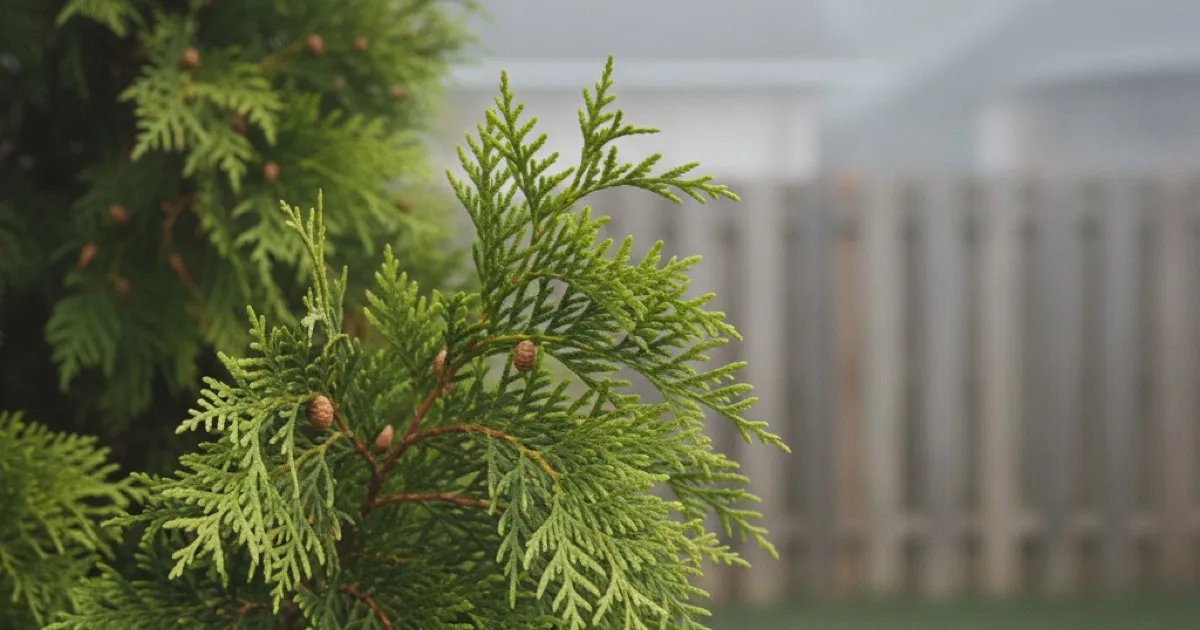
The foliage grows in flat, overlapping fan-like sprays that you can hold like a playing card. Each spray has a distinct top and bottom surface, which separates Thuja from junipers and most cypresses at a glance. Color runs from bright yellow-green (eastern) to dark glossy green (western), and eastern cultivars often bronze in winter before greening back up in spring.
Bark is thin and fibrous on both native species, peeling in long vertical strips of reddish-brown to gray. On large western red cedars, the base flares outward and the bark thickens to 1 to 2 inches, deeply furrowed on old-growth specimens. Younger trees show smoother, thinner bark that shreds easily.
Cones are small: about 1/2 to 3/4 inch long, with overlapping leathery scales. They cluster near branch tips and stand upright or slightly angled, ripening from green to brown. This upright cone posture is one of the cleaner arborvitae field marks compared to juniper berries (round and fleshy) and cypress cones (small, round woody balls).
How to Confirm You’re Looking at an Arborvitae
Arborvitae share the “scale-like foliage” look with junipers and cypresses. Three features separate them.
Flat fan-shaped sprays. This is the defining arborvitae trait. The foliage grows in flattened, fan-like sprays that you can hold like a playing card. Juniper foliage wraps around the twig in a more rounded, cord-like pattern. Cypress foliage is also flattened but tends to be finer and lacier. If the foliage fans out flat and you can see distinct upper and lower surfaces, arborvitae is your best guess.
Tiny upright cones. Arborvitae cones are small (about 1/2 inch long) and have a distinctive elongated shape with overlapping leathery scales. They stand upright or slightly angled on the branches, unlike juniper’s fleshy round berries or cypress’s small woody balls.
Mild fragrance when crushed. Crush an arborvitae leaf and it gives off a mild, pleasant scent that’s sometimes described as slightly fruity or tangy. Juniper leaves produce a sharper, gin-like smell. Cypress foliage smells more resinous.
Arborvitae identification starts with the foliage structure. The genus Thuja produces flattened, fan-shaped sprays of scale-like leaves arranged in overlapping pairs, creating a distinct upper and lower surface on each spray. This flat arrangement separates arborvitae from juniper, which wraps foliage three-dimensionally around the twig, and from most cypress species, which produce finer, lacier sprays. The cones are small and elongated, about half an inch long, with overlapping leathery scales that distinguish them from juniper’s fleshy berries and cypress’s round woody cones. The bark is thin and fibrous, shredding vertically in reddish-brown strips on both eastern and western species. When crushed, the foliage releases a mild, pleasant fragrance rather than the sharp gin-like scent of juniper. Together, these features (flat fan sprays, small elongated cones, fibrous bark, and mild scent) make Thuja one of the easier conifer genera to identify in the field.
Eastern Arborvitae (Thuja occidentalis)
Eastern arborvitae (also called northern white cedar) is native from southeastern Canada down through the Great Lakes region and into the Appalachians. It’s also the species behind most landscaping arborvitae in the nursery trade.
How to identify wild eastern arborvitae:
- Size: 40 to 60 feet tall in the wild, with a narrow, conical shape. Landscaping cultivars range from 3-foot dwarfs to 30-foot columns
- Foliage: Bright green to yellow-green flat sprays. The underside is slightly paler than the top. In winter, foliage often turns bronze or brownish-green; this is normal and not a sign of disease
- Cones: About 1/2 inch long, elongated, with 8 to 12 overlapping scales. Green when young, ripening to brown. Cones cluster near branch tips
- Bark: Thin, reddish-brown, peeling in long, narrow vertical strips. Similar to cedar bark but thinner
- Habitat: Moist, limestone-rich soils. Often found along lakeshores, stream banks, and swamps. Thrives in cool, humid climates
Eastern arborvitae is one of the longest-lived trees in eastern North America. Cliff-dwelling specimens on the Niagara Escarpment in Ontario have been documented at over 1,000 years old. They grow incredibly slowly in these harsh spots: sometimes just a fraction of an inch per year.
Common Landscaping Cultivars
Most arborvitae you see in yards are cultivars of Thuja occidentalis:
- ‘Emerald Green’ (Smaragd): The most popular hedge arborvitae. Narrow pyramidal form, 12 to 15 feet tall, keeps its bright green color through winter. Dense foliage makes it an effective privacy screen
- ‘Green Giant’: A hybrid (Thuja standishii × plicata), not a pure occidentalis. Grows fast (3 to 5 feet per year) and reaches 40 to 60 feet. Darker green and more disease-resistant than most eastern cultivars
- ‘Techny’: Broad pyramidal form, 10 to 15 feet tall. Better winter color retention than most occidentalis cultivars
- ‘Danica’: Globe-shaped dwarf, 2 to 3 feet tall and wide. Used in foundation plantings
- ‘Nigra’: Keeps dark green foliage through winter without bronzing
Western Red Cedar (Thuja plicata)
Despite its common name, western red cedar belongs to genus Thuja and counts as an arborvitae. It’s one of the largest trees in the Pacific Northwest, reaching heights that rival Douglas fir.
How to identify it:
- Size: 150 to 200 feet tall in old growth, with trunk diameters up to 13 feet. The buttressed base flares outward dramatically. Landscaping specimens are typically 50 to 70 feet
- Foliage: Glossy, dark green flat sprays with a lacy, drooping quality. Underside shows whitish butterfly-shaped markings where the scale leaves meet. Foliage has a sweet, pineapple-like fragrance when crushed
- Cones: Slightly larger than eastern arborvitae (about 1/2 to 3/4 inch). Egg-shaped with fewer scales (8 to 10)
- Bark: Thin, reddish-brown to gray, peeling in long fibrous strips. On old trees, bark can be 1 to 2 inches thick and deeply furrowed at the base
- Habitat: Moist coastal and mountain forests from Alaska to northern California. Also inland through Idaho and Montana. Prefers deep, moist soils
Western red cedar wood is famously rot-resistant and has been used for centuries by Pacific Northwest Indigenous peoples for canoes, longhouses, and totem poles. The wood’s natural oils repel insects and resist decay, making it a top choice for outdoor fencing, decking, and shingles.
Telling Eastern From Western Arborvitae
If you’re not sure which species you’re looking at, these differences help:
| Feature | Eastern (T. occidentalis) | Western (T. plicata) |
|---|---|---|
| Max height | 60 feet | 200+ feet |
| Foliage color | Yellow-green, bronzes in winter | Dark glossy green, stays green |
| Underside markings | Pale but uniform | White butterfly patterns |
| Crushed scent | Mild, slightly tangy | Sweet, pineapple-like |
| Cone size | ~1/2 inch | 1/2 to 3/4 inch |
| Geographic range | Eastern NA | Pacific Northwest |
Geography alone solves most cases. East of the Rockies, it’s almost certainly T. occidentalis (or a hybrid cultivar). West of the Cascades, it’s likely T. plicata.
How to Tell Which Arborvitae You Have
If you’re standing in front of an arborvitae and can’t figure out which one it is, start with location.
East of the Rocky Mountains: almost certainly Thuja occidentalis or one of its cultivars. The species is native from southeastern Canada through the Great Lakes and into the Appalachians, and it’s the arborvitae most nurseries carry from Maine to Georgia.
West of the Cascades: likely Thuja plicata, the western red cedar. The species reaches 150 to 200 feet in old growth and has glossier, darker foliage than eastern arborvitae. Flip a spray over and look for the white butterfly markings where the scale leaves meet. Eastern arborvitae shows a paler underside without those distinct markings.
For cultivars, growth habit is the fastest clue:
- Globe or ball shape (under 4 feet): ‘Danica’ or ‘Hetz Midget’
- Narrow column under 15 feet: probably ‘Emerald Green’
- Tall, fast-growing screen at 3 to 5 feet per year: ‘Green Giant’
- Stays dark green through winter without bronzing: ‘Nigra’
If you’re still not certain, the Tree Identifier app recognizes both native Thuja species and most common cultivars from a photo of the foliage spray.
Arborvitae Problems to Watch For
Arborvitae are tough, but a few issues show up often enough to mention.
Deer browsing is the number-one problem for eastern arborvitae in suburban and rural areas. Deer eat arborvitae foliage heavily in winter, stripping the lower branches bare. Western red cedar is slightly less palatable but still gets browsed.
Bagworms create spindle-shaped silk bags covered in bits of foliage that hang from branches. A heavy infestation can defoliate and kill an arborvitae within two seasons. Check for bags in late summer and remove them by hand before winter.
Winter burn turns foliage brown on the windward side during cold, dry winters. It’s caused by moisture loss when the ground is frozen and the tree can’t replace water lost through its leaves. Most trees recover in spring, pushing new green growth from the interior.
Spider mites cause foliage to turn yellow-brown and feel gritty. They’re most active in hot, dry weather. A strong water spray from a hose knocks them off.
How Tree Identifier Helps With Arborvitae ID
With dozens of cultivars in the nursery trade, knowing exactly which arborvitae is in your yard can be difficult. Tree Identifier’s AI recognizes both wild Thuja species and common cultivars. Snap a photo of the foliage spray, and the app identifies the species and often the cultivar variety.
The app works with leaves, bark, cones, and whole tree photos, so you can photograph whatever feature is most accessible. Whether you’re checking a newly purchased nursery plant or trying to identify a mature tree in a park, the app matches against thousands of species. You get 2 free identifications per day, and offline mode works without cell service.
Frequently Asked Questions
How fast do arborvitae grow?
Growth rate depends on the cultivar. ‘Emerald Green’ grows about 6 to 12 inches per year. ‘Green Giant’ is the fastest at 3 to 5 feet per year. Wild eastern arborvitae grows 12 to 18 inches annually in good conditions. Western red cedar grows 1 to 2 feet per year.
Do arborvitae turn brown in winter?
Eastern arborvitae cultivars often bronze or turn yellowish-brown in winter. This is a natural response to cold and isn’t harmful. The green color returns in spring. ‘Nigra’ and ‘Techny’ cultivars keep their green color better. Western red cedar stays green year-round.
Are arborvitae and cedar the same thing?
Western red cedar (Thuja plicata) is technically an arborvitae. True cedars belong to the genus Cedrus and are native to the Mediterranean and Himalayas. The confusion comes from common names: “cedar” gets applied to many aromatic, rot-resistant conifers regardless of their actual genus.
How long do arborvitae live?
Eastern arborvitae can live several hundred years in the wild. Cliff-dwelling specimens in Ontario have been documented at over 1,000 years old. Landscaping cultivars typically live 25 to 50 years with proper care. Western red cedar lives 800 to 1,000 years in old-growth forests.
What’s the best arborvitae for a privacy hedge?
‘Emerald Green’ is the most popular choice for a narrow privacy hedge. It stays compact at 3 to 4 feet wide and grows 12 to 15 feet tall. For a taller screen, ‘Green Giant’ reaches 40 to 60 feet but needs more lateral space. Both handle shearing well.
Arborvitae are one of the most planted conifers in North America, and knowing your species helps with care, pruning, and problem-solving. To identify the arborvitae in your yard or find out which cultivar a neighbor has, try Tree Identifier (snap a photo of the foliage and get your answer in seconds) or use the free web tree identifier without downloading anything.
Identify a tree from your photo — free
Upload a leaf, bark, or whole-tree photo and get the species in seconds. No signup.
Confidence:
Unlock the full species profile
Free in the app — with unlimited identifications.


AI result for guidance — the app gives full species details and works offline.
Want unlimited identifications?
Get the full species profile, photos and details — free in the app, with unlimited scans.
- Unlimited identifications
- Full species profiles & details
- Works offline, anywhere
- Save and revisit your finds
Elena Torres
Tree Identifier Team