Best Trees for Privacy: 8 Top Picks for Any Yard
A fence gives you privacy today. A tree gives you privacy, shade, wind protection, and wildlife habitat for decades. But picking the wrong privacy tree means years of waiting for something that ends up too tall, too wide, or too thin to do the job. The best trees for privacy grow dense foliage from top to bottom, hold their leaves (or needles) year-round, and match your climate and available space.
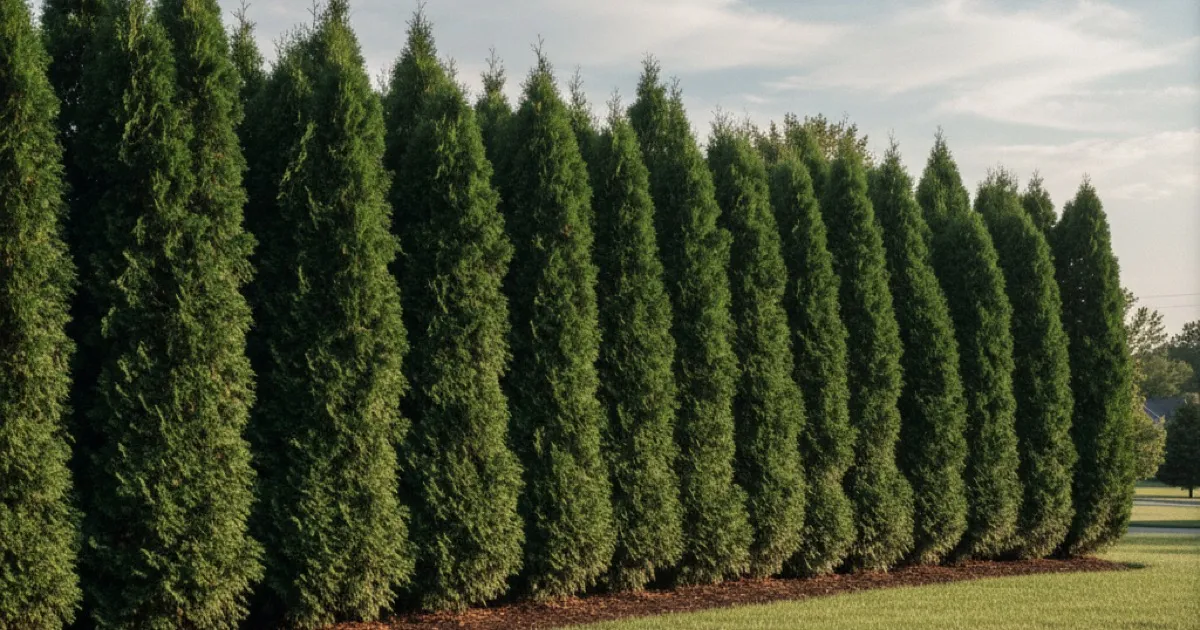
The best trees for privacy are evergreens that hold dense foliage year-round. Arborvitae varieties (‘Emerald Green’ for narrow spaces, ‘Green Giant’ for large properties) are the top choice for most yards. Eastern white pine and Leyland cypress grow faster but need more room. In zones 6-10, southern magnolia and holly work as broadleaf alternatives.
What Makes a Good Privacy Tree
Not every tall tree works as a privacy screen. The best privacy trees share these traits:
- Year-round foliage: Evergreens are essential. A deciduous tree that drops its leaves in November gives you privacy for six months at best
- Dense branching low to the ground: Many trees lose their lower branches as they age (called “limbing up”). Good privacy trees keep branches all the way to the ground or close to it
- Moderate growth rate: Too slow and you wait a decade. Too fast (like Leyland cypress) and the tree often becomes structurally weak
- Manageable width: A tree that spreads 30 feet wide doesn’t work on a property line with 10 feet of clearance
- Disease resistance: You’re planting a row of the same species. Disease or pest problems can wipe out your entire screen
Privacy tree data from North American extension services shows clear patterns by zone. In zones 3-7, arborvitae ‘Emerald Green’ holds 3-4 feet wide at maturity, grows 6-12 inches per year, and survives down to -30°F. ‘Green Giant’ (zones 5-8) delivers 3-5 feet of annual growth, topping out at 40-60 feet tall with 12-18 feet of spread. Norway spruce covers zones 2-7 and outperforms most conifers in windbreak situations: its drooping branches block sight lines at ground level and hold up in heavy snow loads. Eastern red cedar grows across the widest zone range of any native privacy tree (zones 2-9) and tolerates drought and poor soils where most conifers fail. Leyland cypress grows fast but averages only 15-25 years before disease or structural failure forces replacement, making it the most-replaced screening tree in the Southeast. Spacing drives timeline: plant at 60-75% of a tree’s mature width and the screen fills in within 3-5 years.
Best Evergreen Trees for Privacy
Arborvitae ‘Emerald Green’ (Thuja occidentalis ‘Smaragd’)
The single most popular privacy hedge tree in North America. Arborvitae ‘Emerald Green’ checks every box for suburban privacy screening.
- Height: 12 to 15 feet
- Width: 3 to 4 feet
- Growth rate: 6 to 12 inches per year
- Spacing: Plant 3 to 4 feet apart for a solid screen within 3 to 4 years
- Best for: Small to medium yards, property-line hedges, narrow spaces
- Drawbacks: Deer browsing in winter (a serious problem in some areas), heavy snow can split branches
- Zones: 3 to 7
The narrow form means ‘Emerald Green’ fits in tight spaces where wider trees won’t work. It keeps its bright green color through winter in most climates.
Thuja ‘Green Giant’ (Thuja standishii × plicata)
For larger properties where you need a tall, fast screen, ‘Green Giant’ is the most reliable option. It’s also one of the top species in our guide to fast-growing trees.
- Height: 40 to 60 feet
- Width: 12 to 18 feet
- Growth rate: 3 to 5 feet per year — one of the fastest evergreens
- Spacing: Plant 5 to 6 feet apart for a dense screen, 8 to 10 feet for individual specimens
- Best for: Large yards, rural properties, windbreaks
- Drawbacks: Gets too big for small yards. Can’t be easily maintained at a smaller size
- Zones: 5 to 8
‘Green Giant’ is a hybrid between Japanese and western arborvitae. It resists deer browsing, bagworms, and most diseases better than pure Thuja occidentalis cultivars.
Eastern White Pine (Pinus strobus)
Eastern white pine is the fastest-growing native pine in the east. It makes an excellent privacy screen when young, with soft, feathery needles.
- Height: 50 to 80 feet
- Width: 20 to 40 feet
- Growth rate: 2 to 3 feet per year
- Spacing: Plant 10 to 15 feet apart
- Best for: Large properties, naturalized screens, windbreaks
- Drawbacks: Loses lower branches as it matures (not ideal for low screening). Susceptible to white pine blister rust and pine weevil
- Zones: 3 to 8
White pine works best as a screen when planted in a staggered double row. The second row fills the gaps where the first row loses lower branches.
Leyland Cypress (× Cupressocyparis leylandii)
Leyland cypress is the speed champion of privacy trees. It grows faster than almost any other evergreen, making it popular for quick screening.
- Height: 40 to 70 feet
- Width: 15 to 25 feet
- Growth rate: 3 to 4 feet per year
- Spacing: Plant 6 to 10 feet apart
- Best for: Quick screens in mild climates
- Drawbacks: Short-lived (often 15 to 25 years). Susceptible to canker diseases. Shallow roots make it prone to blowdown in storms. Not cold-hardy north of zone 6
- Zones: 6 to 10
Leyland cypress gets a lot of criticism from arborists because it’s been overplanted and has structural problems. For long-term privacy, ‘Green Giant’ arborvitae or spruce are often better choices.
Norway Spruce (Picea abies)
Norway spruce makes one of the best windbreaks and privacy screens for cold climates. Its drooping branches create a dense curtain from top to bottom.
- Height: 40 to 60 feet
- Width: 25 to 30 feet
- Growth rate: 2 to 3 feet per year
- Spacing: Plant 12 to 15 feet apart
- Best for: Large properties in cold climates, windbreaks, snow screening
- Drawbacks: Gets wide — needs space. Lower branches droop heavily, which is great for screening but requires room
- Zones: 2 to 7
The drooping branch habit is Norway spruce’s biggest advantage for privacy. The branches sweep down and outward, creating a layered screen that blocks sight lines even at ground level.
Eastern Red Cedar (Juniperus virginiana)
Eastern red cedar is technically a juniper, and it’s one of the toughest evergreens for privacy in poor soils and dry conditions.
- Height: 30 to 50 feet
- Width: 8 to 15 feet
- Growth rate: 12 to 18 inches per year
- Spacing: Plant 6 to 8 feet apart
- Best for: Dry sites, poor soils, rural property lines, areas where deer are a problem (deer avoid it)
- Drawbacks: Can host cedar-apple rust, which affects nearby apple trees. Dense shade can cause interior browning
- Zones: 2 to 9
Eastern red cedar grows where many other evergreens struggle — in dry, rocky, or clay soils. It’s also one of the most drought-tolerant privacy options.
Best Broadleaf Evergreens for Privacy
Not all privacy trees are conifers. In warmer climates, broadleaf evergreens offer dense, year-round screening.
Southern Magnolia (Magnolia grandiflora)
Southern magnolia creates a massive, dense screen with glossy dark green leaves. The large white flowers in late spring are a bonus.
- Height: 60 to 80 feet (smaller cultivars like ‘Little Gem’ reach 20 to 25 feet)
- Width: 30 to 40 feet (‘Little Gem’: 10 to 15 feet)
- Best for: Southern and mid-Atlantic climates, large properties
- Zones: 6 to 10
Holly (Ilex species)
American holly (Ilex opaca) and other holly species make excellent year-round privacy screens with the added benefit of winter berries.
- Height: 15 to 50 feet depending on species
- Width: 10 to 20 feet
- Best for: Mid-Atlantic to southern climates, formal screens
- Zones: 5 to 9
Privacy Trees for Small Yards
Many suburban lots don’t have room for trees that spread 20-30 feet wide. Small yards need upright, narrow-form trees that stay manageable without constant pruning.
Arborvitae ‘Emerald Green’ is the top choice for tight spaces: 3-4 feet wide at maturity and only 12-15 feet tall. Plant 3 feet apart and you’ll have a solid screen within 3-4 years without trees overhanging fences or walkways.
‘Sky Pencil’ holly (Ilex crenata ‘Sky Pencil’) grows to 6-10 feet tall and stays just 2 feet wide, making it one of the narrowest broadleaf evergreens available. It works in zones 5-9 and tolerates shade better than most conifers.
‘Degroot’s Spire’ arborvitae is narrower still than ‘Emerald Green’: 2-3 feet wide and 15-20 feet tall, in zones 3-7, holding its columnar shape without shearing.
For a full breakdown of what works in compact spaces, including small flowering trees and low-canopy options, see best trees for small yards. Pairing a narrow conifer screen with a deciduous accent tree behind the house addresses privacy without overwhelming the lot.
Spacing and Planting Tips
Getting the spacing right determines whether your screen fills in within a few years or stays gappy for a decade.
General spacing rules:
- For a solid hedge: Plant at 60 to 75% of the tree’s mature width apart. A tree that grows 4 feet wide should be planted 2.5 to 3 feet apart
- For a natural screen: Plant at 75 to 100% of mature width
- For a windbreak: Use a staggered double row with trees offset by half the spacing
Planting depth: Plant at the same depth the tree was growing in the nursery. Planting too deep suffocates roots and is the most common cause of privacy tree failure.
Mulch: Apply 2 to 3 inches of mulch in a ring around each tree, keeping it 6 inches away from the trunk. Mulch against the trunk causes rot.
Watering: New privacy trees need 1 inch of water per week for the first two growing seasons. Deep, infrequent watering is better than frequent shallow watering.
Near structures: Setback from foundations, utilities, and fences matters as much as property-line clearance. See best trees to plant near your house for species-specific safe distances.
How Tree Identifier Helps With Privacy Tree Selection
Before planting, it helps to know what’s already growing on your property and in your neighborhood. Trees that thrive nearby are adapted to your soil and climate. Tree Identifier lets you snap photos of trees you admire in parks, neighborhoods, or garden centers to find out exactly what species they are.
The app identifies trees from leaves, bark, flowers, and overall shape, covering thousands of species including popular cultivars. Offline mode works without cell service, and you get 2 free identifications per day to start.
Frequently Asked Questions
What is the fastest-growing privacy tree?
Leyland cypress and ‘Green Giant’ arborvitae are the fastest, both growing 3 to 5 feet per year. However, ‘Green Giant’ is the better long-term choice because Leyland cypress is prone to disease and structural failure after 15 to 25 years.
How far from the property line should I plant privacy trees?
Check your local ordinances — setback requirements vary by municipality. A common rule is 3 to 5 feet from the property line, but some areas require more. Also consider the tree’s mature width; branches that extend over the property line may need to be pruned.
Do I need to plant evergreens for privacy?
Evergreens provide the most reliable year-round privacy. Deciduous trees lose their leaves for 4 to 6 months, leaving your yard exposed. If you prefer deciduous trees for aesthetics, plant them behind a row of smaller evergreens to maintain winter screening.
How many privacy trees do I need?
Divide the length of the area you want to screen by the recommended spacing for your chosen species. A 60-foot property line using ‘Emerald Green’ arborvitae (spaced 3 feet apart) needs about 20 trees. Add one or two extra to account for any losses.
Can I use privacy trees as a windbreak?
Yes. Plant a double row with trees staggered for the best wind protection. Norway spruce, eastern white pine, and ‘Green Giant’ arborvitae are the top windbreak choices. A good windbreak reduces wind speed for a distance of 10 to 20 times the tree’s height downwind.
The right privacy tree depends on your space, climate, and patience level. To identify trees that are already thriving in your area, try Tree Identifier — photograph a tree you like in the neighborhood and find out what it is before you buy.
Identify a tree from your photo — free
Upload a leaf, bark, or whole-tree photo and get the species in seconds. No signup.
Confidence:
Unlock the full species profile
Free in the app — with unlimited identifications.


AI result for guidance — the app gives full species details and works offline.
Want unlimited identifications?
Get the full species profile, photos and details — free in the app, with unlimited scans.
- Unlimited identifications
- Full species profiles & details
- Works offline, anywhere
- Save and revisit your finds
Elena Torres
Tree Identifier Team