Best Trees to Plant Near Your House: 9 Safe Choices
Finding the best trees to plant near a house takes more thought than most people expect. Choose the wrong species and you’re looking at cracked foundations, blocked gutters, and structural damage from falling limbs. Silver maple roots can crack a concrete slab in under 10 years. Weeping willows find sewer lines like they have GPS. Bradford pears look great for a decade, then split in half during a windstorm.
But plenty of trees grow happily close to a house without causing problems. The key is choosing species with non-invasive root systems and a mature size that actually fits the space.
The best trees to plant near a house are Japanese maple, eastern redbud, flowering dogwood, serviceberry, crape myrtle, American holly, star magnolia, native plum, and pistachio. These species have fibrous, non-aggressive root systems and stay under 30 feet tall, keeping them clear of foundations, roof lines, and underground pipes.
What Makes a Tree Safe to Plant Near a House
Two things cause most tree-related home damage: root behavior and canopy spread.
Root type matters more than most people realize. Trees like silver maple, willow, and cottonwood have aggressive, water-seeking roots that push into any crack they can find, including your foundation, sewer pipes, and irrigation lines. Trees like dogwood, redbud, and Japanese maple have fibrous root systems that spread more evenly through the soil rather than tunneling toward a specific target.
Mature size determines how close you can safely plant. A tree that grows 60 feet tall needs 30-50 feet of clearance from your house. A tree that tops out at 20 feet can grow 10-15 feet away without problems.
Growth rate is the third variable. Fast-growing trees tend to have more aggressive roots and weaker wood structure. Slow-growing trees (the ones that add 6-12 inches per year) are generally denser, stronger, and less likely to drop limbs in storms.
Best Trees to Plant Near a House
Japanese Maple (Acer palmatum)
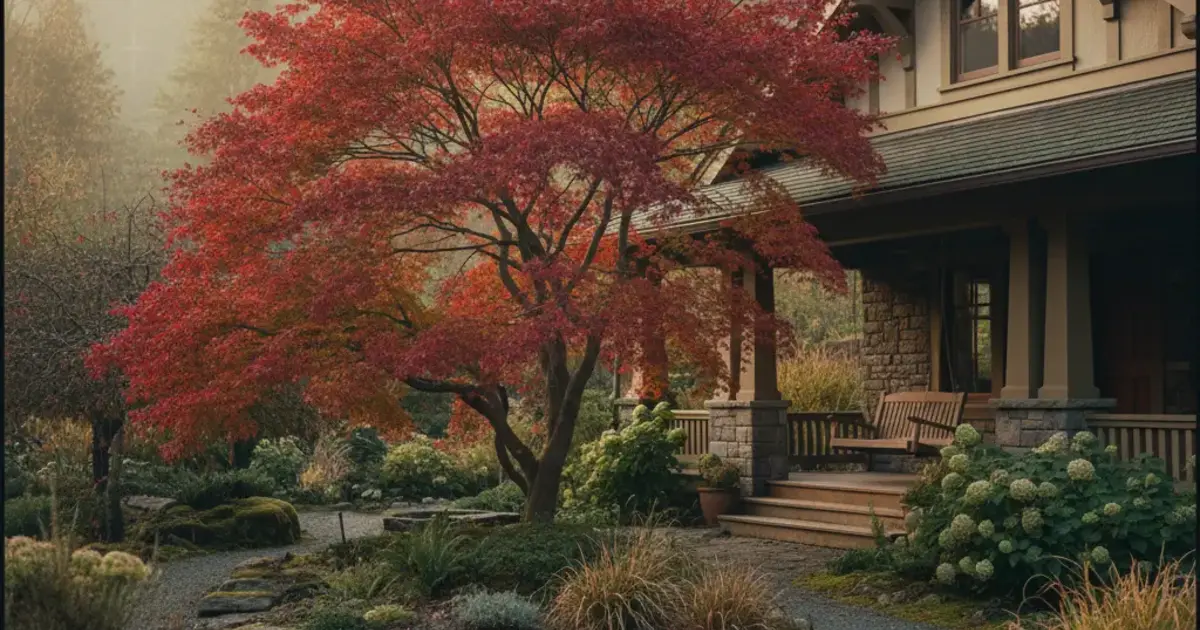
Japanese maple is the most house-friendly ornamental tree you can buy. It grows 15-25 feet tall depending on variety, has shallow fibrous roots that don’t invade foundations, and grows slowly enough that you won’t need emergency pruning.
The canopy turns gold, orange, or deep burgundy in fall. It handles partial shade well, which makes it a good fit for the north or east side of a house. Plant it 8-10 feet from the foundation.
If you’re choosing between cultivars, the Japanese maple varieties guide covers 12 different options by size and fall color.
Eastern Redbud (Cercis canadensis)
Redbud is native to most of the eastern U.S. and blooms in early spring before the leaves emerge. That early color (purple-pink flowers covering bare branches in February or March) is especially striking when you can see it from a window.
Mature height runs 20-30 feet. The root system is deep and fibrous rather than surface-spreading, which keeps it away from foundations and sidewalks. Once established, it’s also drought-tolerant, so it won’t go hunting for your irrigation lines.
Plant it 10-15 feet from the house.
Flowering Dogwood (Cornus florida)
Dogwood is one of the classic American ornamental trees, and it works well near a house for a few reasons. It stays small (20-25 feet), blooms white or pink in spring, and turns deep red in fall. The roots are shallow but non-invasive, and it doesn’t drop messy seed pods or large limbs.
It grows well in partial shade, so it fits into spots that already get filtered light from a larger tree nearby.
Plant it 10-15 feet from the house.
Serviceberry (Amelanchier species)
Serviceberry is an underused native that deserves more attention. It grows 15-25 feet tall, produces white flowers in early spring (often the first tree to bloom in its area), and the berries attract birds through summer and fall. The root system is fibrous and non-aggressive.
It handles full sun and partial shade, tolerates most soil types, and is one of the better native alternatives to ornamental pears. It’s also a top pick in the guide to trees for small yards for tight spaces where a larger ornamental won’t fit.
Plant it 8-10 feet from the house.
Crape Myrtle (Lagerstroemia indica)
Crape myrtle is the near-house standard in the South, and the root system is notably non-invasive. It blooms all summer in shades of white, pink, red, and purple. Mature size varies widely: dwarf cultivars stay under 6 feet, standard varieties reach 20-30 feet.
Match the cultivar to your space. A standard crape myrtle planted 6 feet from the house causes problems eventually, but a dwarf variety works fine at that distance.
Plant dwarf varieties 6-10 feet from the house, standard sizes 12-15 feet away.
American Holly (Ilex opaca)
For year-round evergreen screening near the house, American holly is hard to beat. It grows 15-30 feet tall at a slow, steady rate and has a compact, non-spreading root system.
The red berries in winter add color when most other trees are bare. You’ll need at least one male plant near female plants for berry production. (Most nurseries label them clearly, or carry self-fertile varieties.)
Plant it 10-15 feet from the house.
Star Magnolia (Magnolia stellata)
Star magnolia tops out at 15-20 feet and produces white flowers in early spring, sometimes before the last frost. The root system is fleshy but non-aggressive.
Southern magnolia (Magnolia grandiflora) is a different story entirely: it grows 60-80 feet tall and eventually causes foundation problems. If you want magnolia near your house, star magnolia and saucer magnolia (Magnolia x soulangeana) are the right choices. Southern magnolia belongs 30-50 feet away.
Plant star magnolia 8-12 feet from the house.
Native Plum and Small Prunus Species
Native plum (Prunus americana), ornamental cherry, and similar small Prunus species grow 15-25 feet tall, bloom heavily in spring, and have manageable root systems. They attract pollinators and produce small fruits that wildlife eat through summer and fall.
Plant them 10-15 feet from the house.
Pistachio Tree (Pistacia vera)
Pistachio works well near a house in warm, dry climates (USDA zones 7-11). It grows 15-20 feet tall with a rounded canopy and a deep taproot that won’t push into foundations or sidewalk joints.
It’s drought-tolerant once established, needing water every 2-3 weeks in most Western summers. The foliage drops in fall after turning orange-yellow. For nuts, plant one male and one female tree within 50 feet of each other.
Plant it 10-12 feet from the house.
How Far From the House Should You Plant a Tree?
The standard rule: plant distance should equal at least half the tree’s mature canopy spread.
For most near-house plantings, these ranges work:
- Small trees (under 25 feet): 8-10 feet from the foundation
- Medium trees (25-40 feet): 15-20 feet from the foundation
- Large trees (40+ feet): 30-50 feet from the foundation
Choosing the right planting distance for a tree near your house depends on 3 factors: the tree’s mature height, its canopy spread, and its root system behavior. As a general rule, plant small trees (under 25 feet at maturity) at least 8-10 feet from the foundation. Medium trees reaching 25-40 feet need 15-20 feet of clearance. Large trees over 40 feet should stay 30-50 feet from the house. These distances prevent canopy overhang from depositing debris on the roof, keep falling limbs away from the structure in storms, and give root systems room to grow without contacting the foundation or underground pipes. Trees with aggressive root systems, including silver maple, willow, and Norway maple, need additional clearance beyond these minimums. Native species with fibrous root systems are generally safer at standard distances. When in doubt, plant farther than the minimum: trees can’t be moved once established.
Money Tree Plant: Can You Grow It Near Your House?
The money tree plant (Pachira aquatica) is one of the most searched houseplants in the U.S., and a common follow-up question is whether it can grow outdoors near a house.
That depends entirely on where you live.
Pachira aquatica is native to Central and South American wetlands, where it reaches 30-60 feet tall in natural habitat. In U.S. cultivation it typically tops out at 10-15 feet. It’s winter-hardy outdoors only in USDA zones 10-12: coastal South Florida, Hawaii, and frost-protected spots in Southern California. Outside those zones, a single frost kills it to the roots.
In zones 10-12, money tree works fine near a house. The root system is fibrous and non-invasive. At its cultivated height of 10-15 feet, plant it 8-10 feet from the foundation. It prefers bright indirect light or morning sun, and well-drained soil, since poor drainage kills roots even though the plant evolved in swampy ground.
In zones 1-9, money tree stays a container plant. Move it indoors before the first frost and set it near a bright window. It handles the transition well. One thing to know: the braided trunk sold at nurseries is a production technique. Young seedlings are braided at 4-6 weeks when the stems are still flexible, then fuse as the plant grows. The braiding has no effect on health or longevity.
For a broader look at ornamental trees that work in landscape settings, the ornamental trees guide covers 15 species with identification tips for each.
Trees to Avoid Planting Near Your House
Some of the most popular nursery trees are the worst choices for near-house planting.
Silver maple (Acer saccharinum): Fast-growing, widely available, and cheap. The roots are among the most aggressive of any common tree, pushing into foundations, clay drainage pipes, and irrigation lines. Keep it 50+ feet away.
Weeping willow (Salix babylonica): Beautiful near a pond, destructive near a house. The roots actively seek moisture and will grow into sewer lines, septic systems, and foundation drains. Keep it 50+ feet away.
Norway maple (Acer platanoides): Widely planted as a street tree, invasive in many states, and its dense surface roots make it nearly impossible to grow grass underneath. Keep it 30+ feet from the house.
Bradford pear (Pyrus calleryana ‘Bradford’): Looks great for 10-15 years, then fails structurally. The narrow branch angles create weak attachment points that split in storms. It’s also invasive in many regions. Avoid it entirely.
Cottonwood (Populus deltoides): Grows fast, reaches enormous size, and has roots that travel aggressively in search of water. The cotton it releases in spring clogs gutters and air conditioning filters. Keep it 50+ feet away.
How Tree Identifier Helps You Choose
Before you buy a tree at a nursery, it helps to know exactly what you’re looking at. A lot of nurseries mislabel similar species, and some sell varieties under common names that can mean very different things. (There’s a big size difference between a compact Japanese maple and a full-moon maple variety, but they’re often shelved together under the same label.)
Tree Identifier lets you photograph a leaf, bark sample, or fruit and get an accurate species ID in seconds. If you spot a tree in a neighbor’s yard that you’d like to plant, or you’re at a nursery with a vague label, a quick photo confirms exactly what it is before you buy.
The app covers thousands of species and includes detailed information about each one: mature size, habitat range, and key identifying features. It works offline too, which is useful when you’re at a nursery with spotty cell service.
If you’re choosing between fast-growing options, the guide to fast-growing trees covers which ones are worth planting and which are best avoided.
Download Tree Identifier on iOS or Android to identify any tree before it goes in the ground near your house.
Frequently Asked Questions
Can I plant a tree right next to my house?
Yes, if you choose the right species. Trees with fibrous, non-aggressive root systems and mature heights under 25 feet can grow 8-10 feet from a foundation safely. Avoid fast-growing trees and any species known for water-seeking roots near any structure.
What trees damage foundations the most?
Silver maple, weeping willow, cottonwood, and Norway maple are the most common foundation offenders. All four have aggressive root systems that grow toward water sources and push into any existing crack in concrete or clay pipes.
How do I know if a tree is safe to plant near my house?
Research the mature size and root system type before planting. Trees with fibrous roots and a mature height under 30 feet are generally safe at 8-15 feet from the house. When you’re not sure, plant farther.
What’s the fastest-growing safe tree for near a house?
Crape myrtle adds 3-5 feet per year in good conditions and has a non-invasive root system, making it one of the faster options that’s still safe near a house.
Can I plant a Japanese maple close to my house?
Yes. Japanese maple is one of the best choices for planting near a house. Plant it 8-10 feet from the foundation. It won’t send roots into the structure, and its mature canopy of 15-20 feet stays clear of most roof lines.
Can you plant a money tree plant near your house?
In USDA zones 10-12 (coastal South Florida, Hawaii, frost-free Southern California), yes. Pachira aquatica has a fibrous, non-invasive root system and tops out at 10-15 feet in cultivation. Plant it 8-10 feet from the foundation. In zones 1-9, keep it in a container. Frost kills it to the roots.
The Short List
The safest trees to plant near a house are smaller native and ornamental species with fibrous root systems: Japanese maple, redbud, dogwood, serviceberry, star magnolia, crape myrtle, American holly, native plum, and pistachio (zones 7-11). Plant small trees at least 8-10 feet from the foundation, medium trees 15-20 feet away. Money tree plant works near a house in zones 10-12 only.
Avoid silver maple, weeping willow, cottonwood, Norway maple, and Bradford pear near any structure. If you’re ever unsure what tree you’re looking at before planting, Tree Identifier can confirm the species from a single photo.
Identify a tree from your photo — free
Upload a leaf, bark, or whole-tree photo and get the species in seconds. No signup.
Confidence:
Unlock the full species profile
Free in the app — with unlimited identifications.


AI result for guidance — the app gives full species details and works offline.
Want unlimited identifications?
Get the full species profile, photos and details — free in the app, with unlimited scans.
- Unlimited identifications
- Full species profiles & details
- Works offline, anywhere
- Save and revisit your finds
Elena Torres
Tree Identifier Team