Catalpa Tree Identification: Giant Leaves, Flowers, and Bean Pods
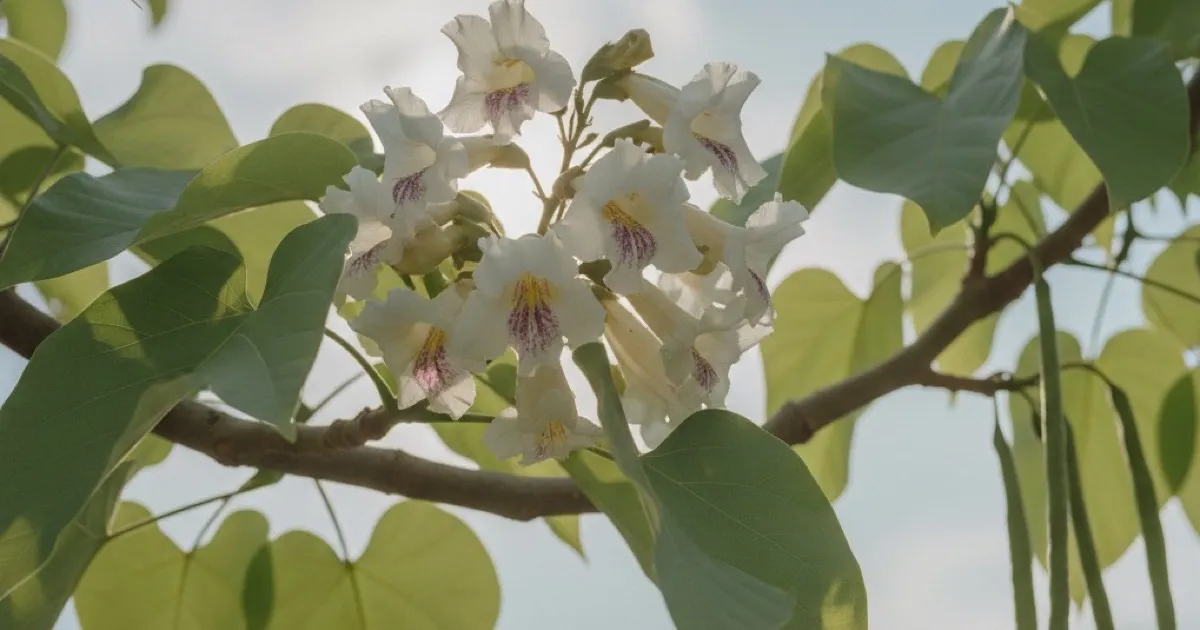
Catalpa trees are hard to miss. The leaves are enormous — often a foot long and 8 inches wide. The flowers are showy white clusters that look like orchids. And the fruit is a long, slender bean pod that can hang on the tree all winter. Yet despite all these bold features, many people don’t know what catalpas are called. They just point at the tree with the giant leaves and the long beans. Catalpa tree identification is easy once you know what you’re looking at, because almost nothing else in North America matches this combination of features.
Two native species grow in the United States: northern catalpa (Catalpa speciosa) and southern catalpa (Catalpa bignonioides). Both are widely planted far beyond their original range. This guide covers how to identify catalpas by leaf, flower, fruit, and bark, plus how to tell the two species apart.
Catalpa Leaves: The Biggest in the Neighborhood
Catalpa leaves are among the largest of any North American tree. They’re the first feature most people notice, and the most reliable for identification.
Key leaf features:
- Size: 6 to 12 inches long and 4 to 8 inches wide. Some leaves on vigorous shoots reach 14 inches. They’re roughly heart-shaped but broader and more rounded than linden or redbud leaves.
- Shape: Broadly ovate to heart-shaped, with a pointed tip and a heart-shaped or flat base
- Margin: Smooth (entire) with no teeth. Occasionally the margins are slightly wavy, but there are no serrations
- Arrangement: Opposite or whorled — catalpas often have leaves in groups of three at a node (whorled), which is unusual among North American trees
- Surface: Light green, soft, and slightly fuzzy. The underside is paler and has a velvety texture
- Smell: Crushed catalpa leaves have a mildly unpleasant scent that some describe as “green” or “sour”
The combination of huge, smooth-margined, heart-shaped leaves in whorled arrangement is unique. No other common tree in North America has all of these traits together. A redbud leaf has the same heart shape but is a fraction of the size, and a linden leaf is toothed along the margin. If you’re working through a list of trees with heart-shaped leaves, catalpa is the one where a single leaf can cover your whole hand.
One more tell: catalpa leaf stalks (petioles) are long and stout, 4 to 6 inches on big leaves, and the twigs are thick with large, sunken leaf scars once the leaves drop. Crush a leaf and you’ll get that faintly sour, “green” smell that lingers on your fingers.
Catalpa leaves appear late in spring (often two weeks after maples and oaks) and drop early in fall, sometimes after just a light frost. The fall color is minimal — they turn dull yellowish-green or brown and drop quickly. That late-out, early-drop habit is another quiet clue when you’re comparing a catalpa tree to its neighbors.
Catalpa Flowers
Catalpa flowers are spectacular. They bloom in late May to June, appearing in large upright clusters (panicles) at the tips of branches. Each flower is about 2 inches across, white with purple and yellow spots inside the throat. The spots are nectar guides that direct bees and other pollinators to the center of the flower.
Details about catalpa flowers:
- Clusters are cone-shaped (panicles), 6 to 12 inches tall, containing 20 to 40 individual flowers
- Each flower has five ruffled, fringed petals fused into a bell shape
- The interior markings are purple-brown spots and streaks with two yellow stripes
- The flowers are mildly fragrant — a sweet scent that’s lighter than linden but noticeable
In full bloom, a catalpa tree is covered in white flower clusters and is genuinely stunning. The bloom period is relatively short, usually about two weeks. When the flowers drop, they blanket the ground beneath the tree like confetti.
The flowers distinguish catalpa from any potential look-alike. No other common tree in the eastern U.S. produces large clusters of orchid-like white flowers with purple-spotted throats. Among the trees with white flowers you might run into, catalpa stands out for the sheer size of the bloom clusters and the freckled, yellow-striped throat on each flower. Timing helps too: catalpa blooms in late spring to early summer, weeks after the spring-flowering dogwoods and cherries have already finished.
Catalpa Bean Pods
After the flowers, catalpas produce their most famous feature: long, slender seed pods that look like green beans hanging from the tree. These pods give the tree its common nickname, “cigar tree” or “bean tree.”
Pod characteristics:
- Length: 8 to 20 inches long, about 1/2 inch in diameter
- Shape: Cylindrical, straight or slightly curved, tapering to a point at each end
- Color: Green in summer, turning dark brown as they dry in fall
- Persistence: The dried brown pods hang on the tree through winter, often into the following spring
- Seeds: Each pod contains flat, winged seeds with fringed ends, packed in rows inside the pod
The pods are one of the best winter identification features for catalpa. Few other trees produce anything resembling a long, thin bean pod, and catalpa’s are the longest of the bunch. Compared with other trees with long seed pods like honeylocust or catawba, catalpa pods are rounder in cross-section, much thinner, and hang straight down in loose clusters rather than twisting. If you’re stuck on a bare tree in January, our guide to seed pod identification walks through the shapes side by side. If you see a bare deciduous tree with clusters of dangling 12-inch brown pods, it’s almost certainly catalpa.
When the pods eventually split open in late winter or spring, the seeds scatter in the wind. The empty pods litter the ground beneath the tree and can be a cleanup nuisance in tidy landscapes.
Catalpa Bark Identification
Catalpa bark is less distinctive than the leaves, flowers, or pods, but it has a recognizable character:
Young trees: Thin, smooth, and grayish-brown.
Mature trees: Develops scaly plates or ridges separated by shallow furrows. The bark is grayish-brown and has a somewhat rough, irregularly plated texture. On older trees, the plates become thicker and may peel slightly at the edges.
Northern catalpa tends to develop thicker, more deeply furrowed bark than southern catalpa. The bark of both species is less dramatic than oak or hickory bark but is identifiable in combination with the tree’s other features.
For bark identification, catalpa’s scaly gray plates are useful mainly for confirming an ID already suggested by the leaves, pods, or flowers.
Northern vs. Southern Catalpa
The two native species are similar and were once thought to be the same tree. In practice, telling them apart can be tricky, but a few differences help:
| Feature | Northern Catalpa (C. speciosa) | Southern Catalpa (C. bignonioides) |
|---|---|---|
| Size | Larger — 50 to 70 feet tall | Smaller — 30 to 40 feet tall |
| Trunk | Often a single straight trunk | Often short, with multiple spreading trunks |
| Flowers | Larger (2+ inches), fewer per cluster, less heavily spotted | Slightly smaller, more per cluster, more heavily spotted |
| Pods | Thicker pods (about 1/2 inch diameter) | Thinner pods (about 3/8 inch) |
| Leaf | Slightly longer, less pungent when crushed | Slightly broader, more pungent smell |
| Native range | Midwest (Ohio to Arkansas) | Southeast (Georgia to Mississippi) |
In practice, the two species hybridize freely where they overlap, and many planted catalpas are of uncertain parentage. For most identification purposes, simply identifying the tree as “catalpa” is sufficient.
Catalpa Tree Shape and Size
Catalpas have an irregular, somewhat coarse growth form that gives them a distinctive silhouette:
- Northern catalpa: 50 to 70 feet tall with a narrow, irregular crown and a straight trunk. In forest settings, the trunk is tall and relatively clean.
- Southern catalpa: 30 to 40 feet tall with a short trunk that often divides into several large spreading limbs, creating a broad, rounded, sometimes lopsided crown.
Both species have coarse branching with thick twigs that end abruptly rather than tapering to fine tips. The winter silhouette is recognizable: few branches, thick and crooked, with clusters of hanging pods.
Catalpas grow fast when young, adding 2 to 3 feet per year. They slow down with age and are not particularly long-lived, typically reaching 60 to 100 years.
Where Catalpa Trees Grow
Northern catalpa is native to a narrow range in the central Midwest, from southern Indiana and Illinois to western Tennessee and northeastern Arkansas. It grows naturally along rivers and streams in rich bottomland soil.
Southern catalpa is native to the Gulf Coast region, from western Georgia through Alabama and Mississippi. Like its northern relative, it favors moist bottomland sites.
Both species have been planted far beyond their native ranges. You’ll find catalpas growing in yards, parks, cemeteries, and along streets across the entire eastern United States, the Midwest, and parts of the Pacific Northwest. They tolerate poor soil, drought, heat, and urban conditions surprisingly well despite their preference for moist ground in the wild.
Catalpas are also common in abandoned homesteads and old farmyards, where they were planted as shade trees in the 1800s and early 1900s. Finding a catalpa in a rural area often marks the location of a former homesite.
Catalpa Worms and Fishing
Catalpas have a famous relationship with the catalpa sphinx moth (Ceratomia catalpae). The moth lays eggs on catalpa leaves, and the larvae — fat, dark caterpillars with a distinctive horn at the rear — feed voraciously on the foliage. A heavy infestation can strip a catalpa of every leaf in a matter of days.
These “catalpa worms” are prized by fishermen as bait. They’re considered one of the best catfish baits available. Some people plant catalpa trees specifically to attract the moth and harvest the caterpillars. The worms can be frozen for year-round use.
The caterpillars don’t kill the tree. Catalpas are resilient and will push out a second flush of leaves after being defoliated. A healthy tree can tolerate annual defoliation with minimal long-term damage.
Identifying Catalpa Trees With Tree Identifier
Catalpas are distinctive, but if you’re not sure whether you’re looking at a catalpa, a paulownia (which has similar large leaves and showy flowers), or something else, the Tree Identifier app can sort it out. Snap a photo of a giant leaf, a cluster of spotted white flowers, or one of those long bean pods, and the AI identifies the species. It works with leaves, bark, flowers, and fruit.
The app runs offline too, which helps if you’re exploring a rural area or old homestead where cell service is spotty. You get 2 free identifications per day.
Frequently Asked Questions
Are catalpa trees messy?
Yes. Catalpas drop flowers in late spring, large leaves in fall, and pods through winter and into spring. The pods and leaves are large enough to be noticeable. The catalpa sphinx caterpillars also leave droppings (frass) on anything beneath the tree during infestations. If tidiness matters, catalpa may not be the best choice.
Are catalpa beans poisonous?
Catalpa pods and seeds are not considered poisonous to humans, though they’re not edible either. The leaves and flowers are also non-toxic. However, some people experience skin irritation from handling the flowers or leaves. Catalpa worms (sphinx moth caterpillars) are not poisonous but can stain clothing.
What is the difference between catalpa and paulownia?
Paulownia (princess tree) is a common catalpa look-alike. Both have large heart-shaped leaves and showy flower clusters. Key differences: paulownia flowers are lavender-purple (catalpa flowers are white with purple spots), paulownia blooms before the leaves emerge (catalpa blooms after), and paulownia fruit is a round woody capsule (catalpa fruit is a long bean pod). Paulownia is also considered invasive in the eastern U.S.
How long do catalpa trees live?
Catalpas typically live 60 to 100 years. They grow fast and die relatively young compared to oaks or maples. The wood is moderately durable and was historically used for fence posts and railroad ties because it resists rot.
Why is my catalpa tree losing all its leaves in summer?
The catalpa sphinx moth caterpillar is the most likely cause. Heavy infestations can strip every leaf from a tree in a week. The tree will grow new leaves within a few weeks. This is cosmetically alarming but rarely kills the tree. Some people consider the caterpillars a benefit because they’re excellent fishing bait.
See a tree with giant leaves and long bean pods? Try Tree Identifier — snap a photo and find out the species in seconds.
Identify a tree from your photo — free
Upload a leaf, bark, or whole-tree photo and get the species in seconds. No signup.
Confidence:
Unlock the full species profile
Free in the app — with unlimited identifications.


AI result for guidance — the app gives full species details and works offline.
Want unlimited identifications?
Get the full species profile, photos and details — free in the app, with unlimited scans.
- Unlimited identifications
- Full species profiles & details
- Works offline, anywhere
- Save and revisit your finds
Elena Torres
Tree Identifier Team