Chestnut Tree Identification: American, Chinese, and Horse Chestnut
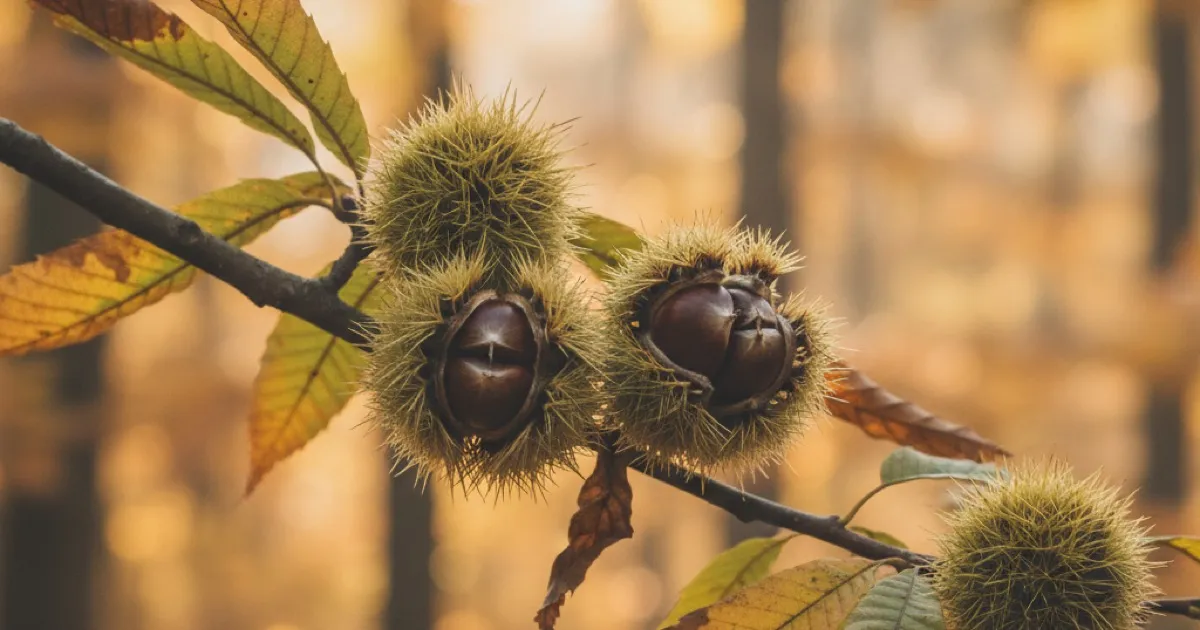
A century ago, the American chestnut was one of the most important trees in eastern North America. Billions of them filled Appalachian forests, their massive trunks reaching 100 feet tall and 10 feet in diameter. Then a fungal blight arrived from Asia in the early 1900s and killed virtually every mature American chestnut on the continent within 50 years. The trees aren’t gone — stump sprouts still push up from old root systems across the East — but finding a full-sized American chestnut today is extremely rare. Chestnut tree identification still matters, though, because several chestnut species grow in North America and people regularly confuse them with horse chestnuts, which aren’t related at all.
This guide covers the American chestnut, Chinese chestnut, horse chestnut, and how to tell all three apart by their leaves, bark, nuts, and growth habits.
American Chestnut Identification
The American chestnut (Castanea dentata) belongs to the beech family (Fagaceae), the same family as oaks and beech trees. Before the blight, it made up roughly 25% of all hardwood trees in the Appalachian forest. Today, most surviving American chestnuts are small understory sprouts that grow from old root systems, reach 15 to 30 feet, then succumb to the blight before they can reproduce.
American Chestnut Leaves
American chestnut leaves are long, narrow, and distinctively toothed:
- Shape: Oblong-lanceolate, 5 to 9 inches long and about 2 inches wide
- Margin: Coarsely serrated with large, forward-pointing teeth that curve toward the leaf tip. Each tooth ends in a bristle-like point
- Surface: Smooth and hairless on both sides (this is a key distinction from Chinese chestnut)
- Arrangement: Alternate on the branch
- Color: Dark yellow-green above, slightly paler below
- Fall color: Golden yellow
The teeth are the most recognizable feature. They’re large, hooked, and evenly spaced, giving the leaf margin a saw-blade appearance. Each tooth curves forward like a fish hook, which is unusual among eastern hardwoods.
American Chestnut Bark
Young American chestnuts have smooth, dark reddish-brown bark. Mature trees (now extremely rare) develop bark with broad, flat-topped ridges in a slightly spiraling pattern, often described as having a “ropy” appearance.
Since most surviving American chestnuts are small sprouts, you’ll typically see the smooth, young bark. On the occasional larger specimen (20-30 feet tall), the bark begins to develop shallow furrows with a reddish-brown color that’s darker than most oaks.
American Chestnut Nuts
The nuts grow inside spiny burs that split open in fall. Each bur typically contains two to three nuts. The nuts are small (about 1 inch), flattened on one side, pointed at the tip, and covered in fine silky hairs at the top.
American chestnut nuts are edible and were historically a major food source for humans and wildlife. They have a sweet, mild flavor and were roasted, boiled, ground into flour, and fed to livestock. The loss of the chestnut as a food source affected both human communities and wildlife across the Appalachian region.
Chinese Chestnut Identification
The Chinese chestnut (Castanea mollissima) is the species most people encounter today in yards, parks, and orchards. It’s resistant to the chestnut blight and has been planted widely as a replacement for the American chestnut.
Chinese Chestnut Leaves
Chinese chestnut leaves are similar to American chestnut but with key differences:
- Shape: Broader and more oval than American chestnut (3 to 7 inches long)
- Margin: Coarsely toothed, but the teeth are less sharply hooked
- Surface: Fuzzy underside — the lower leaf surface has dense, soft hairs. This is the single best way to distinguish Chinese from American chestnut
- Color: Glossy dark green above
The fuzzy underside is the definitive test. American chestnut leaves are smooth on both sides. Chinese chestnut leaves are hairy underneath. Flip the leaf and rub the underside with your thumb.
Chinese Chestnut Form
Chinese chestnuts are smaller trees than their American counterparts, typically reaching 40 to 60 feet tall with a broad, spreading crown. They’re wider than tall, with heavy horizontal branches that give the tree a rounded, sprawling shape.
The bark on mature Chinese chestnuts develops furrows and ridges similar to oak, but with a grayish-brown color. The nuts are larger than American chestnut nuts (often over 1 inch in diameter) and are the chestnuts you find roasted at street vendors and in grocery stores during the holidays.
Horse Chestnut: Not a Real Chestnut
Horse chestnut (Aesculus hippocastanum) is the source of the biggest chestnut confusion. Despite the name, horse chestnut is not related to true chestnuts at all. It belongs to the soapberry family (Sapindaceae), the same family as maple trees and buckeyes.
Horse chestnuts are widely planted as ornamental trees in parks and along streets. They produce shiny brown nuts that look superficially like chestnuts but are mildly toxic to humans.
How to Tell Horse Chestnut from True Chestnut
The differences are significant once you know what to look for:
| Feature | True Chestnut (American/Chinese) | Horse Chestnut |
|---|---|---|
| Leaves | Simple, alternate, long and narrow with hooked teeth | Palmately compound — 5-7 leaflets radiating from a central point (like fingers on a hand) |
| Leaf arrangement | Alternate | Opposite |
| Nut husk | Densely spiny bur with many fine spines | Sparsely spiny or smooth green husk with few thick spines |
| Nut shape | Pointed, flattened, hairy tip | Round, glossy, large white “eye” (hilum) |
| Nut edibility | Edible (sweet flavor) | Mildly toxic (bitter flavor) |
| Flowers | Small catkins (not showy) | Large upright cone-shaped clusters, white with pink spots |
The leaf alone settles it. True chestnuts have simple leaves — one blade per stem. Horse chestnuts have compound leaves with 5 to 7 large leaflets fanning out from a central point like a hand. If the leaves are compound and opposite, it’s horse chestnut. If simple and alternate with hooked teeth, it’s a true chestnut.
The Chestnut Blight Story
The chestnut blight (Cryphonectria parasitica) arrived in New York around 1904, likely on imported Asian chestnut trees. The fungus enters through bark wounds and kills the cambium layer, girdling branches and trunks. Within 50 years, it had killed an estimated 3 to 4 billion American chestnut trees.
The roots survive because the fungus doesn’t attack underground tissue. American chestnut root systems continue to send up sprouts that grow for 10 to 20 years before the blight finds them and kills them back to the ground. This cycle has continued for over a century.
Active restoration efforts are underway:
- The American Chestnut Foundation has been backcross-breeding American chestnuts with blight-resistant Chinese chestnuts since the 1980s
- SUNY College of Environmental Science and Forestry developed a transgenic American chestnut with a wheat gene that confers blight resistance
- Hypovirulence (a virus that weakens the blight fungus) has shown promise in European chestnuts and is being tested in American populations
If you find what appears to be an American chestnut, especially a larger tree with a trunk over 6 inches in diameter, it’s worth reporting to the American Chestnut Foundation. Every surviving mature tree is scientifically valuable.
Where Chestnut Trees Grow
American chestnut was native from Maine to Mississippi and west to Ohio, with its core range in the Appalachian Mountains. Sprouts still occur throughout this range, especially in the mountains of Virginia, West Virginia, North Carolina, and Tennessee. Look for them as understory trees on well-drained, acidic, upland soils.
Chinese chestnut is widely planted across the eastern and central United States in yards, parks, and orchards. It tolerates a range of soils but prefers well-drained, slightly acidic conditions. Commercial chestnut orchards are concentrated in the mid-Atlantic, Midwest, and Pacific Northwest.
Horse chestnut is native to southeastern Europe but widely planted as an ornamental across North America. It’s common in parks, campuses, and older residential neighborhoods. It prefers moist, well-drained soil and partial shade.
Identifying Chestnut Trees With Tree Identifier
Telling American chestnut from Chinese chestnut — or either from horse chestnut — takes some practice with leaf shapes and nut characteristics. The Tree Identifier app speeds up the process. Snap a photo of the toothed leaves, the spiny bur, or the bark, and the AI identifies the species. It works with leaves, bark, flowers, and fruit, so you can ID during any season.
The app runs offline, which is useful if you’re hiking Appalachian trails where American chestnut sprouts still grow and cell service disappears. You get 2 free identifications per day to start.
Frequently Asked Questions
Are horse chestnuts edible?
No. Horse chestnuts contain aesculin and other compounds that are mildly toxic to humans. Eating them causes nausea, vomiting, and digestive upset. True chestnuts (American and Chinese) are edible and sweet. The name overlap is unfortunate. If a chestnut is round, glossy, and came from a tree with compound palmate leaves, don’t eat it.
How do I know if I found an American chestnut?
Check the leaves: simple, alternate, 5-9 inches long, with large hooked teeth and smooth on both sides (no fuzz underneath). If the tree is more than 20 feet tall with a trunk over 6 inches, it’s rare and worth documenting. Most American chestnut sightings turn out to be Chinese chestnuts. The smooth leaf underside is the key test.
Can American chestnuts still grow large?
Rarely. Most American chestnuts today are stump sprouts that die back from blight before reaching reproductive age. Occasional trees in isolated locations (far from other chestnuts and blight spores) reach 40-50 feet, but these are exceptions. Restoration programs are working to produce blight-resistant trees that can grow to full size.
What’s the difference between chestnut and buckeye?
Buckeyes (genus Aesculus) are closely related to horse chestnut and share the palmate compound leaf and opposite arrangement. Ohio buckeye has five leaflets, horse chestnut has five to seven. True chestnuts have simple, alternate leaves. Buckeye nuts are also toxic, like horse chestnut.
When do chestnut trees bloom?
True chestnuts bloom in late June to July, producing long, creamy-white catkins that have a distinctive (some say unpleasant) smell. Horse chestnuts bloom earlier, in May, with large upright flower clusters that are showier and more ornamental.
Think you’ve found a chestnut tree? Try Tree Identifier — photograph the leaves or nuts and find out which species you’re looking at in seconds.
Elena Torres
Tree Identifier Team