Cypress Tree Identification: Leaves, Bark & Cones
Cypress tree identification confuses people because “cypress” refers to several unrelated groups of trees. True cypresses (Cupressus) grow in the West. Bald cypress (Taxodium) grows in southern swamps. Leyland cypress is a hybrid sold at every garden center. And arborvitae gets called “false cypress” in some regions. These trees share a name but look different, grow in different climates, and belong to different genera.
This guide sorts out the major cypress types you’ll find in North America, with the specific bark, foliage, and cone features that separate them in the field.
Cypress trees in North America fall into three genera: true cypress (Cupressus), bald cypress (Taxodium), and false cypress (Chamaecyparis). True cypresses are evergreen with scale-like foliage and round woody cones. Bald cypress drops its feathery needles every fall. Check whether the foliage looks like flat scales or feathery needles, and whether the tree holds its color through winter.
What Does a Cypress Tree Look Like?
Cypress trees vary more than the name suggests. Italian cypress grows 60 feet tall but stays 3 to 6 feet wide, a pencil-narrow shape you’d recognize from Mediterranean landscapes. Bald cypress is a massive swamp tree with a flared base and rusty orange fall foliage before it drops its needles. Monterey cypress, in exposed coastal settings, flattens into a wide wind-sculpted crown that looks nothing like either of those.
Despite the variation, all members of the Cupressaceae family share a few traits. The foliage is either flat scale-like leaves pressed against the twig or, in bald cypress, feathery flat needles arranged in two rows. There’s no single crown shape, but foliage texture is the fastest field check.
Cypress trees belong to the family Cupressaceae, which includes roughly 30 genera and more than 130 species worldwide. In North America, the most common groups are true cypresses (Cupressus, 12 species native to the western U.S. and Mediterranean climates), bald and pond cypress (Taxodium, 3 species native to the southeastern U.S. and Mexico), and false cypresses (Chamaecyparis, 6 species across North America and eastern Asia). True cypresses grow 40 to 70 feet tall with scale-like leaves pressed tightly against the twigs and round, woody cones 1 to 1.5 inches across. Italian cypress (Cupressus sempervirens) holds a columnar crown just 3 to 6 feet wide at 60 feet tall. Bald cypress grows 50 to 120 feet, turns rusty orange before dropping its needles in November, and produces pencil-thin knees from flooded roots. Leyland cypress reaches 40 to 70 feet and grows 3 to 4 feet per year.
Bark differs by species and age. Bald cypress has reddish-brown bark that peels in long vertical strips. Arizona cypress bark turns cherry-red and smooth as it matures, peeling away in thin sheets. Monterey cypress develops deep gray ridges on old trees.
The one reliable seasonal marker: if a conifer with scale-like foliage turns orange and drops its needles in fall, that’s bald or pond cypress. Every other cypress holds its foliage year-round.
True Cypress vs. Bald Cypress vs. False Cypress
Before getting into species, here’s the broad breakdown:
True cypresses (Cupressus) are evergreen conifers with scale-like leaves pressed flat against the twigs, round woody cones about the size of a golf ball, and bark that ranges from smooth to fibrous. They grow naturally in the western U.S. and Mediterranean climates.
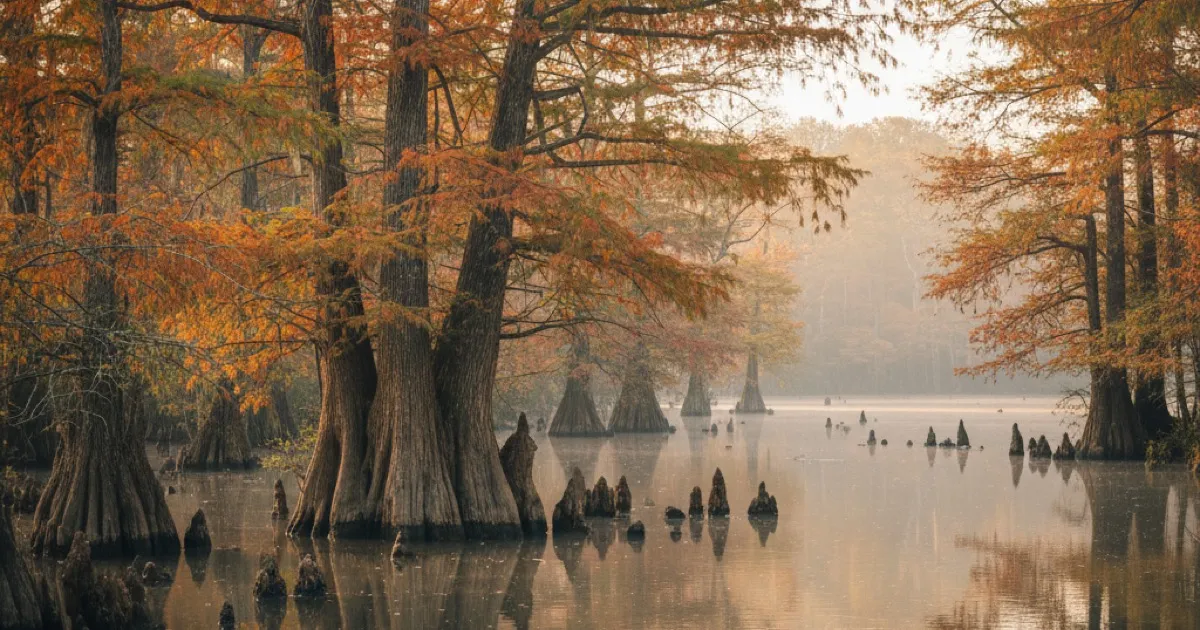
Bald cypress (Taxodium) is a deciduous conifer. It drops its needles every fall. It has feathery, flat needles (not scales), small round cones, and grows in flooded swamps and river bottoms across the Southeast. The signature “knees” that poke up from the roots around the trunk are found on no other common North American tree.
False cypresses (Chamaecyparis) look similar to true cypresses but have smaller cones and flattened sprays of foliage. This group includes Port Orford cedar and Atlantic white cedar.
If the tree has scale-like leaves, it’s in the cypress family. If it has flat, feathery needles and drops them in winter, it’s bald cypress.
Bald Cypress (Taxodium distichum)
Bald cypress is the most recognizable cypress in the eastern U.S. It’s the tree standing in swamp water with its trunk flared wide at the base and woody “knees” rising from the shallow roots around it.
Key identification features:
- Flat, feathery needles arranged in two rows along small branchlets. Bright green in spring and summer, turning rusty orange-brown before dropping in fall
- Small round cones, about 1 inch in diameter, green turning purple-brown when mature
- Bark is fibrous and reddish-brown, peeling in long vertical strips
- Trunk base is dramatically swollen (buttressed), especially in wet sites
- Cypress knees: woody projections that grow up from the roots, sometimes 3 to 4 feet tall. Only present when the tree grows in standing water or saturated soil
- Grows 50 to 70 feet tall in landscapes, up to 120 feet in old-growth swamps
Where it grows: Coastal plain from Delaware to Texas, up the Mississippi Valley to Indiana and Illinois. Planted as an ornamental as far north as New York and Michigan. It’s far more cold-hardy than most people assume.
Bald cypress is one of the fastest-growing quality trees for wet sites, adding 1.5 to 2 feet per year. It also thrives in normal yard soil, despite its swamp reputation. The knees only develop when the root zone is regularly flooded. For the full species breakdown including pond cypress, see the bald cypress tree identification guide.
Pond Cypress (Taxodium ascendens)
Pond cypress is bald cypress’s smaller relative. It grows in the same southeastern range but prefers shallower, more acidic water: ponds, bog edges, and flatwoods swamps rather than deep river bottoms.
Key identification features:
- Needles are pressed upward against the twig (appressed) rather than spreading flat in two rows like bald cypress. This gives the foliage a more stringy, rope-like appearance
- Cones and bark are similar to bald cypress but generally smaller
- Trunk is still buttressed, and it still forms knees in standing water
- Typically smaller than bald cypress: 40 to 60 feet tall, with a narrower, more columnar crown
Where it grows: Southeastern coastal plain from Virginia to Louisiana. Most common in Florida and the Carolinas.
The needle arrangement is the fastest way to separate pond cypress from bald cypress. Bald cypress needles spread flat like a fern. Pond cypress needles hug the twig.
Monterey Cypress (Cupressus macrocarpa)
Monterey cypress is native to exactly two small groves on the California coast near Carmel and Point Lobos. Despite this tiny natural range, it’s one of the most photographed trees in the world. The windswept specimens clinging to rocky cliffs above the Pacific are iconic.
Key identification features:
- Scale-like leaves pressed tight against the twig, bright green to dark green
- Round, woody cones 1 to 1.5 inches across, with 8 to 14 scales. Cones stay on the tree for years
- Bark on old trees is deeply ridged and dark gray
- Young trees are pyramidal. Mature trees in exposed coastal sites develop broad, flat-topped crowns sculpted by wind
- Grows 40 to 70 feet tall
Where it grows: Native only to the Monterey Peninsula in California. Widely planted as an ornamental and windbreak along the Pacific coast from central California through Oregon. Also planted in coastal areas worldwide, including New Zealand, Australia, and the British Isles.
The Lone Cypress at Pebble Beach is probably the most famous individual tree in America. It’s a Monterey cypress estimated at 250+ years old.
Italian Cypress (Cupressus sempervirens)
Italian cypress is the tall, narrow, flame-shaped tree that lines Mediterranean landscapes, vineyards, and cemeteries. In North America, it’s planted in California, the Southwest, and the Deep South.
Key identification features:
- Extremely narrow, columnar form: 40 to 60 feet tall but only 3 to 6 feet wide. No other common tree holds this shape without pruning
- Scale-like leaves, dark green, tightly pressed to twigs
- Round cones about 1 to 1.5 inches, with 8 to 14 scales
- Bark is thin, grayish-brown, with shallow furrows
Where it grows: Native to the eastern Mediterranean and western Asia. In North America, planted in USDA Zones 7b through 11. Common in California’s Central Valley, the Arizona desert, and along the Gulf Coast.
If you see an extremely narrow, columnar evergreen in a warm climate, it’s almost certainly Italian cypress.
Arizona Cypress (Cupressus arizonica)
Arizona cypress is the desert-adapted member of the true cypress group. It grows naturally in dry, rocky canyons in the Southwest, and it handles heat and drought better than any other cypress.
Key identification features:
- Scale-like leaves, often blue-gray to silver-blue (some cultivars are selected for the bluest color)
- Round cones 3/4 to 1 inch, woody, often clustering on branches
- Bark is distinctive: reddish-brown on young trees, becoming cherry-red and smooth on mature trunks as the outer bark peels off in thin strips. Some varieties have rough, furrowed gray bark instead
- Pyramidal to conical shape, 30 to 50 feet tall
- Strong aromatic resin scent when foliage is crushed
Where it grows: Arizona, New Mexico, western Texas, and northern Mexico at elevations of 3,000 to 8,000 feet. The cultivar ‘Blue Ice’ is popular in landscaping across the South and Southwest.
Arizona cypress is the best choice for dry-climate screening. It handles drought, heat, and poor soil with minimal irrigation once established.
Leyland Cypress (× Cuprocyparis leylandii)
Leyland cypress is a hybrid between Monterey cypress and Alaska yellow cedar that became one of the most-planted screening trees in the U.S. during the 1990s and 2000s. It grows 3 to 4 feet per year, forming a dense evergreen column.
Key identification features:
- Flat sprays of dark green scale-like foliage
- Rarely produces cones (being a hybrid, it’s often sterile)
- Bark is thin, reddish-brown, with shallow ridges
- Columnar to pyramidal shape, 40 to 70 feet tall, 10 to 15 feet wide
- Very fast growth: 3 to 4 feet per year
Where it grows: Planted throughout the southeastern U.S., mid-Atlantic, and Pacific Northwest. Hardy in USDA Zones 6 through 10.
Leyland cypress has serious drawbacks despite its popularity. It’s susceptible to Seiridium canker, bagworms, and root rot. When one tree in a hedge row dies, the gap is hard to fill. Many landscapers now recommend Green Giant arborvitae as a more disease-resistant alternative for privacy screens.
Port Orford Cedar (Chamaecyparis lawsoniana)
Despite the name, Port Orford cedar is actually a false cypress. It’s native to a small area in southwestern Oregon and northwestern California, but it’s widely planted as an ornamental across the Pacific Northwest and northern Europe.
Key identification features:
- Flat, lacy sprays of bright green foliage with a distinctive spicy scent when crushed
- Small round cones, about 1/3 inch, with 8 to 10 scales: much smaller than true cypress cones
- Bark is thick, reddish-brown, and deeply furrowed on old trees
- Pyramidal form, 40 to 60 feet in cultivation, up to 200+ feet in old-growth forests
- White “X” or “Y” pattern on the underside of foliage sprays (formed by white stomatal bands)
Where it grows: Native range is extremely limited: the Klamath Mountains of southwestern Oregon and the far northwest corner of California. Widely planted from Seattle to San Francisco and across the British Isles.
Port Orford cedar wood is prized for its rot resistance, straight grain, and ginger-like scent. It’s one of the most valuable timber species in the Pacific Northwest.
Cypress Bark, Foliage, and Cone Comparison
| Feature | Bald Cypress | True Cypress | False Cypress | Leyland Cypress |
|---|---|---|---|---|
| Foliage | Flat needles in rows | Scales pressed to twig | Flat sprays of scales | Flat sprays of scales |
| Deciduous? | Yes | No | No | No |
| Cones | ~1 inch, round | 1-1.5 inches, woody | 1/3 inch, small | Rarely produces cones |
| Bark | Fibrous, peeling strips | Variable by species | Thick, furrowed | Thin, reddish-brown |
| Knees | Yes (in wet soil) | No | No | No |
| Native range | Eastern U.S. | Western U.S./Mediterranean | Pacific coast | Hybrid (no wild range) |
For separating cypresses from other scale-leaved conifers, see the guides to juniper tree identification and cedar tree identification.
Identifying Cypress Trees With Tree Identifier
The word “cypress” covers a wide range of trees, and telling them apart from arborvitae, cedars, and junipers can be difficult. All these conifers have scale-like foliage. The Tree Identifier app sorts them from a photo of the foliage, bark, or cones. Snap a photo and the AI returns the species. It handles the tricky separations between true cypress, false cypress, and cedar-labeled trees that are actually something else. The app works offline, and you get 2 free identifications per day.
Frequently Asked Questions
Is bald cypress actually a cypress?
Bald cypress (Taxodium distichum) belongs to the family Cupressaceae (the cypress family), so it’s a cypress in the broad sense. But it’s not a true cypress (Cupressus). It’s more closely related to dawn redwood than to Monterey or Italian cypress. The biggest practical difference: bald cypress is deciduous and drops its needles. True cypresses are evergreen.
Do cypress trees grow in cold climates?
Bald cypress is the most cold-hardy cypress, surviving in USDA Zone 4 (Minnesota, Wisconsin). Most true cypresses (Cupressus) need Zone 7 or warmer. Leyland cypress handles Zone 6. If you’re north of Zone 6, bald cypress or arborvitae are better screening options than true cypress species.
What are cypress knees and why do they form?
Cypress knees are woody projections that grow upward from the root system of bald cypress and pond cypress. They only form when the tree grows in standing water or regularly saturated soil. Scientists still debate their exact function: theories include oxygen exchange for submerged roots, structural support in soft mud, and methane release. Trees planted in normal yard soil rarely produce knees.
How do you tell cypress from cedar?
Many “cedars” in North America are actually cypresses or false cypresses (Port Orford “cedar,” Alaska “cedar,” Atlantic white “cedar”). True cedars (Cedrus) have clusters of needles on short shoots, similar to larches. If the tree has scale-like leaves pressed flat against the twig, it’s in the cypress family regardless of what the common name says. Foliage scent also helps: true cedars have a sharp, pencil-like smell, while most cypresses have a resinous or spicy scent.
Are cypress trees good for landscaping?
Italian cypress works for narrow vertical accents in warm climates. Arizona cypress handles drought and heat. Bald cypress thrives in both wet and dry soil. Leyland cypress provides fast screening but has disease issues. For most screening needs in Zone 6 and warmer, bald cypress planted in rows gives a long-lived, low-maintenance result.
Not sure which cypress is in your yard? Try Tree Identifier — snap a photo of the foliage or bark and the AI tells you the exact species.
Identify a tree from your photo — free
Upload a leaf, bark, or whole-tree photo and get the species in seconds. No signup.
Confidence:
Unlock the full species profile
Free in the app — with unlimited identifications.


AI result for guidance — the app gives full species details and works offline.
Want unlimited identifications?
Get the full species profile, photos and details — free in the app, with unlimited scans.
- Unlimited identifications
- Full species profiles & details
- Works offline, anywhere
- Save and revisit your finds
Elena Torres
Tree Identifier Team