Fir Tree Identification: 7 Species by Needle, Cone, and Bark
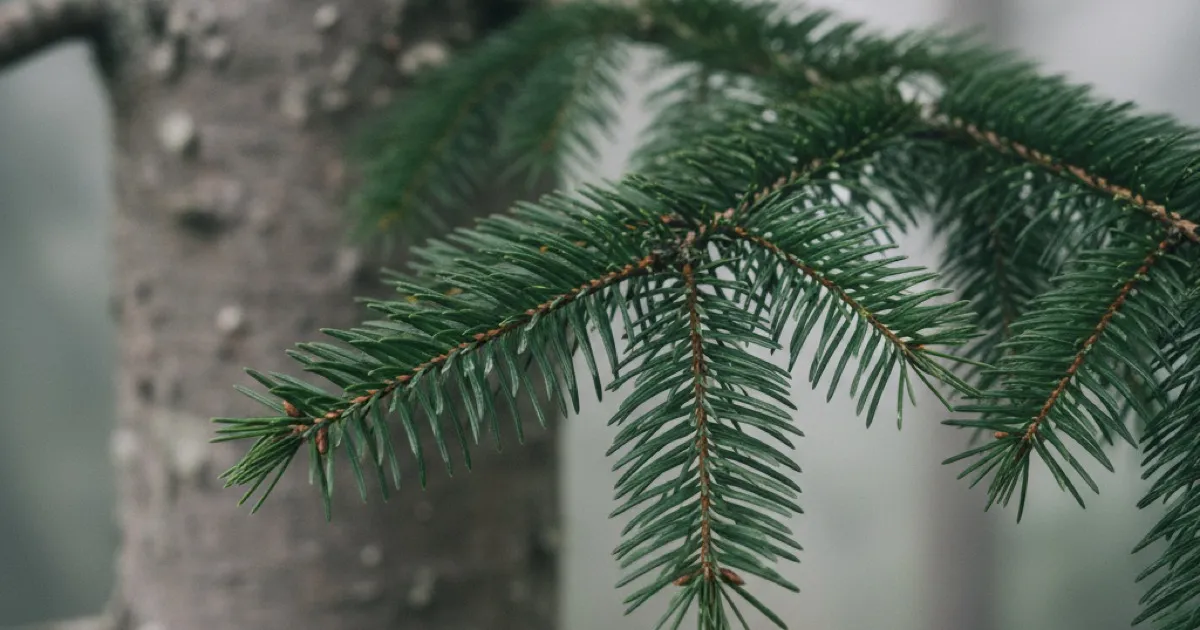
Fir tree identification comes down to one feature most people overlook: the needles are soft. Grab a fir branch and it feels friendly. Grab a spruce branch and you’ll pull your hand back. That difference alone separates the two groups people confuse most often.
Firs belong to the genus Abies, and North America has about 10 native species. They’re the conifers of high mountains and northern forests: cool, moist places where they form dense stands that smell like Christmas. Some fir trees top out around 40 feet; others, like the noble fir, push past 250. This guide walks through how to identify a fir tree by needle, cone, and bark, how to separate firs from spruces and pines, and the 7 species you’re most likely to run into.
How to Identify a Fir Tree
Before you pin down which fir, confirm it’s a fir at all and not a spruce, pine, or hemlock. Three features do most of the work, and a fourth confirms it from across the trailhead.
1. Flat, soft needles that won’t roll. Fir needles are flattened in cross-section, so they lie flat on the twig and won’t roll between your fingers. They’re soft, blunt-tipped, and usually carry two pale stripes (stomatal bands) on the underside. Pull one off and the twig stays smooth, with a small round scar. Spruce needles are the opposite: square, sharp enough to prick, and they leave a rough peg behind when you strip them.
2. Cones that stand up like candles. Fir cones sit upright on top of the branches, the single most distinctive fir trait. Spruce and pine cones hang downward. Fir cones also come apart on the tree: the scales drop off one by one, releasing the seeds and leaving a bare central spike behind. That’s why you’ll almost never find a whole fir cone on the ground.
3. Smooth bark with resin blisters. On young firs the bark is smooth and gray, dotted with resin blisters that pop and weep sticky sap when you press them. Older trunks furrow and plate up, but young fir bark is among the smoothest of any conifer.
4. A narrow, spire-like silhouette. From a distance most firs hold a tight, conical crown that tapers to a single pointed tip, built to shed heavy mountain snow. Subalpine fir takes this to an extreme and looks like a church steeple; white fir and grand fir stay broader but still clearly conical.
Soft flat needles + upright cones + smooth blistered bark = fir tree.
Balsam Fir (Abies balsamea)
Balsam fir is the classic Christmas tree fir and the most common fir in the northeastern U.S. and eastern Canada. Its resin has been used for everything from canoe sealant to microscope slide mounting medium.
Key identification features:
- Needles are 3/4 to 1.5 inches long, flat, dark green above with two white stripes below
- Needles spread outward from the twig in a flat, comb-like arrangement
- Bark is smooth and gray on young trees, with prominent resin blisters. Older trees develop reddish-brown, scaly plates
- Cones are 2 to 4 inches long, dark purple when immature, standing upright on upper branches
- Grows 40 to 60 feet tall with a narrow, symmetrical, spire-like crown
- Crushed needles have the classic “Christmas tree” balsam scent
Where it grows: From Newfoundland across eastern Canada to Alberta, south through New England, New York, the Great Lakes states, and into the Appalachians at higher elevations. The dominant fir east of the Rockies.
Balsam fir is shade-tolerant and often grows as an understory tree beneath larger spruces and hardwoods. It’s relatively short-lived for a conifer, and most trees max out around 150 to 200 years.
Fraser Fir (Abies fraseri)
Fraser fir is balsam fir’s southern Appalachian counterpart. It grows only at high elevations (above 4,500 feet) in the mountains of Virginia, North Carolina, and Tennessee. It’s considered the premium Christmas tree species: dense, symmetrical, and strongly scented.
Key identification features:
- Very similar to balsam fir. The key difference: Fraser fir cone scales have prominent bracts (small pointed projections) that curve downward and are visible between the scales, giving the cone a “mousetail” appearance
- Needles are slightly shorter than balsam fir (1/2 to 1 inch), dark green above, silvery-white below
- Bark is smooth and gray with resin blisters, becoming scaly on older trees
- Grows 30 to 50 feet tall
Where it grows: Limited to the highest peaks of the southern Appalachians: Great Smoky Mountains, Blue Ridge Parkway, Mount Mitchell, and Roan Mountain. One of the most geographically restricted tree species in North America.
Fraser fir populations have been devastated by the balsam woolly adelgid, an invasive insect from Europe. Many high-elevation fir forests in the Smokies are now standing dead timber. As of 2026, surviving stands are recovering slowly, helped by predator-beetle releases and cold-spray treatments on protected trees.
Douglas Fir (Pseudotsuga menziesii)
Here’s the confusing part: Douglas fir isn’t actually a fir. It belongs to its own genus (Pseudotsuga, meaning “false hemlock”). But it’s called a fir, sold as a fir, and people search for it as a fir, so it belongs in this guide.
Key identification features:
- Needles are flat and soft like true firs, 1 to 1.5 inches long, yellow-green to blue-green depending on variety
- Cones hang downward (unlike true firs) and have distinctive three-pointed bracts sticking out between the scales. The bracts look like the hind legs and tail of a mouse diving into the cone. This is the easiest ID feature for Douglas fir
- Bark on young trees is smooth and gray with resin blisters (like true fir). Mature bark becomes very thick, deeply furrowed, and dark brown, sometimes 6+ inches thick on old-growth trees
- Grows 70 to 250 feet tall. In the Pacific Northwest, it’s the dominant timber tree and can reach over 300 feet in old-growth stands
Where it grows: Two varieties. Coast Douglas fir grows from British Columbia to central California in wet coastal and mountain forests. Rocky Mountain Douglas fir grows at higher elevations from Alberta to Mexico, is slower-growing and more cold-hardy.
Douglas fir is the most important timber species in North America and one of the tallest tree species on Earth. The thick bark on old-growth trees is a fire adaptation: it insulates the cambium from moderate ground fires.
White Fir (Abies concolor)
White fir is the most common true fir in western mountains and the most widely planted fir in landscaping. Its needles are longer than most firs and have a distinctive blue-green to silver color that makes it look like a blue spruce from a distance.
Key identification features:
- Needles are long for a fir: 1.5 to 3 inches, curved upward, blue-green to silver-gray. The longest needles of any native fir
- Needles on lower branches tend to spread flat; needles on upper, sun-exposed branches curve upward and crowd together
- Cones are 3 to 5 inches long, olive-green to purple, standing upright
- Bark is smooth and gray on young trees, becoming thick, deeply furrowed, and ash-gray on mature trees
- Grows 60 to 100 feet tall with a conical crown
Where it grows: Rocky Mountains from Wyoming to Arizona and New Mexico, Sierra Nevada and mountains of southern California and Oregon. Planted widely as an ornamental across the northern U.S.
White fir is more heat and drought tolerant than most firs, which is why it works in landscaping where other firs struggle. It’s one of the few firs that survives in Zone 4 through Zone 7 gardens.
Noble Fir (Abies procera)
Noble fir is the largest true fir in the world. Old-growth trees reach 200+ feet tall with massive trunks. It grows in the Cascade Range and Coast Range of Oregon and Washington.
Key identification features:
- Needles are blue-green to silvery, 1 to 1.5 inches, with a distinctive hockey-stick curve: they bend upward at the base, then sweep toward the tip of the branch. On upper branches, needles press flat against the twig from below, giving the branch a braided or rope-like appearance
- Cones are large (4 to 6 inches) with papery bracts that completely cover the cone scales, giving the cone a shingle-like texture
- Bark is smooth and gray on young trees, becoming reddish-brown and plated on older trees
- Grows 100 to 200+ feet tall
Where it grows: Cascade Range and Coast Range from Washington to central Oregon, at elevations of 3,000 to 6,000 feet.
Noble fir is sold as a premium Christmas tree and wreath material. The branch structure is tiered and open, making it popular for ornament display. The wood is stronger than most firs and used for ladder rails and aircraft construction.
Grand Fir (Abies grandis)
Grand fir is the fir of low-elevation Pacific Northwest forests. It’s one of the most shade-tolerant conifers in the region, growing beneath Douglas fir and western red cedar in moist valley bottoms.
Key identification features:
- Needles are 1 to 2 inches long, arranged in flat sprays with needles of two different lengths alternating on the twig. This creates a distinctly flat, comb-like appearance
- Needles are dark, glossy green above with two bright white stripes below
- Crushed foliage has a strong citrus scent, sharper and sweeter than balsam fir
- Cones are 2 to 4 inches long, yellow-green to purple, standing upright
- Bark is smooth with resin blisters when young, becoming dark brown and furrowed with flat ridges on old trees
- Grows 140 to 200 feet tall in favorable conditions
Where it grows: Pacific Northwest from British Columbia to northern California, inland to Idaho and Montana. Most common at lower elevations (sea level to 4,500 feet) in moist forests.
Grand fir grows fast for a true fir, up to 2 feet per year when young. The flat needle sprays and citrus scent are the quickest identification features.
Subalpine Fir (Abies lasiocarpa)
Subalpine fir is the fir of high mountains and timberline. It has the narrowest crown of any North American fir: a tight, pointed spire that sheds heavy snow.
Key identification features:
- Extremely narrow, spire-like crown, often with the bottom third of the trunk bare. The overall shape resembles a church steeple
- Needles are 1 to 1.5 inches long, blue-green, crowding upward on the twig. Crushed foliage smells like balsam
- Cones are 2 to 4 inches, dark purple, standing upright
- Bark is smooth and gray with resin blisters, even on mature trees. Rarely develops the thick, furrowed bark of lowland firs
- Grows 40 to 100 feet at mid-elevation, but stunted to 10 to 20 feet at timberline (krummholz form)
Where it grows: High mountains from Alaska to Arizona and New Mexico, at elevations of 3,000 feet (in Alaska) to 12,000 feet (in Colorado). The most widely distributed fir in western North America.
At timberline, subalpine fir grows in the krummholz form: stunted, wind-flagged trees with branches only on the leeward side. These trees may be only 5 feet tall but centuries old.
Fir Tree vs. Spruce vs. Pine: How to Tell Them Apart
Most fir confusion isn’t between two fir species, it’s telling a fir tree apart from a spruce or a pine. Three checks settle it fast.
Fir vs. spruce comes down to the needles. Both attach singly to the twig, so people mix them up constantly. Fir needles are flat and soft; roll one between your fingers and it won’t turn. Spruce needles are square and sharp, and they roll easily. Then look at the twig where a needle used to be: firs leave a smooth, flush scar, while spruces leave a rough little peg (technically a sterigma) that makes bare spruce twigs feel like sandpaper. If cones are around, that seals it, since fir cones stand up and fall apart on the branch while spruce cones hang down and drop whole.
Fir vs. pine is usually the easy one. Pines carry their needles in bundles of 2 to 5, wrapped at the base by a papery sheath. Firs attach each needle separately, straight to the twig, with no bundle. Pine needles also tend to be much longer, often 3 to 8 inches, while fir needles rarely pass 3 inches. Pine bark plates into large scaly puzzle pieces; young fir bark stays smooth with resin blisters. For a deeper split of the pines themselves, see our guide to the types of pine trees.
One more lookalike worth naming: hemlock. Hemlock needles are flat like a fir’s but much shorter and finer, attached to tiny stalks, and hemlock cones are small and hang down. If you’re just trying to sort the evergreens in your yard, start with the broader evergreen tree identification guide.
| Feature | Fir | Spruce | Pine |
|---|---|---|---|
| Needles | Flat, soft, blunt | Square, stiff, sharp | Long, in bundles of 2 to 5 |
| Needle feel | Friendly | Prickly | Stiff |
| Twig after pulling needle | Smooth, round scar | Rough, woody peg remains | Smooth |
| Cones | Stand upright, disintegrate on tree | Hang down, fall whole | Hang down, fall whole |
| Young bark | Smooth with resin blisters | Thin, scaly | Scaly, plated |
For the full breakdown, see our pine vs spruce vs fir comparison.
How Big Do Fir Trees Get, and Where Do They Grow?
Size depends heavily on the species and the site. On a tough timberline ridge, a subalpine fir might stay a 20-foot spire; drop it into a sheltered valley and it can clear 100 feet. Here’s the rough range for the species in this guide.
- Balsam fir: 40 to 60 feet
- Fraser fir: 30 to 50 feet
- White fir: 60 to 100 feet
- Grand fir: 140 to 200 feet
- Noble fir: 100 to 250+ feet (the largest true fir on Earth)
- Douglas fir: 70 to 250+ feet, occasionally over 300 in old-growth stands
As a group, fir trees are mountain and cold-climate specialists. Balsam and Fraser fir hold the East, with balsam blanketing the northern forests from Newfoundland to the Great Lakes and Fraser clinging to a handful of southern Appalachian peaks. The West carries the rest: white fir through the Rockies and Sierra Nevada, grand and noble fir in the Pacific Northwest, and subalpine fir strung along high ridges from Alaska to New Mexico. Nearly all of them prefer cool, moist ground and higher elevations, which is why firs thin out fast as you move into hot, dry lowlands.
What Fir Trees Are Used For
Fir trees earn their keep several ways. The best-known is the Christmas tree trade: Fraser and balsam fir dominate the cut-tree market for their strong branches, dense shape, and needle retention. Noble fir wreaths and garlands are a whole industry of their own in Oregon.
Fir wood is light, pale, and straight-grained. It’s milled for construction lumber, plywood, pulp for paper, and crates, and noble fir’s unusually strong wood once went into ladder rails and aircraft framing. If you’re curious how fir stacks up against other conifers for building and burning, our hardwood vs. softwood guide covers where softwoods like fir fit.
Firs matter ecologically too. Their dense stands shelter deer, elk, and small mammals through hard winters, and the seeds feed squirrels, grouse, and crossbills. Balsam fir resin, sold historically as “Canada balsam,” was prized as a clear optical cement for lenses and microscope slides.
Identifying Fir Trees With Tree Identifier
Fir identification gets complicated when species overlap in mountain forests. White fir and grand fir. Subalpine fir and Engelmann spruce. Balsam fir and Fraser fir. The Tree Identifier app separates these from a photo of the needles, bark, or cones. Snap a close-up of the needle arrangement or the bark texture, and the AI identifies the species. The app works offline, which helps in the mountain forests and wilderness areas where firs grow. You get 2 free identifications per day.
Frequently Asked Questions
How do you tell a fir from a spruce?
Grab the branch. Fir needles are flat, soft, and friendly. Spruce needles are square, stiff, and sharp. After pulling off a needle, check the twig: fir leaves a smooth round scar, spruce leaves a rough woody peg. Fir cones stand upright and fall apart on the tree. Spruce cones hang down and fall to the ground intact.
How do you tell a fir tree from a pine tree?
Look at how the needles attach. Pines grow their needles in bundles of 2 to 5, tied at the base by a small papery sheath, and the needles are usually long (3 to 8 inches). A fir tree attaches each needle separately, straight to the twig, with no bundle, and the needles are shorter and flat. Pine cones hang down and are woody; fir cones stand upright and fall apart on the branch.
Is Douglas fir a true fir?
No. Douglas fir belongs to the genus Pseudotsuga, not Abies. The easiest way to tell: Douglas fir cones hang downward with distinctive mouse-tail bracts between the scales. True fir cones stand upright on branches and disintegrate in place. Douglas fir bark also becomes much thicker and more furrowed than any true fir.
What is the best fir tree for landscaping?
White fir (Abies concolor) is the most adaptable fir for landscaping. It tolerates more heat and drought than other firs, grows in Zones 4 through 7, and has attractive blue-green to silver needles. Balsam fir works well in cool northern climates (Zones 3-5) but struggles in heat. Noble fir and Fraser fir are options in the Pacific Northwest and higher elevations.
Why can’t I find fir cones on the ground?
Fir cones disintegrate while still attached to the tree. The scales fall off one by one, releasing the seeds, and only a bare central spike remains on the branch. This is unique to true firs. If you find a complete cone on the ground under what you think is a fir, it’s probably a spruce or Douglas fir cone instead.
Do fir trees make good Christmas trees?
Firs are the most popular Christmas tree genus. Balsam fir has the classic Christmas scent. Fraser fir holds its needles well and has strong branches. Noble fir has open, tiered branches ideal for ornaments. Douglas fir (not a true fir) is the most widely sold Christmas tree overall, prized for its fullness and moderate price.
Trying to identify a fir on your next mountain hike? Try Tree Identifier: snap a photo of the needles, bark, or cone and get the species in seconds.
Identify a tree from your photo — free
Upload a leaf, bark, or whole-tree photo and get the species in seconds. No signup.
Confidence:
Unlock the full species profile
Free in the app — with unlimited identifications.


AI result for guidance — the app gives full species details and works offline.
Want unlimited identifications?
Get the full species profile, photos and details — free in the app, with unlimited scans.
- Unlimited identifications
- Full species profiles & details
- Works offline, anywhere
- Save and revisit your finds
Elena Torres
Tree Identifier Team