Hemlock Tree Identification: 4 Species by Needle and Cone
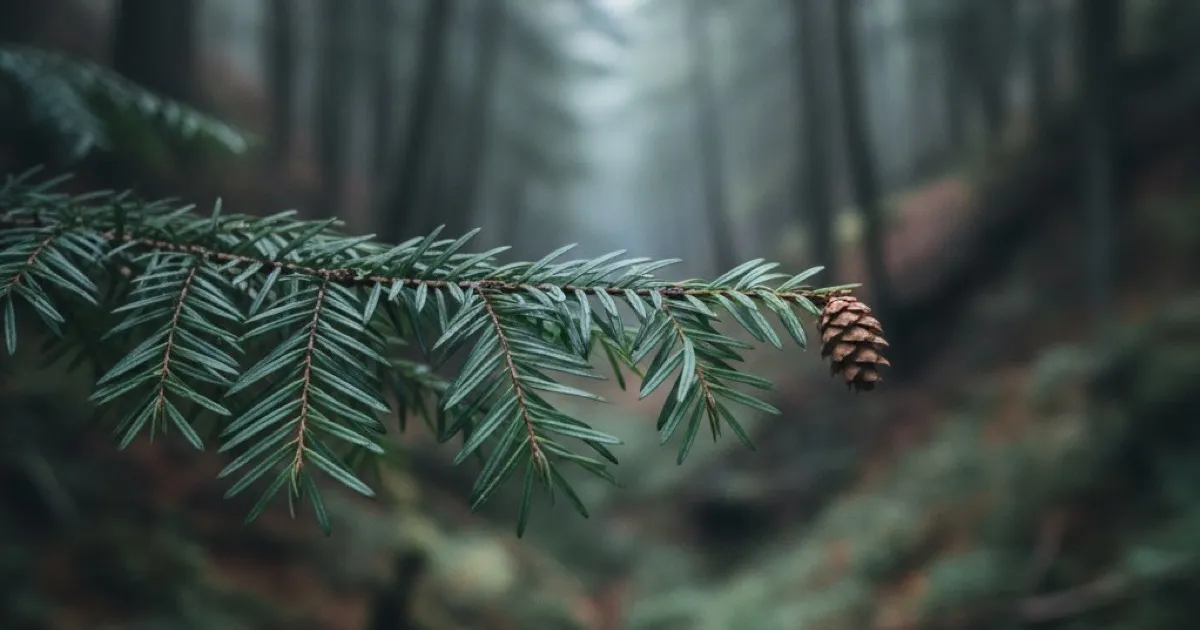
Hemlock trees are the quiet giants of North American forests. They don’t have the showy flowers of a magnolia or the blazing fall color of a maple. But they form some of the densest, shadiest canopies in the eastern and western woods, and they’re among the few conifers that actually thrive in deep shade. Hemlock tree identification comes down to three features: short flat needles with white stripes underneath, tiny cones, and graceful drooping branch tips.
North America has four native hemlock species in the genus Tsuga. Two grow in the East, two in the West. They share enough traits that confirming “this is a hemlock” is straightforward. Telling which hemlock takes a closer look at needle arrangement, cone size, and geography. This guide covers all four species, plus the crisis threatening eastern hemlocks right now.
How to Tell a Hemlock From Other Conifers
Hemlocks get confused with firs, spruces, and sometimes yews. A few quick checks separate them.
Needles are the fastest test. Hemlock needles are short — typically 1/4 to 3/4 inch long — flat, and attached to the twig by a tiny stem (called a petiole). Flip a needle over and you’ll see two bright white stripes running the length of the underside. These are stomatal bands, and they’re more prominent on hemlock than on most other conifers.
Here’s how hemlock compares to the conifers people confuse it with:
- Hemlock vs fir: Both have flat needles with white stripes underneath. But fir needles attach directly to the twig and leave a smooth, round scar when pulled off. Hemlock needles sit on a tiny stem. Also, fir cones stand upright on branches; hemlock cones dangle
- Hemlock vs spruce: Spruce needles are square in cross-section and roll between your fingers. Hemlock needles are flat and won’t roll. Spruce needles are also sharp-pointed, while hemlock needles have rounded tips
- Hemlock vs yew: Yew needles look similar — flat, dark green, with pale undersides. But yew needles are longer (about 1 inch), arranged in two flat rows, and yew produces red berry-like fruits instead of cones
Cones confirm it. Hemlock cones are among the smallest of any conifer — usually 3/4 to 1 inch long for eastern species, up to 3 inches for western hemlock. They hang from branch tips and have thin, papery scales. No other large conifer in North America produces cones this small relative to tree size.
The droop. Hemlock branch tips and the tree’s leader (the topmost point) curve gently downward. This gives hemlocks a soft, feathery look from a distance. Spruces and firs hold their leaders stiffly upright.
Hemlock identification relies on a combination of features that together make this genus unmistakable among North American conifers. The needles are the primary diagnostic tool: they’re notably short at just 1/4 to 3/4 inch, flat rather than square, and connected to the twig by a visible petiole rather than growing directly from it. The underside shows two distinct white stomatal bands. The cones are disproportionately small for such a large tree, rarely exceeding 1 inch in eastern species, and they hang downward from branch tips with thin papery scales. The overall silhouette features drooping branch tips and a nodding leader that gives the tree a graceful, feathery appearance. These four markers — short petiolate needles, white-striped undersides, tiny hanging cones, and drooping form — separate hemlocks from every other conifer genus in North America.
Eastern Hemlock (Tsuga canadensis)
Eastern hemlock is the most common and widely known species. It ranges from Nova Scotia to northern Alabama, following the Appalachian Mountains southward. Old-growth eastern hemlocks can live 800 years and reach 160 feet tall.
How to identify it:
- Size: 40 to 70 feet tall in most settings, up to 160 feet in old growth. Trunk diameter 2 to 4 feet
- Needles: 1/4 to 1/2 inch long, flat, with two white stripes on the underside. Needles are arranged in two flat rows along the twig, giving each branch a feathery, spray-like appearance
- Cones: 3/4 inch long — remarkably small. Oval, brown, hanging from branch tips. Scales are smooth and rounded
- Bark: Young trees have smooth, grayish bark. Older trees develop deep, reddish-brown furrows with broad, scaly ridges. Mature bark is thick and deeply furrowed, similar to some oaks
- Habitat: Cool, moist ravines and north-facing slopes. Often found along streams and in shaded gorges. Does not tolerate dry or exposed sites
Eastern hemlock is the shade champion of North American trees. Seedlings can survive for decades in deep shade, waiting for a gap in the canopy. This makes hemlock forests some of the darkest, most cathedral-like environments in the eastern woods.
Carolina Hemlock (Tsuga caroliniana)
Carolina hemlock is the rare cousin, found only in the southern Appalachians from Virginia to Georgia. It grows on rocky ridges and exposed slopes — a very different habitat from eastern hemlock’s shaded ravines.
How to identify it:
- Size: 30 to 60 feet tall, smaller than eastern hemlock
- Needles: Slightly longer than eastern hemlock (up to 3/4 inch) and arranged all around the twig rather than in two flat rows. This gives Carolina hemlock branches a fuller, more three-dimensional look
- Cones: About 1 to 1.5 inches long — noticeably larger than eastern hemlock cones. Cone scales often flare outward
- Bark: Similar to eastern hemlock but tends to stay smoother longer
- Habitat: Rocky ridges, cliff faces, and mountain summits between 2,500 and 5,000 feet in the southern Appalachians
The easiest way to tell Carolina from eastern hemlock: needle arrangement. Eastern hemlock needles lie flat in two rows. Carolina hemlock needles radiate in all directions from the twig. If you’re in the southern Appalachians and the needles stick out all around the branch, it’s Carolina.
Western Hemlock (Tsuga heterophylla)
Western hemlock is the giant of the hemlock family. It grows from Alaska to northern California along the Pacific coast, reaching sizes that rival Douglas fir and Sitka spruce.
How to identify it:
- Size: 100 to 200 feet tall, with trunk diameters up to 9 feet. This is one of the largest hemlocks in the world
- Needles: Variable length on the same twig (hence the species name heterophylla — “different leaves”). Short needles (1/4 inch) mix with longer ones (3/4 inch). Two white stripes underneath
- Cones: About 1 inch long, slightly larger than eastern hemlock. Oval with smooth scales
- Bark: Young bark is thin and brownish. Older trees develop deeply furrowed bark with flat-topped ridges, reddish-brown to gray
- Habitat: Moist, coastal forests from sea level to about 5,000 feet. Thrives in the fog belt of the Pacific Northwest
Western hemlock is the state tree of Washington. In old-growth Pacific Northwest forests, you’ll often see young western hemlocks growing on top of fallen nurse logs — their roots straddling the decaying trunk like stilts.
Mountain Hemlock (Tsuga mertensiana)
Mountain hemlock lives at high elevations in the Pacific mountains, from Alaska to central California. It’s the hemlock you’ll find near tree line, growing in heavy snowpack.
How to identify it:
- Size: 25 to 100 feet tall, often shorter and more compact at higher elevations
- Needles: Different from other hemlocks — needles are thicker, more blue-green, and radiate from all sides of the twig (like a bottlebrush) rather than lying flat. Upper surface is rounded rather than flat
- Cones: The largest hemlock cones — 1 to 3 inches long, cylindrical, purple when young, brown when mature
- Bark: Dark brown to reddish-brown, deeply furrowed on older trees
- Habitat: Subalpine zones between 4,000 and 7,000 feet in the Cascades and Sierra Nevada. Grows in areas with 30+ feet of annual snowfall
Mountain hemlock is the outlier in the genus. Its bottlebrush needle arrangement, blue-green color, and larger cones make it look more like a spruce than a hemlock at first glance. But the drooping leader and tiny petioles on each needle confirm it’s a Tsuga.
The Hemlock Woolly Adelgid Crisis
No hemlock identification guide is complete without mentioning the insect that’s killing eastern hemlocks across their range. The hemlock woolly adelgid (HWA) is a tiny aphid-like insect from East Asia that feeds on hemlock sap.
You can spot HWA damage by looking at the base of needles on the underside of branches. Infested twigs show small, white, cottony masses — each one is a protective covering for a cluster of adelgid eggs. Healthy hemlock branches should be clean; white cotton at the needle bases means adelgid.
HWA has spread through most of the eastern hemlock’s range since it was first detected in Virginia in the 1950s. Infested trees lose needles progressively, starting from the bottom of the canopy. Without treatment, most trees die within 4 to 10 years. Carolina hemlock is even more vulnerable because of its smaller, isolated populations.
Conservation efforts include releasing predatory beetles from Asia that feed on adelgids, and treating individual high-value trees with systemic insecticides. If you spot hemlocks in the wild, checking for adelgid can help forest managers track the spread.
How Tree Identifier Helps With Hemlock ID
Hemlocks can be tricky because their needles look similar to fir and yew at a glance. Tree Identifier’s AI compares multiple features at once — needle length, attachment style, cone size, and overall form — to distinguish hemlocks from lookalikes.
The app works with photos of leaves, bark, cones, and whole tree silhouettes, so you can photograph whatever feature is easiest to capture. In dense hemlock forests where cell signal is often weak, the app’s offline mode keeps working — species data downloads to your phone ahead of time. You get 2 free identifications per day to start.
Frequently Asked Questions
Is hemlock tree the same as poison hemlock?
No. Hemlock trees (Tsuga) are conifers related to pines and spruces. Poison hemlock (Conium maculatum) is a flowering plant in the carrot family. They share a name because early settlers thought the crushed needles of hemlock trees smelled like poison hemlock leaves. The tree is not toxic.
How fast do hemlock trees grow?
Hemlocks are slow growers, typically adding 12 to 24 inches per year when young. In deep shade, growth can slow to just a few inches annually. Eastern hemlocks may take 250 to 300 years to reach their full height. This slow growth produces dense, fine-grained wood.
Can hemlock trees grow in full sun?
Hemlocks prefer shade and do best in partial to full shade. They can tolerate full sun in cooler climates, but in warmer regions, full sun exposure causes needle burn and stress. Of the four species, mountain hemlock tolerates the most sun exposure.
What does hemlock bark look like?
Young hemlock bark is smooth and gray. As the tree ages, the bark develops deep reddish-brown furrows with broad, scaly ridges. Mature eastern hemlock bark can be 2 inches thick and is sometimes mistaken for oak bark due to its deeply ridged texture.
Hemlocks are among the most elegant conifers in North American forests, and their conservation status makes identification even more valuable. If you encounter a hemlock and want to confirm the species, try Tree Identifier — photograph the needles or cones and get your answer in seconds.
Identify a tree from your photo — free
Upload a leaf, bark, or whole-tree photo and get the species in seconds. No signup.
Confidence:
Unlock the full species profile
Free in the app — with unlimited identifications.


AI result for guidance — the app gives full species details and works offline.
Want unlimited identifications?
Get the full species profile, photos and details — free in the app, with unlimited scans.
- Unlimited identifications
- Full species profiles & details
- Works offline, anywhere
- Save and revisit your finds
Elena Torres
Tree Identifier Team