How to Identify Trees in Spring: Flowers, Buds, and Early Leaves
Spring is the best time of year to identify trees. Buds are swelling, flowers are opening, and new leaves are emerging in shapes and colors that won’t be visible again for another twelve months. Many trees are easier to identify in spring than at any other season because their flowers, catkins, and early leaf shapes provide clues that disappear by summer. If you’ve been meaning to learn how to identify trees in spring, this is your window.
This guide walks through the key identification features that spring reveals, which trees are easiest to ID during March through May, and a practical approach for building your skills while everything is in bloom.
Why Spring Is the Best Season for Tree Identification
Winter tree identification relies on bark, buds, and silhouette — useful skills but challenging for beginners. Summer identification depends on mature leaves, which can look similar across species. Spring gives you everything at once: bark is still visible before full leaf-out, flowers are open, and emerging leaves show distinctive shapes and colors that fade as they mature.
Spring-specific ID advantages:
- Flowers appear before or with leaves on many species, making them visible from a distance
- Early leaves are often a different color than mature leaves — reddish, bronze, or bright yellow-green
- Catkins and seed structures are visible on trees like oaks, birches, and willows
- Bark is still fully exposed on trees that haven’t leafed out yet, giving you a two-for-one opportunity
- Fruit from the previous year may still hang on some species (like sweetgum gumballs or catalpa bean pods)
The window for spring identification clues varies by latitude. In the southern U.S., things start moving in late February. In New England and the upper Midwest, peak spring ID season runs from mid-April through late May.
Trees That Bloom Before Their Leaves
Some of the easiest spring identifications come from trees that flower before their leaves emerge. With bare branches covered in blooms, there’s no foliage blocking your view.
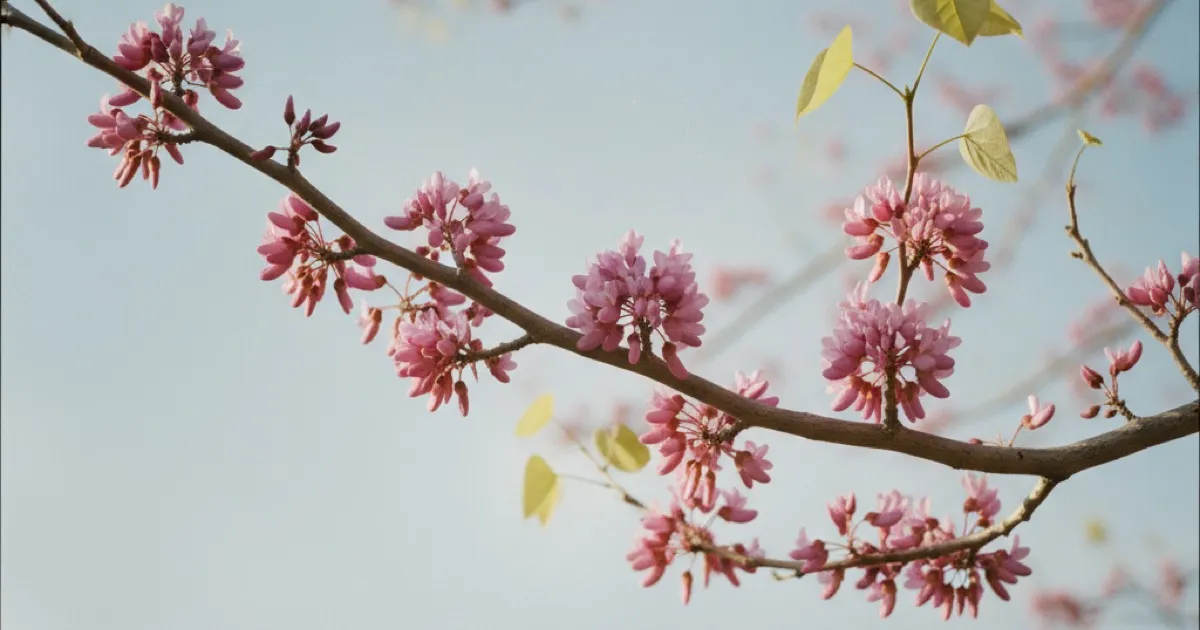
Redbud (Cercis canadensis): Clusters of tiny pink-purple flowers cover every branch and even the trunk in early spring, weeks before the heart-shaped leaves appear. Redbud identification is effortless during bloom — nothing else flowers in quite the same way.
Dogwood (Cornus florida): The large white or pink “flowers” (actually bracts surrounding tiny green flowers) open in April before full leaf-out. Dogwood in bloom is one of the most recognizable sights in eastern forests.
Magnolia (Magnolia spp.): Saucer magnolia and star magnolia produce enormous white or pink flowers on bare branches in early spring. Magnolia identification is simplest during bloom because the flowers are unmistakable.
Red maple (Acer rubrum): Tiny red flower clusters appear in late winter to early spring, weeks before the leaves. The flowers give the entire canopy a reddish haze that’s visible from hundreds of yards away. By the time you notice that haze, red maples have already started blooming.
Serviceberry (Amelanchier spp.): Delicate white flowers appear in early spring, often at the same time as redbud. Serviceberry blooms in woodland edges and along streams.
Cornelian cherry dogwood (Cornus mas): Small clusters of bright yellow flowers appear on bare branches in very early spring, before forsythia.
Spring Leaf Emergence: What to Watch For
As leaves emerge, they often reveal identification clues that disappear once the foliage matures.
Leaf color at emergence. Many trees push out leaves in colors quite different from their summer green:
- Oaks often emerge with reddish, bronze, or pinkish new leaves that gradually turn green
- Black walnut emerges late (often the last tree to leaf out) with leaves that start pale yellow-green
- Sassafras pushes out bright green leaves with the distinctive mitten and trident shapes immediately visible
- Beech emerges with silky, pleated leaves that are pale green and semi-translucent before darkening
Leaf size at emergence. New leaves start small and expand over 2-3 weeks. During this expansion period, the leaf shape is sometimes exaggerated — lobes appear deeper, teeth look more prominent. This can actually make identification easier because the defining features are amplified.
Leaf timing. Not all trees leaf out at the same time. This staggered emergence is itself an identification clue:
- Early (March-April): Red maple, willows, elms, birches
- Mid-season (April-May): Oaks, hickories, beech, tulip tree
- Late (May-June): Black walnut, catalpa, honey locust
If all the trees around you have leafed out except one, and it’s mid-May, check for compound leaves. Black walnut and locust trees are famously late to leaf out.
Spring Catkins and Other Clues
Not all spring flowers are showy. Many trees produce catkins — drooping, cylindrical clusters of tiny flowers that release pollen in the wind. Catkins are useful identification features because they’re visible, distinctive, and appear on specific tree groups.
Trees with prominent spring catkins:
- Birch: Slender, pendulous catkins that hang from branch tips. Male catkins are 2-4 inches long and appear before the leaves
- Oak: Thin, yellowish-green catkins that dangle from new growth. If you see yellow-green strings hanging from a tree in April, check for oak buds and bark
- Willow: Fuzzy “pussy willows” (actually catkins) on some species are among the earliest spring signs
- Alder: Dark, cone-like female catkins from last year persist alongside new dangling male catkins
- Poplar/cottonwood: Reddish catkins appear before leaves, and the cotton from female trees arrives weeks later
Other spring clues:
- Elm samaras (flat, papery winged seeds) ripen and drop in spring — one of the few trees whose seeds mature this early
- Red maple samaras (helicopter seeds) turn bright red in spring, visible in the canopy before falling
- Pine candles (new growth at branch tips) elongate in spring, covered in tightly packed needles that haven’t yet spread
A Practical Spring ID Walk
Here’s how to approach a spring identification walk, whether you’re in a park, on a trail, or just walking through your neighborhood.
Step 1: Look for flowers first. Scan the canopy and understory for anything in bloom. Flowering trees in spring are announcing themselves. Note the flower color, size, and arrangement.
Step 2: Check trees that haven’t leafed out yet. These late leafers still have bare branches, making bark identification easier. Use the bark to narrow your options, then watch over the following weeks as their leaves emerge to confirm.
Step 3: Examine emerging leaves. Find a branch at eye level (or pick up a fallen twig with buds) and look at the leaf shape, arrangement (alternate vs. opposite), and color. Even partially emerged leaves often show enough shape to identify the species.
Step 4: Look down. The ground beneath trees tells a story in spring. Fallen petals, old seed pods, last year’s leaves, and early samaras can all point to the species above you.
Step 5: Use your nose. Spring is full of tree scents. Sassafras roots and leaves smell like root beer. Black locust flowers smell sweet and grape-like. Bradford pear flowers smell distinctly unpleasant. Crushed cherry bark smells like almonds.
Step 6: Photograph everything. Spring clues are temporary. Flowers last a week or two. New leaf colors fade in days. Take photos of flowers, emerging leaves, bark, and catkins while they’re available.
Spring Identification by Flower Color
A quick-reference guide for the most common spring-flowering trees by color:
White flowers:
- Dogwood (large bracts, April)
- Black locust (hanging clusters, fragrant, May-June)
- Serviceberry (small clusters, early April)
- Cherry (clusters of 2-5, April-May)
- Hawthorn (clusters, May)
- Catalpa (large spotted clusters, late May-June)
Pink to purple flowers:
- Redbud (tiny clusters on branches and trunk, March-April)
- Crabapple (pink buds opening to white or pink, April-May)
- Saucer magnolia (large cups, early spring)
- Kwanzan cherry (double pink flowers, late April)
Yellow flowers:
- Cornelian cherry dogwood (small clusters, very early spring)
- Sassafras (small clusters, April)
- Tulip tree (greenish-yellow cups high in canopy, May-June)
Inconspicuous flowers (catkins or small clusters):
- Oaks, birches, willows, poplars, elms, maples (various shapes, March-May)
Common Spring ID Mistakes to Avoid
Confusing crabapple with cherry. Both have pink or white flowers in spring. Cherry flowers have a notched petal tip and grow in clusters of 2-5 on long stems. Crabapple flowers have rounded petals and grow in denser clusters. Cherry bark is smooth with horizontal lenticels. Crabapple bark is rougher and scaly.
Assuming all white-flowering trees are dogwoods. Serviceberry, hawthorn, and some crabapples all produce white flowers in spring. Dogwood “flowers” are actually four large bracts (modified leaves) surrounding a small cluster of true flowers. The bracts have a distinctive notch at the tip.
Mistaking red maple flowers for damage. The tiny red flower clusters on red maples in early spring can look like the tree is covered in red growths or even insect damage from a distance. They’re normal and one of the earliest spring identification clues.
Ignoring opposite vs. alternate branching. This fundamental distinction works in every season but is especially useful in spring when some trees are still bare. Maples, ashes, and dogwoods have opposite branching. Most other trees have alternate branching. Checking this one feature cuts your identification options roughly in half.
Identifying Spring Trees With Tree Identifier
Spring is when the most identification clues are available at once — but it’s also when confusion peaks because everything is changing week by week. The Tree Identifier app handles spring identification well because it works with flowers, emerging leaves, bark, and fruit. Snap a photo of a flowering branch, a cluster of catkins, or a partially emerged leaf, and the AI identifies the species.
The app is especially useful during the narrow window when trees are blooming but you can’t find the right page in a field guide. It works offline for trail walks where cell signal drops, and you get 2 free identifications per day.
Frequently Asked Questions
What is the easiest tree to identify in spring?
Redbud is probably the easiest. Its bright pink-purple flowers cover every branch and even the trunk in early spring, weeks before leaves appear. No other common tree flowers in exactly this pattern. Dogwood is a close second — the large white or pink bracts are unmistakable.
Why do some trees leaf out later than others?
Leaf-out timing is driven by a combination of accumulated warmth (growing degree days), day length, and species-specific genetics. Trees like black walnut and catalpa evolved to avoid late frosts by waiting until conditions are reliably warm. Early leafers like red maple and willows tolerate frost better.
Can you identify a tree by its flowers alone?
In many cases, yes. Spring flowers on trees like redbud, dogwood, magnolia, black locust, and catalpa are distinctive enough for confident identification without checking the leaves. For trees with less showy flowers (oaks, elms, birches), the flowers narrow the options but you’ll want to confirm with leaf shape or bark.
What trees should I learn to identify first in spring?
Start with the showiest bloomers: redbud, dogwood, magnolia, cherry, and crabapple. These are common, easy to spot, and teach you to look up during spring walks. Then move to the common shade trees: oaks, maples, and elms. Learning 10-12 species covers the majority of trees in most eastern U.S. neighborhoods.
How do I tell spring tree flowers from shrub flowers?
Size and height are the main clues. Trees generally have a single trunk (or a few trunks) and grow above 15 feet. Shrubs are multi-stemmed and stay below 15 feet. Some species like serviceberry and redbud can grow as either trees or large shrubs depending on conditions, so focus on the flowers and leaves rather than the growth form.
Ready to put your spring identification skills to the test? Try Tree Identifier — snap a photo of any flower, leaf, or bark you see this spring and get an instant species match.
Identify a tree from your photo — free
Upload a leaf, bark, or whole-tree photo and get the species in seconds. No signup.
Confidence:
Unlock the full species profile
Free in the app — with unlimited identifications.


AI result for guidance — the app gives full species details and works offline.
Want unlimited identifications?
Get the full species profile, photos and details — free in the app, with unlimited scans.
- Unlimited identifications
- Full species profiles & details
- Works offline, anywhere
- Save and revisit your finds
Rachel Nguyen
Tree Identifier Team