How to Identify Wood in Furniture: Grain, Color, and Pores
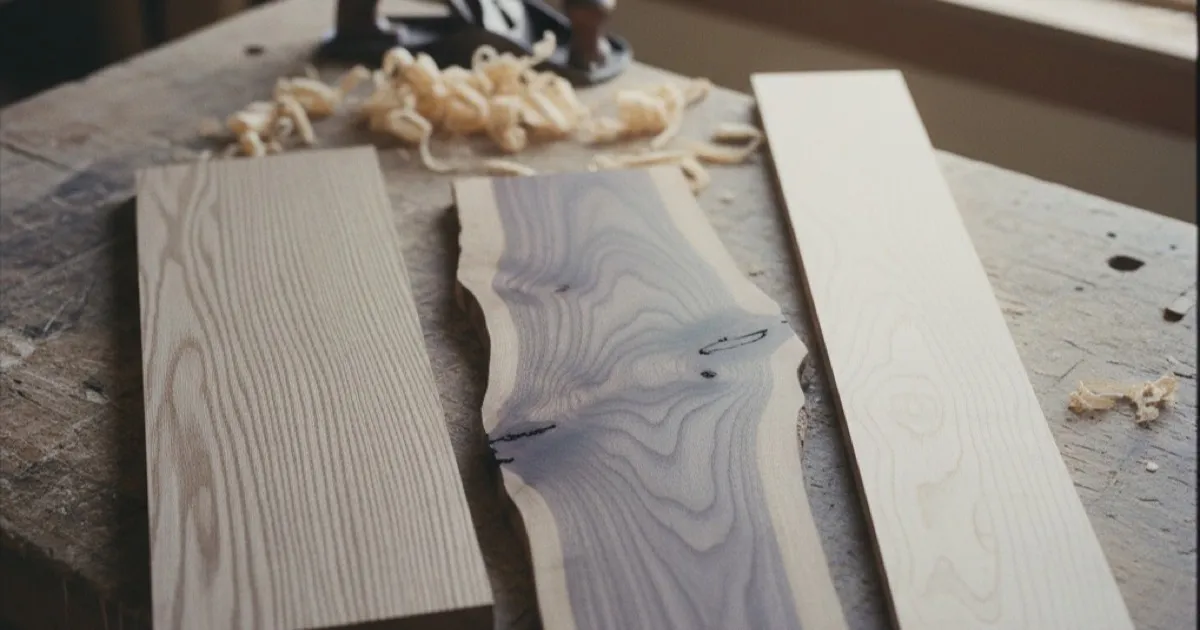
You found a dresser at an estate sale. The seller says it’s walnut. Your neighbor thinks it’s cherry. The finish is so dark you can’t tell either way. Knowing how to identify wood in furniture saves you from overpaying for pine labeled as oak and helps you match pieces, repair damage with the right materials, and understand what you actually own.
Wood identification in furniture relies on four visible features: grain pattern, color, pore structure, and weight. Each wood species has a distinct combination of these traits. Oak has prominent open pores and visible rays. Cherry has fine, closed pores and darkens with age. Maple is pale with a tight, subtle grain. Once you learn what to look for, you can identify most common furniture woods without removing the finish.
The Four Features That Identify Furniture Wood
Every piece of furniture wood shows these four characteristics. Checking all four gives you a confident identification.
Grain Pattern
Grain is the most visible feature on any piece of furniture. It’s the pattern of lines, swirls, and figures created by the tree’s growth rings and cellular structure.
- Straight grain: Lines run parallel. Common in maple, poplar, and alder. Straight-grained wood looks clean and uniform
- Cathedral grain: Arched patterns that look like pointed church windows. This is the classic look of flat-sawn oak, ash, and elm. The arches form where the saw blade cuts through growth rings at an angle
- Curly or figured grain: Waves, ripples, or flame-like patterns. Tiger maple, quilted maple, and birdseye maple all show figured grain. These patterns increase the wood’s value significantly
- Interlocked grain: A ribbon-like effect where the grain alternates direction in bands. Common in mahogany and sapele. Creates a striped shimmer when the light hits it
Color
Wood color narrows your options fast, but it’s also the most misleading feature because stains and finishes change it. Try to find an unfinished surface — inside a drawer, on the back panel, or under a shelf.
Light woods (cream to pale yellow):
- Maple: Cream to pale gold with a subtle, tight grain
- Birch: Similar to maple but slightly yellower, with a faint curl to the grain
- Ash: Pale cream to light brown, with prominent open grain similar to oak
- Pine: Pale yellow with visible knots and resin pockets. Softwood — dents easily
- Poplar: Pale cream, sometimes with green or purple streaks. Often used as a secondary wood inside drawers
Medium woods (golden to reddish-brown):
- Oak: Golden brown with strong grain. White oak has a warmer, honey tone. Red oak leans slightly pinkish
- Cherry: Medium reddish-brown that deepens dramatically over time. New cherry is almost pinkish; antique cherry is deep brown
- Walnut: Rich chocolate brown with lighter sapwood. The color contrast between heartwood and sapwood is one of walnut’s signatures
- Mahogany: Reddish-brown with interlocked grain. Genuine mahogany has a golden shimmer
Dark woods (deep brown to near-black):
- Ebony: Nearly black, extremely dense and heavy
- Wenge: Dark brown with black streaks, coarse texture
- Rosewood: Deep reddish-brown to purple with dark veining
Pore Structure
Pores are tiny holes in the wood surface where the tree’s water-conducting vessels were. You can see them with the naked eye on some species, and they’re one of the most reliable identification features.
Open-pore (ring-porous) woods: Large, visible pores, especially in the earlywood (spring growth). You can feel them with your fingertip as tiny grooves.
- Oak: Large pores in distinct rings. Often visible even through a finish
- Ash: Similar to oak but slightly smaller pores
- Elm: Pores visible but arranged in wavy, irregular patterns rather than clean rings
- Hickory: Large pores in the earlywood, similar to oak
Closed-pore (diffuse-porous) woods: Tiny pores distributed evenly. The surface feels smooth, almost like plastic when finished.
- Maple: Very fine, uniform pores. Surface is glass-smooth when finished
- Cherry: Fine pores, smooth surface. Occasional small pitch pockets
- Birch: Fine, even pores similar to maple
- Walnut: Semi-ring-porous — larger pores in earlywood, smaller in latewood. Between open and closed
No visible pores (softwoods): Softwoods like pine, cedar, and fir don’t have pores. Their water-conducting cells (tracheids) are too small to see. Softwood surfaces look smooth and even-textured.
Weight and Hardness
Pick the piece up or push your thumbnail into a hidden surface. Weight and hardness separate wood groups quickly.
- Heavy and hard: Oak, maple, hickory, walnut, cherry. These are the classic furniture hardwoods
- Medium weight: Birch, ash, mahogany. Solid but not as dense as oak or maple
- Light and soft: Pine, poplar, cedar, basswood. Dent easily. Often used for painted furniture, drawer interiors, and backs
If you can dent the wood with moderate thumbnail pressure, it’s likely a softwood or a soft hardwood like poplar. If your thumbnail barely marks it, you’re dealing with a hard hardwood like maple or hickory.
Common Furniture Woods and How to Tell Them Apart
Here’s a quick-reference comparison of the woods you’ll encounter most often in furniture.
| Wood | Color | Grain | Pores | Weight | Common Uses |
|---|---|---|---|---|---|
| Oak | Golden brown | Bold, cathedral | Large, open | Heavy | Tables, chairs, cabinets |
| Maple | Cream to pale gold | Subtle, tight | Fine, closed | Heavy | Dressers, tables, flooring |
| Cherry | Reddish-brown (darkens) | Fine, flowing | Fine, closed | Medium-heavy | Cabinets, fine furniture |
| Walnut | Chocolate brown | Moderate, flowing | Semi-ring-porous | Medium-heavy | Tables, accent pieces |
| Pine | Pale yellow | Knotty, visible rings | None (softwood) | Light | Rustic furniture, shelving |
| Ash | Light cream-brown | Bold, open | Large, open | Medium-heavy | Chairs, tool handles |
| Mahogany | Reddish-brown | Interlocked, ribboned | Semi-ring-porous | Medium | Fine furniture, antiques |
How to Identify Wood Under a Finish
Most furniture has a stain, lacquer, or polyurethane coating that changes the wood’s natural color. Here’s how to work around it.
Find unfinished wood. Check inside drawers, under the piece, on the back panel, and under removable shelves. Furniture makers often leave secondary surfaces unfinished.
Look at the end grain. End grain — visible where the wood was crosscut — shows pore structure and growth rings more clearly than face grain. Check the ends of shelves, the tops of drawer sides, or any exposed cut edge.
Use pore structure, not color. Stain changes color but can’t fill pores. If you can see large, open pores through the finish, you’re likely looking at oak or ash. If the surface is glass-smooth, it’s maple, cherry, or birch.
Check the weight. A solid oak nightstand weighs noticeably more than a pine one of the same size. Lift the piece or a removable drawer to judge density.
Look for figure. Curly maple, quartersawn oak (with its ray flecks), and mahogany’s ribbon stripe show through most finishes. These figured patterns are species-specific.
Solid Wood vs Veneer vs Laminate
Not everything that looks like wood is solid wood.
Solid wood: The whole piece is made from planks of real wood. Look at edges and joints — solid wood shows continuous grain that wraps around corners. Scratches and dents damage the actual wood.
Veneer: A thin layer of real wood (1/40 to 1/8 inch) glued over a substrate (plywood or MDF). Veneer is real wood and can be identified the same way as solid wood. Look at edges where the veneer might be peeling or where you can see the substrate underneath.
Laminate: A printed image of wood grain on plastic or paper, bonded to particleboard. Laminate has no pores, no variation in the grain pattern (it repeats), and feels like plastic when you tap it. It’s not real wood and can’t be identified as a species.
How Tree Identifier Helps With Wood ID
When you can’t figure out the wood by eye, a photo can. Tree Identifier’s AI recognizes wood species from grain patterns, color, and texture — the same features you’d use manually, but analyzed against a database of thousands of species. Snap a close-up of the grain on an unfinished surface, and the app identifies the wood type.
The app handles both living trees and wood samples, making it useful for furniture shopping, antique appraisal, and woodworking projects. You get 2 free identifications per day, and offline mode works without internet.
Frequently Asked Questions
How can you tell oak from ash in furniture?
Both have open pores and bold grain, but oak has visible medullary rays — small flecks or lines that run perpendicular to the grain. These show up especially well in quartersawn oak. Ash lacks these ray flecks. Oak also tends toward golden-brown while ash stays lighter.
Does cherry wood really darken over time?
Yes. Cherry darkens significantly with light exposure. New cherry is pale pinkish-tan. After a few years of exposure to sunlight, it deepens to a rich reddish-brown. This is a chemical reaction driven by UV light, not staining. Covering part of a cherry surface (with a placemat, for example) will leave a lighter spot underneath.
How do I tell real wood from laminate?
Check for pores — real wood has them, laminate doesn’t. Tap the surface: real wood sounds solid, laminate sounds hollow. Look at edges and underneath for particleboard substrate. Real wood grain has natural variation; laminate grain patterns repeat every few feet.
What wood is most antique furniture made from?
It depends on the era and region. American antiques from the 1700s-1800s often use walnut, cherry, maple, and mahogany. Victorian furniture favors walnut and oak. Early 1900s pieces lean heavily on oak and maple. Pine was common for country and informal pieces throughout all periods.
Next time you’re at a flea market or antique shop, use these techniques to check what you’re buying. For a faster answer, try Tree Identifier — snap a photo of the wood grain and let the AI tell you exactly what species you’re looking at.
Identify a tree from your photo — free
Upload a leaf, bark, or whole-tree photo and get the species in seconds. No signup.
Confidence:
Unlock the full species profile
Free in the app — with unlimited identifications.


AI result for guidance — the app gives full species details and works offline.
Want unlimited identifications?
Get the full species profile, photos and details — free in the app, with unlimited scans.
- Unlimited identifications
- Full species profiles & details
- Works offline, anywhere
- Save and revisit your finds
Elena Torres
Tree Identifier Team