Japanese Maple Varieties: 12 Cultivars Compared
Japanese maples are probably the most obsessed-over ornamental trees in landscaping. There are over 1,000 named cultivars, ranging from 3-foot dwarf mounds to 25-foot upright specimens. The color range alone spans chartreuse, burgundy, coral, variegated white-and-pink, and about fifty shades of red. If you’ve ever stood in a nursery wondering which Japanese maple varieties are worth the $80 to $300 price tag, this guide sorts it out.
Japanese maple varieties fall into two main groups: palmate (upright trees with hand-shaped leaves) and dissectum (weeping or cascading trees with finely cut, lace-like leaves). The most popular palmate varieties include ‘Bloodgood’ and ‘Emperor I’ for deep red foliage, while ‘Crimson Queen’ and ‘Viridis’ lead the dissectum category. Most Japanese maples grow 10 to 25 feet tall, thrive in zones 5 to 8, and prefer partial shade with moist, well-drained soil.
Palmate vs Dissectum: The Two Main Types
Every Japanese maple variety fits into one of two broad categories based on leaf shape and growth habit. Knowing the difference narrows your search immediately.
Palmate varieties (Acer palmatum) have hand-shaped leaves with 5 to 9 pointed lobes. They grow upright with a vase-shaped or rounded canopy. Most reach 15 to 25 feet tall. These are the ones you see as shade trees, specimen plantings, and front-yard focal points.
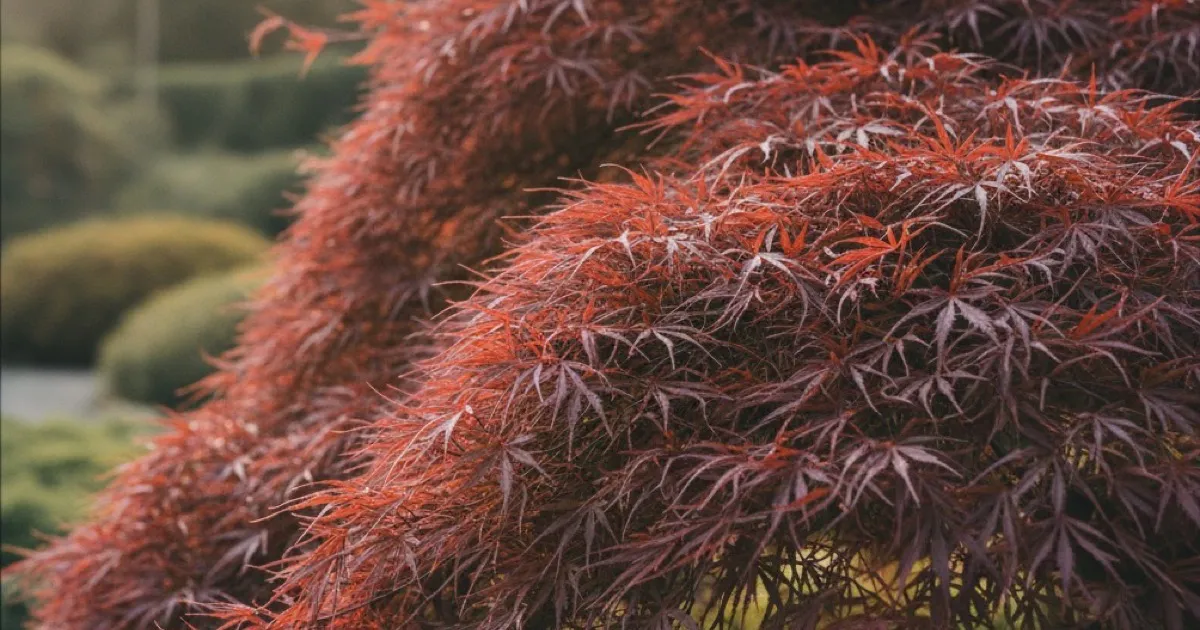
Dissectum varieties (Acer palmatum var. dissectum) have deeply cut, threadlike leaves that look like lace or fern fronds. They grow as weeping or mounding forms, typically reaching 6 to 12 feet tall and wider than they are tall. These are the “weeping Japanese maples” you see cascading over rocks, ponds, and garden walls.
Japanese maple identification relies on distinguishing these two leaf types, plus understanding how foliage color changes through the growing season. Palmate cultivars tend to hold their color more consistently from spring through fall, while dissectum types often shift dramatically, starting one color in spring and ending another in autumn. Both groups include red, green, and variegated cultivars, so leaf shape is a more reliable identifier than color alone. Within each group, cultivar differences come down to mature size, growth rate, leaf size, and seasonal color shifts. A ‘Bloodgood’ and an ‘Emperor I’ look similar from 20 feet away, but side by side, their leaf color, bark hue, and fall transitions are distinct. The palmate group also includes several dwarf cultivars like ‘Shaina’ (8 feet max) that blur the line between tree and shrub. For positive identification, photograph the leaves up close, capture the overall form from a distance, and note the bark color, which ranges from green to deep reddish-brown depending on variety.
Best Red Japanese Maple Varieties
Red maples dominate the Japanese maple market. These are the cultivars that stop traffic in October.
‘Bloodgood’
The most widely planted red Japanese maple, and for good reason. Deep burgundy-red leaves hold their color from spring through fall without fading to green in summer heat (a problem with cheaper red cultivars). Grows 15 to 20 feet tall with a rounded canopy. Zones 5 to 8.
Why it’s popular: Reliable color, moderate growth rate (1 to 2 feet per year), and widely available at nurseries for $60 to $150 depending on size.
‘Emperor I’
Similar to ‘Bloodgood’ but leafs out 2 weeks later in spring, which protects it from late frost damage. Slightly more upright growth habit. If you live in zone 5 where late frosts are common, ‘Emperor I’ is the safer pick.
‘Crimson Queen’ (Dissectum)
The gold standard weeping red Japanese maple. Deeply cut burgundy leaves cascade over a mounding form that reaches 8 to 10 feet tall and 10 to 12 feet wide. The branching structure looks sculptural in winter after leaf drop. This is the one you see draped over water features and rock gardens.
‘Tamukeyama’ (Dissectum)
Holds its deep red color better in heat than ‘Crimson Queen.’ Slightly more compact at 6 to 8 feet tall. If you garden in zone 7 or 8 where summers are brutal, ‘Tamukeyama’ resists the summer green-out that plagues other red dissectums.
‘Shaina’
A dwarf palmate variety that tops out at 8 feet. Dense, compact growth makes it work in containers and foundation plantings where a full-sized Japanese maple would be too large. New growth emerges bright crimson, maturing to deep burgundy.
Best Green Japanese Maple Varieties
Green-leafed varieties get overlooked, but their fall color is often more spectacular than the reds. Going from green to gold to orange to scarlet beats staying one shade of burgundy all season.
‘Osakazuki’
Widely considered the best fall color of any Japanese maple. Leaves are plain green all summer, then explode into blazing crimson-red in October. Grows 15 to 20 feet. If you want one tree that puts on the best autumn show, this is it.
‘Sango-kaku’ (Coral Bark Maple)
The standout feature isn’t the leaves (which are light green turning gold in fall). It’s the bark. Young branches turn vivid coral-red in winter, creating stunning contrast against snow or evergreen backgrounds. Grows 20 to 25 feet. One of the few Japanese maples with true four-season interest that doesn’t rely on leaf color alone.
‘Viridis’ (Dissectum)
The green counterpart to ‘Crimson Queen.’ Finely cut green leaves turn gold and orange in fall. Same weeping mound form, reaching 8 to 10 feet. ‘Viridis’ handles more sun than red dissectums because green leaves tolerate heat better than pigment-loaded red ones.
Variegated and Unusual Varieties
For collectors and gardeners who want something different.
‘Butterfly’
Small palmate leaves edged in white and pink. Grows 10 to 12 feet with an upright, somewhat irregular form. The variegation makes it stand out in a way that solid-colored maples can’t match, but it needs afternoon shade to prevent leaf scorch.
‘Shirazz’
New spring leaves emerge pink-and-green variegated, mature to deeper green with cream edges in summer, then turn crimson in fall. Three distinct looks from one tree. Grows 12 to 15 feet. A newer cultivar that’s gaining popularity fast.
‘Koto-no-ito’
A “linearilobum” type with extremely narrow, strap-like leaf lobes that look nothing like a typical maple. Green leaves turn yellow and orange in fall. Grows 10 to 12 feet with an upright vase shape. A conversation-starter tree that most visitors won’t recognize as a Japanese maple.
How to Grow Japanese Maples
Japanese maples aren’t as fussy as their reputation suggests, but they do have non-negotiable requirements.
Sun and shade: Most varieties prefer morning sun and afternoon shade, especially in zones 7 and above. Red dissectum types scorch fastest in full sun. Green-leafed palmate varieties handle the most sun. In zones 5 to 6, full sun is usually fine for all types.
Soil: Moist, well-drained, slightly acidic (pH 5.5 to 6.5). They hate soggy roots. If your soil is clay, plant on a mound or in a raised bed.
Water: Consistent moisture matters, especially in the first 2 to 3 years. Once established, they’re moderately drought tolerant, but prolonged drought causes leaf scorch (crispy brown edges).
Pruning: Less is more. Japanese maples have a naturally graceful form that heavy pruning ruins. Remove dead wood, crossing branches, and anything growing straight up from the interior. The best time to prune is late winter before leaf-out.
Cold hardiness: Most varieties are hardy to zone 5 (minus 20 degrees F). Container-grown trees need winter protection in zones 5 to 6 because roots freeze faster above ground. Wrapping the pot in burlap or moving it to an unheated garage works.
How Tree Identifier Helps with Japanese Maple Varieties
With over 1,000 cultivars, identifying a specific Japanese maple variety from sight alone is tough even for experienced gardeners. Tree Identifier makes it straightforward. Snap a photo of the leaves (get a close-up showing the lobe pattern and color) and the app identifies the species and provides detailed characteristics.
The app recognizes both palmate and dissectum types, and handles the tricky cases where leaf shape alone doesn’t give a clear answer. It works offline too, which is useful when you’re browsing garden centers or botanical gardens without cell service. You get 2 free identifications per day, so you can test it on the next Japanese maple you pass.
Frequently Asked Questions
What is the most popular Japanese maple variety?
‘Bloodgood’ is the most widely sold Japanese maple in North America. It’s popular because it holds deep burgundy-red color all season without fading to green, grows to a manageable 15 to 20 feet, and tolerates a wide range of conditions (zones 5 to 8). It’s also one of the more affordable varieties at $60 to $150.
Can Japanese maples grow in full sun?
Green-leafed palmate varieties handle full sun in zones 5 to 7. Red and variegated varieties prefer morning sun with afternoon shade. In zones 8 and above, all Japanese maples benefit from afternoon shade to prevent leaf scorch. The hotter your climate, the more shade protection you need.
How fast do Japanese maples grow?
Most Japanese maples grow 1 to 2 feet per year when young, slowing down as they mature. Dissectum (weeping) varieties grow slightly slower at 6 to 12 inches per year. A ‘Bloodgood’ planted as a 6-foot nursery tree will reach 12 to 15 feet in about 5 to 7 years with proper care.
What is the smallest Japanese maple variety?
‘Shaina’ is one of the smallest, reaching just 6 to 8 feet tall with dense, compact growth. For even smaller options, ‘Beni-hime’ tops out at 3 to 4 feet and works in containers. Among dissectum types, ‘Red Dragon’ stays around 5 to 7 feet and mounds rather than spreading.
Want to identify a Japanese maple variety you’ve spotted in a park or garden center? Download Tree Identifier and take a close-up photo of the leaves. The app identifies the species and shows you detailed characteristics, so you know exactly what you’re looking at.
Identify a tree from your photo — free
Upload a leaf, bark, or whole-tree photo and get the species in seconds. No signup.
Confidence:
Unlock the full species profile
Free in the app — with unlimited identifications.


AI result for guidance — the app gives full species details and works offline.
Want unlimited identifications?
Get the full species profile, photos and details — free in the app, with unlimited scans.
- Unlimited identifications
- Full species profiles & details
- Works offline, anywhere
- Save and revisit your finds
Elena Torres
Tree Identifier Team