Juniper Tree Identification: Species, Berries, and Bark
Junipers are everywhere, but most people can’t name the one growing in their yard. That’s partly because junipers come in so many forms — ground-hugging shrubs, mid-sized bushes, and full-sized trees topping 60 feet. And partly because some junipers go by other names. That “cedar” in your backyard? Probably a juniper. Juniper tree identification starts with understanding this group’s wide range of shapes, then zeroing in on the foliage, berries, and bark details that separate one species from the next.
Junipers belong to the genus Juniperus in the cypress family (Cupressaceae), with about 60 to 70 species worldwide. In North America, around a dozen species are common. They share a few traits that make juniper identification straightforward once you know what to look for: scale-like mature foliage, fleshy berry-like cones, and aromatic wood. This guide covers the species you’re most likely to encounter, from the Eastern red cedar that lines highways to the Rocky Mountain juniper that dots Western hillsides.
How to Confirm You’re Looking at a Juniper
Before identifying which juniper, confirm it’s a juniper at all. Several evergreen groups look similar from a distance.
Foliage tells you first. Juniper foliage comes in two forms, and most species show both on the same tree. Juvenile leaves are sharp, needle-like, and prickly. Mature leaves are flattened, scale-like, and pressed tight against the twig in overlapping pairs. If you see a conifer with scale-like leaves that feel slightly rough when you run your hand along the branch, juniper is a strong candidate.
The main confusion is with cypress and arborvitae. Here’s how to tell them apart:
- Juniper vs cypress: Both have scale-like leaves, but juniper foliage is more rounded and cord-like. Cypress foliage is flatter, more fan-shaped. Juniper produces fleshy berries; cypress produces small woody cones.
- Juniper vs arborvitae: Arborvitae foliage fans out in flat sprays. Juniper foliage is more three-dimensional, wrapping around the twig rather than lying flat. Crush a juniper leaf and it smells sharply aromatic, like gin. Arborvitae has a milder, less distinctive scent.
- Juniper vs cedar: True cedars (Cedrus) have clusters of needles on short spurs, not scale-like leaves. What Americans call “cedar” is almost always a juniper or arborvitae.
Berry-like cones are the clincher. Junipers are the only common conifer genus that produces fleshy, round, berry-like cones instead of woody cones. Female junipers grow small green berries that ripen to blue-black or blue-gray over one to three years. These berries are what gives gin its distinctive flavor.
Eastern Red Cedar (Juniperus virginiana)
Eastern red cedar is the most widespread juniper in the eastern United States. It grows in every state east of the Rockies and is one of the first trees to colonize abandoned fields.
Despite the name, this is not a cedar. It’s a juniper through and through.
How to identify it:
- Size: 30 to 50 feet tall, often with a dense, columnar or pyramidal shape
- Foliage: Dark green scale-like leaves on mature growth. Young branches show sharp, needle-like juvenile foliage. Trees under stress show more prickly juvenile leaves
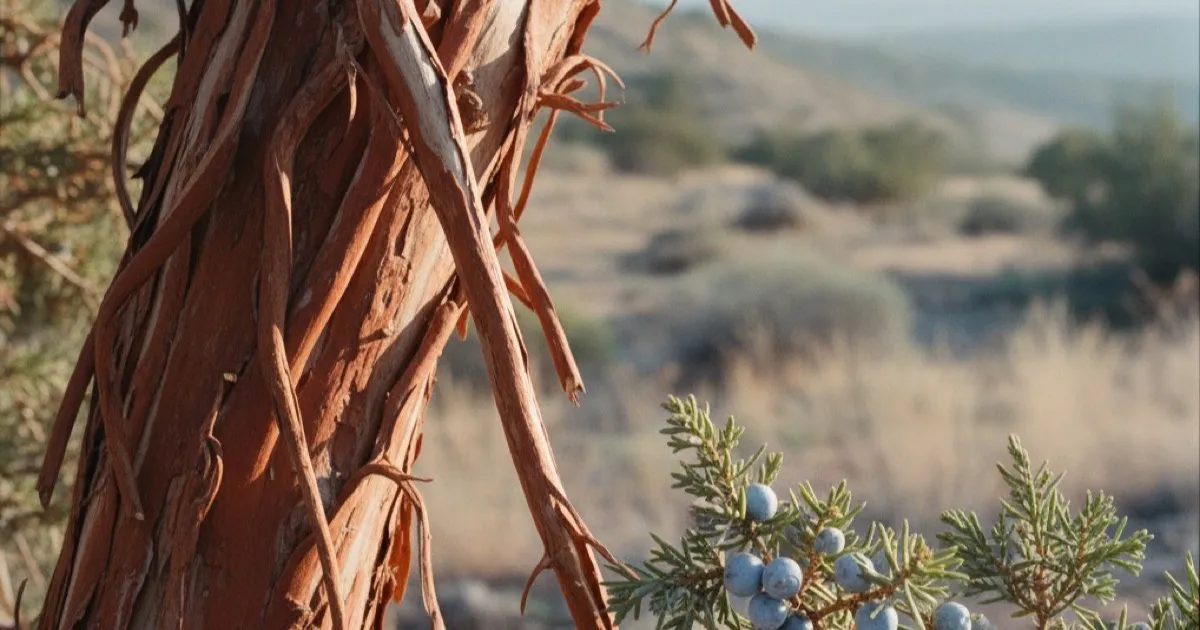
- Bark: Thin, reddish-brown, peeling in long, fibrous strips. The bark is one of the most distinctive features — it shreds vertically like string
- Berries: Small (1/4 inch), pale blue with a waxy coating, maturing in fall. Birds love them
- Wood: Aromatic, reddish-pink heartwood surrounded by white sapwood. This is the “cedar” in cedar chests and closet linings
Eastern red cedar is often confused with Chinese juniper cultivars used in landscaping. The easiest way to tell them apart: Eastern red cedar has shredding bark and pale blue berries. Most Chinese juniper cultivars have tighter bark and are pruned into formal shapes.
Rocky Mountain Juniper (Juniperus scopulorum)
This is the western counterpart to Eastern red cedar. It ranges from British Columbia down to Arizona, mostly at elevations between 5,000 and 9,000 feet.
How to identify it:
- Size: 15 to 30 feet tall, often with an irregular, twisted form shaped by wind
- Foliage: Blue-green to silvery-green scale-like leaves. The blue tint separates it from Eastern red cedar’s darker green
- Bark: Gray-brown, shredding in thin strips — similar to Eastern red cedar but grayer
- Berries: Bright blue with a heavy waxy bloom, slightly larger than Eastern red cedar berries. Takes two years to ripen
- Habitat: Rocky slopes, dry hillsides, canyon rims. Rarely found in moist bottomlands
Several popular landscaping cultivars come from this species, including ‘Blue Arrow’ (narrow columnar form) and ‘Wichita Blue’ (silver-blue foliage).
Common Juniper (Juniperus communis)
Common juniper has the widest natural range of any tree in the world, spanning North America, Europe, and Asia. In North America, it usually grows as a low, spreading shrub rather than a tree.
How to identify it:
- Size: Usually 2 to 6 feet tall, spreading 8 to 12 feet wide. Occasionally grows taller in protected spots
- Foliage: Unlike most junipers, common juniper keeps its needle-like juvenile leaves throughout its life. The needles are sharp, about half an inch long, and grow in whorls of three. They have a single white stripe on the upper surface
- Bark: Thin, reddish-brown, peeling in papery strips
- Berries: Dark blue-black when ripe, taking two to three years to mature. These are the berries used to flavor gin
- Growth habit: Low and sprawling, often forming dense mats. This is the juniper you’ll find creeping across rocky alpine slopes and sandy coastal areas
The all-needle foliage makes common juniper easy to distinguish from other junipers. If every leaf on the plant is a sharp, three-per-whorl needle with no scale-like leaves anywhere, it’s common juniper.
Alligator Juniper (Juniperus deppeana)
Found in the American Southwest and Mexico, alligator juniper gets its name from bark that looks exactly like alligator skin — deeply checkered into small, square plates.
How to identify it:
- Size: 20 to 40 feet tall with a broad, rounded crown
- Foliage: Blue-green scale-like leaves, similar to other tree-form junipers
- Bark: The standout feature. Deeply furrowed into small rectangular blocks that look like alligator hide. No other North American juniper has bark remotely like this
- Berries: Reddish-brown to dark blue, about 1/2 inch across — larger than most juniper berries
- Habitat: Mountains of Arizona, New Mexico, West Texas, and northern Mexico. Usually between 4,500 and 8,000 feet
If you’re in the Southwest and see a juniper with checkered bark, the identification is done. Alligator juniper is the only species with this bark pattern.
Utah Juniper (Juniperus osteosperma)
Utah juniper dominates the vast stretches of high desert across the Great Basin, from eastern California to Colorado.
How to identify it:
- Size: 10 to 20 feet tall, often with a single trunk that splits into several major branches near the ground
- Foliage: Yellow-green to gray-green scale-like leaves. Tends to look paler and more yellowish than other junipers
- Bark: Gray, shredding in thin strips
- Berries: Brownish-blue, about 1/4 inch, with a mealy texture. Contains a single large seed (most junipers have multiple seeds per berry)
- Habitat: Dry, rocky slopes between 3,000 and 8,000 feet. Often found growing alongside pinyon pines in the classic pinyon-juniper woodland
The single-seeded berry is Utah juniper’s most reliable field mark. Crack open a berry: one seed means Utah juniper. Two or more seeds means a different species.
How Tree Identifier Helps With Juniper ID
Junipers challenge even experienced naturalists because the foliage looks similar across species. Bark, berry color, and growth habit matter more than usual, and those details can be hard to capture in a standard field guide.
Tree Identifier’s AI analyzes multiple features at once — foliage texture, bark pattern, berry color, and overall form. Snap a photo of the bark and the app can distinguish Eastern red cedar’s shredding strips from alligator juniper’s checkered blocks. The app works with leaves, bark, flowers, fruits, and whole tree shape, so you can photograph whatever feature is most visible.
For hikers in the West who encounter junipers far from cell towers, the app’s offline mode means you can identify species without service. Species data downloads to your phone ahead of time. You get 2 free identifications per day to start.
Frequently Asked Questions
Is Eastern red cedar actually a cedar?
No. Eastern red cedar (Juniperus virginiana) is a juniper, not a true cedar. True cedars belong to the genus Cedrus and are native to the Mediterranean and Himalayas. The name stuck because early American settlers thought the aromatic wood resembled cedar.
What are juniper berries used for?
Juniper berries flavor gin and some foods. The berries of common juniper (Juniperus communis) are the primary species used commercially. Not all juniper berries are safe to eat in large quantities, so don’t forage without proper identification.
How do you tell juniper from arborvitae?
Check the foliage arrangement. Arborvitae (Thuja) has flat, fan-shaped sprays of foliage. Juniper foliage wraps around the twig in a more three-dimensional pattern. Crushing the foliage also helps: juniper has a strong, sharp, gin-like aroma, while arborvitae smells milder.
How long do juniper trees live?
Many junipers live 200 to 300 years. Some Rocky Mountain and Utah junipers in the West have been documented at over 1,000 years old. Alligator junipers can reach 500 years. Junipers grow slowly, so even a small tree may be decades old.
Junipers are one of the most common conifers in North America, but telling species apart takes a closer look at bark, berries, and foliage type. If you spot a juniper you can’t place, try Tree Identifier — photograph the bark or berries and let the AI sort out which species you’re looking at.
Identify a tree from your photo — free
Upload a leaf, bark, or whole-tree photo and get the species in seconds. No signup.
Confidence:
Unlock the full species profile
Free in the app — with unlimited identifications.


AI result for guidance — the app gives full species details and works offline.
Want unlimited identifications?
Get the full species profile, photos and details — free in the app, with unlimited scans.
- Unlimited identifications
- Full species profiles & details
- Works offline, anywhere
- Save and revisit your finds
Elena Torres
Tree Identifier Team