Light Colored Wood Types: Species Guide with Hardness Tips
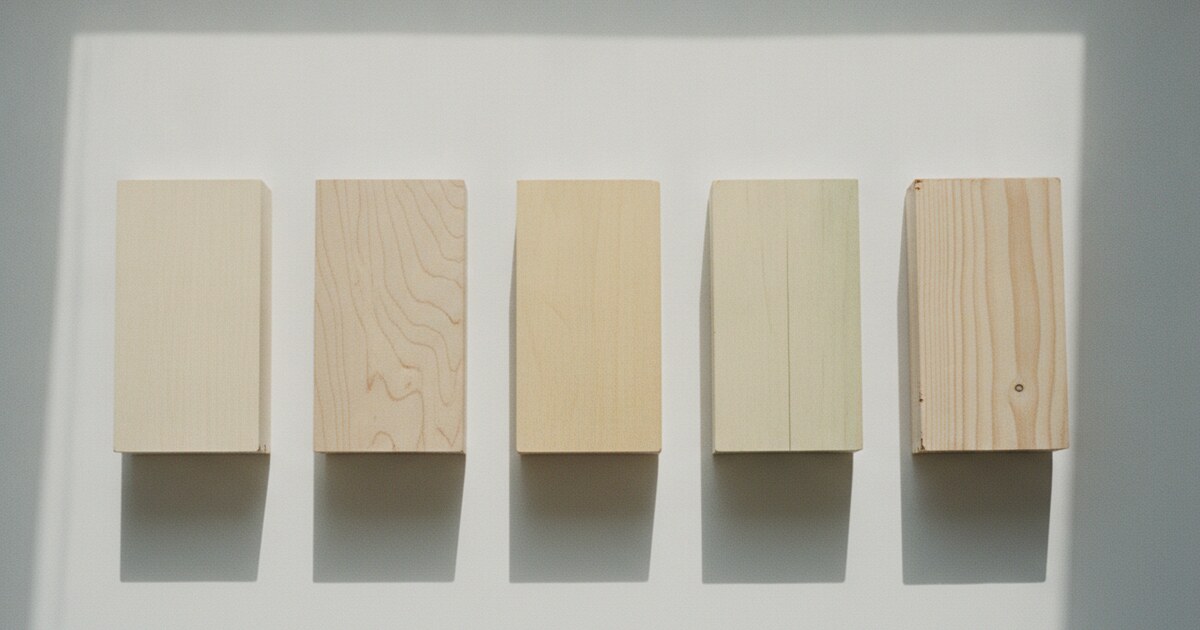
Walk into any furniture showroom and you’ll see the same pale tones on a good half the pieces: maple credenzas, ash dining tables, birch cabinets with barely-there grain. Light colored wood is popular, but the phrase covers a wide range of species with very different properties. A hard maple floor and a poplar cabinet both look pale fresh from the mill, but one handles 1,450 lbf of force before denting while the other dents under a dropped stapler. Knowing which light colored wood you’re dealing with changes every decision that follows, from finish selection to joinery method to expected lifespan. This guide covers the most common light colored wood types, how to tell them apart by grain and end grain, how they age, and how they perform in use.
The most common light colored wood types are hard maple, white ash, yellow birch, American beech, poplar, eastern white pine, and spruce. Hard maple and yellow birch are the palest hardwoods, with cream-to-white faces and fine diffuse-porous grain. White ash and oak run slightly warmer. Softwoods like pine and spruce are lightest in color but dent far more easily.
What Makes Wood Light Colored?
Color in wood comes from extractive compounds deposited in the heartwood: tannins, resins, and phenolic pigments. Species with few of these compounds stay pale. That’s why maple, birch, and ash run so much lighter than walnut, cherry, or mahogany. Sapwood is lighter than heartwood in almost every species because it hasn’t yet accumulated those compounds.
Grain structure also shapes appearance. Diffuse-porous species like maple, birch, and beech have tiny, evenly distributed pores that scatter light uniformly and produce a clean, smooth face. Ring-porous species like ash and oak have larger earlywood pores that add texture and warmth to the surface, even when the base color is pale.
The most-used light hardwoods span a wide hardness range. Hard maple (Acer saccharum) tops the group at 1,450 lbf Janka and 44 lbs per cubic foot, making it the standard for bowling lanes and butcher blocks. Yellow birch (Betula alleghaniensis) runs close at 1,260 lbf and 43 lbs per cubic foot, with a slightly warmer yellow-white tone. White ash (Fraxinus americana) reaches 1,320 lbf, but its ring-porous grain opens up the face enough that it takes stain differently from maple. American beech (Fagus grandifolia) hits 1,300 lbf with fine diffuse-porous grain, though it’s rarely stocked at lumber yards because it checks badly as it dries. Poplar (Liriodendron tulipifera) sits at 540 lbf, pale cream-green and soft enough to dent under moderate use. Eastern white pine runs softer still at 380 lbf. The hardness gap between the palest softwood and the hardest light hardwood is roughly 4x, which shows up clearly in daily service.
The Most Common Light Colored Wood Types
Hard maple is the palest of the commercial hardwoods. Freshly milled, the face is nearly white with a slight cream cast. The grain is fine, tight, and straight, with occasional curly or bird’s-eye figure on the face. On end grain, maple is diffuse-porous with very small, evenly distributed pores. The rays are fine and numerous but don’t flash the way quartersawn oak does. Price runs $4–8 per board foot, and it ages to a light amber over years of UV exposure.
White ash shows a light tan to pale straw color with a pronounced ring-porous grain that reads as a bold, open pattern on the face. The earlywood pores in ash are large enough to see without a loupe. Janka: 1,320 lbf. Density: 41 lbs per cubic foot. Price: $3–6/bf. Ash bends and absorbs shock well, which is why it’s behind most baseball bats and hockey sticks. Emerald ash borer has reduced domestic supply significantly since the early 2000s, pushing retail prices up in many regions.
Yellow birch sits at 1,260 lbf with a pale yellow-white face that looks similar to hard maple at a glance. The distinction is subtle: birch runs slightly warmer in tone, and its diffuse-porous end grain has pores arranged in a faint diagonal pattern rather than the completely random distribution in maple. Density: 43 lbs per cubic foot. Price: $3–6/bf. For a detailed side-by-side comparison of grain and aging patterns, see the maple vs birch wood guide.
American beech is pale pinkish-cream with a fine, diffuse-porous grain. The most distinctive ID feature is its medullary rays: visible as thin reddish-brown flecks on the face grain, they become pronounced ray fleck on quartersawn surfaces. Janka: 1,300 lbf. Density: 45 lbs per cubic foot. Beech is prized for steam-bending (classic Thonet bentwood chairs) but it’s prone to checking and tricky to kiln-dry, so it shows up mainly in specialty and European markets rather than most US lumber yards.
Poplar (Liriodendron tulipifera, also called tulipwood or yellow poplar) has a pale cream face with distinctive greenish or gray-purple streaks in the heartwood. Janka: 540 lbf. It’s soft enough to dent with a thumbnail under firm pressure. Poplar’s main job in furniture is as a secondary wood: drawer bottoms, frame members, back panels — places that don’t show and need something light and affordable. At $1–2/bf, it’s the cheapest light-colored hardwood at most lumber yards. For flooring, furniture faces, or any exposed surface, it’s the wrong choice.
For a full hardness comparison across commercial species including the light-to-dark spectrum, the guide to the hardest types of wood has Janka ratings for the full range from balsa to Australian buloke.
Light Colored Softwoods
Eastern white pine is the lightest-colored commonly available softwood in North America. Freshly milled boards are pale straw-yellow to nearly cream, with a gradual shift from light sapwood to slightly darker heartwood. The grain is straight, with resin canals visible as fine lines parallel to the growth rings. Janka: 380 lbf. Density: 25 lbs per cubic foot. It yellows significantly under UV exposure, particularly in window-lit areas. Price: $1–3/bf rough-sawn. Under foot traffic it dents easily, but some people prefer the worn, dented look for farmhouse floors.
Spruce (primarily Picea glauca and Picea rubens in the eastern US, Picea sitchensis on the Pacific Coast) runs even lighter than white pine, with a nearly white face and very tight, straight grain. Density: 25–28 lbs per cubic foot. Sitka spruce Janka is around 510 lbf. Spruce is the tonewood of choice for guitar tops, violin bellies, and piano soundboards because of its high stiffness-to-weight ratio. In construction it shows up as dimensional lumber in the SPF (spruce-pine-fir) combination grade.
Douglas fir is slightly warmer in tone than spruce or white pine, with a light reddish-tan heartwood and pale cream sapwood. Janka: 660 lbf for the coast variety. The growth rings in fir are distinct and tightly spaced, creating a pronounced straight-grain pattern that shows up well in exposed structural beams and modern industrial interiors. It’s harder than white pine but still soft enough to dent under heavy furniture.
How Light Colored Wood Changes Over Time
Most light-colored species darken or yellow with UV exposure, and the change is permanent unless you sand back to bare wood. Hard maple ages from cream-white to light amber over 5–10 years, noticeable where furniture legs or area rugs have blocked sunlight on a floor, leaving two-tone stripes when you move them. Birch yellows faster than maple. Ash and oak deepen to a richer gold-tan.
White pine is the most dramatic: fresh boards are pale straw, but a pine floor in a south-facing room can turn dark honey within 3–5 years. Covering part of the floor creates a two-tone problem when you move rugs around.
One species that often surprises people: cherry. It starts out pale pinkish-tan and darkens to reddish-brown within 6–12 months, driven by photoreactive phenolic compounds. It’s one of the few woods that begins light and becomes a darker species, which makes it worth treating separately from the others on this list.
Water-based finishes with UV inhibitors slow color change in all species but don’t stop it. Outdoor UV exposure accelerates the process compared to indoor light.
How to Identify Light Colored Wood by End Grain
End grain is the most reliable ID method when you can get to it. A sharp chisel cut or fresh crosscut saw face examined with a 10x loupe will tell you more than looking at the face grain alone.
Diffuse-porous end grain (maple, birch, beech, poplar): pores are small and evenly distributed throughout each growth ring. If the end grain looks like a field of tiny dots with no obvious clustering pattern, you’re looking at a diffuse-porous species. Separating maple from birch requires noting the rays: maple has fine, numerous rays; birch rays are slightly less prominent. Beech has broad rays visible to the naked eye.
Ring-porous end grain (ash, white oak): large pores cluster in a distinct row at the start of each growth ring, then shift to much smaller pores in the latewood. This creates a striped pattern on the cut face. White oak’s ray cells extend outward from the center as long, thin lines — these are what produce ray fleck on quartersawn oak. Ash has larger, rounder earlywood pores than oak and fewer rays.
Softwood end grain (pine, spruce, fir): no visible pores at all under a loupe. Instead you see distinct growth rings with resin canals — pine and fir show these as small dark dots in the latewood; spruce has fewer. The ring boundary is abrupt in pine (hard line between light earlywood and dark latewood), more gradual in spruce and fir.
For a deeper look at pore patterns across all major species, the wood grain identification guide covers ring-porous, diffuse-porous, and softwood end grain in detail. The complete wood identification guide covers field tests, loupe technique, and weight-based sorting across the full species range.
Frequently Asked Questions
What are the lightest colored hardwoods? Hard maple and yellow birch are the palest commercially available hardwoods in North America. Both are diffuse-porous with cream-to-white faces and fine, tight grain. Hard maple is slightly lighter, nearly white fresh from the mill. American beech is also pale pinkish-cream and similarly fine-grained, but it’s rarely available at retail lumber yards in the US due to its tendency to check as it dries.
Does light colored wood get darker over time? Yes, most light-colored species darken with UV exposure. Hard maple ages to light amber over 5–10 years. Birch yellows faster. Eastern white pine yellows significantly in sun-exposed rooms. The color change is permanent unless you sand back to bare wood. Water-based finishes with UV inhibitors slow the process, but they don’t stop it entirely.
Is poplar a good choice for light-colored furniture? Poplar works for painted furniture or cabinet interiors where a finish covers the surface. For natural or clear-finished furniture, the greenish heartwood streaks and low Janka (540 lbf) make it a poor choice. Hard maple, yellow birch, or white ash are better options for natural-finish light-colored furniture that gets regular use.
What’s the difference between light colored hardwood and softwood? The main difference is density and hardness. Light hardwoods like maple (1,450 lbf) and ash (1,320 lbf) resist denting and abrasion, making them suitable for floors and work surfaces. Light softwoods like eastern white pine (380 lbf) and spruce (510 lbf) are more affordable and easier to work but dent under normal foot traffic and furniture legs.
How do I identify light colored wood without testing equipment? Start with end grain and a 10x loupe. Diffuse-porous end grain (small, evenly distributed pores) points to maple, birch, or beech. Ring-porous end grain (large pores in distinct rows at each growth ring) points to ash or white oak. No visible pores at all indicates softwood. Weight helps too: maple and beech feel noticeably heavier than poplar or pine for the same board dimensions.
If you have a photo of the wood, the Tree Identifier app’s wood recognition feature reads grain, texture, and pore patterns and returns the most likely species. It covers hundreds of wood species, including all the common light-colored types in this guide. You can also try it in your browser for free at treeidentifier.app/tools/wood-identifier — no download required.
Identify a tree from your photo — free
Upload a leaf, bark, or whole-tree photo and get the species in seconds. No signup.
Confidence:
Unlock the full species profile
Free in the app — with unlimited identifications.


AI result for guidance — the app gives full species details and works offline.
Want unlimited identifications?
Get the full species profile, photos and details — free in the app, with unlimited scans.
- Unlimited identifications
- Full species profiles & details
- Works offline, anywhere
- Save and revisit your finds
Elena Torres
Tree Identifier Team