Linden Tree Identification: Leaves, Flowers, and Bracts
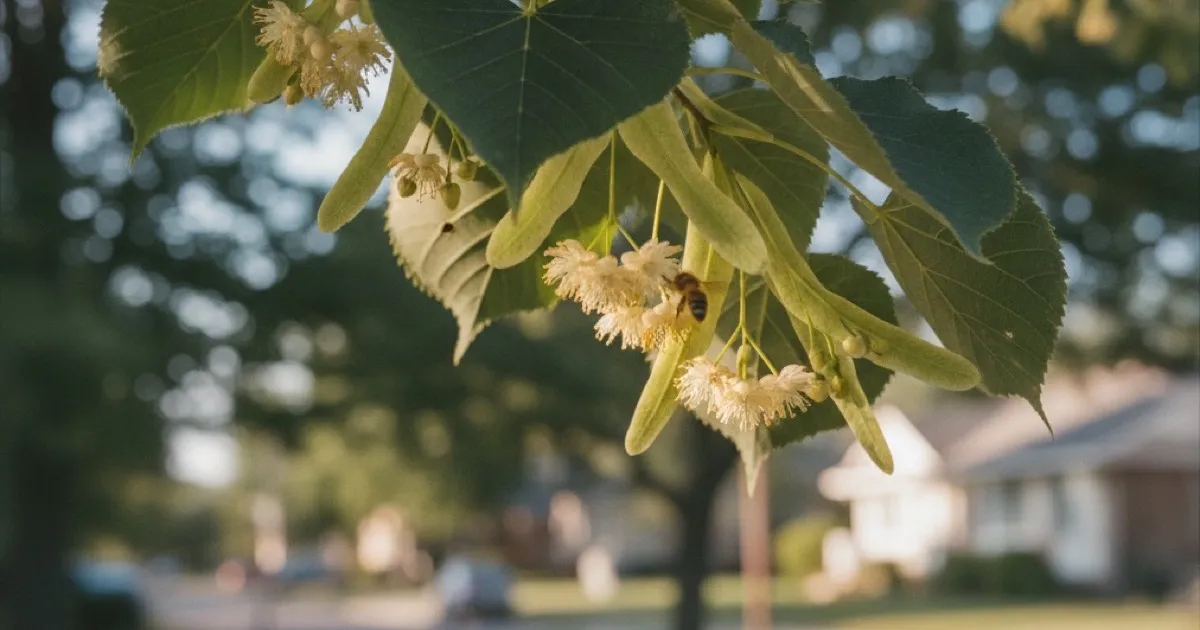
Walk down a street lined with large shade trees in the Midwest or Northeast, and there’s a good chance you’re walking under lindens. These trees go by several names — linden, basswood, lime tree (in Europe) — and they’re among the most widely planted urban shade trees in the temperate world. Linden tree identification starts with one feature that’s hard to miss: large, heart-shaped leaves with an asymmetrical base. Add the fragrant yellow flowers that appear in early summer and the distinctive leaf-like bract attached to each flower cluster, and linden becomes one of the more straightforward trees to identify.
The genus Tilia includes about 30 species worldwide. In North America, the most common are American basswood (Tilia americana), littleleaf linden (Tilia cordata), and silver linden (Tilia tomentosa). This guide covers all three and how to tell them apart.
Standing in front of one? Identify it from a photo in seconds — free, no sign-up needed.
Linden Leaves: The Heart Shape
The leaf is the first thing to check. All lindens share the same basic shape: broadly heart-shaped (cordate), with a pointed tip and serrated margins.
Key leaf features across all lindens:
- Shape: Heart-shaped, roughly as wide as long
- Base: Asymmetrical — one side of the leaf base extends slightly lower than the other along the petiole
- Margin: Serrated with sharp, forward-pointing teeth
- Arrangement: Alternate on the branch
- Veins: Prominent veins radiating from the base, with secondary veins branching in a herringbone pattern
The differences between species show up in size and surface texture:
American basswood (Tilia americana): The largest leaves of any linden species — 5 to 10 inches long. Dark green above, paler below, with tufts of brownish hairs in the vein axils on the underside. These are big, bold leaves that dominate a branch.
Littleleaf linden (Tilia cordata): Much smaller leaves, 2 to 3 inches long. Dark glossy green above, with distinctive tufts of rust-orange hairs in the vein axils underneath. The small leaf size is the quickest way to ID this species. It’s the most commonly planted street linden in North America.
Silver linden (Tilia tomentosa): Medium-sized leaves, 3 to 5 inches long. The upper surface is dark green, but the underside is covered in dense, silvery-white felt-like hairs. When the wind flips the leaves, the silvery undersides flash — visible from a distance and unique to this species.
If you’re learning to identify trees by leaf shape, linden’s heart-shaped outline with the lopsided base is one of the most recognizable forms you’ll encounter.
The Bract: Linden’s Unique Feature
Lindens have a feature found on almost no other North American tree: a leaf-like bract attached to each flower and fruit cluster.
The bract is a narrow, strap-shaped, pale green leaf, usually 3 to 5 inches long, that’s fused to the stem of the flower cluster. The flower cluster (and later the fruit) hangs from the midrib of this bract like a pendant from a ribbon. The bract acts as a wing — when the fruit ripens and drops, the bract catches the wind and helps disperse the seeds away from the parent tree.
Even after the flowers and fruit are gone, the dried bracts persist on the tree into late summer and fall. They’re papery, tan, and visible when you look up into the canopy. No other common tree has this structure, so the bracts alone confirm linden identification.
Linden Flowers
Linden flowers are small, pale yellow, and appear in early to mid-summer (June-July in most of the U.S.). They hang in clusters of 5 to 20 beneath the characteristic bract.
The flowers are individually inconspicuous, but they produce a powerful fragrance. A linden in full bloom perfumes the surrounding air with a sweet, honey-like scent that carries for hundreds of feet. If you walk through a neighborhood in late June and smell something sweet that you can’t place, look up. There’s probably a linden overhead.
The fragrance attracts huge numbers of honeybees, bumblebees, and other pollinators. Linden honey is prized worldwide for its light color and delicate floral flavor. In Europe, linden-flower tea (tilleul) is a traditional remedy for anxiety and insomnia.
Caution about silver linden: The nectar of silver linden (Tilia tomentosa) has been linked to bumblebee deaths in some studies. Dead bees are sometimes found in large numbers beneath silver linden trees during bloom. The exact mechanism isn’t fully understood — it may be toxicity or simply that exhausted bees keep visiting flowers with insufficient nectar. Other linden species don’t cause this problem.
Linden Bark Identification
Linden bark varies somewhat by species but shares common traits:
Young trees: Smooth, gray-green bark that’s similar to beech but darker.
Mature trees: Develops narrow, flat-topped ridges separated by shallow furrows. The bark is gray to grayish-brown, and the overall pattern is less dramatic than oaks or hickory trees — more of a uniform texture of vertical ridges.
Species differences in bark:
- American basswood: Bark develops long, narrow, flat ridges with shallow furrows. Grayish brown. On large trees, the furrows deepen but the ridges remain flat and relatively narrow.
- Littleleaf linden: Similar to basswood but often smoother on young trees. Old trees develop shallow furrows with grayish bark.
- Silver linden: Bark is smoother than other lindens for longer, remaining light gray well into maturity. Eventually develops shallow ridges.
Linden bark is serviceable for identification but not the strongest feature. Rely on the leaves, bracts, and flowers first.
Linden Tree Shape and Size
Lindens are medium to large shade trees with dense, symmetrical crowns:
American basswood: 60 to 80 feet tall with a trunk diameter of 2 to 4 feet. Broad, rounded crown. Often the largest of the lindens. Native trees can develop massive trunks, especially in rich bottomland soil. Basswood often sends up multiple trunks from the base, forming a cluster of stems.
Littleleaf linden: 50 to 70 feet tall. Dense, pyramidal to rounded crown. This is the classic European street tree — tidy, symmetrical, and reliable. The dense canopy makes it one of the best shade trees but also means grass struggles beneath it.
Silver linden: 50 to 70 feet tall. Broad pyramidal to oval crown. The silver-flashing leaves give the whole tree a shimmery quality in a breeze that makes it easy to spot from a distance, even in a row of other trees.
All lindens tolerate pruning well, which is part of why they’ve been planted as street trees for centuries. In Europe, lindens have been planted in formal allees and town squares since the Middle Ages.
Where Linden Trees Grow
American basswood is native from New England west to Manitoba and south to North Carolina and Kansas. It grows in rich, moist deciduous forests, often in ravines, floodplains, and north-facing slopes. It’s shade-tolerant and typically found as a canopy or sub-canopy tree in mixed hardwood forests alongside sugar maples, beech trees, and yellow birch.
Littleleaf linden is native to Europe and widely planted across North America as a street and park tree. It’s the most commonly encountered linden in urban areas. Cultivars like ‘Greenspire’, ‘Chancellor’, and ‘Corinthian’ are standard choices for municipal tree plantings.
Silver linden is native to southeastern Europe and western Asia. It’s planted as an ornamental for its attractive silver-backed leaves and tolerance of heat and drought. It handles urban conditions better than most lindens.
All lindens prefer moist, well-drained, fertile soil. American basswood is the most demanding about soil moisture; littleleaf and silver linden tolerate drier conditions and urban stress better.
Basswood: The Woodworker’s Linden
Linden wood (sold as “basswood” in North America) is one of the most important carving woods in the world. The wood is:
- Very soft and light (one of the lightest hardwoods)
- Fine-grained and uniform, with almost no visible grain pattern
- Creamy white to pale tan
- Easy to carve with hand tools — the standard choice for whittling, decoy carving, and architectural molding
Basswood is also used for beehive components, musical instrument parts (especially guitar bodies), match sticks, and food containers. The inner bark fibers (called “bast”) are strong and were historically used for rope, mats, and cloth — which is where the name “basswood” comes from.
If you encounter a piece of very light, pale, easily carved wood with minimal grain pattern, there’s a good chance it’s basswood.
Identifying Linden Trees With Tree Identifier
Not sure whether you’re looking at a linden, a redbud, or another heart-shaped-leaf tree? The Tree Identifier app can tell you from a single photo. Snap a picture of the leaf (check both sides — the underside tells you which linden species), the hanging bract-and-flower cluster, or the bark, and the AI identifies the species. It works with leaves, bark, flowers, and fruit.
The app runs offline, useful when you’re hiking a forest trail where American basswood grows and cell service is unreliable. Two free identifications per day to start.
Frequently Asked Questions
Are linden and basswood the same tree?
American basswood (Tilia americana) is the native North American linden species. “Linden” and “basswood” refer to the same genus (Tilia). In practice, Americans tend to call the native species “basswood” and the European species “linden,” but they’re closely related trees in the same genus.
Why do linden trees smell so good?
Linden flowers produce nectar with a high concentration of volatile organic compounds that create the characteristic sweet, honey-like fragrance. The scent evolved to attract pollinators, especially bees. A single linden tree can produce enough nectar to support thousands of bee visits during its 2-3 week bloom period.
How do you tell littleleaf linden from American basswood?
Leaf size is the quickest test. Littleleaf linden leaves are 2-3 inches long. American basswood leaves are 5-10 inches long — roughly three times bigger. Littleleaf linden also has rust-orange hair tufts under the leaf, while basswood has brownish tufts. In landscape settings, littleleaf linden is far more common.
Are linden trees good for bees?
Most linden species are excellent bee trees. American basswood and littleleaf linden are major nectar sources for honeybees, and linden honey is considered premium. Silver linden is the exception — it has been associated with bumblebee deaths during bloom, and some municipalities have stopped planting it for this reason.
How long do linden trees live?
Lindens are long-lived trees. American basswood commonly reaches 200 years. European lindens in parks and churchyards have been documented at 500 to 1,000 years old. The famous Tanzlinde (dancing linden) trees in German villages are often several centuries old.
Spotted a tree with big heart-shaped leaves and a sweet scent? Try Tree Identifier — snap a photo and find out which linden species it is in seconds.
Elena Torres
Tree Identifier Team