How to Identify Locust Trees: Honey Locust vs Black Locust (2026)
Locust trees confuse people because the two most common species look almost nothing alike. Honey locust has delicate, feathery leaves and an open canopy that lets light through. Black locust carries oval leaflets on a compound leaf and hangs out heavy clusters of fragrant white flowers in spring. Both are native to eastern North America, both grow fast, and both have thorns (in the wild, at least). But locust tree identification gets simple once you know the handful of features that separate these two.
This guide covers honey locust and black locust in detail: leaves, bark, thorns, flowers, pods, size, and growth habits, plus how to tell them apart at a glance.
Standing in front of one? Identify it from a photo in seconds — free, no sign-up needed.
How to Identify a Locust Tree at a Glance
If you only have a few seconds, run through these four checks. They’ll get you to honey locust or black locust most of the time.
- Leaf texture. Tiny, fern-like leaflets mean honey locust. Larger oval leaflets in matched pairs mean black locust.
- Thorns. Big branching thorns growing straight out of the trunk point to a wild honey locust. Short paired spines at the leaf bases point to black locust.
- Seed pods. Long (6 to 18 inches), twisted, leathery pods belong to honey locust. Short (2 to 4 inches), flat pods belong to black locust.
- Flowers. Showy, drooping white clusters in late spring mean black locust. Small greenish flowers you’d walk right past mean honey locust.
Get two of these to agree and you’ve almost certainly got your answer. The rest of this guide breaks down each feature so you can confirm it.
Honey Locust Identification
The honey locust (Gleditsia triacanthos) is one of the most planted street and landscape trees in North America. Its fine-textured foliage and filtered shade make it a favorite in urban settings. Wild honey locusts are armed with branching thorns up to 8 inches long, but most planted specimens are thornless cultivars.
Honey Locust Leaves
Honey locust leaves are the tree’s most distinctive feature. They come in two forms, and you’ll often find both:
- Pinnately compound: A central stem (rachis) with 15 to 30 small leaflets arranged on both sides, each leaflet about 3/4 to 1.5 inches long
- Bipinnately compound: The central stem branches into secondary stems, each carrying its own row of tiny leaflets
Many honey locusts produce both leaf types on the same tree. The bipinnate leaves look almost fern-like. Individual leaflets are so small that they don’t need to be raked in fall; they filter through grass and break down quickly. That’s one reason landscapers love the tree. If compound leaves throw you off, our guide to trees with compound leaves walks through the difference between simple, pinnate, and bipinnate arrangements.
The leaves turn yellow in fall, but the color is subtle compared to maples or sweetgums. The tiny leaflets drop one at a time, leaving less visible litter than most deciduous trees.
Honey Locust Bark and Thorns
Young honey locust bark is smooth and gray-brown. Mature bark develops long, flat-topped ridges separated by deep furrows, often with a slightly reddish-brown tint in the furrow bottoms.
The thorns on wild honey locusts are impossible to miss. They grow from the trunk and branches in clusters of three (the species name triacanthos means “three-thorned”). These thorns are stiff, sharp, and branching, and some reach 8 inches or more. On the trunk, they can bristle into dense masses of spines that make the tree look weaponized. Honey locust is one of the most heavily armed natives you’ll meet; see how it stacks up against others in our roundup of trees with thorns.
Almost all honey locusts planted in yards and along streets are the thornless variety Gleditsia triacanthos var. inermis, or cultivars like ‘Shademaster’ and ‘Sunburst’. These were bred to lack thorns entirely. If you find a locust with branching thorns on the trunk, it’s either a wild-type honey locust or a seedling that reverted.
Honey Locust Seed Pods
Honey locust pods are long, flat, twisted, and dark brown when ripe. They typically run 6 to 18 inches and hold hard seeds surrounded by a sweet, sticky pulp (the “honey” in the common name). The pods hang in clusters and drop in fall, often littering the ground beneath the tree. Those long, corkscrew pods are one of the fastest ID shortcuts there is, and you can compare them with other big-podded species in our guide to trees with long seed pods.
The pods are edible and were a food source for Indigenous peoples and early settlers. Deer, squirrels, rabbits, and cattle also eat them. Many thornless cultivars produce fewer pods than wild types, and some (‘Shademaster’) are mostly podless.
For an even deeper single-species breakdown, see our full guide to honey locust tree identification.
Black Locust Identification
Black locust (Robinia pseudoacacia) is a very different tree from honey locust despite sharing a name. It’s native to the Appalachian region and Ozark Plateau but has spread across the entire United States (and much of the world) since colonial times.
Black Locust Leaves
Black locust leaves are pinnately compound, never bipinnate like honey locust. Each leaf has 7 to 19 oval leaflets arranged in pairs along a central stem, with one leaflet at the tip. The leaflets are larger than honey locust leaflets, usually 1 to 2 inches long, with smooth margins and a rounded or slightly notched tip.
The overall effect is a medium-textured leaf that looks nothing like honey locust’s fine, ferny foliage. Black locust leaves are dark blue-green above and paler underneath.
At the base of each leaf stem, look for a pair of small spines. These are modified stipules, and they show up on most black locust branches. They’re much shorter than honey locust thorns (usually under 1 inch) and always come in pairs at the leaf nodes rather than in branching clusters on the trunk.
Black Locust Bark
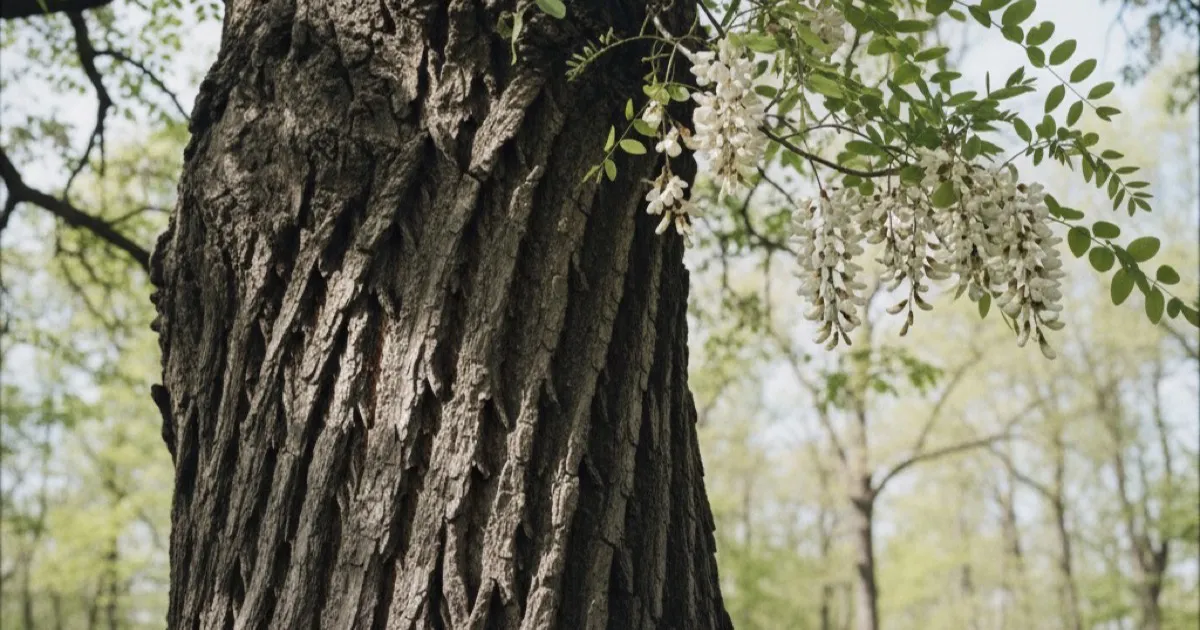
Black locust bark is one of the tree’s best identification features. On mature trees, it sets into deep, interlocking, rope-like ridges that look like braided or twisted cords running up the trunk. The color is dark gray-brown to nearly black, which gives the tree its common name.
This distinctive bark pattern is visible from a distance and unlike most other hardwoods. Combined with the compound leaves and paired thorns, it makes black locust easy to identify. If you’re learning to identify trees by their bark, black locust’s ropy furrows are among the most recognizable patterns you’ll encounter.
Black Locust Flowers
Black locust produces showy clusters of white flowers in late May to early June. The flowers hang in dense, drooping racemes 4 to 8 inches long, and they’re fragrant, with a sweet scent almost like grape or wisteria. Black locust flowers are a major nectar source for honeybees, and “black locust honey” is prized for its light color and mild flavor.
Honey locust flowers are small, greenish, and easy to miss. If you see a locust tree covered in white flower clusters, it’s black locust.
Black Locust Seed Pods
Black locust pods are flat, smooth, and dark brown, typically 2 to 4 inches long. They’re much shorter and neater than honey locust’s long, twisted pods. Each pod holds 4 to 8 small, hard, kidney-shaped seeds.
The seeds are toxic to humans and livestock if eaten in quantity. The bark, leaves, and young shoots are toxic too. That’s another sharp contrast with honey locust, whose pods and pulp are edible.
Honey Locust vs. Black Locust: Side by Side
These two trees share a name but are easy to separate once you know what to look for.
| Feature | Honey Locust | Black Locust |
|---|---|---|
| Leaves | Pinnate or bipinnate, tiny leaflets (fern-like) | Pinnate only, larger oval leaflets |
| Thorns | Branching clusters on trunk (wild type) or thornless (cultivars) | Small paired spines at leaf nodes |
| Bark | Flat-topped ridges, moderate furrows | Deep rope-like, interlocking ridges |
| Flowers | Small, greenish, not showy | Large white clusters, fragrant |
| Pods | Long (6-18”), twisted, sweet pulp | Short (2-4”), flat, toxic seeds |
| Size | 60-80 ft tall, wide spreading crown | 40-80 ft tall, more upright and irregular |
| Spread | Native, planted widely | Native but aggressively invasive |
The quickest test: look at the leaf texture. If the leaflets are tiny and fern-like, it’s honey locust. If they’re 1-2 inch oval leaflets in matched pairs, it’s black locust.
Where Locust Trees Grow
Honey locust is native from Pennsylvania south to Alabama and west to Nebraska and Texas. It grows in bottomlands, riverbanks, and open woodlands. The thornless cultivars are planted throughout the United States and southern Canada as street trees and shade trees. They shrug off road salt, compacted soil, drought, and urban pollution better than most species.
Black locust is native to the Appalachian Mountains and Ozark Plateau. Since European settlement, it has spread to all 50 states and is considered invasive in many areas. It colonizes disturbed ground aggressively through root suckers, throwing up dense thickets. You’ll find it along roadsides, old fields, forest edges, and railroad corridors. It’s a familiar face on most lists of invasive tree species in the eastern US.
Both species prefer full sun and tolerate poor, dry soils. As legumes, they fix atmospheric nitrogen through root nodule bacteria, which lets them thrive in nutrient-poor ground where other trees struggle.
Common Locust Cultivars You’ll See
Most locust trees in landscaped areas are cultivars, not wild types:
- ‘Shademaster’ honey locust — Thornless, mostly podless, strong central leader. The most commonly planted street tree cultivar.
- ‘Sunburst’ honey locust — Thornless, with bright yellow-green new growth in spring that gradually turns green. Smaller than ‘Shademaster’.
- ‘Skyline’ honey locust — Thornless, broadly pyramidal crown, good fall color.
- ‘Purple Robe’ black locust — Dark pink-purple flowers instead of white. Planted ornamentally.
- ‘Frisia’ black locust — Golden-yellow foliage through the growing season. Popular in European gardens.
If you see a locust tree in a yard or along a street, it’s almost certainly a thornless honey locust cultivar. Black locust cultivars are less common in landscaping because the species spreads aggressively.
Trees Often Mistaken for Locust Trees
A few other trees carry compound leaves, thorns, or long pods and get tagged as locusts by mistake:
- Black walnut: Compound leaves like locust, but the leaflets are larger (2 to 5 inches), serrated, and give off a strong spicy scent when crushed. See black walnut identification for the full comparison.
- Kentucky coffeetree: Also bipinnately compound and pod-bearing, but its pods are thick, woody, and only 5 to 10 inches, and it has no thorns.
- Mimosa (silk tree): Bipinnate, ferny foliage that resembles honey locust from a distance, but it produces pink powder-puff flowers no locust has.
- Tree of heaven: Compound leaves that look vaguely locust-like, but the leaflets have a couple of glandular teeth near the base and the crushed foliage smells rank. Our tree of heaven guide covers the tells.
When the leaves and pods send mixed signals, a bark and flower check usually settles it.
Identifying Locust Trees With Tree Identifier
Locust trees have compound leaves that trip up beginners. The Tree Identifier app takes the guesswork out of it. Photograph a leaf, a section of bark, or a flower cluster, and the AI will tell you whether you’re looking at honey locust, black locust, or something else entirely. The app identifies from leaves, bark, flowers, and fruit, so you can confirm during any season.
It also works offline, which helps if you’re hiking through Appalachian forests where black locust is common and cell signal is spotty. Two free identifications per day let you try it without a subscription.
Frequently Asked Questions
How do I tell honey locust from black locust fast?
Check the leaf texture and the pods. Honey locust has tiny, fern-like leaflets and long (6 to 18 inch) twisted pods. Black locust has larger oval leaflets in matched pairs and short (2 to 4 inch) flat pods. If it’s covered in drooping white flower clusters in late spring, it’s black locust.
Are locust trees toxic?
Black locust bark, leaves, and seeds are toxic to humans and livestock. Honey locust isn’t toxic; its pods and pulp are edible and were historically used as food. Always confirm the species before assuming anything is safe.
Are locust trees invasive?
Black locust is considered invasive in many US states. It spreads through root suckers and can form dense thickets that crowd out native plants. Honey locust isn’t typically invasive, though seedlings can pop up from pods.
How long do locust trees live?
Honey locusts typically live 100 to 150 years. Black locusts have shorter lifespans, usually 60 to 100 years, partly because they’re prone to the locust borer beetle, which weakens the trunk over time.
Why do honey locust trees have thorns?
The thorns evolved as defense against large herbivores that are now extinct in North America, including mammoths and ground sloths that browsed on the tree. The long, twisted seed pods were likely dispersed by these megafauna. Today, cattle and deer eat the pods, but the thorns serve less purpose, which is why thornless cultivars grow fine without them.
How do I identify a locust tree in winter?
With the leaves gone, use bark, thorns, and leftover pods. Black locust shows deep, rope-like braided ridges and short flat pods. Honey locust shows flatter ridged bark, often big branching trunk thorns on wild trees, and long corkscrew pods on the ground. The seed pods usually give it away.
Can you tell honey locust from black walnut by the leaves?
Both have compound leaves, but black walnut leaflets are larger (2 to 5 inches), have serrated edges, and release a strong spicy scent when crushed. Honey locust leaflets are much smaller (under 1.5 inches) and unscented. The leaf texture difference is obvious side by side.
Want to identify locust trees and other species with confidence? Try Tree Identifier — snap a photo of a leaf, bark, or flower and get an instant ID.
Identify a tree from your photo — free
Upload a leaf, bark, or whole-tree photo and get the species in seconds. No signup.
Confidence:
Unlock the full species profile
Free in the app — with unlimited identifications.


AI result for guidance — the app gives full species details and works offline.
Want unlimited identifications?
Get the full species profile, photos and details — free in the app, with unlimited scans.
- Unlimited identifications
- Full species profiles & details
- Works offline, anywhere
- Save and revisit your finds
Elena Torres
Tree Identifier Team