Persimmon Tree Identification: 7 Reliable Signs
You’ve probably walked past a persimmon tree dozens of times without knowing it. In summer, they blend right in with the surrounding woodland. Come fall, they’re impossible to miss: bright orange fruits hanging from bare branches like ornaments, weeks after every leaf has dropped. Knowing how to do persimmon tree identification before the fruit appears is what separates a casual hiker from someone who can read the forest. This guide covers 7 reliable features, from bark to fruit to twig anatomy.
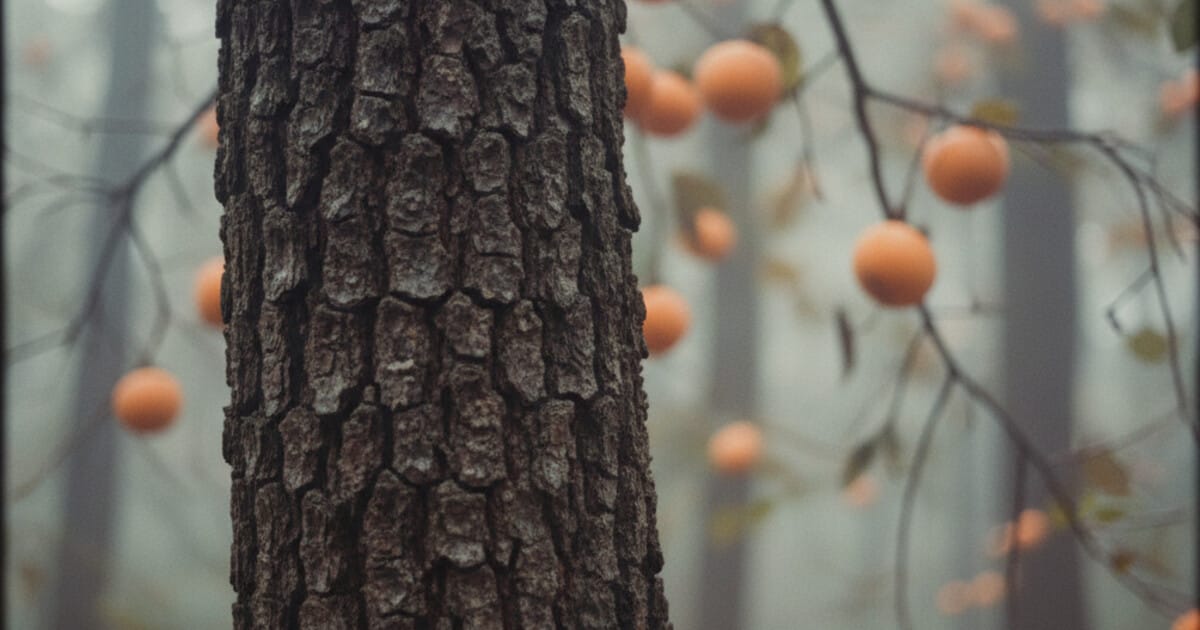
To identify a persimmon tree, look for deeply furrowed bark broken into thick, blocky squares (commonly called “alligator bark”), alternate oval leaves with a glossy dark green surface, and small bell-shaped white flowers in early summer. In fall, ripe orange fruits cinch the identification. American persimmon trees grow throughout the eastern United States, from Connecticut to Florida and west to Kansas.
What Does a Persimmon Tree Look Like?
The American persimmon (Diospyros virginiana) is a medium-sized tree, typically 35-60 feet tall in the wild, though yard specimens often stay at 20-35 feet. The crown is dense and rounded, with branches that tend to droop slightly at the tips as the tree matures.
American persimmon (Diospyros virginiana) grows natively across the eastern United States, from Connecticut south to Florida and west to Kansas and Texas. It’s one of only two persimmon species native to North America. The tree reaches 35-60 feet in ideal conditions but more often matures at 20-40 feet in open areas and suburban settings. The most diagnostic feature for identification is the bark: thick, blocky, and deeply furrowed into a pattern botanists compare to alligator hide or a cracked tile mosaic. This bark pattern appears on trees as young as 10-12 years and becomes more pronounced with age. Persimmon is dioecious, meaning male and female flowers appear on separate trees, so only female trees produce fruit. The wood is exceptionally hard and was historically used for golf club heads and shuttle blocks in textile mills, making it one of the most commercially valuable small hardwoods in North America.
You’ll find persimmons in abandoned fields, forest edges, and along roadsides. The tree tolerates poor soils and drought better than most native hardwoods, which is why it colonizes disturbed areas so readily.
Persimmon Tree Identification by Bark
Persimmon bark is the single most reliable year-round identification feature, and it’s one of the more distinctive barks on any eastern tree.
On mature trees, the bark breaks into thick, blocky plates separated by deep furrows. The overall color ranges from dark gray to brown-black. From a distance the pattern looks like stacked bricks or puzzle pieces locked together. Some people call it “alligator bark” because the rough, rectangular scales really do resemble hide.
This pattern sets in on trees as young as 8-10 years. Young persimmons have smoother, gray-brown bark with shallower grooves, but by middle age the alligator texture is hard to mistake.
There’s also a quick twig test: cut a persimmon twig and look at the cross-section. The pith is chambered, divided into horizontal segments like a ladder. This feature appears in only a handful of native species and serves as a fast confirmation when you’re uncertain. Our full tree bark identification guide walks through how bark texture and pattern work as a systematic ID tool across dozens of species.
Persimmon Tree Identification by Leaf
Persimmon leaves are alternate (they don’t grow in opposite pairs) and simple, with an oval to oblong shape. They run 2-6 inches long, taper at the tip, and have smooth edges with no teeth or lobes. The upper surface is a rich, glossy dark green; the underside is lighter and sometimes slightly fuzzy along the midrib.
In good light, the leaves have a slightly waxy, leathery quality. They’re not flashy like maple or oak, but the combination of alternate arrangement, smooth margins, and glossy top surface narrows things down quickly.
In fall, persimmon leaves turn yellow, orange, and occasionally red before dropping. The timing often overlaps with fruit ripening, so leaves and fruit fall together in many areas.
One identification trick worth knowing: crush a persimmon leaf and smell it. The scent is faintly astringent and slightly medicinal, distinct once you’ve noticed it a few times. It doesn’t smell like anything you’d confuse with a nearby oak or maple.
For a broader look at how leaf shape and margin characteristics speed up identification, see our guide on tree identification by leaf shape. Alternate leaf arrangement is one of the first things to check; we also have a dedicated piece on trees with alternate leaves that covers which families use this pattern.
Persimmon Identification by Fruit and Flower
Persimmon flowers are small, bell-shaped, and cream to pale yellow. They appear in May through June on American persimmon, hanging singly or in small clusters from leaf axils. The flowers aren’t showy. Most people walk right past them.
The fruit is the showpiece. American persimmon fruits are round, 1-2 inches across, and start out yellow-green. They ripen to deep orange, sometimes with a reddish blush, from September through November. The dried calyx (the leafy cap at the base of the fruit) stays attached even after the fruit drops, which is another reliable clue.
A note on taste: unripe persimmons are aggressively astringent, dry enough to make your mouth pucker for minutes. Ripe ones, especially after a frost, are sweet and almost date-like. Many people bite into an unripe one and assume something is wrong. The fruit just isn’t ready.
Japanese persimmon (Diospyros kaki) fruits are larger at 2-4 inches, more orange-red, and found mainly on cultivated trees in gardens and farms. If the fruit is large and tomato-shaped, you’re looking at a Japanese variety.
American Persimmon vs. Japanese Persimmon
Both species share the same family and look similar at a glance. A few features separate them in the field:
| Feature | American Persimmon | Japanese Persimmon |
|---|---|---|
| Fruit size | 1-2 inches | 2-4 inches |
| Native range | Eastern United States | Asia (cultivated in US) |
| Tree height | 20-60 feet | 15-30 feet |
| Bark | Deeply blocky, very dark | Moderate furrows, gray-brown |
| Cold hardiness | USDA Zones 4-9 | Zones 7-10 typically |
American persimmon bark is darker and more deeply textured than Japanese persimmon. Japanese persimmon is almost always found near homes, orchards, and farms in warmer climates (the Southeast, California, Pacific Northwest).
If you’re in the eastern US and the tree is growing in a wild or semi-wild setting with that characteristic alligator bark, it’s almost certainly Diospyros virginiana. Wild persimmons are rare west of the Great Plains.
The 7 Signs: Quick Field Reference
When you’re standing in front of a tree and want a fast confirmation, run through this list:
- Bark: Deeply furrowed, blocky plates (alligator pattern), dark gray to black
- Twig pith: Chambered (segmented), visible when cut
- Leaves: Alternate, oval, smooth margins, glossy dark green on top
- Leaf scent: Faintly astringent when crushed
- Flowers: Small, bell-shaped, cream-colored, May-June
- Fruit: Round, 1-2 inches, orange when ripe, persistent calyx at base
- Growth habit: Medium tree, rounded crown, drooping branch tips
Any 3-4 of these together make a confident identification. The bark plus chambered pith plus alternate leaves is an airtight combination even without fruit.
How Tree Identifier Helps
Persimmon is a tree where photos reveal detail the naked eye can miss under a time crunch. The chambered pith requires cutting a twig, which isn’t always practical. The bark pattern is obvious up close but easy to second-guess when you’re not yet familiar with it.
Tree Identifier can confirm a persimmon ID from a leaf photo, a bark photo, or a fruit photo. The app supports multiple input types, so whichever part of the tree you have access to, you can get a result. It covers both American and Japanese persimmon and gives you detailed species info with each identification: habitat, characteristics, and uses.
Two free daily identifications, with offline mode for areas without cell signal. Download on iOS or Android and bring it on your next walk.
Frequently Asked Questions
What’s the easiest way to identify a persimmon tree?
The bark. On any mature persimmon (10+ years old), the deeply furrowed, blocky plate pattern is unmistakable. It looks like alligator hide and doesn’t closely resemble any other common North American tree. For quick confirmation, cut a small twig and check for the distinctive chambered (segmented) pith inside.
Are persimmon trees common in the US?
American persimmon is widespread across the eastern United States, from Connecticut to Florida and as far west as Kansas. It’s especially common in abandoned fields, forest edges, and along roadsides. The tree tolerates poor, dry soils and colonizes disturbed areas readily, so you likely pass several without recognizing them.
Do all persimmon trees produce fruit?
Only female trees produce fruit. Persimmon is dioecious, meaning male and female flowers grow on separate trees. A male persimmon will flower but never fruit. In the wild, both sexes grow in the same area because the trees spread readily from seed by wildlife.
How do I tell persimmon from black gum (tupelo)?
Both have dark, furrowed bark and oval leaves with smooth margins, so they’re genuinely easy to confuse. The pith test settles it fast: persimmon pith is chambered (segmented), while black gum pith is solid white. Persimmon leaves are slightly glossier on top, and the bark breaks into more distinctly blocky, raised plates.
When do persimmon fruits ripen?
American persimmon fruits ripen from September through November, depending on location. In the South, harvest can start in late September. Further north, peak ripeness often falls in October or November, sometimes after the first frost. Ripe fruit is soft to the touch and deep orange throughout.
Start Identifying Persimmons This Season
Persimmon is a tree worth knowing. The bark alone is enough to identify a mature specimen any time of year, and once you’ve found that alligator-block pattern a few times, you’ll start spotting persimmons everywhere you walk in eastern woods.
If you want a faster confirmation, snap a photo of the leaf, bark, or fruit and let Tree Identifier give you the species in seconds. It works offline, covers both persimmon species, and gives you the full species profile with each result. Available on iOS and Android at treeidentifier.app.
Identify a tree from your photo — free
Upload a leaf, bark, or whole-tree photo and get the species in seconds. No signup.
Confidence:
Unlock the full species profile
Free in the app — with unlimited identifications.


AI result for guidance — the app gives full species details and works offline.
Want unlimited identifications?
Get the full species profile, photos and details — free in the app, with unlimited scans.
- Unlimited identifications
- Full species profiles & details
- Works offline, anywhere
- Save and revisit your finds
Elena Torres
Tree Identifier Team