Redbud Trees: Identification by Leaves, Flowers and Bark
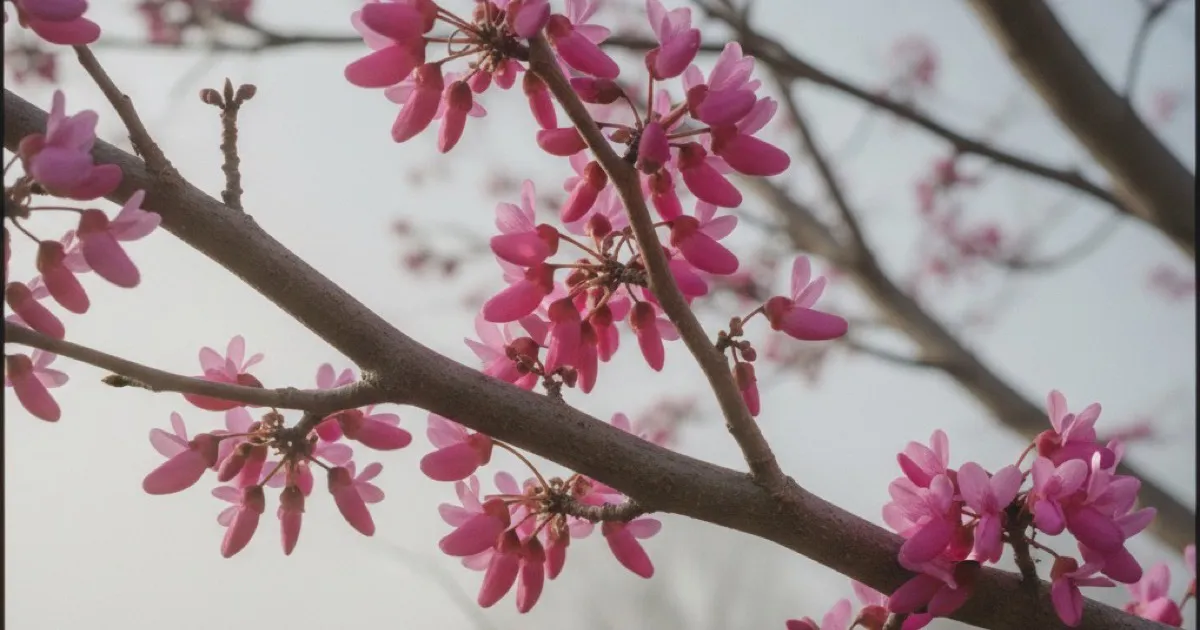
The Eastern redbud stands out in early spring with vibrant pink blooms that appear before the leaves emerge. Redbud trees are small deciduous trees best identified by their heart-shaped leaves, magenta flowers growing directly on branches, and distinctive seed pods that last through winter.
This guide covers how to identify redbud trees by their leaves, flowers, bark, and growth pattern across all four seasons.
Redbud trees (genus Cercis) are small deciduous trees identified by three features: heart-shaped leaves 3 to 5 inches wide, magenta-pink flowers that bloom directly on bare branches in March or April before leaves emerge, and flat brown seed pods that persist through winter. Eastern redbud (Cercis canadensis) is native to eastern North America and grows in USDA zones 4-9.
What Does a Redbud Tree Look Like?
Redbud trees belong to genus Cercis in the pea family (Fabaceae), with 10 species distributed across North America, southern Europe, and Asia. The Eastern redbud (Cercis canadensis) is the most common landscape species in the US, ranging from New Jersey and southern Pennsylvania west to Nebraska and south to central Florida and Texas. Mature trees typically reach 20 to 30 feet tall with a spread of 25 to 35 feet, though specimens in ideal conditions occasionally reach 40 feet. Young redbuds grow fast, adding 4 to 6 feet per year in their early years, before settling into a moderate pace of 12 to 18 inches annually once established. The crown forms a rounded, vase-shaped canopy that spreads wider than its height in open settings. Lifespan averages around 25 years in landscape plantings, often limited by canker disease, though woodland specimens can live longer. USDA hardiness zones 4 through 9 cover the Eastern redbud’s cultivated range.
From a distance, redbuds read as small multi-stemmed trees with a low branching habit. The trunk usually splits near the base, sending up 2 to 4 main stems instead of a single leader. In spring, the whole tree looks wrapped in a purple-pink cloud. By midsummer, the dense heart-leaf canopy turns it into a solid shade tree. Through winter, the zigzagging branch structure and clusters of dangling seed pods make redbud easy to pick out even without any foliage.
Identifying Redbud Trees by Flowers
Redbud flowers arrive in March or April, depending on your location. The blooms appear before leaves, covering bare branches in clusters of magenta-pink petals.
Each flower measures about half an inch long and grows in tight bunches directly on the wood. This growth pattern is called cauliflory, where flowers emerge from old bark rather than new growth. You’ll see blooms sprouting from thick trunks and major branches, not just twigs.
The flowers attract early-season pollinators like bees and hummingbirds. Bloom time lasts two to three weeks before petals drop and leaves take over.
White-flowered cultivars exist, but the standard Eastern redbud displays that signature pink-purple color that gives the tree its name. If you see similar pink spring blooms and wonder whether you’re looking at a redbud or a cherry tree, check the trunk: a cherry tree’s flowers cluster on thin stalks from stem nodes, while redbud blooms push directly out of thick bark with almost no stalk at all.
Heart-Shaped Leaves Make Redbud Easy to Spot
Once leaves emerge in late spring, redbud tree identification becomes straightforward. The leaves are perfectly heart-shaped with smooth edges and a pointed tip.
Leaf size ranges from 3 to 5 inches across. They’re arranged alternately on branches, not in pairs. The surface feels slightly leathery with visible veins radiating from the base.
Color starts as bronze-red when leaves first unfold, shifts to deep green through summer, then turns yellow or pale gold in fall. Some cultivars like ‘Forest Pansy’ maintain purple foliage all season.
The leaf shape is so distinct that you can identify a redbud from across a yard once you’ve seen it once. No other common landscape tree has that perfect heart outline. For a look at other spring-blooming trees that share a similar landscape role, the guide to trees with pink flowers covers 10 species side by side.
Bark Texture and Color Changes with Age
Young redbud bark is smooth and gray-brown, similar to beech or cherry. As the tree matures, the bark develops shallow fissures and small scales.
Older specimens show a darker, almost charcoal color with irregular vertical ridges. The bark never becomes deeply furrowed like oak or ash. Instead, it maintains a relatively smooth appearance with subtle texture.
Branch structure is also useful for redbud tree identification. The trunk typically splits low to the ground, creating multiple stems. Branches zigzag slightly rather than growing perfectly straight.
In winter, you can spot redbuds by their branching pattern and the small flower buds that dot every twig and branch. Dogwood trees share the spring-bloomer niche but separate easily: dogwoods have opposite branching (pairs of branches directly across from each other), while redbud branches alternate. Dogwood’s showy spring display comes from white or pink bracts with a distinct notch at the tip, not from true petals pressed against bare wood.
Seed Pods Hang Through Winter
After flowers fade, flat seed pods develop by midsummer. Each pod measures 2 to 4 inches long and contains several hard seeds.
The pods start green, turn brown by fall, and persist through winter. They hang in clusters from branches, making redbud identification possible even when the tree is bare.
Inside each pod, you’ll find 4 to 10 round, flat seeds. The pods eventually split open in late winter, scattering seeds on the ground below.
Birds and small mammals eat the seeds, helping spread redbuds to new locations.
Redbud Species, Varieties, and Seedling ID
The Eastern redbud (Cercis canadensis) is native to the eastern United States and most common in landscapes. It grows from New York south to Florida and west to Texas.
Western redbud (Cercis occidentalis) grows in California and nearby states. It’s smaller, more drought-tolerant, and has slightly different flower color. Western redbud leaves are more rounded and sometimes slightly notched at the tip, while Eastern redbud leaves taper to a distinct point.
Chinese redbud (Cercis chinensis) is a popular ornamental with showier flowers and a more compact shape. European varieties like Cercis siliquastrum appear in older gardens and parks.
Cultivars offer different features. ‘Forest Pansy’ has purple leaves all season. ‘Covey’ grows in a weeping form. ‘Alba’ produces white flowers instead of pink. ‘Rising Sun’ shows apricot-orange new growth that fades to gold-green by midsummer.
Redbud seedling identification trips people up because young trees haven’t developed their cauliflory flowering yet. Look for the heart-shaped leaf with a rounded base and slightly pointed tip, the thin alternate branching, and the reddish-bronze color of new growth. Seedlings often appear in disturbed soil near mature redbuds, where split pods have scattered seeds. The alternate leaf arrangement and perfectly cordate (heart-shaped) base distinguish redbud seedlings from most other tree seedlings in the same habitat.
Where Redbuds Grow and How Big They Get
Eastern redbuds thrive in USDA zones 4 through 9. They prefer woodland edges, roadsides, and stream banks in partial shade.
Full sun works fine, but afternoon shade in hot climates helps prevent leaf scorch. Redbuds tolerate most soil types as long as drainage is decent, including clay soil and both alkaline and acidic pH.
Mature height reaches 20 to 30 feet, with a similar spread. The canopy forms a rounded or vase shape. Growth rate slows considerably after the first few years, settling around 12 to 18 inches per year once established.
Redbuds make excellent understory trees beneath taller oaks, maples, or pines. They also work as standalone specimens in smaller yards where space limits options. For a broader look at small flowering trees that fill a similar landscape role, see the guide to ornamental trees.
How Tree Identifier Helps Confirm Redbud
If you’re not sure whether you’ve found a redbud or a similar species, taking a photo can settle the question instantly.
Tree Identifier uses AI to analyze leaves, flowers, bark, or the whole tree shape. The app compares your photo against thousands of species and returns an identification with a confidence score.
The offline mode works on remote hikes where cell service drops out. You get 2 free identifications daily, so you can check multiple trees without paying upfront.
Photos of heart-shaped leaves or those distinctive pink blooms work best. The app also identifies wood grain if you’re working with cut lumber and want to know the species.
Frequently Asked Questions
When do redbud trees bloom?
Redbud trees bloom in early spring, typically March or April depending on location. Flowers appear before leaves emerge and last 2-3 weeks. Southern regions see blooms earlier than northern areas.
Are redbud and Judas tree the same?
Yes, Eastern redbud is sometimes called Judas tree, though that name more commonly refers to the European species Cercis siliquastrum. Both share the same distinctive flowers and leaf shape.
Do redbud trees grow fast?
Young redbuds grow fast, adding 4 to 6 feet per year in their first several years. Growth slows to 12 to 18 inches per year once established. Mature height of 20 to 30 feet is typically reached within 10 to 15 years.
Can you eat redbud flowers?
Redbud flowers are edible and have a slightly tart, pea-like flavor. People add them to salads, bake them into cookies, or pickle the buds. Always confirm identification before eating any wild plant.
Why is my redbud not blooming?
Lack of blooms often results from too much shade, heavy pruning that removed flower buds, or late spring frost damage. Redbuds need at least 4 hours of sun and should be pruned right after flowering, not in fall or winter.
Identify a tree from your photo — free
Upload a leaf, bark, or whole-tree photo and get the species in seconds. No signup.
Confidence:
Unlock the full species profile
Free in the app — with unlimited identifications.


AI result for guidance — the app gives full species details and works offline.
Want unlimited identifications?
Get the full species profile, photos and details — free in the app, with unlimited scans.
- Unlimited identifications
- Full species profiles & details
- Works offline, anywhere
- Save and revisit your finds
Elena Torres
Tree Identifier Team