How to Identify a Spruce Tree: 7 Species by Needle, Cone, and Bark
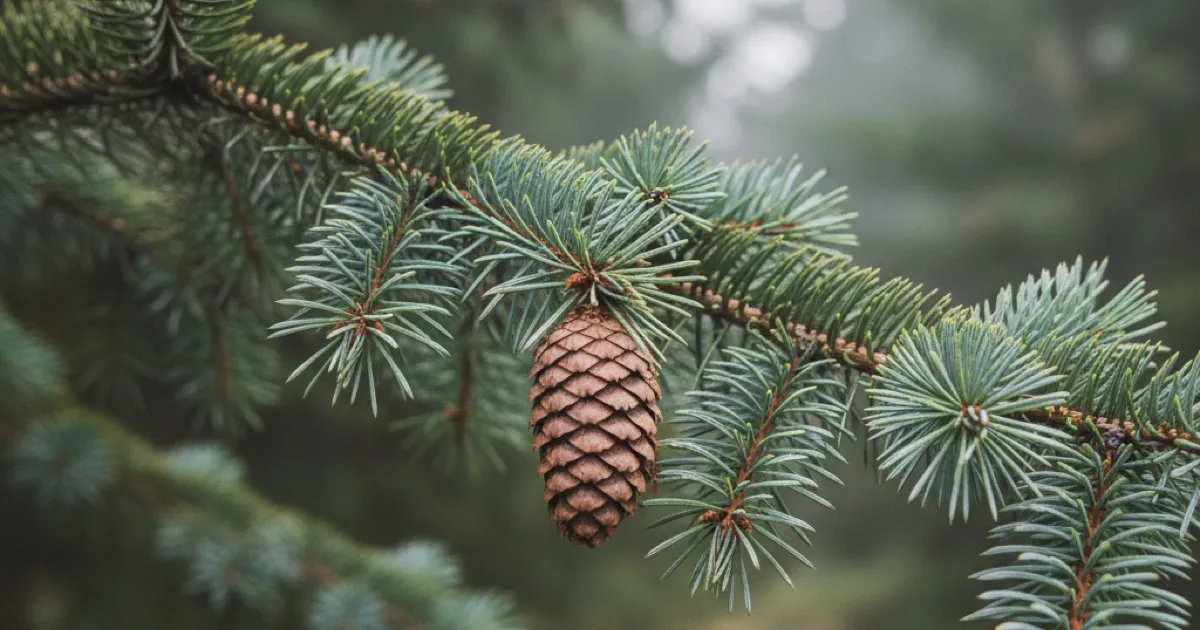
Spruce trees are everywhere in northern forests, mountain landscapes, and suburban yards, but most people lump them in with pines and firs without knowing the difference. Spruce tree identification starts with one simple test: roll a needle between your fingers. If it rolls easily, it’s a spruce. Pine needles come in bundles, and fir needles are flat and won’t roll. That single check separates spruce from the two groups it’s most confused with.
North America has about 20 native and commonly planted spruce species. This guide covers the most widespread ones, with the specific features you need to tell them apart in the field.
The Quick Spruce Test: Needles, Pegs, and Cones
Before diving into individual species, here’s how to confirm you’re looking at a spruce and not a pine or fir.
Spruce needles are:
- Short (1/2 to 1 inch on most species)
- Stiff and sharp-pointed — they prick your hand when you grab a branch
- Square in cross-section (they roll between your fingers)
- Attached individually to small woody pegs (called sterigmata) on the twig
- When you pull a needle off, the peg stays on the twig, leaving it rough and bumpy
Spruce cones hang downward from branches and fall to the ground intact. Fir cones stand upright and disintegrate on the tree. Pine cones are typically larger and have thicker scales.
Spruce bark is thin and scaly on most species, often flaking off in small plates or strips. It’s generally not as dramatic as pine bark.
If the tree has short, stiff, individually-attached needles on bumpy twigs with hanging cones, it’s a spruce.
Blue Spruce (Picea pungens)
Blue spruce is the most recognizable spruce in landscaping. Its needles range from silvery blue to blue-green, and the color is distinctive enough to identify the tree from across a parking lot.
Key identification features:
- Needles are 3/4 to 1.25 inches long, very stiff and sharply pointed — the most painful spruce to grab
- Needle color ranges from green to intense silver-blue. Cultivars like ‘Hoopsii’ and ‘Fat Albert’ are selected for the bluest color
- Cones are 2 to 4 inches long, light brown, with thin, papery, wavy-edged scales
- Bark is grayish-brown and furrowed on mature trees
- Grows 30 to 60 feet tall in landscapes (up to 100 feet in the wild)
Where it grows: Native to the Rocky Mountains of Colorado, Utah, Wyoming, and New Mexico at elevations of 6,000 to 11,000 feet. Planted extensively as an ornamental across the northern half of the U.S. and southern Canada.
Blue spruce is the state tree of Colorado and one of the most planted conifers in American yards. It tolerates drought better than most spruces but can struggle with fungal diseases (needle cast, Cytospora canker) in humid eastern climates.
Norway Spruce (Picea abies)
Norway spruce is the classic European spruce, widely planted in North America as a windbreak, specimen tree, and Christmas tree. Mature trees are immediately recognizable by their drooping branch tips — the side branches hang down like curtains.
Key identification features:
- Needles are 1/2 to 1 inch long, dark green, with a slight sheen
- The drooping (pendulous) side branches are the strongest ID feature — no other common spruce droops this much
- Cones are the largest of any spruce: 4 to 7 inches long, cylindrical, light brown
- Bark is dark reddish-brown with thin, irregular scales
- Grows fast for a spruce — 60 to 80 feet tall, sometimes over 100 feet
Where it grows: Native to northern and central Europe. In North America, planted throughout the Northeast, Midwest, and Great Lakes region. Common on farms, old estates, and as windbreaks along roads.
Norway spruce is one of the fastest-growing spruces, adding 2 to 3 feet per year when young. The large cones are a useful ID feature — find a cone under a spruce and it’s probably Norway if the cone is over 4 inches long.
White Spruce (Picea glauca)
White spruce is one of the most common native spruces in North America, stretching across Canada and into the northern U.S. It’s adaptable, cold-hardy, and widely used for reforestation and windbreaks.
Key identification features:
- Needles are 1/2 to 3/4 inch long, pale blue-green to green
- Crushed needles have a strong, unpleasant smell that some describe as cat urine or skunk. This smell is the fastest way to confirm white spruce
- Cones are small (1.5 to 2.5 inches), light brown, with smooth-edged scales
- Bark is thin, grayish-brown, scaly
- Grows 40 to 60 feet tall with a narrow, conical shape
Where it grows: Native from Alaska across Canada to Newfoundland, and south into the northern U.S. (Minnesota, Wisconsin, Michigan, Maine, Vermont). Also planted widely as a landscape tree, windbreak, and Christmas tree.
The Black Hills spruce (Picea glauca var. densata) is a compact, slower-growing variety popular in landscaping. It has denser needles and a more uniform shape than typical white spruce.
Black Spruce (Picea mariana)
Black spruce is a boreal specialist. It grows in cold, wet, acidic bogs and muskegs across northern North America. It’s typically smaller and scruffier than other spruces, adapted to some of the harshest growing conditions on the continent.
Key identification features:
- Needles are short (1/4 to 1/2 inch), blue-green, and blunt-tipped — less prickly than other spruces
- Cones are very small (3/4 to 1.5 inches), egg-shaped, dark purple when young, turning brown. They often cluster near the top of the tree and persist for years
- Bark is thin, grayish-brown to blackish
- Grows 30 to 50 feet tall, often with a narrow, spire-like crown. In bogs, trees may be stunted to 10 to 15 feet
- Lower branches often layer (touch the ground and root), forming clusters around the parent tree
Where it grows: Alaska across Canada to Newfoundland, south into Minnesota, Wisconsin, Michigan, and New England. Dominates boreal bogs and muskegs.
If you’re in a northern bog and see small, scraggly spruces with tiny cones clustered at the top, they’re black spruce.
Red Spruce (Picea rubens)
Red spruce is the spruce of the Appalachian Mountains and the New England highlands. It grows at higher elevations in the East, often mixed with balsam fir in cloud forests.
Key identification features:
- Needles are 1/2 to 5/8 inch long, yellow-green to dark green, curved slightly upward
- Cones are 1.5 to 2 inches long, reddish-brown (giving the tree its name), with stiff, smooth-edged scales
- Bark is reddish-brown and scaly — redder than other spruces
- Grows 60 to 80 feet tall with a narrow, pointed crown
Where it grows: Appalachian Mountains from North Carolina to New England, and across the Canadian Maritimes. At lower elevations in the north, at higher elevations (above 4,500 feet) in the south.
Red spruce has declined in parts of its range due to acid rain and climate change. It’s still common in northern New England and at high elevations in West Virginia and North Carolina.
Sitka Spruce (Picea sitchensis)
Sitka spruce is the largest spruce species in the world. Mature trees in coastal Pacific Northwest forests reach 200 feet tall with trunks 8 to 12 feet in diameter. It’s a tree of the fog belt, growing only within the maritime influence zone along the coast.
Key identification features:
- Needles are 3/4 to 1 inch long, flat (unusual for spruce), stiff, and extremely sharp-pointed. Running your hand along a branch is painful
- Needles are dark green above and silvery-white below (two bright white stripes of stomata)
- Cones are 2 to 3.5 inches long, light brown, with thin, papery scales with irregular edges
- Bark on old trees is dark purplish-brown and breaks into thick, loose scales
- Grows 150 to 200+ feet tall in old-growth forests
Where it grows: A narrow coastal strip from Alaska to northern California, never more than about 50 miles inland. Requires cool temperatures and high humidity.
Sitka spruce is the most important timber species in coastal Alaska and one of the iconic trees of the Pacific Northwest rainforest.
Engelmann Spruce (Picea engelmannii)
Engelmann spruce is the high-elevation spruce of the western mountains. It fills the same ecological role as red spruce does in the East — the dominant spruce at higher altitudes.
Key identification features:
- Needles are 1 to 1.25 inches long, blue-green, softer and more flexible than blue spruce. Less painful to grab
- Crushed needles have a distinctive camphor or menthol smell (different from white spruce’s unpleasant odor)
- Cones are 1.5 to 2.5 inches long, light brown, with thin scales that have ragged or pointed tips
- Bark is thin, reddish-brown to grayish, scaly
- Grows 80 to 120 feet tall
Where it grows: Rocky Mountains and Cascades from British Columbia to Arizona, at elevations of 5,000 to 12,000 feet. Often the dominant tree at timberline.
Engelmann and blue spruce overlap in the Rockies and can hybridize. Engelmann has softer needles and a camphor smell; blue spruce has stiffer, bluer needles and no distinctive crushed-needle odor.
Spruce vs. Fir vs. Pine: Quick Comparison
People confuse these three conifer groups constantly. Here’s the fastest way to tell them apart:
| Feature | Spruce | Fir | Pine |
|---|---|---|---|
| Needles | Short, stiff, square, roll between fingers | Short, soft, flat, won’t roll | Long, in bundles of 2, 3, or 5 |
| Attachment | Individual on woody pegs | Individual, flat to twig | In bundles (fascicles) |
| Twig after needle removal | Rough, bumpy (pegs remain) | Smooth (no pegs) | Smooth |
| Cones | Hang down, fall whole | Stand upright, fall apart on tree | Hang down, fall whole |
| Needle feel | Prickly, sharp | Soft, friendly | Stiff but not sharp |
For a deeper comparison, see our pine vs spruce vs fir guide.
Identifying Spruce Trees With Tree Identifier
Spruce identification gets tricky when you’re dealing with similar-looking species in the same forest. Blue spruce and Engelmann spruce. White spruce and black spruce. The Tree Identifier app can sort these out from a photo of the needles, bark, or cones. Snap a close-up of the needle arrangement on the twig, and the AI identifies the species. The app works offline, which matters in the remote mountain and boreal forests where spruces dominate. You get 2 free identifications per day.
Frequently Asked Questions
How do you tell spruce from pine?
The fastest test: check how needles attach. Spruce needles grow individually from small pegs on the twig. Pine needles grow in bundles of 2, 3, or 5 wrapped at the base. Also, spruce needles are short (under 1.5 inches) and sharp. Most pine needles are 2+ inches long.
What spruce tree has blue needles?
Blue spruce (Picea pungens) is the most common spruce with blue needles. The color ranges from green to intense silver-blue depending on the individual tree and cultivar. Engelmann spruce and white spruce can also appear blue-green, but neither matches the vivid blue of selected blue spruce cultivars.
Are spruce trees good for landscaping?
Blue spruce, Norway spruce, and white spruce (especially Black Hills variety) are all popular landscape trees. Blue spruce provides year-round color. Norway spruce grows fast and makes an excellent windbreak. White spruce is cold-hardy and compact. All prefer full sun and well-drained soil. In humid southeastern climates, spruces often struggle with fungal diseases.
Do spruce trees drop their needles?
Spruce trees are evergreen and keep their needles year-round. However, individual needles last 5 to 10 years, and older needles near the trunk do drop naturally. If a spruce is losing needles from the tips of branches or turning brown in patches, that’s likely disease or stress, not normal shedding.
What is the largest spruce tree?
Sitka spruce is the largest spruce species, reaching over 200 feet tall with trunks exceeding 10 feet in diameter. The largest known Sitka spruce stands in Olympic National Park in Washington state. In the eastern U.S., red spruce and Norway spruce are the tallest spruces, typically reaching 80 to 100 feet.
Need help identifying a spruce in your yard or on a mountain hike? Try Tree Identifier — snap a photo of the needles, bark, or cone and get the species in seconds.
Identify a tree from your photo — free
Upload a leaf, bark, or whole-tree photo and get the species in seconds. No signup.
Confidence:
Unlock the full species profile
Free in the app — with unlimited identifications.


AI result for guidance — the app gives full species details and works offline.
Want unlimited identifications?
Get the full species profile, photos and details — free in the app, with unlimited scans.
- Unlimited identifications
- Full species profiles & details
- Works offline, anywhere
- Save and revisit your finds
Elena Torres
Tree Identifier Team