Sweetgum Tree Identification: Leaves, Bark, and Spiky Gumballs
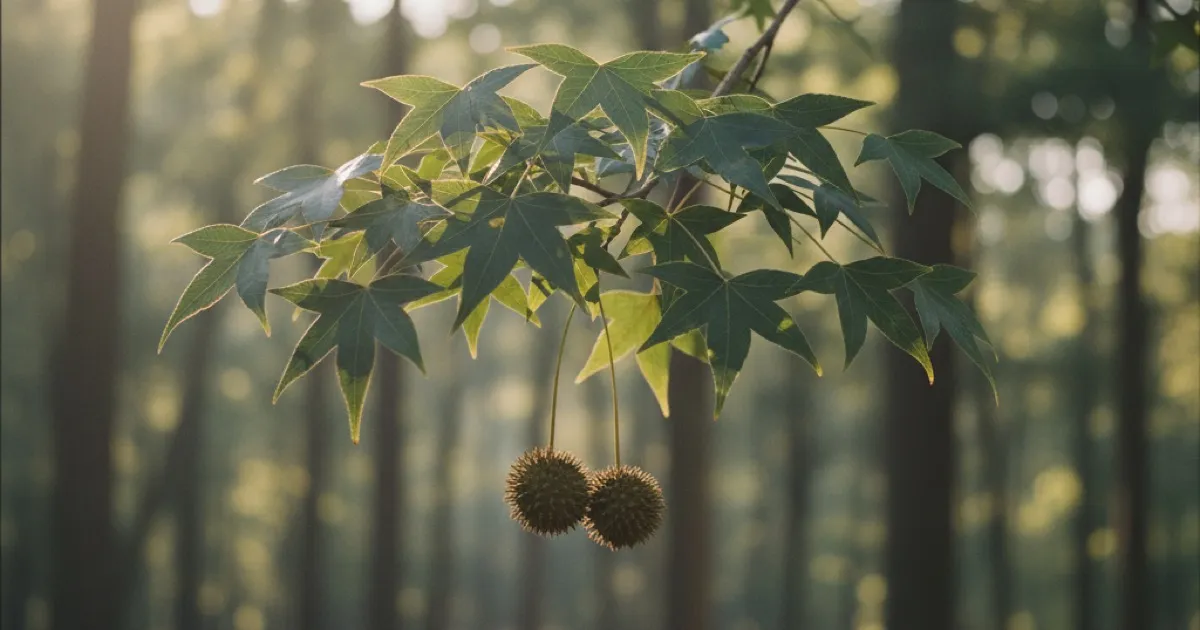
Most people meet sweetgum trees without knowing their name. They step on the spiky brown balls littering sidewalks in fall, curse the mess, and move on. But the American sweetgum (Liquidambar styraciflua) is one of the most recognizable trees in eastern North America once you know what to look for. Its star-shaped leaves, corky-winged branches, and those infamous seed balls make sweetgum tree identification straightforward at any time of year.
This guide covers how to identify sweetgum trees by their leaves, bark, fruit, and overall shape. You’ll also learn where they grow, how to tell them from look-alikes, and why they deserve more credit than they get.
Sweetgum Leaves: The Five-Pointed Star
The leaf is the fastest way to identify a sweetgum. Each leaf has five pointed lobes arranged in a star shape, roughly 4 to 7 inches across. The lobes are deeply cut and evenly spaced, giving the leaf a symmetrical, almost geometric look.
A few key details separate sweetgum leaves from similar species:
- Alternate arrangement. Sweetgum leaves grow alternately on the branch, one per node. This is the single most reliable way to distinguish them from maples, which have opposite leaves (two per node, directly across from each other).
- Serrated edges. The margins of each lobe have fine, sharp teeth. Maple leaves can be smooth-edged or toothed depending on species, but sweetgum teeth are consistently fine and even.
- Fragrance. Crush a sweetgum leaf and it releases a mild, resinous scent. The name “sweetgum” comes from the aromatic sap, and the leaves carry a hint of it.
- Glossy surface. The upper surface of the leaf is dark green and shiny during the growing season. In fall, sweetgum leaves turn vivid shades of yellow, orange, red, and purple — often with multiple colors on the same tree or even the same leaf.
Sweetgum fall color is among the most spectacular of any North American hardwood. A single tree can display four or five colors at once because individual leaves change at different rates.
Sweetgum Bark Identification
Young sweetgum trees have smooth, gray-brown bark that’s unremarkable. But as the tree matures, the bark develops deep, narrow furrows in a roughly rectangular pattern. Old sweetgums have bark that looks like a grid of narrow ridges separated by dark, flat-bottomed grooves.
The bark alone won’t identify a sweetgum with certainty — several hardwoods develop furrowed bark with age. But combined with the star-shaped leaves or spiky fruit, it confirms the ID.
One distinctive bark feature shows up on younger branches and twigs: corky wings. Sweetgum branches often develop flat, corky ridges of bark that project outward from the twig like fins. Not every branch has them, but when present, they’re a strong clue. Cork-winged twigs show up most often on vigorous young growth and are visible even in winter when the leaves are gone.
If you’re interested in identifying trees by their bark, sweetgum’s combination of furrowed trunk bark and corky twig wings is a useful two-part pattern to learn.
Sweetgum Fruit: The Spiky Gumball
The fruit is what most people notice first. Sweetgum seed balls are round, about 1 to 1.5 inches in diameter, covered in small woody points. Each ball is actually a cluster of tiny capsules fused together. When the capsules open to release their seeds, the empty points remain, creating the spiky “gumball” that litters the ground from fall through winter.
Here’s what to know about sweetgum fruit:
- They hang from the tree on long, flexible stems, swaying in the wind
- Green in summer, turning brown and woody as they mature in fall
- Each capsule inside the ball holds one or two small winged seeds
- The empty balls persist on the ground well into the following spring
- A single large sweetgum can drop thousands of gumballs per year
The gumballs are the reason some homeowners dislike sweetgum trees. They’re hard to rake, painful to step on barefoot, and can create a slipping hazard on sidewalks. Fruitless cultivars like ‘Rotundiloba’ exist for people who want the tree without the mess.
For identification purposes, the spiky balls are unmistakable. No other common North American tree produces a round, woody, spiny fruit ball quite like the sweetgum.
Sweetgum Tree Shape and Size
American sweetgums are medium to large deciduous trees, typically reaching 60 to 80 feet tall with a trunk diameter of 2 to 3 feet. Some specimens in bottomland forests grow over 100 feet.
The crown shape changes with age:
- Young trees have a narrow, pyramidal shape with a strong central leader
- Mature trees develop a broader, rounded crown
- Open-grown trees (in yards or parks) form a symmetrical oval that makes them popular as shade trees
The branching pattern is moderately dense with a somewhat layered look. In winter, the silhouette is distinctive: a straight trunk with horizontal to slightly drooping branches, often still holding clusters of hanging gumballs.
Where Sweetgum Trees Grow
Sweetgums are native to the southeastern United States and range from Connecticut south to central Florida, west to Texas, and up through the Ohio River valley. They also grow in scattered populations in Mexico and Central America.
They prefer moist, fertile soil and full sun. You’ll find them in:
- Bottomland hardwood forests along rivers and streams
- Mixed hardwood forests throughout the Piedmont and Coastal Plain
- Urban and suburban landscapes as street and park trees
- Abandoned fields and disturbed areas (they colonize open ground quickly)
Sweetgums tolerate wet feet better than most hardwoods. They often share floodplain habitats with tulip poplars, red maples, and river birches. In drier upland sites, they grow more slowly but still survive.
If you’re trying to identify trees in the eastern U.S. and spot star-shaped leaves with alternate branching, sweetgum should be near the top of your list.
Sweetgum vs. Maple: How to Tell Them Apart
This is the most common mix-up. Both sweetgum and maple trees have lobed, star-shaped leaves. But telling them apart is simple once you know the trick.
The one rule: check the leaf arrangement.
- Sweetgum: Leaves are alternate — one leaf per node, staggered along the branch
- Maple: Leaves are opposite — two leaves per node, directly across from each other
That’s it. If the leaves sit in pairs across the stem, it’s a maple. If they alternate singly, it’s a sweetgum. This works even on fallen leaves if you can find a twig still attached.
Other differences that help:
| Feature | Sweetgum | Maple |
|---|---|---|
| Leaf lobes | 5, deeply cut, pointed | 3-5, varies by species |
| Leaf margin | Finely serrated | Smooth or coarsely toothed |
| Fruit | Spiky gumball | Paired winged seeds (samaras) |
| Bark (mature) | Deeply furrowed grid | Varies widely by species |
| Twig feature | Corky wings common | No corky wings |
Uses and Value of Sweetgum Trees
Sweetgum gets a bad reputation because of the gumballs, but the tree has real value.
Lumber. Sweetgum wood is commercially harvested and sold under different names depending on the cut. The heartwood, called “redgum,” has a warm reddish-brown color with darker streaks. The sapwood, called “sapgum,” is lighter and blends well with other hardwoods. It’s used in furniture, plywood, veneer, and interior millwork.
Wildlife. Sweetgum seeds feed goldfinches, purple finches, sparrows, mourning doves, and squirrels. The dense crown provides nesting habitat, and mature trees with cavities shelter woodpeckers and owls.
Landscaping. Despite the gumball complaints, sweetgums are widely planted for their fall color, fast growth, and tolerance of wet soils. The fruitless cultivar ‘Rotundiloba’ has rounded leaf lobes and produces no fruit, solving the litter problem while keeping the spectacular fall display.
Historical use. The resinous sap (called storax or American styrax) was historically used in perfumes, medicines, and chewing gum. Indigenous peoples used the hardened sap medicinally.
Identifying Sweetgum Trees With Tree Identifier
If you’ve found a tree with star-shaped leaves but aren’t sure whether it’s a sweetgum, maple, or something else, the Tree Identifier app can sort it out in seconds. Snap a photo of a leaf, a piece of bark, or one of those spiky gumballs, and the AI identifies the species from the image. It works with leaves, bark, flowers, fruit, and whole tree photos, so you can confirm your ID no matter what part of the tree is in front of you.
The app runs offline too, which matters if you’re in a bottomland forest or on a trail without cell signal. You get 2 free identifications per day to start.
Frequently Asked Questions
Are sweetgum trees and maple trees related?
No. Despite looking similar, sweetgums belong to the family Altingiaceae while maples are in Sapindaceae. They’re not closely related. The easiest way to tell them apart is leaf arrangement: sweetgum leaves grow alternately on the branch, maple leaves grow in opposite pairs.
Are sweetgum balls poisonous?
Sweetgum balls are not poisonous to humans or pets. They’re a nuisance because of their sharp points, but they pose no toxicity risk. The sap has historically been used in traditional medicine and food products.
Can you stop a sweetgum tree from producing gumballs?
Growth regulators containing ethephon can reduce fruit production when applied by a certified arborist during bloom. The only permanent solution is planting a fruitless cultivar like ‘Rotundiloba’ instead. Removing gumballs by hand or with a nut roller is the most common approach for existing trees.
How fast do sweetgum trees grow?
Sweetgums grow moderately fast, adding 1 to 2 feet of height per year in average conditions and up to 3 feet in moist, fertile soil. A 10-year-old sweetgum planted in a yard can reach 20 to 25 feet tall.
What trees look similar to sweetgum?
Maples are the most common look-alike because of the star-shaped leaves. Some people also confuse sweetgum with sycamore trees at a distance, though sycamore leaves are much broader with shallower lobes and the bark is completely different (patchy white and tan). The leaf arrangement test — alternate for sweetgum, opposite for maple — resolves most confusion.
Ready to identify sweetgum trees and other species on your next walk? Try Tree Identifier — snap a photo of any leaf, bark, or fruit and get an instant species match.
Identify a tree from your photo — free
Upload a leaf, bark, or whole-tree photo and get the species in seconds. No signup.
Confidence:
Unlock the full species profile
Free in the app — with unlimited identifications.


AI result for guidance — the app gives full species details and works offline.
Want unlimited identifications?
Get the full species profile, photos and details — free in the app, with unlimited scans.
- Unlimited identifications
- Full species profiles & details
- Works offline, anywhere
- Save and revisit your finds
Elena Torres
Tree Identifier Team