Trees With Alternate Leaves: 9 Species Identified
Walk down any wooded trail and you’re surrounded by trees with alternate leaves. Most deciduous trees in North America grow their leaves this way. But if you’ve never paid attention to how leaves attach to branches, the pattern is easy to miss.
Leaf arrangement is one of the fastest identification clues available. You can check it in seconds, it doesn’t change with the seasons, and it immediately narrows down what tree you’re looking at. This guide covers 9 common trees with alternate leaves, what the pattern looks like, and how to use it in the field.
Trees with alternate leaves include oaks, elms, birches, cherries, willows, sweetgum, tulip trees, hackberries, and mulberries. Alternate arrangement means each leaf grows from a different point on the branch, staggered rather than in pairs. This is the most common leaf arrangement among North American deciduous trees, covering roughly 75% of species.
What Is Alternate Leaf Arrangement?
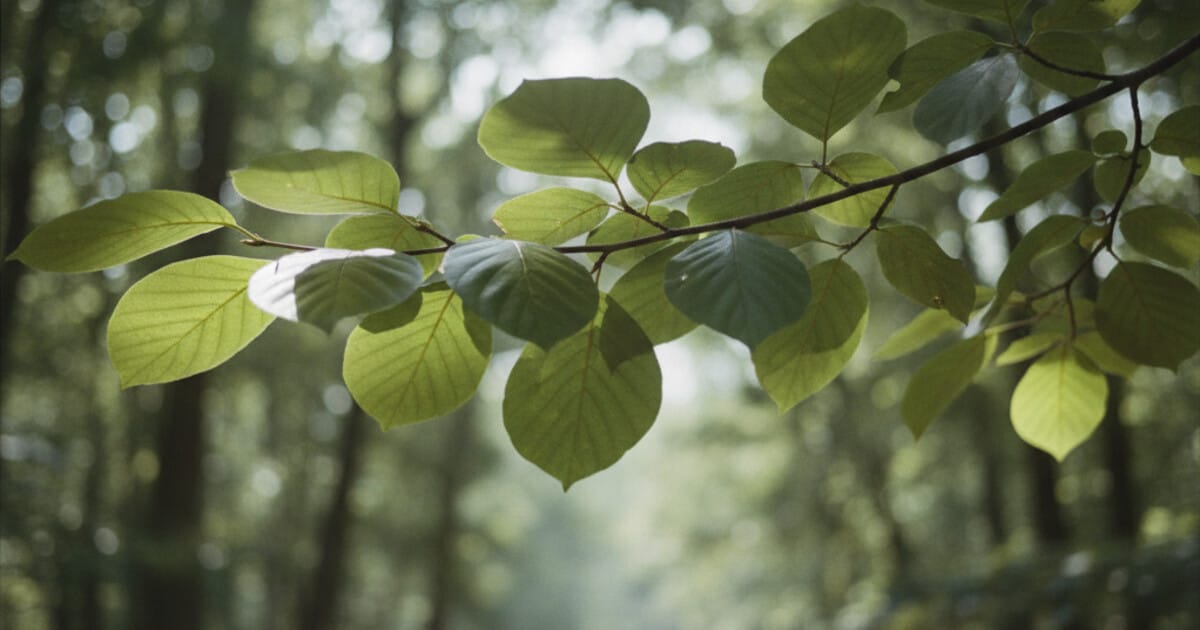
Alternate leaf arrangement means leaves grow one at a time from individual points along the stem, staggered in a zigzag or spiral pattern. There’s no partner leaf directly across. Each leaf sits offset from the one before it.
Compare this to opposite leaf arrangement, where two leaves grow from the same node, directly across from each other. Maples, ashes, and dogwoods all have opposite leaves. If you’ve read our trees with opposite leaves guide, you’ll recognize those as the exceptions, not the rule.
Almost everything else is alternate. Oaks, elms, birches, willows, cherries, sweetgum, tulip trees, hackberries, mulberries. Alternate is the default pattern for most trees you’ll encounter.
Alternate leaf arrangement is the dominant pattern among North American deciduous trees. In this arrangement, leaves grow from individual nodes staggered along the stem rather than appearing in pairs. Each leaf attaches at a slightly different angle, creating a spiral that maximizes the surface area each leaf exposes to sunlight. Botanists classify leaf arrangements into three main types: alternate, opposite, and whorled. Of the three, alternate is the most common by far. In eastern North American forests, roughly 75% of deciduous species have alternate leaves. This includes the entire oak family (Fagaceae), the elm family (Ulmaceae), the willow family (Salicaceae), and most of the rose family (Rosaceae), which covers cherries, crabapples, and hawthorns. Checking leaf arrangement takes about 3 seconds and immediately rules out or confirms dozens of species. It’s one of the fastest clues a tree spotter can use, and one of the most underused by beginners.
9 Trees With Alternate Leaves
1. Oak (Quercus spp.)
Every oak species has alternate leaves, from red oak to white oak to live oak. Oak leaves vary widely in shape: the deeply lobed red oak leaf, the rounded lobes of white oak, the narrow unlobed leaves of live oak. But the alternate arrangement holds across the entire genus.
Pair it with the presence of acorns and you’ve got a reliable double-check. If you’re still unsure of the species, our oak tree identification guide covers leaf shape, bark, and acorn type by species.
2. Elm (Ulmus spp.)
Elm leaves are alternate, oval, and asymmetrical at the base. One side of the leaf attaches lower than the other. That lopsided base is an elm signature. The leaves are also doubly serrated: each main tooth has smaller teeth along its edge.
The upper surface feels slightly rough, like worn sandpaper. Elms were once dominant street trees across American cities until Dutch elm disease swept through in the mid-20th century, but they’re still common along rivers and in older neighborhoods. See our elm tree identification guide for species details.
3. Birch (Betula spp.)
Birch leaves are alternate, triangular to oval, and sharply serrated with a pointed tip. Most species have leaves 2-3 inches long with a lighter green underside. The serrations are fine but distinct, giving the leaf edge a saw-toothed look.
What makes birch easy to confirm is the bark. Paper birch and river birch both have peeling or flaking bark that stands out immediately. The leaves and bark together make birch one of the faster IDs in the field.
4. Cherry (Prunus spp.)
Wild and ornamental cherries have alternate leaves with finely serrated edges and pointed tips. They tend to be narrower than the leaves of related stone fruit trees. Most cherry leaves have small reddish glands at the base of the leaf stem, right where it meets the branch.
That gland detail is useful when you’re comparing cherry to similar-looking trees like birch or serviceberry. Our cherry tree identification guide covers wild black cherry, ornamental flowering cherries, and pin cherry.
5. Willow (Salix spp.)
Willows have some of the most distinctive alternate leaves you’ll encounter: long, narrow, and lance-shaped, typically 3-5 inches long and under an inch wide. They grow in a clearly staggered pattern along slender, flexible branches.
The combination of narrow leaves, alternate arrangement, and drooping form makes willows identifiable from across a clearing. Most other alternate-leaved trees have much broader leaves, so the narrow lance shape stands out quickly.
6. Sweetgum (Liquidambar styraciflua)
Sweetgum leaves are alternate, star-shaped, and 5-7 pointed. They look similar to a maple leaf at first glance, but checking the arrangement settles it quickly. Maple leaves are opposite. Sweetgum leaves are alternate.
If you’re standing in front of a star-shaped leaf and unsure which tree it’s from, look at whether the leaves grow in pairs or one at a time. That single check gives you the answer before you need to look at anything else.
7. Tulip Tree (Liriodendron tulipifera)
The tulip tree has alternate leaves with a shape you won’t forget after seeing it once. Each leaf has 4 broad lobes and a squared-off or notched tip rather than a pointed one. That flat or indented top is unusual among deciduous trees.
In summer, the tree produces orange-yellow, tulip-shaped flowers high in the canopy. By fall, the leaves turn a clean bright gold. The 4-lobed shape paired with the alternate arrangement makes tulip tree one of the more distinctive species in eastern forests.
8. Hackberry (Celtis occidentalis)
Hackberry leaves are alternate, oval, and sharply toothed. They look similar to elm leaves and share the asymmetrical base where one side attaches lower than the other. The similarity trips up a lot of people.
The fastest way to separate them is the bark. Hackberry bark has distinctive corky ridges and small wart-like bumps. Elm bark has a more interlaced, shaggy pattern without the corky growths. Once you’ve seen hackberry’s warty bark, you’ll spot it by the trunk before you even look at the leaves.
9. Mulberry (Morus spp.)
Mulberry is alternate-leaved with unusually variable leaf shapes. On the same tree, you might see unlobed oval leaves alongside deeply lobed, mitten-shaped ones. This variability on a single branch is itself an identification clue. Very few other trees do this.
Add the alternate arrangement and the tree’s tendency to produce small, raspberry-like fruits by midsummer, and mulberry becomes recognizable once you’ve seen it a couple of times. The fruit often drops and stains sidewalks, which is how many people first notice mulberries in urban areas.
How to Check Leaf Arrangement in the Field
You don’t need any tools to check leaf arrangement. Here’s how to do it quickly:
Pick a mid-branch section. Avoid the tips of fast-growing shoots because new growth sometimes looks irregular. Go to the middle of a mature branch where leaves have fully developed.
Look at several leaf attachment points. With alternate leaves, each leaf grows from a different node, staggered left and right or spiraling. With opposite leaves, you’ll see matching pairs at each node. The difference is obvious once you’re looking for it.
Use it as a filter. If you’re trying to decide between maple and sweetgum, leaf arrangement gives you the answer in seconds. If you’re comparing elm and hackberry, both are alternate, so you’ll need the next clue (bark texture). Arrangement works best as the first filter, not the only one.
For a broader framework of what leaf features to check and in what order, our tree identification by leaf shape guide walks through the full process. Leaf arrangement, shape, edge type, and texture together cover most common identification scenarios.
If you want to compare notes on compound vs. simple leaves alongside the alternate pattern, the trees with compound leaves guide covers the distinction in detail.
How Tree Identifier Helps With Alternate Leaf IDs
Tree Identifier works from a photo. Take a picture of a leaf, some bark, a flower, or the overall tree shape, and the app runs AI analysis to return the species name with a confidence score and detailed information about the tree.
For alternate-leaved trees specifically, the multi-input approach is useful. A single clear leaf photo is often enough. If the leaves are high up or the lighting is poor, bark can confirm the species. An acorn for an oak, a spiky gumball for sweetgum, or the cone-shaped fruit cluster of a tulip tree are all strong supporting identifiers the app also recognizes.
The app works offline. Download species data before your hike and identification works without cell service. On trails where oaks, birches, and willows make up most of the canopy, that matters.
Tree Identifier gives you 2 free identifications daily, which covers a typical walk. Your past identifications are stored in a personal tree collection you can build over time. It’s a practical way to learn the trees in your area systematically rather than looking up the same species twice.
Try it at treeidentifier.app the next time you’re standing in front of a tree you can’t name.
Frequently Asked Questions
How do I tell alternate from opposite leaf arrangement?
With alternate leaves, each leaf attaches to a different point along the branch, staggered one at a time. With opposite leaves, two leaves grow from the same node, directly across from each other. To check, look at a mid-section of a branch: do the leaves come in pairs, or one at a time? The difference takes about 5 seconds to confirm once you know what to look for.
Are most trees alternate or opposite?
Most deciduous trees are alternate. Roughly 75% of North American deciduous species use the alternate pattern. The most common opposite-leaved trees are maples, ashes, dogwoods, catalpa, and horse chestnuts. The memory aid “MAD Cap Horse” covers the main ones: Maple, Ash, Dogwood, Catalpa, Horse Chestnut.
Do all oaks have alternate leaves?
Yes. Every oak species in the genus Quercus has alternate leaves: red oaks, white oaks, pin oaks, live oaks, bur oaks. The alternate arrangement holds across the entire genus. The acorn is still the definitive oak identifier, but alternate leaf arrangement is consistent across all of them.
Can leaf arrangement change with the seasons?
No. Leaf arrangement is a fixed genetic trait. An alternate-leaved tree is always alternate, whether it’s leafing out in spring, fully grown in summer, or dropping leaves in fall. This makes it one of the most reliable identification features. Unlike flower color or fruit type, which are only available for part of the year, leaf arrangement is there as long as leaves are on the tree.
What are whorled leaves?
Whorled leaves grow in groups of 3 or more from the same node on the stem. This arrangement is rare in trees but does appear in some species. Catalpa sometimes shows a whorled or pseudo-whorled pattern. Checking whether a tree’s leaves are alternate, opposite, or whorled is one of the first steps in any systematic tree identification process.
Spot a tree you can’t name on your next walk? Start with leaf arrangement. If the leaves are staggered one at a time along the branch, you’re looking at an alternate-leaved tree, and the 9 species in this guide are good starting points. Download Tree Identifier at treeidentifier.app, snap a photo of the leaf or bark, and get the species name and full details in seconds.
Elena Torres
Tree Identifier Team