Trees With White Flowers: 10 Species Identified by Bloom Time
You see a tree covered in white flowers and want to know what it is. That question comes up every spring, and the answer depends on when it’s blooming, how big the flowers are, and what the leaves look like. White is the most common flower color among North American trees, which means there are a lot of candidates.
The most common trees with white flowers in the U.S. include dogwood, serviceberry, black locust, hawthorn, Bradford pear, catalpa, and several species of cherry and crabapple. Bloom time, flower size, and petal count separate them quickly.
Standing in front of one? Identify it from a photo in seconds — free, no sign-up needed.
Early Spring White Flowers (March-April)
These trees bloom first, often before their leaves fully emerge. Bare branches covered in white blooms make them easy to spot.
Serviceberry (Amelanchier spp.)
Serviceberry is one of the first trees to bloom in spring, often appearing in March or early April. The flowers are small (about 1 inch across), with five narrow, slightly droopy white petals. They grow in loose clusters at the branch tips.
Serviceberry flowers don’t last long — about a week. By the time other white-flowering trees start blooming, serviceberry is already leafing out. The tree grows 15 to 25 feet tall as either a small tree or large shrub, often with multiple trunks. It produces small reddish-purple berries in June that are edible and taste like blueberries.
If you see white flowers on a small tree in very early spring, before dogwoods and cherries, it’s likely serviceberry.
Callery/Bradford Pear (Pyrus calleryana)
Bradford pear covers itself in dense clusters of white flowers in early to mid-spring. The flowers are about 3/4 inch across with five rounded petals. From a distance, the tree looks like it’s been dipped in snow.
There’s a catch: the flowers smell bad. People describe the scent as fishy or like rotting flesh. If you’re standing near a tree with white flowers and thinking “what is that smell,” it’s probably Bradford pear.
Bradford pear is considered invasive in much of the eastern U.S. Many states are phasing it out. The trees also have weak branch structure and tend to split apart in storms after 15 to 20 years. You’ll see them in parking lots, along streets, and in yards planted in the 1990s and 2000s.
Flowering Cherry (Prunus spp.)
Several cherry species produce white flowers in spring. Yoshino cherry (the species famous in Washington, D.C.) has pale pink buds that open to nearly white flowers. Wild black cherry (Prunus serotina) produces drooping clusters of small white flowers in late April to May.
Cherry flowers typically have five petals, grow in clusters of 2 to 5, and have a notched petal tip. The bark is smooth with horizontal lenticels (small lines) — one of the most recognizable bark patterns in eastern forests.
Double-flowering cultivars like ‘Mt. Fuji’ (also called ‘Shirotae’) have large, fully white double flowers that appear in mid-spring.
Mid-Spring White Flowers (April-May)
Flowering Dogwood (Cornus florida)
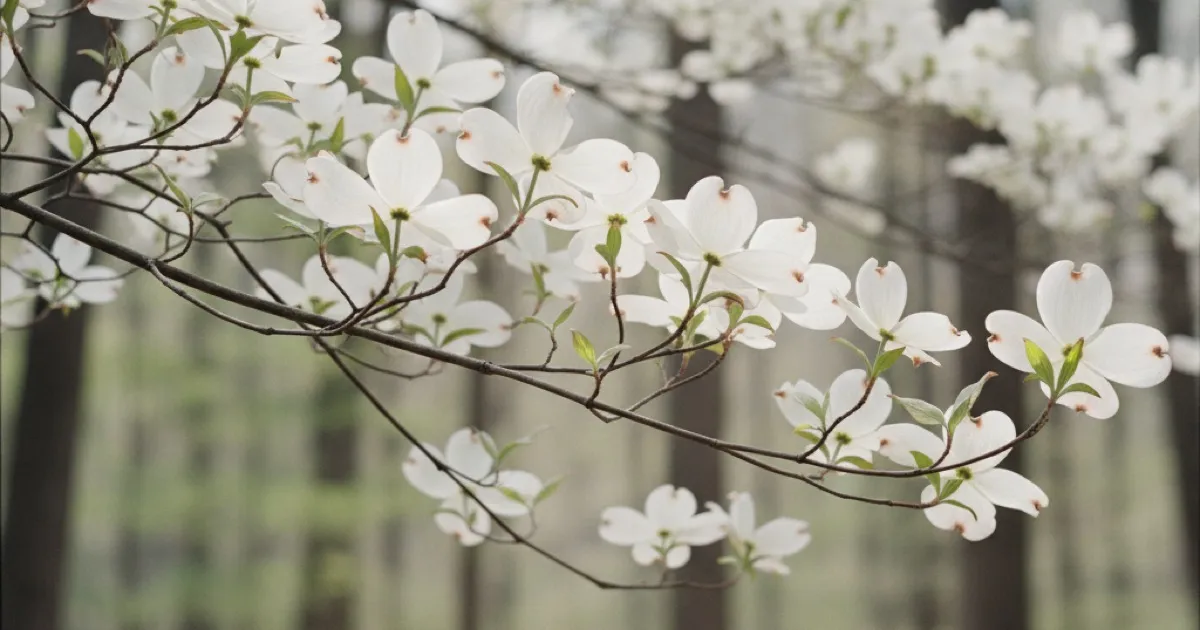
Dogwood is one of the most recognized white-flowering trees in eastern North America. What most people call the “flowers” are actually four large white bracts (modified leaves) surrounding a cluster of tiny true flowers in the center.
Each “bloom” is 3 to 4 inches across. The bracts have a distinctive notch at the tip. Dogwood flowers appear in April to early May, just as the leaves begin to emerge. The tree grows 20 to 30 feet tall with a layered, horizontal branching pattern.
Dogwood is easy to identify even without flowers. The opposite branching, blocky bark on mature trees, and red berries in fall all confirm the ID. In bloom, though, nothing else looks quite like it.
Crabapple (Malus spp.)
Crabapples are among the showiest spring-flowering trees. Many cultivars produce white flowers, though pink is equally common. White-flowering varieties include ‘Donald Wyman,’ ‘Sugar Tyme,’ and the native sweet crabapple (Malus coronaria).
Crabapple flowers are 1 to 1.5 inches across with five rounded petals (not notched like cherry). They grow in dense clusters that can cover every branch. The fragrance is pleasant — sweet and mild.
How to tell crabapple from cherry: crabapple flowers have rounded petals and grow in denser clusters. Cherry flowers have notched petals and grow in looser clusters of 2 to 5 on longer stems. Crabapple bark is rougher and scaly; cherry bark is smooth with horizontal lines.
Hawthorn (Crataegus spp.)
Hawthorns produce clusters of small white flowers in May, usually after dogwood and crabapple have finished. The flowers are about 1/2 inch across with five rounded petals and prominent stamens. They have a sweet but slightly musty scent.
Hawthorns are small trees (15 to 30 feet) with thorns on their branches — sometimes long, sharp thorns up to 3 inches. The thorns are the quickest way to confirm you’re looking at a hawthorn and not something else.
In fall, hawthorns produce small red fruits that look like tiny apples. They’re edible (used for jellies and herbal preparations) and important food for birds.
Late Spring to Early Summer White Flowers (May-June)
Black Locust (Robinia pseudoacacia)
Black locust produces hanging clusters of fragrant white flowers in late May to June. The flower clusters are 4 to 8 inches long and droop from the branches like wisteria. Each individual flower is pea-shaped (black locust is in the legume family). The fragrance is strong, sweet, and reminiscent of grape — many people consider it one of the best-smelling tree flowers.
Black locust is a medium-sized tree (40 to 70 feet) with deeply furrowed bark and compound leaves. For more details, see our locust tree identification guide. The wood is extremely hard and rot-resistant, historically used for fence posts.
Catalpa (Catalpa spp.)
Catalpa blooms in late May to June with large, upright clusters of white flowers. Each flower is about 2 inches across, bell-shaped, with ruffled petals and purple-brown spots inside the throat. The flower clusters are 6 to 12 inches tall and are genuinely showy.
Catalpa is easy to identify even without flowers: the leaves are enormous (up to 12 inches long), heart-shaped, and the tree produces long bean-like seed pods that can hang on through winter.
Tulip Tree (Liriodendron tulipifera)
Tulip tree flowers are greenish-yellow with an orange band at the base, not pure white. But people sometimes mistake them for white-flowering trees when seeing them from the ground. The flowers are tulip-shaped, 2 to 3 inches across, and grow high in the canopy where they can be hard to see clearly. Fallen petals on the ground are often the first sign of bloom.
Japanese Tree Lilac (Syringa reticulata)
Japanese tree lilac blooms in June, later than almost any other white-flowering tree. The flowers are creamy white, tiny, and packed into large feathery plumes 6 to 12 inches long. From a distance, they look like giant white lilac blooms — which makes sense, because this tree is a lilac, just tree-sized (20 to 30 feet).
Japanese tree lilac has a pleasant but milder fragrance than shrub lilacs. It blooms after everything else has finished, filling a gap in the flowering calendar.
How to Identify a White-Flowering Tree
When you find a tree with white flowers and want to identify it, check these features in order:
1. Timing. When is it blooming? March (serviceberry), April (dogwood, cherry, crabapple), May (hawthorn, black locust), June (catalpa, Japanese tree lilac)?
2. Flower size. Small (under 1 inch: serviceberry, hawthorn, cherry), medium (1-2 inches: crabapple, catalpa), or large bracts (3-4 inches: dogwood)?
3. Flower arrangement. Hanging clusters (black locust), upright clusters (catalpa, Japanese tree lilac), scattered along branches (dogwood), or dense clusters (crabapple, hawthorn)?
4. Smell. Sweet and grape-like (black locust), pleasant mild (crabapple), bad/fishy (Bradford pear), or no particular scent?
5. Thorns. If the tree has thorns, it’s likely hawthorn.
6. Leaf shape. Heart-shaped and huge (catalpa), compound with many leaflets (black locust), simple and oval (cherry, crabapple), opposite arrangement (dogwood).
White-Flowering Trees by Region
Southeastern U.S.: Dogwood, magnolia (southern magnolia has large white flowers in summer), catalpa, black locust, cherry, Bradford pear.
Northeastern U.S.: Serviceberry, dogwood, crabapple, hawthorn, black locust, cherry, Japanese tree lilac.
Midwestern U.S.: Serviceberry, crabapple, hawthorn, catalpa, black locust, Bradford pear.
Western U.S.: Pacific dogwood (Cornus nuttallii), western serviceberry, Oregon crabapple. Fewer white-flowering native trees overall — the Pacific Northwest has more conifers than flowering hardwoods.
Identifying White-Flowering Trees With Tree Identifier
If you’ve found a tree with white flowers and the guide above hasn’t narrowed it down, the Tree Identifier app can help. Snap a photo of the flowers, and the AI identifies the species. Close-ups of individual flowers work best, but photos of flower clusters or the whole tree in bloom also work. The app handles leaves, bark, flowers, and fruit, so you can photograph whatever feature is most visible. It works offline and gives you 2 free identifications per day.
Frequently Asked Questions
What tree has large white flowers in spring?
Dogwood has the largest-looking white blooms in spring (3 to 4 inches across), though they’re technically bracts, not petals. Magnolia species like star magnolia and saucer magnolia also produce large white flowers (4 to 6 inches) on bare branches in early spring. Catalpa has 2-inch flowers in large clusters, but it blooms later (May-June).
What is the white flowering tree that smells bad?
Bradford pear (Pyrus calleryana) is the most common white-flowering tree with an unpleasant smell. The flowers have a fishy or rotting odor that’s noticeable from several feet away. The tree is widely planted in urban areas but is increasingly being removed because it’s invasive and structurally weak.
What white flowering tree blooms the longest?
Most white-flowering trees bloom for 1 to 2 weeks. Crabapple and hawthorn tend to hold their flowers slightly longer (up to 2 weeks in cool weather). Japanese tree lilac blooms for about 2 weeks in June. No common white-flowering tree blooms for more than about 3 weeks. If you want extended white blooms, plant several species that bloom at different times (serviceberry in March, dogwood in April, black locust in May, catalpa in June).
Are dogwood flowers really white?
The white parts of dogwood blooms are bracts (modified leaves), not true petals. The actual flowers are the tiny green-yellow cluster in the center. This distinction matters for botanists but doesn’t change the fact that dogwoods look white when they’re “flowering.” Pink dogwood cultivars exist too — they have pink bracts.
What small tree has white flowers?
Serviceberry (15 to 25 feet), flowering dogwood (20 to 30 feet), hawthorn (15 to 30 feet), and Japanese tree lilac (20 to 30 feet) are all small trees with white flowers. Crabapple (15 to 25 feet) has white-flowering varieties as well. These are good choices for yards where a full-sized shade tree won’t fit.
Spotted a tree with white flowers and want to know what it is? Try Tree Identifier — snap a photo and get the species in seconds.
Identify a tree from your photo — free
Upload a leaf, bark, or whole-tree photo and get the species in seconds. No signup.
Confidence:
Unlock the full species profile
Free in the app — with unlimited identifications.


AI result for guidance — the app gives full species details and works offline.
Want unlimited identifications?
Get the full species profile, photos and details — free in the app, with unlimited scans.
- Unlimited identifications
- Full species profiles & details
- Works offline, anywhere
- Save and revisit your finds
Elena Torres
Tree Identifier Team