Tulip Tree Identification: Leaves, Bark, and Flowers
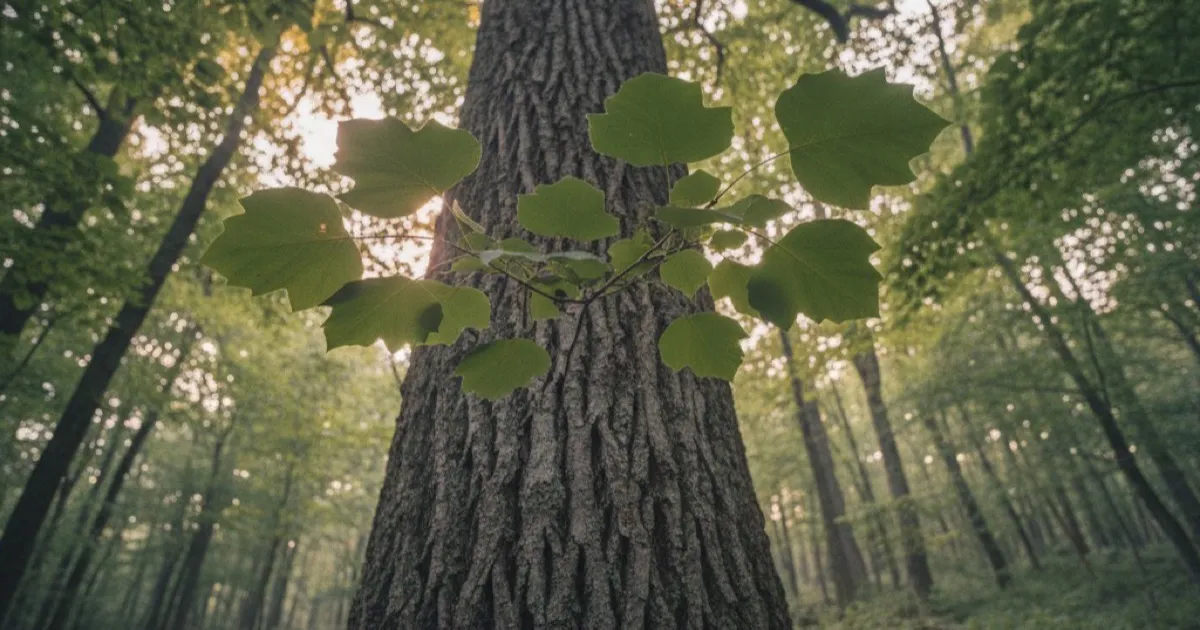
The tulip tree is the tallest hardwood in eastern North America. It routinely reaches 80 to 100 feet, and old-growth specimens have been measured above 170 feet. Despite its size, many people walk right past it because the tulip-shaped flowers bloom high in the canopy where they’re hard to see from the ground. But tulip tree identification doesn’t depend on the flowers alone. The leaves have a shape found on no other North American tree — a broad, flat-topped outline with four pointed lobes and a notched tip that looks like someone cut a piece out of the top.
The tulip tree (Liriodendron tulipifera) goes by several names: tulip poplar, yellow poplar, tulipwood, and fiddle tree. Despite the “poplar” nickname, it’s not a true poplar at all. It belongs to the magnolia family (Magnoliaceae), making it a relative of magnolias, not aspens or cottonwoods. This guide covers everything you need to identify tulip trees by leaf, bark, flower, and shape.
Tulip Tree Leaves: The Flat-Topped Shape
The leaf is the single best way to identify a tulip tree. No other common tree has this shape.
Each leaf has four pointed lobes — two on each side — with a broad, flat or slightly notched tip. Instead of coming to a point at the top like most leaves, the tulip tree leaf looks like the top was snipped off with scissors. The result is a shape that some describe as a tulip silhouette, others as a cat’s face, and still others as a child’s drawing of a crown.
Key leaf details:
- Size: 3 to 8 inches long and about as wide. Large leaves on vigorous shoots can reach 10 inches
- Lobes: Four pointed lobes with smooth margins and wide, rounded sinuses between them
- Tip: Flat, notched, or slightly concave — never pointed
- Arrangement: Alternate on the branch
- Surface: Bright green and smooth above, paler below
- Fall color: Bright golden yellow. Tulip trees are among the first large trees to change color in autumn, often turning in early October
The leaves are distinctive enough that they work as a standalone identification feature. If you find a large tree with alternate, four-lobed leaves that have a flat notched top, it’s almost certainly a tulip tree.
If you’re building your leaf identification skills, the tulip tree leaf is one of the most memorable shapes in the eastern forest.
Tulip Tree Bark Identification
Tulip tree bark changes dramatically from youth to old age.
Young trees (under 15-20 years) have smooth, light gray-green bark, sometimes with a faint whitish bloom. The bark is thin and easily damaged at this stage.
Mature trees develop a striking pattern of interlocking ridges and furrows. The ridges are flat-topped and light gray, separated by deep, dark furrows that form a diamond or rectangular pattern. On large, old tulip trees, the bark pattern is bold and geometric — almost like alligator skin.
The mature bark color is distinctive: pale ash gray on the ridges with much darker furrows creating strong contrast. This two-tone pattern helps identify tulip trees even in winter.
One bark feature worth noting: tulip tree bark is thick enough that mature trees resist low-intensity ground fires reasonably well. In old-growth forests, tulip trees often survive fires that kill thinner-barked species. You can sometimes see fire scars on the lower trunk of old specimens.
For bark identification practice, tulip tree is a good species to learn because the interlocking diamond pattern is recognizable from a distance once you’ve seen it a few times.
Tulip Tree Flowers
The flowers give the tree its name, and they’re worth looking for even though they can be hard to spot.
Tulip tree flowers bloom in late April to June, depending on latitude. Each flower is 2 to 3 inches across, cup-shaped (like a tulip), with six petals that are pale greenish-yellow with an orange band at the base. The flower sits upright on the branch, opening toward the sky.
The problem is that the flowers appear high in the canopy on mature trees. A 90-foot tulip tree has its lowest flowers 40 or 50 feet up, making them invisible from directly below. The best ways to see them:
- Look up from a distance with binoculars
- Find a tulip tree growing on a slope and look at it from the uphill side
- Check the ground beneath the tree in late spring for fallen petals (pale greenish-yellow with an orange base)
- Young trees under 30 feet sometimes produce flowers at eye level
Tulip trees are important nectar sources for honeybees, and “tulip poplar honey” is a prized dark-amber variety in the Appalachian region. The flowers also attract hummingbirds and orioles.
Tulip Tree Fruit and Seeds
After the flowers, tulip trees produce a distinctive cone-shaped fruit cluster that stands upright on the branch. The fruit is 2 to 3 inches long, narrow, and pointed, made up of overlapping winged seeds (samaras) arranged in a tight cone.
The fruit starts out green, turns light brown by late summer, and begins shedding individual seeds in fall and winter. The winged seeds spiral away from the tree in the wind. After the seeds fall, a central spike remains on the branch — a dried, finger-like structure that persists through winter and is visible against the sky.
These persistent fruit spikes are a useful winter identification feature. If you see a tall deciduous tree with diamond-patterned gray bark and upright brown spikes at the branch tips, you’re looking at a tulip tree.
Tulip Tree Size and Shape
Tulip trees grow big. They are consistently the tallest hardwoods in the forests where they grow, and they grow fast — 2 to 3 feet per year in good conditions when young.
Typical dimensions:
- Height: 70 to 100 feet in the open, 100 to 150 feet in forest conditions
- Trunk diameter: 2 to 5 feet, though old-growth trees can exceed 8 feet
- Crown shape: Tall, straight trunk with a narrow, oval crown in forests; broader and more spreading in the open
The trunk is notably straight. Tulip trees grow with a strong central leader and self-prune their lower branches in forest conditions, producing a tall, column-like trunk with the crown concentrated at the top. This straight growth form made tulip tree lumber historically valuable — colonial shipbuilders and canoe makers prized the long, clear trunks.
In open settings (yards, parks), tulip trees develop a more pyramidal crown that’s broader at the base. Even in the open, they still have one of the straightest trunks of any eastern hardwood.
Where Tulip Trees Grow
Tulip trees are native to the eastern United States, from southern New England west to Michigan and south to Louisiana and northern Florida. Their core range is the Appalachian region, where they dominate moist cove forests and reach their largest sizes.
Preferred habitats:
- Rich, moist cove forests in the Appalachian Mountains
- Well-drained bottomlands and lower slopes
- Deep, fertile soils with consistent moisture
- Full sun to partial shade (they need light to reach the canopy)
Tulip trees don’t tolerate drought, compacted soil, or heavy clay. They grow best where moisture is reliable and soil is deep. In the Great Smoky Mountains and Blue Ridge, tulip trees form the canopy of old-growth cove forests alongside sugar maples, beech trees, and yellow buckeye.
They’re widely planted as landscape trees outside their native range, including in the Pacific Northwest and parts of California. In urban settings, they perform best with adequate water and space — they’re too large for small yards.
Tulip Poplar vs. True Poplars
The name “tulip poplar” causes genuine confusion. True poplars (genus Populus) include cottonwoods, aspens, and Lombardy poplars. The tulip tree isn’t related to any of them.
How did the name stick? Early settlers noticed that tulip tree wood is soft, light, and easy to work — similar to poplar lumber. The wood is pale yellowish-green (hence “yellow poplar”), and lumberyards still sell it as “poplar” today. But the tree is a magnolia family member, not a poplar.
Quick comparison:
| Feature | Tulip Tree (tulip poplar) | True Poplars |
|---|---|---|
| Family | Magnoliaceae (magnolia) | Salicaceae (willow) |
| Leaf shape | 4-lobed with flat/notched tip | Triangular, round, or heart-shaped |
| Flowers | Large, tulip-shaped, green-yellow-orange | Catkins (dangling clusters) |
| Fruit | Upright cone of winged seeds | Cottony seed capsules |
| Bark (mature) | Diamond-patterned interlocking ridges | Deep furrows (cottonwood) or smooth white (aspen) |
If someone says “poplar” at a lumberyard, they probably mean tulip tree. If they say “poplar” in the forest, they could mean either. Check the leaves to settle it.
Tulip Tree Lumber and Uses
Tulip tree wood is one of the most commercially important hardwoods in the eastern United States. The wood is:
- Light and soft for a hardwood (easier to work than oak or maple)
- Pale yellow-green to cream colored, sometimes with darker streaks
- Straight-grained with a fine, uniform texture
- Inexpensive compared to oak, cherry, or walnut
It’s used in furniture, cabinets, trim, siding, plywood cores, and painted millwork. The wood takes paint well, which is why it’s popular for trim and molding that will be painted rather than stained.
Historically, tulip tree trunks were hollowed out to make dugout canoes. The straight, knot-free trunks could produce canoes over 30 feet long from a single log.
Identifying Tulip Trees With Tree Identifier
Tulip tree leaves are distinctive, but if you’re not sure whether you’re looking at a tulip tree, a young magnolia, or something else, the Tree Identifier app can settle it quickly. Take a photo of the flat-topped leaf, a section of the diamond-patterned bark, or one of those greenish-yellow flowers if you’re lucky enough to spot one low. The AI identifies the species from any of these features.
The app works offline and identifies from leaves, bark, flowers, and fruit. You get 2 free identifications per day.
Frequently Asked Questions
Is a tulip tree the same as a tulip poplar?
Yes. Tulip tree, tulip poplar, yellow poplar, and tulipwood are all names for the same species: Liriodendron tulipifera. Despite the “poplar” name, it’s in the magnolia family and is not related to true poplars like cottonwood or aspen.
How fast do tulip trees grow?
Tulip trees are fast growers, adding 2 to 3 feet of height per year when young in good conditions. A 20-year-old tulip tree can reach 40 to 50 feet. Growth slows somewhat with age, but they continue gaining height for decades. They often reach 80+ feet in 40 to 50 years.
Are tulip tree flowers hard to see?
On mature trees, yes. The flowers bloom near the top of the canopy, often 50+ feet up. Look for fallen petals on the ground beneath the tree in late spring. Young trees (under 30 feet) sometimes bloom at eye level. Binoculars help on taller trees.
Why are tulip tree leaves turning yellow in summer?
Summer yellowing usually means the tree is stressed. Common causes are drought (tulip trees need consistent moisture), soil compaction, root damage from construction, or iron chlorosis in alkaline soil. Brief dry spells can cause lower leaves to yellow and drop while the upper canopy stays green.
How tall do tulip trees get?
In forest conditions, tulip trees commonly reach 100 to 130 feet. Old-growth specimens in Great Smoky Mountains cove forests have been measured above 170 feet, making them the tallest hardwoods in eastern North America. In open landscapes, they typically reach 70 to 90 feet.
Curious about the tall tree in your neighborhood? Try Tree Identifier — snap a photo of that flat-topped leaf or diamond bark and find out what species you’re looking at in seconds.
Identify a tree from your photo — free
Upload a leaf, bark, or whole-tree photo and get the species in seconds. No signup.
Confidence:
Unlock the full species profile
Free in the app — with unlimited identifications.


AI result for guidance — the app gives full species details and works offline.
Want unlimited identifications?
Get the full species profile, photos and details — free in the app, with unlimited scans.
- Unlimited identifications
- Full species profiles & details
- Works offline, anywhere
- Save and revisit your finds
Elena Torres
Tree Identifier Team