Types of Pine Trees: 14 Species Identified by Needle and Bark
Pine trees are the most widespread conifers in North America, but telling one pine from another trips people up. There are roughly 50 native pine species on this continent, and many of them grow in overlapping ranges. The good news is that pines are easier to identify than most people think, because the key feature (the number of needles per bundle) narrows your options fast.
The most common types of pine trees in North America can be sorted into two-needle, three-needle, and five-needle groups. Once you know which group your pine belongs to, identification becomes a matter of checking needle length, cone size, and bark pattern.
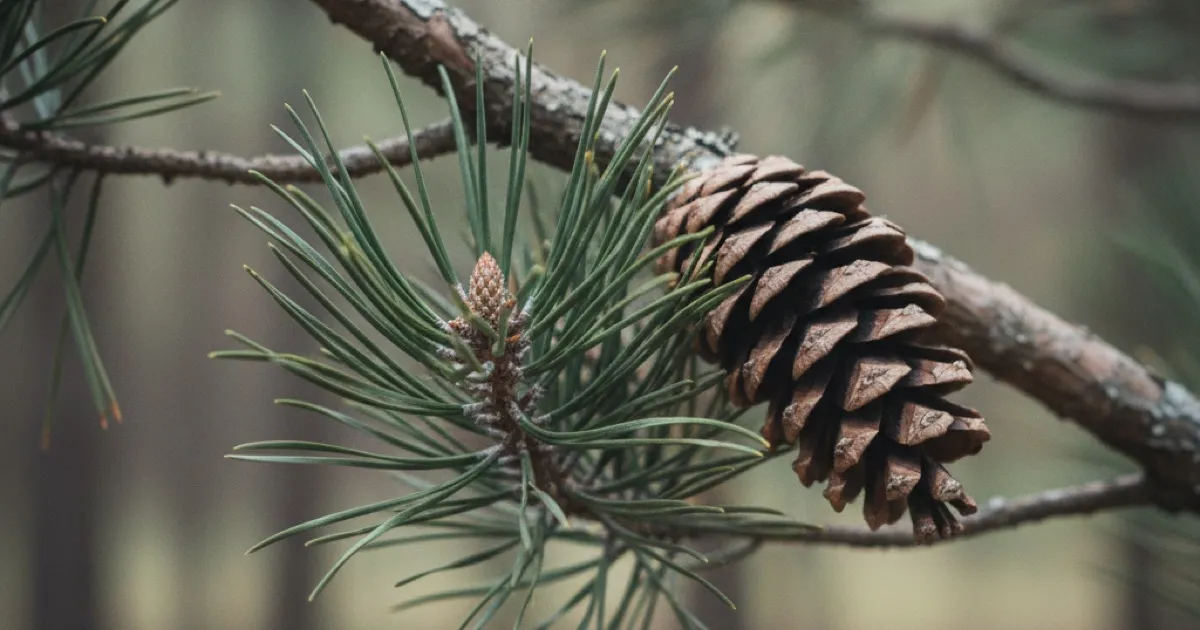
Pine trees (genus Pinus) are identified by needles that grow in bundles of 2, 3, or 5, wrapped at the base by a papery sheath called a fascicle. Counting that bundle is the fastest identification step. Combined with bark texture and cone shape, you can narrow most North American pine trees to species in three steps.
What Does a Pine Tree Look Like?
Pine trees have a conical to pyramidal shape when young, with a central trunk and branches that radiate outward in horizontal whorls. Mature trees develop a broader, more irregular crown as lower branches die back. The needles stay green year-round, giving the tree a consistently dense look in all four seasons.
A few visual markers separate pines from other conifers at a distance. Spruce and fir needles grow individually from the twig; pine needles always grow in bundles. Cedar and juniper leaves are scale-like, not needle-shaped. In winter, when deciduous trees are bare, a full-needled conifer growing in dense sandy-soil stands is almost certainly pine.
Up close, bark is a strong identifier. Young pine bark is smooth and grayish. Mature bark develops into thick orange-brown plates (ponderosa, longleaf), thin scaly flakes (Scots pine, lodgepole), or deep vertical furrows (white pine, loblolly). Scots pine is distinctively orange on the upper trunk and branches, visible from 50 feet away.
The cones hang downward and range from under 2 inches (jack pine) to over 18 inches (sugar pine). They stay attached to the tree for months or years. Jack pine and lodgepole keep their cones sealed shut with resin until fire opens them, which is how these trees regenerate after wildfire.
How to Tell Pines Apart: The Needle Bundle System
Every pine tree grows its needles in bundles (called fascicles) wrapped at the base by a thin papery sheath. The number of needles per bundle is the single most useful identification feature for pines. Grab a cluster of needles and count them.
Pine trees belong to the genus Pinus, the largest genus in the family Pinaceae, with about 126 species worldwide and 50 native to North America. All pines share that defining fascicle trait. North American species sort into three main needle-bundle counts. Two-needle pines include red pine (Pinus resinosa), Scots pine (P. sylvestris), and jack pine (P. banksiana). Three-needle pines include ponderosa pine (P. ponderosa), the most widely distributed pine in North America, and loblolly pine (P. taeda), which grows at 3 or more feet per year when young. Five-needle pines include eastern white pine (P. strobus), the tallest native conifer in the eastern U.S. at 100 or more feet, and bristlecone pine (P. longaeva), with individuals living beyond 4,800 years. Needle-bundle count narrows your options to fewer than 20 candidate species in most North American regions.
Two-needle pines: Red pine, Scots pine, Austrian pine, jack pine, lodgepole pine, Virginia pine, shortleaf pine
Three-needle pines: Ponderosa pine, loblolly pine, slash pine, longleaf pine, pitch pine, Monterey pine
Five-needle pines: Eastern white pine, Western white pine, sugar pine, limber pine, whitebark pine, bristlecone pine
Botanists also group pines into “soft pines” (5-needle species with softer, lighter wood) and “hard pines” (2- and 3-needle species with denser, harder wood). That split matters for lumber grading but doesn’t change the field identification process.
A few species vary occasionally (ponderosa sometimes has two needles, pitch pine sometimes has two), but the typical count is reliable enough to start your identification.
Two-Needle Pines
Red Pine (Pinus resinosa)
Red pine is one of the easiest pines to identify. Its needles are 4 to 6 inches long, dark green, and snap cleanly when bent; no other common pine’s needles do this. The bark on mature trees develops broad, flat, reddish-brown plates that give the tree its name.
Red pine grows throughout the Great Lakes region and northeastern states, often in sandy soil. It’s heavily planted in forest plantations where it forms straight, uniform stands. The cones are small (1.5 to 2.5 inches), egg-shaped, and lack prickles.
Look for: Long, dark, snappable needles in pairs. Reddish bark plates on mature trees. Often planted in rows.
Scots Pine (Pinus sylvestris)
Originally from Europe, Scots pine is widely planted across North America and has naturalized in some areas. The most distinctive feature is the bark: the upper trunk and branches develop a bright orange-brown color that peels in thin, papery flakes. No native pine matches this orange upper bark.
Needles are short (1.5 to 3 inches), blue-green, and slightly twisted. Cones are small (1 to 3 inches). Scots pine is a common Christmas tree species, so many people recognize its shape: irregular, often leaning, with a somewhat scraggly crown at maturity.
Jack Pine (Pinus banksiana)
Jack pine grows in the poorest, driest sandy soils of the northern Great Lakes and boreal regions. It’s scrubby and tough. The needles are the shortest of common two-needle pines, only 1 to 1.5 inches long. The cones are curved and often sealed shut with resin (serotinous), opening only after fire.
Jack pine rarely grows tall or straight. It often leans, forks, and grows into irregular shapes. If you find a scraggly pine with very short needles and curved, sealed cones on sandy ground in Minnesota, Wisconsin, or Michigan, it’s almost certainly jack pine.
Lodgepole Pine (Pinus contorta)
The western equivalent of jack pine, lodgepole pine dominates mountain forests from the Rockies to the Pacific Coast. It grows tall and thin in dense stands: the “lodgepoles” that Native Americans used for building. Needles are 1 to 3 inches long, yellow-green, and slightly twisted.
Lodgepole pine also produces serotinous cones in fire-prone areas. The bark is thin and scaly, grayish-brown. In Yellowstone and other Rocky Mountain parks, the vast pine forests you see are largely lodgepole.
Three-Needle Pines
Ponderosa Pine (Pinus ponderosa)
Ponderosa is the classic pine of the American West: tall, thick-barked, and fragrant. Mature trees develop distinctive bark that splits into large, jigsaw-puzzle-shaped plates in orange-brown and dark brown. Press your nose to the bark fissures on a warm day; it smells like vanilla or butterscotch.
Needles are long (5 to 10 inches), in bundles of three (sometimes two), and clustered at the branch tips in dense tufts. Cones are 3 to 6 inches long with a sharp prickle on each scale.
Ponderosa pine grows across the western U.S. from the Black Hills to the Cascades. It’s the most widely distributed pine in North America and one of the easiest to identify once you know the bark.
Loblolly Pine (Pinus taeda)
Loblolly is the dominant pine of the southeastern United States and one of the most commercially important trees in the country. It grows fast (3+ feet per year when young) and reaches 60 to 90 feet tall. Needles are 6 to 9 inches long, in bundles of three, and persist for two years.
The bark on young trees is dark and furrowed. On mature trees, it develops thick, reddish-brown plates. Cones are 3 to 5 inches long with short, stiff prickles.
Loblolly pine is planted extensively in timber plantations throughout the Southeast. If you see a pine forest in Georgia, the Carolinas, or East Texas, it’s probably loblolly.
Longleaf Pine (Pinus palustris)
Longleaf pine has the longest needles of any eastern pine, 8 to 18 inches, and they grow in dense tufts at the branch tips. Young longleaf pines spend several years in a “grass stage” where they look like a clump of grass rather than a tree, devoting energy to root development before shooting upward.
Longleaf pine forests once covered 90 million acres of the Southeast. Today, less than 3% remains. The species is the focus of major conservation and restoration efforts. Its cones are large (6 to 10 inches) and its bark is thick with broad, orange-brown plates.
Pitch Pine (Pinus rigida)
Pitch pine is the scrappy survivor of the northeastern pine world. It grows on rocky ridges, sandy barrens, and other harsh sites where better-behaved pines won’t grow. Needles are 3 to 5 inches long, stiff, and twisted, in bundles of three.
The most distinctive feature of pitch pine is its ability to sprout new branches directly from the trunk, called epicormic sprouting. After fire, pitch pines resprout aggressively. This gives mature trees a messy, irregular look with tufts of needles growing from thick bark on the trunk. If you see needles growing out of the trunk of a pine, it’s pitch pine.
Five-Needle Pines
Eastern White Pine (Pinus strobus)
Eastern white pine is the tallest native conifer in the eastern U.S., reaching 100+ feet. Its needles are soft, flexible, and blue-green, 3 to 5 inches long, in bundles of five. The soft texture is immediately noticeable when you run your hand along a branch; other pines feel stiff and prickly by comparison.
The cones are long and slender (4 to 8 inches), often slightly curved, with thin, smooth scales and no prickles. The bark on young trees is smooth and greenish-gray. Mature trees develop dark, deeply furrowed bark with broad ridges.
White pine grows from New England south through the Appalachians and west to the Great Lakes. It’s a common landscape and timber tree. You’ll also find it discussed in our pine vs spruce vs fir comparison guide.
Sugar Pine (Pinus lambertiana)
Sugar pine produces the longest cones of any conifer on earth, 10 to 20 inches long, hanging from the tips of upper branches. That alone identifies it. The needles are 2 to 4 inches long, in bundles of five, blue-green with white lines on all surfaces.
Sugar pine grows in mountain forests of California and Oregon, typically at elevations between 3,000 and 7,000 feet. It’s one of the tallest pines in the world, reaching 150 to 200 feet.
Bristlecone Pine (Pinus longaeva / P. aristata)
Bristlecone pines are the oldest living trees on earth, with some individuals exceeding 4,800 years. They grow at high elevations in the White Mountains of California, the Great Basin, and the Rocky Mountains.
The needles are short (1 to 1.5 inches), densely packed along the branches, and persist for 20 to 30 years, the longest needle retention of any pine. This gives branches a bottle-brush appearance. The cones have a distinctive curved bristle (awn) on each scale, which gives the tree its common name.
Bristlecone pines grow slowly, are small and gnarled, and often have large sections of dead wood (called deadwood or stripbark). The twisted, weathered appearance of ancient specimens is unmistakable.
Pine Bark Patterns
Bark identification is useful for pines, especially in winter or when you can’t reach the needles. Common bark patterns:
- Plate bark (ponderosa, longleaf, red pine): Large, flat plates in orange-brown tones. Puzzle-piece pattern
- Scaly bark (Scots pine, lodgepole): Thin scales or flakes, often revealing different colors beneath. Scots pine has distinctive orange upper bark
- Furrowed bark (white pine, loblolly): Deep vertical furrows with flat-topped ridges. Darkens with age
- Thin bark (jack pine, pitch pine): Relatively thin, rough, grayish-brown. No dramatic pattern
Quick Pine Identification Key
If you’re standing in front of a pine tree and want to narrow it down fast:
- Count the needles per bundle. Two? Three? Five? This eliminates most options.
- Measure the needle length. Short (under 3 inches), medium (3-6 inches), or long (6+ inches)?
- Look at the bark. Orange plates? Deep furrows? Thin and scaly?
- Check the cones. Small or large? Prickly or smooth? Sealed shut or open?
- Note the location. Eastern or western? Mountain or coastal? Sandy soil or rich bottomland?
Combining needle count + needle length + location identifies most pines in two or three steps.
Identifying Pine Trees With Tree Identifier
Pine identification can feel overwhelming when you’re staring at a row of similar-looking conifers. The Tree Identifier app simplifies it: snap a photo of the needles, a cone, or the bark, and the AI identifies the species. It works with close-ups of needle bundles, which is where most pine IDs start. The app works offline for backcountry hikes where you’re surrounded by pines and have no signal. You get 2 free identifications per day.
Frequently Asked Questions
How many types of pine trees are there?
There are about 126 pine species worldwide and roughly 50 native to North America. Most areas have only 5 to 10 species growing locally. Learning the pines of your specific region is more practical than trying to know all 126.
What is the difference between pine, spruce, and fir?
Pines have long needles in bundles of 2, 3, or 5. Spruce needles are short, stiff, and grow individually from small pegs on the twig. Fir needles are flat, soft, and attach directly to the branch with a smooth base. For a detailed comparison, see our pine vs spruce vs fir guide.
Which pine tree grows the fastest?
Loblolly pine is one of the fastest, growing 3+ feet per year when young. Monterey pine and slash pine are also fast growers. Eastern white pine grows about 2 feet per year, which is moderate for a pine. Bristlecone pines grow the slowest, sometimes less than an inch per year.
Are all pine trees evergreen?
Yes. All pines are evergreen conifers, meaning they keep their needles year-round. Individual needles drop after 2 to 5 years (depending on species), but the tree always has a full complement of green needles because new growth replaces the old. Larch (tamarack) is a conifer that drops its needles in fall, but it’s not a pine.
What pine tree has the longest needles?
Longleaf pine (Pinus palustris) has the longest needles of any pine in North America, reaching 8 to 18 inches. The needles grow in dense, drooping tufts at the branch tips and give the tree a distinctive, tropical look.
Want to identify a pine tree in your yard or on a hike? Try Tree Identifier: snap a photo of the needles, bark, or cone and get the species in seconds.
Identify a tree from your photo — free
Upload a leaf, bark, or whole-tree photo and get the species in seconds. No signup.
Confidence:
Unlock the full species profile
Free in the app — with unlimited identifications.


AI result for guidance — the app gives full species details and works offline.
Want unlimited identifications?
Get the full species profile, photos and details — free in the app, with unlimited scans.
- Unlimited identifications
- Full species profiles & details
- Works offline, anywhere
- Save and revisit your finds
Elena Torres
Tree Identifier Team