Urban Tree Identification: 10 Common Street Trees Explained
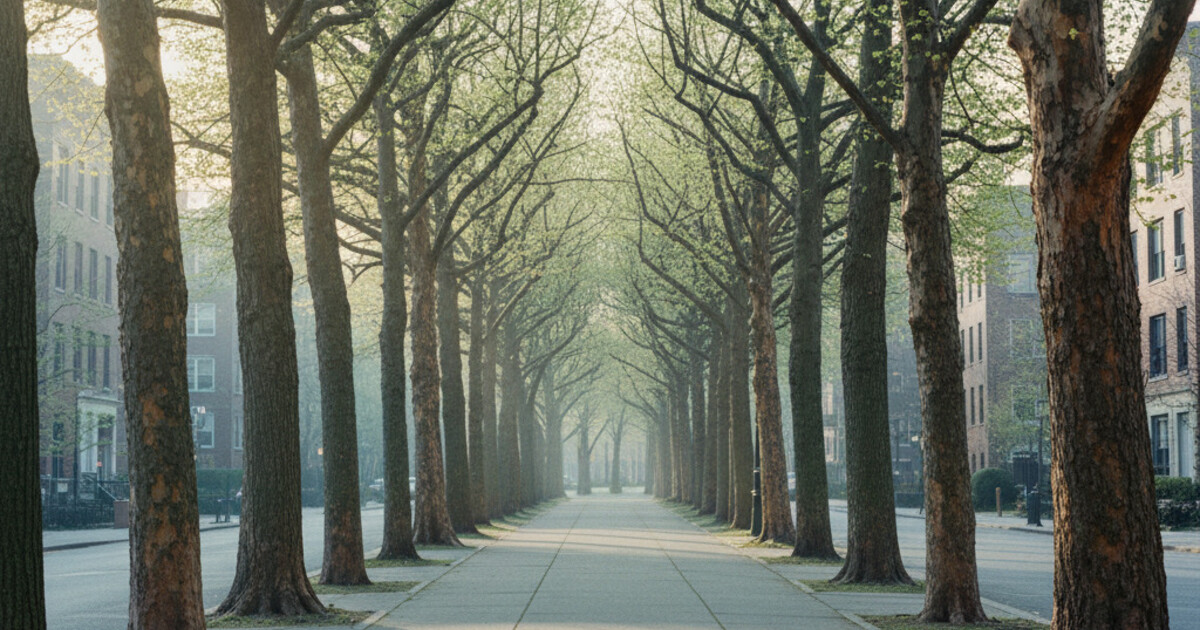
Walk down almost any city street in spring and you’ll see trees budding, blooming, and leafing out in every direction. Most people can’t name a single one. If you’ve ever stopped under a shade tree and wondered what it is, urban tree identification is easier than you’d expect. Cities plant from a short, predictable list of species that can handle exhaust, road salt, and compacted soil. Once you know those 10-15 species, you’ll recognize most of what you walk past.
The most common urban street trees in North America include London plane, Norway maple, ginkgo, callery pear, red oak, honeylocust, linden, green ash, and silver maple. Most can be identified by leaf shape, bark pattern, and branching structure. Cities choose these species because they tolerate air pollution, road salt, and root compaction better than most trees.
Why Cities Plant the Same Trees Over and Over
Urban foresters have a short list of species that actually survive city conditions. Street trees face compressed root zones, salt spray from winter roads, air pollution, drought, and physical damage from trucks and pedestrians. Most tree species can’t handle it.
The trees that make the cut tend to share a few traits: deep roots that can push through compacted soil, thick bark that handles physical damage, and the ability to survive both drought and periodic flooding from storm drains. That’s why the same 10-15 species show up on streets from Boston to Seattle.
For anyone working on urban tree identification, this is good news. You can rule out hundreds of forest species and focus on a much shorter list. Take a photo of an unknown street tree and you’re probably looking at one of the species below.
The 10 Most Common Street Trees (and How to Spot Them)
Knowing what to look for on each species cuts your identification time down fast.
London Plane (Platanus x acerifolia)
The easiest street tree to identify from half a block away. The bark peels in large plates, revealing a cream, tan, and olive patchwork underneath that looks almost like camouflage. Leaves are maple-like but larger, with 3-5 lobes and a coarse texture. The tree produces round, spiky seed balls that hang through winter.
London plane tolerates air pollution better than almost any other large tree, which is why you’ll find it lining avenues in New York, Chicago, and Paris.
Norway Maple (Acer platanoides)
Similar to sugar maple but with a few reliable differences. The leaf lobes are more pointed, and the sinuses between lobes are shallower. Break a leaf stem and milky white sap drips out. Sugar maple doesn’t do that.
Norway maple holds its leaves longer into fall, turning yellow rather than the orange-red of sugar maple. It tolerates shade, pollution, and compacted soil well. Many cities now discourage it because it spreads aggressively into natural areas.
Callery Pear (Pyrus calleryana)
The one that covers suburban streets in white blooms every early spring, before the leaves come out. The flowers smell unpleasant up close, which surprises most people.
Leaves are small, oval, and glossy, turning vivid red or orange-purple in fall. The tree has a tight, symmetrical oval shape when young that breaks apart as it ages. Mature specimens are notorious for splitting in ice storms because the branches grow at narrow, weak angles.
Ginkgo (Ginkgo biloba)
The fan-shaped leaf makes ginkgo impossible to confuse with anything else. No other tree in North America has a leaf that looks like it. Bright green in summer, pure yellow in fall, and when they drop, they often all drop within a day or two.
The bark on mature ginkgos is deeply furrowed and gray. Most street plantings use male trees because female ginkgos produce a fruit with a notorious smell. The species has changed very little in 200 million years, which you can feel when you look at one.
Red Oak (Quercus rubra)
One of the most commonly planted street oaks. Leaves have pointed lobes with small bristle tips at each point (compare this to white oak, which has rounded lobes). The bark is dark gray with flat-topped ridges that look almost plate-like on younger trees.
Red oaks hold their brown leaves well into winter, which makes them easy to spot when other deciduous trees are bare. Acorn caps are flat and shallow, covering only the top quarter of the nut.
Honeylocust (Gleditsia triacanthos)
Compound leaves with many small leaflets give this tree a fine, airy canopy. From a distance it looks feathery compared to most street trees. Wild honeylocusts have vicious 3-pronged thorns on the trunk; street varieties are thornless.
The bark is dark gray with irregular, interlacing ridges. In fall, the leaflets drop early and leave long, flat, twisted seed pods dangling through winter. Those pods are one of the clearest winter ID features on the street.
American Linden (Tilia americana)
Heart-shaped leaves with a toothed edge and an asymmetrical base: one side sits noticeably higher on the stem than the other. This asymmetry is consistent and easy to check. The fragrant flowers in July attract dense clouds of bees.
The fruit is a small, hard nutlet attached to a papery, elongated bract that acts like a wing when it falls. That bract-and-nutlet combination is unique to lindens and a reliable ID feature even into winter.
Green Ash (Fraxinus pennsylvanica)
Compound leaves with 7-9 leaflets, arranged in opposite pairs along the stem. Opposite branching is the key: the branches, buds, and leaves all grow directly across from each other, not alternating like most hardwoods. Check the branch pattern and you’ll identify ash quickly.
Green ash was one of the most planted street trees in North America from the 1950s through the 1990s. The emerald ash borer has killed hundreds of millions of ash trees since its arrival, and many cities are removing dead green ash rather than replacing them.
Littleleaf Linden (Tilia cordata)
A European cousin of American linden. The leaves are smaller (2-4 inches compared to 4-8 inches for American linden), and the tree stays narrower and more compact overall. You’ll often smell one before you see it. The flowers in early summer produce a distinct honey scent that carries for several yards.
The same asymmetrical leaf base and papery bract attached to the fruits applies here as well.
Silver Maple (Acer saccharinum)
Deeply lobed leaves that are silver-white on the underside. When wind moves through the canopy, it flickers between green and silver. The leaf sinuses cut almost to the midrib, giving the leaf a ragged, star-like look compared to other maples.
Silver maple grows fast, which creates structural problems. Branches break in ice storms and the root systems can lift sidewalks. Many municipalities have stepped back from planting it, but older neighborhoods are full of them. The seeds (paired samaras) are the earliest to drop of any maple, falling in late spring.
How to Identify Urban Trees When They’re Heavily Pruned
City trees get cut hard, sometimes reduced to stubs during utility line clearance. Heavy pruning changes the natural crown shape, which makes growth habit unreliable as an ID feature.
Focus on things that don’t change: leaf shape, leaf attachment pattern (opposite vs alternate), bark texture, and fruit or seed type. Opposite vs alternate branching is especially useful because it narrows the field immediately. Ash, maple, and dogwood have opposite branching. Almost everything else is alternate.
Photographing trees in urban settings is straightforward. Take a photo of the leaf up close, then one of the bark, then one of the overall shape if it’s still recognizable. Multiple photos from different angles improve accuracy significantly.
If there are fallen leaves on the sidewalk, use them. They often show the full leaf shape more clearly than photos taken looking up into the canopy.
How Tree Identifier Helps With Urban Trees
When you’re standing in front of an unfamiliar street tree, Tree Identifier gives you an answer fast. Take a photo of the leaf, bark, or the whole tree and the AI returns a species match with a confidence score.
The app covers thousands of species including all the common street trees above. For each identification, you get the species name plus detailed information: characteristics, habitat, distribution, and notes on related species. The offline mode means you can download species data before a walk and use the app without cell service, which matters on wider boulevards where signal can be spotty.
Two free identifications per day let you try it before committing. Once you get the hang of using it alongside your own observations, you’ll identify most street trees within seconds.
For a deeper look at ID techniques, the guide on identifying trees by bark covers texture patterns for most common street species, and tree identification for beginners walks through the fundamentals of reading leaf shape, branching patterns, and fruit type.
Frequently Asked Questions
What is the most common street tree in the United States?
It varies by region, but London plane, Norway maple, and honeylocust rank consistently among the top choices in most North American cities. Callery pear dominated suburban street plantings from the 1970s through the 2000s and remains one of the most widely planted species in the eastern US.
How do I identify a street tree in winter when there are no leaves?
Focus on bark texture, branching pattern (opposite vs alternate), and any remaining fruit or seed pods. London plane has unmistakable peeling bark. Honeylocust keeps its twisted seed pods through winter. Ginkgo has deeply furrowed bark and a distinctive branching silhouette. The Tree Identifier app can identify trees from bark photos alone, which makes winter identification much more manageable.
Why do all the trees on my street look the same?
Urban foresters typically plant one species per block to simplify maintenance and to reduce the risk of a single pest or disease wiping out an entire street. The repetitive look is intentional. It also creates vulnerability: the emerald ash borer’s devastation of green ash across North America is what happens when one species dominates over thousands of miles.
Can a tree app accurately identify pruned city trees?
Yes, especially from leaf photos. The Tree Identifier app identifies species from a single leaf, which gives consistent results even when the tree’s shape has been altered by pruning. Taking photos from multiple angles (leaf, bark, branch pattern) and comparing confidence scores across them improves accuracy further.
What street trees are the hardest to identify?
The lindens (American and littleleaf) look nearly identical to each other, and the difference comes down to leaf size. Young Norway maples can be confused with red or sugar maples before you know to check the milky sap. Heavily pruned honeylocusts and ashes can look similar in winter without seed pods or leaves present.
Conclusion
City trees follow a short, predictable list. Once you know London plane, ginkgo, Norway maple, honeylocust, and the other species above, you’ll recognize most of what you walk past without stopping to think. Leaf shape, bark texture, and branching pattern are the 3 features that hold up even when trees are pruned into unrecognizable shapes.
If you want to identify any tree you walk past, Tree Identifier handles the lookup. Take a photo, get a match, and keep walking.
Identify a tree from your photo — free
Upload a leaf, bark, or whole-tree photo and get the species in seconds. No signup.
Confidence:
Unlock the full species profile
Free in the app — with unlimited identifications.


AI result for guidance — the app gives full species details and works offline.
Want unlimited identifications?
Get the full species profile, photos and details — free in the app, with unlimited scans.
- Unlimited identifications
- Full species profiles & details
- Works offline, anywhere
- Save and revisit your finds
Elena Torres
Tree Identifier Team