Alder Tree Identification: Red, White, and Speckled
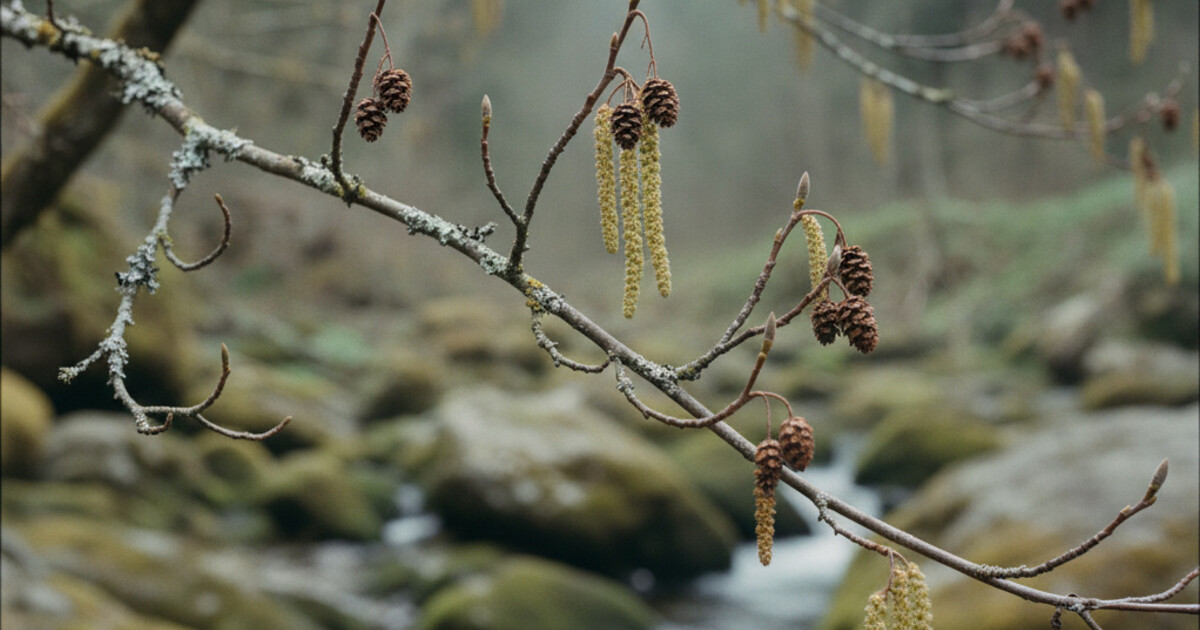
You’re standing next to a stream, looking at a gray-barked tree with small woody cones clinging to its branches. The leaves look almost like birch, but not quite. The habitat seems wrong for birch. Alder tree identification trips up a lot of people. Alders are common, widespread, and frequently confused with their birch cousins.
This guide covers the key features that separate alders from everything else, plus the four most common North American species.
Alder trees are best identified by their small, woody cone-like seed clusters (strobiles) that persist on branches through winter, oval leaves with doubly serrated margins, and a preference for wet riparian habitat. North America’s four main species are red alder, white alder, speckled alder, and Sitka alder, each with its own range and field marks.
What Makes an Alder an Alder
Alders belong to the birch family (Betulaceae), which explains why people confuse them with birches so often. But once you know what to look for, the two are easy to separate.
The most reliable field mark is the strobile: a small, woody, cone-like structure about the size of a large grape. These form from the female catkins after pollination and stay on the tree through winter, even after the leaves drop. Birches don’t have them. If you see a deciduous tree near water with what look like tiny pine cones attached to the twigs, you’re looking at an alder.
Male catkins appear separately, long and pendulous, usually in late winter or very early spring before the leaves emerge. They shed pollen and then drop. The woody strobiles that remain are from the female catkins.
Alder leaves are alternate, simple, and have a distinctively rough texture. The margins are doubly serrated, meaning each main tooth has smaller teeth along its edge. Leaf shapes vary by species, but most are broadly oval with a slightly sunken midrib. The underside often shows small tufts of hair in the vein axils.
One more thing that sets alders apart: they fix nitrogen. Their roots host Frankia bacteria in nodules, pulling nitrogen from the air and releasing it into the soil. This is why alders are often pioneer species after disturbances, building soil fertility that other trees later use.
Red Alder: The Pacific Northwest Giant
Red alder (Alnus rubra) is the largest alder in North America and the dominant hardwood across the Pacific Northwest coast. It grows along stream banks, in second-growth forests, and in disturbed areas from Alaska down through northern California. In moist lowland areas it can reach 80 to 100 feet tall.
The name comes from the orange-red inner bark, visible when you scrape or cut the outer layer. The outer bark itself is gray to grayish-white, often patchy with lichen. It doesn’t peel the way birch bark does. The surface is smoother and more uniform, with faint horizontal lenticels.
Red alder’s most distinctive leaf feature is the rolled-under margin. The leaf edges curl slightly downward, which you can feel by running your finger along the edge. No other common alder does this as consistently. The leaves are 3 to 6 inches long, oval with a pointed tip, and dark green above with a paler underside.
The strobiles on red alder are about half an inch long and stay on the tree through winter, turning dark brown and woody. You’ll often find clusters of 3 to 5 strobiles at branch tips.
Red alder is also commercially important. It’s the primary hardwood used in Pacific Northwest furniture, cabinetry, and (famously) smoking salmon. The wood is light pinkish-brown, fine-grained, and takes stain well.
For more on trees you’ll encounter in red alder country, see our guide to common trees of the Pacific Northwest.
White Alder: California’s Riparian Staple
White alder (Alnus rhombifolia) is the dominant alder in California and ranges north into the Pacific Northwest. It grows almost exclusively along streams and rivers, often forming dense galleries along watercourses in foothill and montane zones.
Compared to red alder, white alder’s leaves don’t curl under at the edges; they lie flat. The leaf margins are finely doubly serrated throughout, and the shape is more rounded (rhombifolia means “diamond-leaved,” though in practice the leaves look more oval than diamond-shaped).
The bark on white alder is gray to whitish and tends to break into irregular, scaly plates on older trees. Younger trees have smoother bark with visible lenticels.
White alder strobiles are similar in size to red alder but often appear in longer clusters. The catkins emerge very early (sometimes in January or February), making white alder one of the first trees to show signs of spring activity in California.
Speckled Alder: The Eastern Species
Speckled alder (Alnus incana ssp. rugosa) is the common alder across eastern North America, from the Great Lakes through New England and into Canada. Unlike its western relatives, speckled alder is often multi-stemmed, growing as a large shrub or small tree rarely exceeding 25 to 30 feet.
The name comes from the bark, which is dark brown to reddish-brown and heavily marked with prominent pale lenticels. Those white flecks give the bark a speckled appearance that’s distinctive even from a distance, especially in winter when the leaves are down.
Speckled alder leaves are oval with a rounded base and doubly serrated margins. They’re slightly more wrinkled (rugose) than other alders, which is where the subspecies name comes from. The underside has some rusty-colored hair along the veins.
This species is a key plant in eastern wetlands. It colonizes stream margins, bogs, and fens, providing dense cover for wildlife and stabilizing streambanks. White-tailed deer browse its stems heavily in winter.
Sitka Alder: The Mountain Shrub
Sitka alder (Alnus viridis ssp. sinuata) is the smallest and shrubiest of the common alders. It grows at high elevations and in coastal areas from Alaska down through the Pacific Northwest, often forming dense thickets on avalanche slopes and along mountain streams.
The leaves on Sitka alder are more sharply toothed than other species, with a slightly sticky feel when young. The bark is smooth and grayish-brown.
If you’re above treeline or on a subalpine slope and you see dense alder thickets blocking the trail, it’s almost certainly Sitka alder. It’s notoriously difficult to walk through and provides important habitat for brown bears and other mountain wildlife.
Alder vs. Birch: How to Tell Them Apart
This is the most common confusion. Both are in the same family, both grow in similar habitats, and both have similar-sized leaves with serrated margins. Here’s how to separate them:
- Fruit type: Alders have woody strobiles (small cone-like structures). Birches have papery catkins that break apart and scatter small winged nutlets. This is the fastest way to separate them in the field
- Bark: Birches (especially paper birch) have white, papery bark that peels in layers. Alder bark doesn’t peel; it’s smooth or scaly but stays intact
- Leaf base: Birch leaves often have a wedge-shaped base. Alder leaves tend to have a more rounded or heart-shaped base
- Habitat overlap: Both can grow near water, but birches tolerate drier sites much better than alders. An alder almost always has its feet wet; a birch might be on a hillside
For a closer look at birch identification, see our guide to birch tree varieties. And if you want to sharpen your bark reading skills, our tree bark identification guide covers the key patterns across dozens of species.
How Tree Identifier Helps with Alder Identification
Alders can be tricky in certain seasons. In summer, when leaves are fully out, the photos are straightforward. In late winter, when you’ve got bare branches with strobiles and dangling catkins, the angle matters a lot.
Tree Identifier works with whatever part of the tree you can photograph clearly. Snap the strobiles up close, the leaf underside, or a section of bark. The app accepts photos of leaves, bark, flowers, fruits, and whole tree shape, so you can use whichever feature is most visible on the tree you’re standing next to.
The species database covers all four major North American alder species (red, white, speckled, and Sitka), with detailed information on each one’s characteristics, habitat, and range. You get a confidence score with each identification, so you can tell whether the app is certain or whether the photo needs a second try.
It also works offline, which matters for riparian hikes where cell service is unreliable. Download the species data before you head out and the identifications work the same way without a connection.
Tree Identifier is free to start, with 2 identifications per day at no cost.
Frequently Asked Questions
How do I identify an alder tree in winter? Look for the woody strobiles (small cone-like structures) on the branches. They persist through winter after the leaves drop. Male catkins may also be visible, elongated and hanging, preparing to open in late winter. The bark and overall form help narrow down the species.
Are alder trees good for landscaping? Alders grow fast and fix nitrogen, but they’re adapted to wet conditions and don’t do well in dry yards. In the right spot (near a pond, along a stream, or in a rain garden), they’re excellent. Their roots help stabilize stream banks and their nitrogen-fixing ability improves soil over time.
What’s the difference between red alder and speckled alder? Red alder is a western species (Pacific Northwest) that can reach 100 feet, with leaves that curl under at the edges. Speckled alder is an eastern species that grows as a large shrub or small tree (under 30 feet), with distinctively speckled bark from its prominent lenticels. Their ranges don’t overlap much.
Why do alders grow near water? Alders are adapted to waterlogged soils that most trees can’t tolerate. Their root systems handle anaerobic (low-oxygen) conditions better than most hardwoods. They’re also pioneer species that colonize disturbed, wet ground early and build soil fertility through nitrogen fixation, which helps other species establish later.
Can I eat alder catkins or berries? The woody strobiles aren’t edible. Alder catkins release pollen and then drop. They’re not a food source. If you’re looking for edible wild plants near alder groves, look for other species in the same habitat.
If you’ve got an unidentified tree near water and want a quick answer, give Tree Identifier a try. Photograph the strobiles, a leaf, or a section of bark, and the app will narrow it down to species in seconds. Download it on iOS or Android at treeidentifier.app.
Identify a tree from your photo — free
Upload a leaf, bark, or whole-tree photo and get the species in seconds. No signup.
Confidence:
Unlock the full species profile
Free in the app — with unlimited identifications.


AI result for guidance — the app gives full species details and works offline.
Want unlimited identifications?
Get the full species profile, photos and details — free in the app, with unlimited scans.
- Unlimited identifications
- Full species profiles & details
- Works offline, anywhere
- Save and revisit your finds
Elena Torres
Tree Identifier Team