Common Trees of the Pacific Northwest
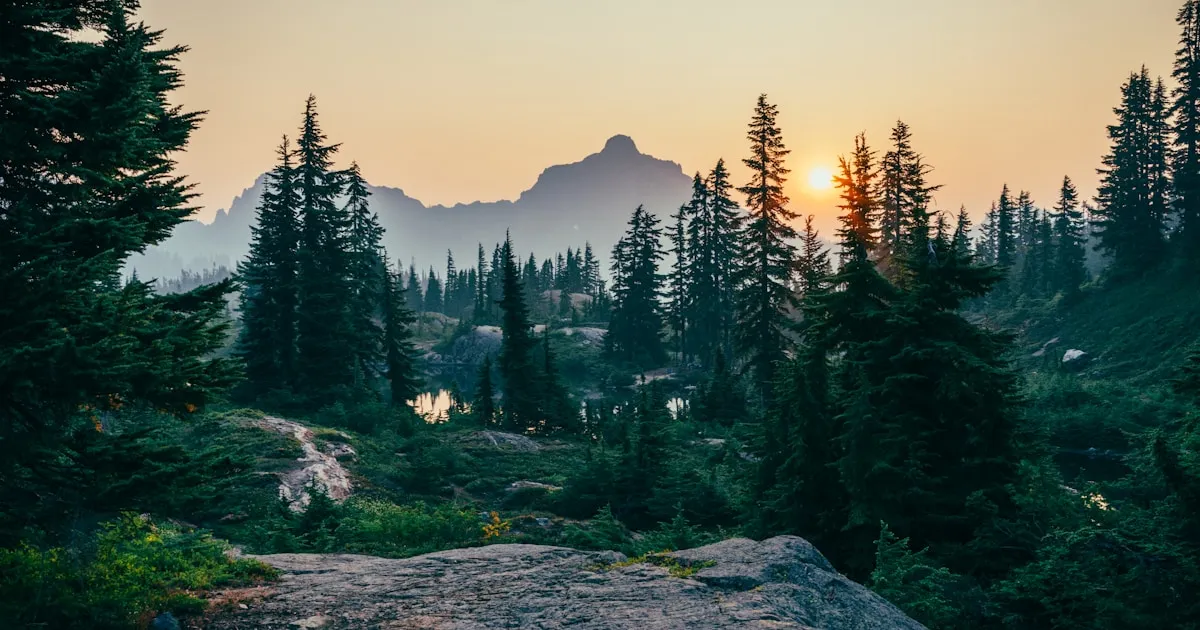
The Pacific Northwest grows trees like nowhere else in North America. A combination of mild temperatures, abundant rainfall (at least west of the Cascades), and long growing seasons produces forests of enormous conifers—some reaching 300 feet tall and living over a thousand years.
If you’re hiking in Washington, Oregon, or British Columbia, you’ll encounter a distinct set of species. Here’s how to identify the most common ones.
The Dominant Conifers
Douglas Fir (Pseudotsuga menziesii)
Despite the name, this isn’t a true fir. It’s the most commercially important timber species in North America and dominates Pacific Northwest forests.
Needles: Soft, flat, about 1-1.5 inches long. They spiral around the twig and have a slight groove on top. When crushed, they smell somewhat sweet.
Cones: Highly distinctive—the only conifer cone with three-pointed bracts sticking out between scales. The bracts look like the back legs and tail of a mouse diving into the cone. Once you see it, you won’t forget it.
Bark: Young trees have smooth, gray bark with resin blisters. Mature trees develop thick, deeply furrowed, reddish-brown bark that can be 12 inches thick.
Size: Can exceed 300 feet tall and 15 feet in diameter in old-growth forests. Even second-growth trees commonly reach 150 feet.
Douglas fir grows from British Columbia to central California and east to the Rockies, and is one of the tallest trees on Earth in its old-growth form. It thrives after disturbance—logging or fire opens areas where Douglas fir seedlings establish rapidly in full sun.
Western Red Cedar (Thuja plicata)
The “cedar” of the Pacific Northwest, though it’s actually in the cypress family, not a true cedar.
Foliage: Scale-like leaves in flat, spray-like branches. When crushed, the foliage has a sweet, somewhat fruity fragrance—the smell of cedar chests and closets.
Bark: Distinctive shreddy, fibrous bark that pulls off in strips. Reddish-brown to grayish.
Cones: Small (about half an inch), clustered near branch tips, with overlapping scales.
Size: Large trees reach 200 feet tall with trunk diameters of 10-13 feet, though typical forest specimens are smaller. The bark at the base often flares dramatically outward.
Western red cedar was essential to Indigenous peoples of the coast. They used the rot-resistant wood for canoes, houses, and totem poles. The bark was woven into clothing and baskets.
Today, the wood remains prized for decking, shingles, and outdoor applications where rot resistance matters—making western red cedar one of the top choices covered in best woods for outdoor projects.
Western Hemlock (Tsuga heterophylla)
The state tree of Washington and the climax species in many lowland Pacific Northwest forests.
Needles: Short (about 1/2 inch), flat, with two white stripes on the underside. The needles vary in length on the same twig, creating a feathery appearance.
Leader: The top of a western hemlock droops distinctively. This drooping leader is visible even from a distance and helps identify the species in a mixed forest.
Cones: Small (about 1 inch), oval, hanging from branch tips.
Bark: Reddish-brown with deep furrows on mature trees.
Size: Typically 100-150 feet tall, occasionally reaching 200 feet. Can grow in deep shade, allowing it to regenerate beneath existing forest canopy.
Western hemlock is shade-tolerant, gradually replacing Douglas fir in forests where fire is suppressed. It dominates old-growth forests that haven’t burned in centuries.
Sitka Spruce (Picea sitchensis)
The largest spruce species in the world, Sitka spruce grows in the fog belt along the Pacific coast.
Needles: Stiff, sharp, four-sided (they’ll roll between your fingers). Bluish-green to yellowish-green. Painfully prickly—the sharpest needles of any Northwest conifer.
Cones: Papery, about 2-3 inches long, with wavy-edged scales.
Bark: Thin, scaly, grayish.
Size: The largest can exceed 300 feet tall and 16 feet in diameter. Enormous specimens grow in Olympic National Park and the redwood belt.
Sitka spruce needs fog and coastal moisture. It rarely grows more than 50 miles from the ocean. The wood was used for aircraft construction (including the Spruce Goose) due to its strength-to-weight ratio.
Western White Pine (Pinus monticola)
The “king of pines” in the Northwest, now much rarer due to white pine blister rust.
Needles: In bundles of 5, soft, bluish-green, 2-4 inches long. The five-needle bundles distinguish it from other Northwest pines.
Cones: Large (6-10 inches long), cylindrical, often slightly curved. Scales tipped with resin.
Bark: Grayish, becoming divided into small rectangular blocks on older trees.
Size: Can reach 200 feet tall and 8 feet in diameter. Old-growth specimens are now rare.
White pine blister rust, an introduced fungal disease, has killed most large western white pines. Resistant strains are being developed, but the species remains far less common than historically.
Ponderosa Pine (Pinus ponderosa)
The pine of drier areas east of the Cascades and on south-facing slopes.
Needles: In bundles of 3, long (5-10 inches), yellow-green. The three-needle bundles identify it immediately.
Bark: One of the most distinctive barks in the Northwest. On mature trees, large reddish-brown plates separated by deep furrows. Smells like vanilla or butterscotch if you stick your nose in a furrow on a warm day.
Cones: 3-5 inches long with sharp prickles on each scale.
Size: Typically 60-130 feet tall. The straight, tall trunks were historically prized for lumber.
Ponderosa pine dominates drier forests where Douglas fir can’t thrive. Fire historically burned through ponderosa forests every 5-15 years, keeping understory clear and maintaining open, park-like conditions.
Native Deciduous Trees
Bigleaf Maple (Acer macrophyllum)
The largest maple species by leaf size, with leaves that can span a foot across.
Leaves: Five deep lobes, up to 12 inches wide. The largest maple leaves you’ll see anywhere.
Bark: Gray-brown with shallow furrows. Often heavily covered with moss, licorice ferns, and other epiphytes in the wet maritime climate.
Seeds: Typical maple “helicopters,” but with hairy wings.
Size: Can reach 100 feet tall with trunks 4-5 feet in diameter.
Bigleaf maple often grows in disturbed areas, along streams, and in forest openings. The wood has beautiful figure and is used for furniture, musical instruments, and veneer.
Red Alder (Alnus rubra)
The most common hardwood in the Pacific Northwest, growing rapidly in disturbed areas.
Leaves: Oval with coarsely toothed edges that roll under slightly. About 3-5 inches long.
Bark: Smooth, gray to whitish, often blotchy with lichens.
Cones: Small woody “cones” (actually catkins) that persist through winter.
Size: Fast-growing but relatively short-lived. Typically 40-80 feet tall.
Red alder fixes nitrogen in the soil, improving fertility for other species. It colonizes logging sites and burned areas, creating conditions for conifers to eventually take over.
Pacific Madrone (Arbutus menziesii)
An evergreen broadleaf tree with striking appearance.
Leaves: Thick, leathery, oval, evergreen. Dark glossy green above.
Bark: The identifying feature. Smooth, reddish-brown bark peels to reveal lime-green younger bark beneath. The color combination is unmistakable.
Flowers: White urn-shaped flowers in clusters, followed by red berries.
Size: Usually 20-80 feet tall. Often twisted and sculptural in form.
Madrones struggle with root disturbance and don’t transplant well. They’re best appreciated where they grow naturally—rocky slopes and dry areas from British Columbia to California.
Oregon White Oak (Quercus garryana)
The only native oak in the Pacific Northwest.
Leaves: Deeply lobed, resembling eastern white oak. 3-6 inches long.
Bark: Light gray with deep furrows and scaly ridges.
Acorns: 1-inch acorns with shallow cups.
Size: 50-90 feet tall in good conditions. In dry areas, grows as a smaller, twisted tree.
Oregon white oak savannas once covered vast areas of the Willamette Valley and Puget lowlands. Most were converted to agriculture or invaded by conifers after fire suppression. Remaining oak habitats support unique wildlife.
Using the Tree Identifier App
The Pacific Northwest presents interesting identification challenges. Multiple conifer species can grow together in the same forest, and their appearance changes with age and growing conditions.
When photographing for identification:
- Conifers: Get close-ups of needle arrangement and cones. The three-pointed Douglas fir bracts and sharp Sitka spruce needles photograph well.
- Bark: The distinctive barks of western red cedar, ponderosa pine, and Pacific madrone are excellent identification features.
- Bigleaf maple: That leaf size speaks for itself.
The app handles regional species well. Submit photos from any Pacific Northwest hike and you’ll likely get confident matches for these common species.
Seasonal Considerations
Spring: Red alder catkins, maple flowers, Pacific madrone blooms. Summer: Full foliage on all species. Best time to study leaf characteristics. Fall: Bigleaf maple turns yellow. Red alder leaves drop early. Evergreen conifers stand out more. Winter: Conifer identification becomes easier without deciduous interference. Look for persistent cone shapes, bark patterns, and evergreen foliage characteristics.
The Pacific Northwest’s mild, wet climate keeps forests green year-round. Unlike eastern forests where winter strips everything bare, you can identify trees here in any season—which makes it one of the best regions in North America for year-round tree exploration.
Identify a tree from your photo — free
Upload a leaf, bark, or whole-tree photo and get the species in seconds. No signup.
Confidence:
Unlock the full species profile
Free in the app — with unlimited identifications.


AI result for guidance — the app gives full species details and works offline.
Want unlimited identifications?
Get the full species profile, photos and details — free in the app, with unlimited scans.
- Unlimited identifications
- Full species profiles & details
- Works offline, anywhere
- Save and revisit your finds
Rachel Nguyen
Tree Identifier Team