Bald Cypress Tree Identification: 7 Reliable Signs
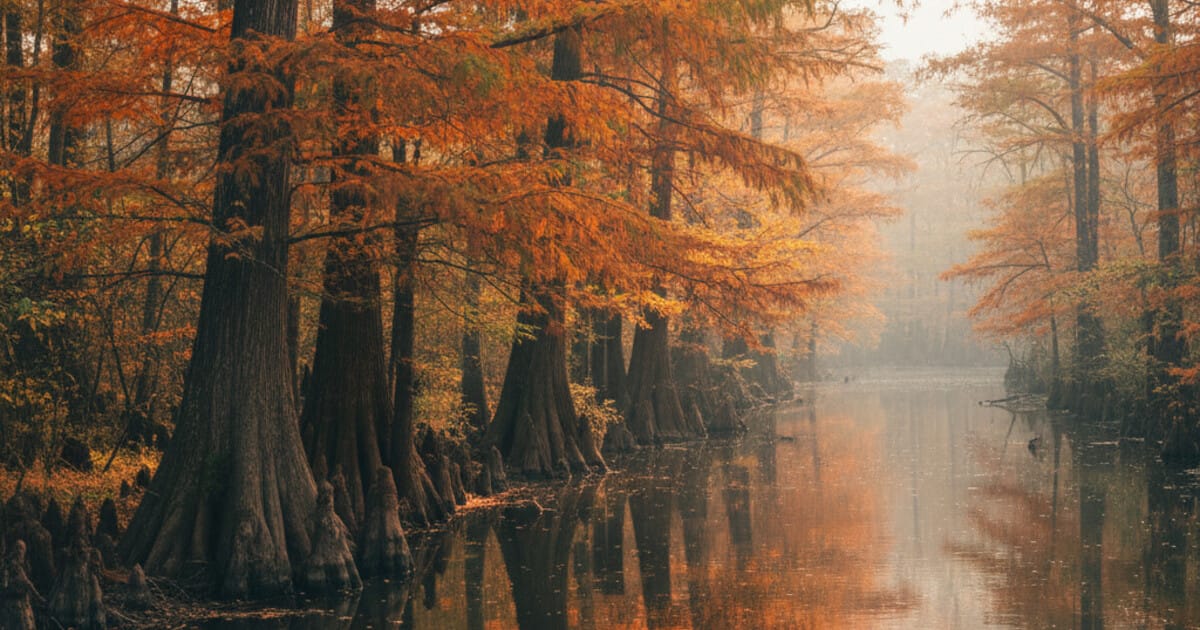
You’ve probably seen it without knowing what it was: a tall, feathery-looking conifer standing knee-deep in a Southern swamp, its foliage turned rusty orange in October before vanishing entirely by December. Bald cypress (Taxodium distichum) looks like an evergreen until it isn’t. That combination (conifer body, bare winter branches) makes it one of the more confusing trees in eastern North America until you know what to look for.
This guide covers 7 reliable identification signs, from the soft flat needles to the famous wooden “knees” that rise from the waterline. Whether you’re hiking through Louisiana bayous, paddling the Okefenokee, or curious about the big feathery tree at the edge of a local pond, these features will lock in the ID.
Bald cypress is a deciduous conifer native to the Southeast US and Gulf Coast. It grows in swamps and river floodplains, produces soft feathery needles that turn rusty orange in fall and drop completely in winter, and grows distinctive woody “knees” from its roots in waterlogged soil. The buttressed trunk flare and small round cones confirm the ID.
How to Read Bald Cypress Needles
The foliage is the fastest starting point. Bald cypress grows soft, flat leaves (not true needles) arranged in 2 alternating rows along slender green branchlets. Each leaf is roughly 1/2 to 3/4 inch long, flat, and bright yellow-green in spring and summer.
Run your finger along a branchlet from tip to base. The leaves spread outward in a feather-like pattern, flexible and almost delicate compared to pine or spruce needles. The overall branchlet looks like a small fern frond, about 4-6 inches long.
Bald cypress foliage follows a growth pattern called 2-ranked or distichous: leaves arranged in the same plane on opposite sides of the stem, not in bundles or whorls. This arrangement is shared by dawn redwood and yew but not by any other common Southern conifer. Color shifts dramatically through the year: bright yellow-green when leaves open in March, deepening to medium green by June, then shifting to rusty orange-brown in September before the entire branchlet drops by late November. This deciduous cycle is shared by fewer than a dozen conifer species worldwide. Individual leaves measure 12 to 20 mm and feel flexible and almost papery, nothing like the stiff, sharp needles of pine, spruce, or fir. During September and October, when a swamp full of bald cypress turns deep orange-brown before dropping its foliage, the color is unmistakable from a distance, the only conifer in the Southeast to lose its needles in fall.
In December, the bare branches are actually a useful ID tool. A leafless “pine” standing in flooded ground in the Southeast is almost certainly bald cypress.
Cypress Knees: The Clearest Bald Cypress Sign
Bald cypress knees are blunt wooden protrusions that rise from the root system around the tree’s base. They range from a few inches to several feet tall and typically cluster in a ring around the trunk, especially in flooded soil.
Scientists debate their exact function. The most supported explanation is oxygen supply: roots buried in anaerobic swamp mud can’t absorb oxygen efficiently, so knees carry air down to them. Trees in permanently flooded sites grow taller, more numerous knees. Trees on dry ground often produce very few.
If you spot a conifer with these woody spires rising from the waterline, the ID is essentially done. Pond cypress (Taxodium ascendens), a close relative found primarily in Florida and coastal Georgia, also produces knees, but its foliage looks quite different. Pond cypress leaves press tightly against the stem (appressed) and point upward, giving the branchlet a rope-like texture instead of a flat fern-frond shape.
No other common North American tree produces this root structure.
Buttressed Trunk and Fibrous Bark
The trunk is worth a close look. Bald cypress flares dramatically at the base, forming a broad buttressed skirt that widens the trunk’s footprint in soft, flooded soil. This flare is most pronounced on old trees in standing water, where the trunk can spread 3-4 feet wider at the base than at chest height.
The bark is reddish-brown to grayish-brown, fibrous, and split into long narrow interlacing ridges. Press on the bark and it feels slightly spongy compared to oak or maple. This fibrous texture runs consistently up the trunk from the buttressed base and is consistent across mature specimens of all ages.
For a comparison of bark textures across species, the tree bark identification guide covers surface patterns, color, and texture across dozens of common North American trees.
Swampy Habitat: Where Bald Cypress Lives
Bald cypress grows across the coastal plain from Delaware south through Florida, then west along the Gulf Coast to east Texas, and north up the Mississippi River valley to southern Illinois. It’s the state tree of Louisiana and dominates millions of acres of bayou and backwater swamp across the Gulf States.
The tree colonizes river swamps, lake margins, bottomland floodplains, and tidal freshwater swamps. It tolerates prolonged flooding that would kill most other tree species, standing in water anywhere from a few inches to several feet deep. In managed habitat studies, bald cypress root systems survived complete submersion for up to 30 consecutive days with minimal stress, a flooding tolerance no common hardwood species in the region comes close to matching. Trees in permanently flooded conditions develop the deepest root systems and the most dramatic trunk flares, with buttressed bases that spread outward for structural stability in soft, saturated soil. This combination of features (water tolerance, root knees, and trunk buttressing) developed over millions of years in the flooded coastal plain environment.
Seeing a large conifer in standing water in the Southeast puts bald cypress at the top of the candidate list. Outside its natural range, the tree is also planted as an ornamental across the eastern US, growing successfully as far north as Michigan and coastal Massachusetts.
Small, Round Cones
The cones are small and easy to miss. Bald cypress produces round, wrinkled cones roughly 1 inch (2.5 cm) across. They start green in late spring and ripen to grayish-brown by October.
The scales fit together in an irregular, warty pattern. When mature in fall, scales separate and the cone disintegrates on the tree rather than dropping intact. You’ll often find scattered scales and seeds on the ground under a mature tree rather than whole cones. This fragmentation distinguishes bald cypress from most other conifers.
Pollen cones (male) hang in slender drooping clusters of 3-5, visible in early spring before foliage emerges. Both male and female cones grow on the same tree.
The small, round, warty cone shape is quite different from the elongated cones of Italian cypress, Leyland cypress, or Arizona cypress. The cypress tree identification guide breaks down how to separate bald cypress from those cultivated species by foliage texture and cone shape.
Size and Silhouette
Mature bald cypress trees are tall. Most reach 70-120 feet with trunk diameters of 3-6 feet. Old-growth trees in protected bottomland stands can top 120 feet.
Crown shape shifts with age and conditions. Young trees in open areas form a narrow pyramid. Older trees in closed swamp canopies develop irregular, flattened crowns with layered horizontal branching. In winter without foliage, the silhouette is tall and narrow with an open crown and the characteristic wide buttressed base.
The oldest confirmed bald cypress in the US grows along the Black River in North Carolina and is at least 2,624 years old, documented in a 2019 study. That makes bald cypress one of the longest-lived trees in the eastern hemisphere, comparable in age to ancient bristlecone pines in the American West.
Seasonal Color Calendar
Bald cypress shifts significantly through the year, which creates different ID windows each season:
- Spring (March-April): Fresh lime-green foliage emerges. Male pollen cones visible in early March before leaves open. New growth is noticeably brighter than surrounding vegetation.
- Summer (May-August): Full medium-green foliage. Knees and buttressed base most accessible when summer water levels drop.
- Fall (September-November): Foliage shifts from green to rusty orange to brown. A swamp full of orange cypress in October is hard to mistake for anything else.
- Winter (December-February): Completely bare. Bark, trunk flare, and knees confirm the ID without any foliage needed.
This four-season pattern contrasts sharply with all other conifers in the region, making bald cypress one of the more recognizable species during the transition months.
How Tree Identifier Helps
Bald cypress looks dramatically different in June (green, feathery canopy) versus January (bare branches over flooded ground). Both can be confusing without context, especially for hikers who don’t expect a conifer to lose all its needles.
Tree Identifier handles bald cypress from multiple inputs: leaf close-ups, bark shots, full-tree silhouettes, and cone or knee photos. The app’s species database includes Taxodium distichum alongside the closely related pond cypress, with habitat and range data that helps confirm whether a location fits.
The app works offline, which matters when you’re on a remote swamp hike or river paddle without cell coverage. Start with 2 free daily identifications to try it out, or upgrade for unlimited scans. Download on iOS and Android and bring it on your next walk through the Southeast.
Frequently Asked Questions
Is bald cypress an evergreen tree?
Bald cypress is a deciduous conifer, which means it drops its foliage every fall unlike most other conifers. The needles turn rusty orange in September and October and fall off by December. This unusual behavior is where the “bald” in the name comes from. The tree spends winter completely bare.
What are bald cypress knees?
Cypress knees are woody protrusions that grow upward from the root system around the tree’s base. They form most prominently in flooded or waterlogged soil. The leading explanation is that knees supply oxygen to roots growing in anaerobic, oxygen-depleted swamp soil, though the function is still actively studied.
Where does bald cypress grow in the United States?
Bald cypress grows naturally across the coastal plain from Delaware south through Florida, west along the Gulf Coast to east Texas, and north up the Mississippi River valley to southern Illinois. It prefers river swamps, lake margins, and flooded bottomlands, though it can grow on drier upland ground with fewer knees and a less pronounced trunk flare.
How do I tell bald cypress from pond cypress?
Foliage texture is the key difference. Bald cypress needles spread outward from the branchlet in 2 flat rows, giving a fern-frond look. Pond cypress needles press tightly against the stem and point upward, giving the branchlet a rope-like or scaly appearance. Pond cypress is also generally smaller and mostly limited to Florida and coastal Georgia.
How long do bald cypress trees live?
Most bald cypress live 200-500 years. The oldest confirmed specimen, along the Black River in North Carolina, is at least 2,624 years old as of 2019. That makes it one of the oldest living trees in the eastern hemisphere, comparable in age to ancient bristlecone pines in the American West.
Identify a tree from your photo — free
Upload a leaf, bark, or whole-tree photo and get the species in seconds. No signup.
Confidence:
Unlock the full species profile
Free in the app — with unlimited identifications.


AI result for guidance — the app gives full species details and works offline.
Want unlimited identifications?
Get the full species profile, photos and details — free in the app, with unlimited scans.
- Unlimited identifications
- Full species profiles & details
- Works offline, anywhere
- Save and revisit your finds
Elena Torres
Tree Identifier Team