Black Cherry Tree Identification: 7 Reliable Signs
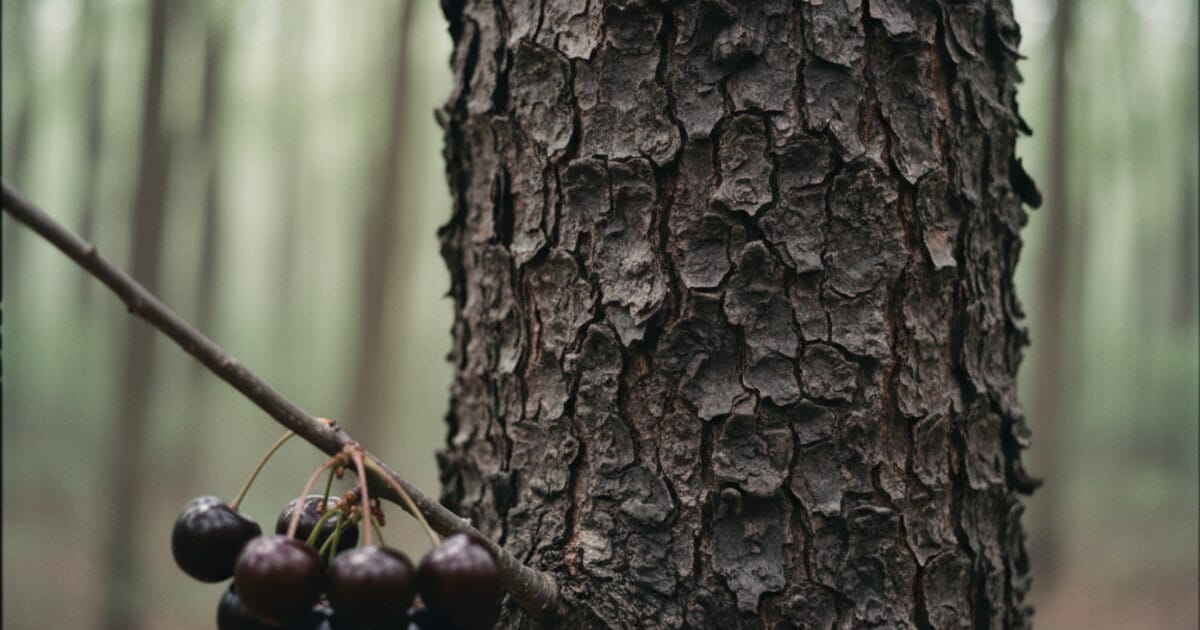
Black cherry (Prunus serotina) is one of the most common native hardwoods in eastern North America, and it looks almost like two different trees depending on age. Young specimens have smooth, reddish-brown bark with horizontal lines, similar to young birches. Old trees carry dark, blocky, deeply furrowed bark that many people describe as burnt potato chips. Connecting those two stages is the first step toward confident black cherry tree identification.
This guide covers 7 reliable signs: bark texture at different ages, the critical twig scratch test, leaf shape and the distinctive midrib hairs, elongated flower clusters, fruit color and timing, and habitat clues that narrow things down quickly.
Black cherry is a medium to large deciduous hardwood native to eastern North America. It has dark, scaly bark on mature trees; lance-shaped leaves with rust-colored hairs along the midrib on the underside; and small fruits that ripen from red to dark purple-black in late summer. Scratch a twig and you’ll smell bitter almonds, the most reliable single identification clue.
What Does a Black Cherry Tree Look Like?
Black cherry is a medium to large hardwood, typically 50 to 80 feet tall in forest settings. The crown is irregular and somewhat spreading, with ascending branches that widen as the tree matures. Along roadsides and old fields, it tends to grow shorter and more open.
The species ranges from Nova Scotia down through Florida and west into Nebraska. It’s especially common along forest edges, abandoned pastures, and disturbed roadsides, where birds drop seeds after eating the fruit.
Black cherry is among the most ecologically significant native hardwoods in North America. It produces small dark-purple fruits in late summer (July through September) that feed at least 47 bird and mammal species, including wild turkeys, foxes, and black bears. In high-quality Appalachian forest stands, black cherry makes up 8 to 10% of hardwood timber volume according to USDA Forest Service surveys, and it’s the most commercially valuable native cherry species on the continent. The wood is dense, fine-grained, and prized for furniture and cabinetry. Mature trees live 100 to 150 years, reaching trunk diameters of 2 to 3 feet. Because of its value and wide distribution, black cherry is one of the most commonly harvested hardwoods in the eastern United States, making accurate species identification important for foresters, landowners, and curious hikers alike.
Black Cherry Bark Identification
Bark is the most reliable way to identify black cherry in any season, but the appearance shifts dramatically with age.
Young trees (4 inches or less in trunk diameter): The bark is smooth, glossy, and reddish-brown to dark gray, with horizontal lenticels (small, elongated pores) across the surface. This stage looks similar to young birch trees, but black cherry lenticels are less prominent and the color sits darker overall.
Mature trees: The bark breaks into small, irregular plates that curl outward at the edges. The texture is often described as “burnt cornflakes” or “alligator skin.” Individual plates are dark gray to nearly black. This distinctive texture narrows the ID considerably once you’ve seen it a few times.
Check a broken branch or fresh cut when you can. The inner bark shows a warm reddish-brown and carries a faint but recognizable smell, which brings up the fastest confirmation method.
Sign 3: The Twig Scratch Test
Snap a small twig or scratch the bark with your fingernail and bring it to your nose.
You’ll smell bitter almonds immediately. That scent comes from prunasin, a compound found throughout the tree that breaks down into benzaldehyde when plant tissue is damaged. It’s the same compound responsible for the almond smell in marzipan and cherry pits.
No other common eastern hardwood carries this scent. If you catch that sharp almond smell, you’ve almost certainly got black cherry.
Black Cherry Leaf Identification
Black cherry leaves are alternate, simple, 2 to 5 inches long, and narrowly oval to lance-shaped, widest at or just below the middle. The edges carry fine, sharp teeth that curve slightly inward, giving them a crisper look than species with more jagged serration.
Turn the leaf over. Along the central vein (midrib), you’ll find a row of short, rust-colored or orange-brown hairs. This feature holds across the species from late spring through fall. Most other Prunus species either lack these hairs or distribute them differently across the leaf surface.
The leaves turn yellow to orange-red in fall. Warm fall color combined with the persistent bark texture makes for reliable ID even after most leaves have dropped.
For a comparison with ornamental and orchard cherries that often get mixed up with native species, see our cherry tree identification guide.
Signs 5 and 6: Flowers and Fruit
Flowers: Black cherry blooms in May and June, producing white flowers in elongated, drooping clusters called racemes. Each raceme is 4 to 6 inches long and holds 20 to 30 individual flowers with 5 rounded petals and a yellow center. The elongated raceme is the key: ornamental cherries bloom in tight, round clusters attached directly to branches, while black cherry’s long drooping stems are hard to miss.
Fruit: The fruit is a small drupe, about 1/4 to 1/3 inch in diameter. It starts pale green, turns red in midsummer, and ripens to dark purple-black by August across most of the range. Ripe fruits cluster on the same long, drooping stems as the flowers.
The fruit looks a lot like chokecherry (Prunus virginiana). The twig scratch test resolves this quickly: chokecherry has a much fainter scent, and its leaves tend to be broader and rounder with sharper, more spreading teeth.
Our fruit tree identification guide covers how to tell fruit-bearing species apart by fruit structure and cluster arrangement if you want a broader comparison.
Sign 7: Habitat and Range
Black cherry is a pioneer species. When farmland is abandoned, it’s often one of the first hardwoods to move in, carried by birds eating the fruit. A few habitat patterns help narrow the ID:
- Forest edges and old fields across the eastern United States
- Disturbed roadsides, fence lines, and power line corridors throughout the East
- Mixed hardwood forests alongside oaks, maples, hickories, and tulip trees
- Northern Appalachians (especially Pennsylvania and New York) for the largest, most commercially valued specimens
The species doesn’t reach western North America. Its range ends roughly at the 100th meridian, so if you’re west of the Great Plains, native black cherry won’t be in the picture.
How Tree Identifier Helps
When the bark hasn’t fully matured yet, or the light is bad, or you want confirmation on an unfamiliar specimen, a photo identification can settle the question fast. Tree Identifier uses AI to analyze photos of bark, leaves, flowers, and fruit and return a species match with a confidence score.
The app handles tricky cases well: young smooth-barked trees, partially opened spring leaves, or fruit clusters that aren’t quite ripe yet. You can photograph bark and leaves separately, and the app processes each input on its own. It works offline too, so you don’t need a cell signal on a remote trail.
You get 2 free identifications per day, which covers most casual encounters. Available on iOS and Android.
Frequently Asked Questions
How do I tell black cherry from chokecherry?
The twig scratch test is the fastest method. Scratch a twig on black cherry and you’ll smell strong bitter almonds. Chokecherry has a much fainter scent. Black cherry leaves are also narrower and lance-shaped, with rust-colored hairs along the midrib underside. Chokecherry leaves are broader and rounder with sharper, more spreading teeth along the edges.
Is black cherry the same as wild cherry?
In North America, yes. “Wild cherry” is a common name for Prunus serotina, the same tree called black cherry. In Europe, “wild cherry” refers to Prunus avium, a different species that’s the ancestor of most cultivated sweet cherries. The two are unrelated despite sharing the name.
When does black cherry fruit ripen?
Black cherry fruit ripens from July through September, depending on latitude and elevation. Trees in southern states ripen earliest (July) and northern or high-elevation trees ripen into September. Production also varies by year: black cherry tends toward heavy mast years every 3 to 4 years, with lighter crops in between.
Why does black cherry smell like almonds?
The bark, leaves, and seeds contain prunasin, a cyanogenic glycoside. When plant tissue is damaged, prunasin breaks down and releases benzaldehyde, which smells like bitter almonds. The same compound appears in apricot and cherry pits. The smell is strongest in fresh twigs and the inner bark, and it works as a field ID clue in any season.
Wrapping Up
Black cherry tree identification comes down to a handful of consistent features: the scaly dark bark on mature trees, rust-colored hairs along the leaf’s midrib, elongated drooping flower and fruit clusters, and the bitter-almond twig smell that’s faster and more reliable than any visual check.
If you want a second opinion on a tree you’re unsure about, Tree Identifier can analyze photos of bark, leaves, or fruit and give you a species match in seconds. That’s especially useful when the tree is young and the bark hasn’t developed its characteristic texture yet. Download the app on iOS or Android and try it free.
Identify a tree from your photo — free
Upload a leaf, bark, or whole-tree photo and get the species in seconds. No signup.
Confidence:
Unlock the full species profile
Free in the app — with unlimited identifications.


AI result for guidance — the app gives full species details and works offline.
Want unlimited identifications?
Get the full species profile, photos and details — free in the app, with unlimited scans.
- Unlimited identifications
- Full species profiles & details
- Works offline, anywhere
- Save and revisit your finds
Elena Torres
Tree Identifier Team