Cherry Tree Identification: Bark, Blooms, and Species Guide
Cherry trees are among the most widely planted and admired trees in North America, yet cherry tree identification trips up even experienced nature enthusiasts. The genus Prunus includes dozens of species that range from towering wild timber trees to compact ornamental varieties bred for their spring blossoms. Telling them apart matters whether you’re choosing a tree for your yard, foraging in the woods, or simply trying to name the pink cloud blooming at the end of your street.
This guide covers the major cherry tree groups: ornamental flowering cherries, wild native species, and the fruiting cherries grown in orchards. Each section focuses on the visual features you can spot in the field — bark, leaves, flowers, and fruit — so you can narrow down the species without needing a botany degree.
How Cherry Tree Identification Starts: Bark With Horizontal Lines
Every cherry tree shares one trait that separates the genus from almost all other trees: smooth bark marked with horizontal lenticels. Lenticels are small pores that allow gas exchange through the bark, and on cherry trees they stretch sideways into thin, papery lines that wrap partway around the trunk. On young trees the bark is glossy and reddish-brown to gray, with these horizontal stripes clearly visible.
This bark pattern is your fastest screening tool. If you see a tree with smooth, shiny bark and obvious horizontal lines, you’re likely looking at a Prunus species. Oaks, maples, and elms develop furrowed or plated bark, and birches peel in sheets rather than forming clean horizontal stripes. Our bark identification guide covers these differences across many genera.
As cherry trees age, the bark on larger species like black cherry develops dark, rough, scaly plates that peel outward at the edges. Even then, you can usually find smooth bark with lenticels on younger branches higher in the canopy.
Ornamental Cherry Trees: The Spring Show
Ornamental cherries were bred in Japan and East Asia for centuries, selected for flower density, color, and form rather than fruit production. Several species and cultivars dominate North American landscapes.
Yoshino Cherry (Prunus x yedoensis)
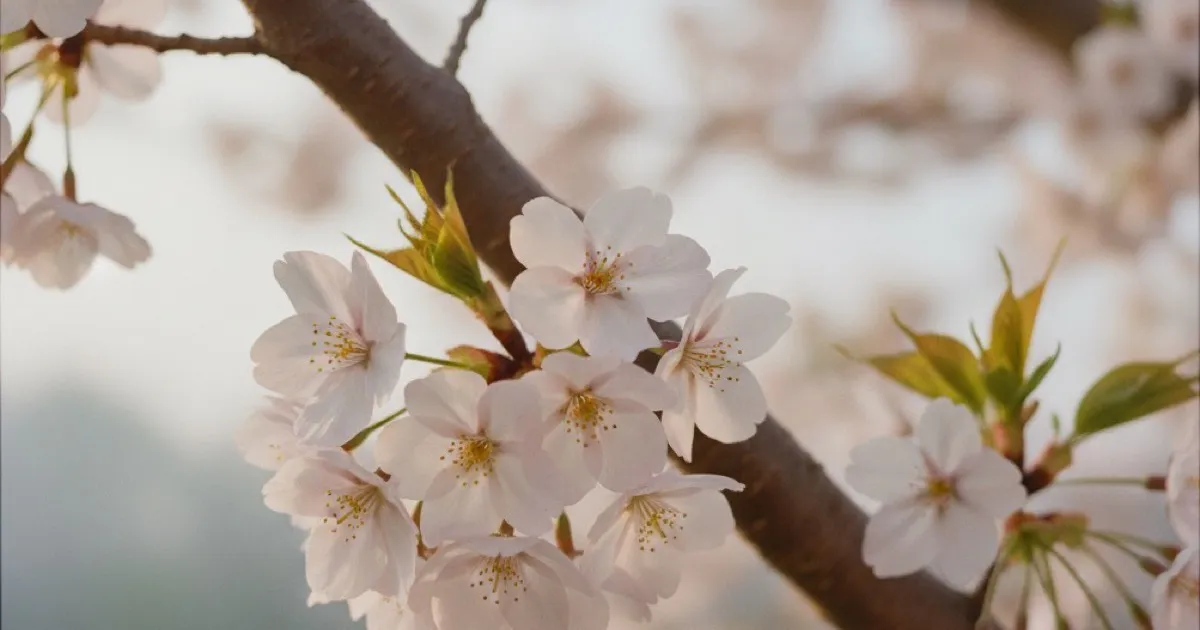
Yoshino cherry is the tree behind Washington D.C.’s cherry blossom festival. It produces clusters of five-petaled flowers that open white to very pale pink, covering the canopy before the leaves fully emerge. Peak bloom lasts roughly one week. The flowers have a faint almond fragrance.
Yoshino grows 25 to 35 feet tall with a broad, spreading crown. The bark is smooth and gray with prominent lenticels. Leaves are oval, 3 to 5 inches long, with serrated edges and a pointed tip.
Kwanzan Cherry (Prunus serrulata ‘Kanzan’)
Kwanzan cherry is the double-flowered ornamental you’ll see in parks and along residential streets. Each bloom has 20 to 50 petals, creating a ruffled, almost carnation-like appearance in deep pink. No wild cherry produces flowers this dense, so a double-flowered pink cherry is nearly always a Kwanzan or closely related cultivar.
Kwanzan blooms about one to two weeks after Yoshino, and the heavier flowers don’t scatter in the wind as readily. The tree reaches 25 to 30 feet with an upright, vase-shaped canopy. New leaves often emerge with a bronze-copper tint before turning green.
Okame Cherry (Prunus ‘Okame’)
Okame cherry blooms earlier than most ornamentals, often in late February or early March. The single flowers are a strong, saturated pink on a compact tree that tops out around 20 to 25 feet. Okame is a hybrid between Prunus incisa and Prunus campanulata, and its early bloom makes it a reliable marker that spring has arrived.
Quick Ornamental Cherry Identification Tips
If you’re standing under a blooming ornamental cherry and want to narrow it down, check these details:
- Petal count: Five petals means a single-flowered variety like Yoshino or Okame. Twenty or more petals means a double like Kwanzan.
- Color intensity: Pale white-pink points to Yoshino. Strong pink suggests Okame (early season) or Kwanzan (mid-season).
- Bloom timing: Okame blooms first, Yoshino next, Kwanzan last.
- Tree shape: Yoshino spreads wide. Kwanzan grows upright. Okame stays compact.
For a broader look at how cherry trees fit into the spring flowering sequence alongside dogwoods, magnolias, and redbuds, see our flowering tree identification guide.
Wild Cherry Tree Identification: Native North American Species
Wild cherries are forest trees, not ornamentals. They grow taller, produce smaller flowers, and bear fruit that feeds dozens of bird and mammal species. Identifying wild cherries takes a slightly different eye than spotting a Yoshino in a park.
Black Cherry (Prunus serotina)
Black cherry is the largest native cherry in North America, reaching 60 to 80 feet in mature forests. It’s a commercially important timber tree — the dark, fine-grained wood is prized for furniture and cabinetry.
Bark is the standout feature. Young black cherry bark is smooth and reddish-brown with prominent lenticels, matching the classic cherry look. Mature bark transforms dramatically into dark, rough plates that curl outward at the edges, often compared to burnt potato chips or cornflakes. This flaky, dark bark on a large trunk is a strong indicator of black cherry.
Leaves are 2 to 5 inches long, narrow and lance-shaped, with fine-toothed edges. A key detail: look at the underside of the leaf along the midrib near the base. Black cherry leaves often have a strip of rusty-brown fuzz along the lower midrib, visible with a hand lens or careful inspection.
Flowers appear in late spring as elongated, drooping clusters (racemes) of small white flowers, each about a quarter inch across. These dangling flower clusters are 4 to 6 inches long and look nothing like the showy bursts of ornamental cherries.
Fruit ripens to dark purple-black in late summer. The small drupes grow in those same drooping clusters. Birds, bears, foxes, and raccoons eat them heavily. Black cherry is one of the most important wildlife food trees in eastern forests.
Chokecherry (Prunus virginiana)
Chokecherry grows as a large shrub or small tree, typically 15 to 25 feet tall. It ranges across nearly all of North America, from coast to coast and from the southern Appalachians into Canada, making it one of the most widespread native cherry species.
Flowers appear as dense, cylindrical clusters similar to black cherry but shorter, usually 3 to 4 inches long. The small white flowers bloom in mid to late spring.
Leaves are broader and more oval than black cherry, 2 to 4 inches long, with finely serrated edges. They lack the rusty midrib fuzz found on black cherry.
Fruit ripens to dark red or black and grows in clusters. The fruit is extremely astringent when raw — hence the name “chokecherry.” Wildlife consumes the fruit readily despite the tartness.
Bark is gray-brown and smooth on young stems, developing shallow fissures with age. It never develops the dramatic flaky plates of mature black cherry.
Pin Cherry (Prunus pensylvanica)
Pin cherry is a fast-growing pioneer species that colonizes forest openings after fires, storms, or logging. It rarely exceeds 30 feet and lives only 20 to 40 years, but it plays an important ecological role as one of the first trees to revegetate disturbed land.
Flowers grow in small, flat-topped clusters of 3 to 7 blooms rather than the elongated racemes of black cherry and chokecherry. This cluster shape is a quick way to separate pin cherry from the other wild species.
Bark is thin, smooth, and reddish-brown with visible lenticels — the classic young-cherry look that persists throughout the tree’s short life span.
Fruit is bright red, small, and grows on long stems. Birds eat the fruit and disperse the seeds widely, which is how pin cherry colonizes new areas so effectively.
Sweet Cherry and Sour Cherry: The Orchard Trees
Two cherry species dominate fruit orchards, and both sometimes escape into semi-wild settings along roadsides and woodland edges.
Sweet cherry (Prunus avium) produces the large, firm cherries sold fresh at grocery stores — Bing, Rainier, and similar cultivars. The tree grows 35 to 50 feet tall with upright branching. Flowers are white, about an inch across, in clusters of 2 to 5. The bark is distinctly shiny and reddish-brown with thick, peeling horizontal lenticels. Leaves are large, 3 to 6 inches, oval with pointed tips and doubly serrated edges.
Sour cherry (Prunus cerasus) stays smaller, typically 15 to 25 feet, with a more spreading, rounded canopy. It produces the tart cherries used in pies and preserves. Flowers are white and slightly smaller than sweet cherry. Sour cherry tends to sucker from the roots, forming clumps or thickets, while sweet cherry grows as a single-trunked tree.
Both orchard cherries are European in origin but have naturalized across North America. You’ll find them along fence rows, old homesteads, and forest edges where birds dropped seeds decades ago. To learn more about identifying fruit-bearing trees by their fruit and flowers, check our fruit tree identification guide.
Cherry Trees and Wildlife
Cherry trees support an outsized share of forest wildlife. Black cherry alone provides food for more than 40 bird species, including cedar waxwings, robins, thrushes, and tanagers. Mammals from black bears to chipmunks eat cherry fruit in late summer. The trees also host hundreds of caterpillar species, making them critical links in the forest food web.
Wild cherries are considered keystone species in many eastern and northern forests because so many animals depend on their fruit and foliage. If you’re interested in which trees provide the most ecological value, our guide to invasive tree species covers the flip side — the non-native trees that displace these important natives.
Cherry Tree Identification Using Your Phone
When you’re standing under a blooming tree and want a definitive answer, a photograph captures the details that matter: the horizontal lenticels on the bark, the petal count in the flowers, and the leaf shape and edge pattern.
Tree Identifier analyzes photos of leaves, bark, flowers, fruit, or the whole tree shape using AI. Snap a close-up of those signature horizontal bark stripes or a cluster of double-petaled Kwanzan blossoms, and the app returns a species identification with a confidence score. It works on both iOS and Android and gives you 2 free identifications per day.
Cherry trees respond well to photo identification because the genus has such consistent visual markers. The bark lenticels, the five-petaled flower structure, and the drooping fruit clusters of wild species all give the AI clear features to work with. If you’re hiking a trail without cell service, the app’s offline mode lets you download species data ahead of time so you can identify trees in remote areas. You can photograph bark in winter, flowers in spring, or fruit in summer and get accurate results in any season.
Frequently Asked Questions
How can I tell the difference between a wild cherry and an ornamental cherry?
Check the flower arrangement and tree size. Ornamental cherries produce dense, showy flower clusters with large or double petals on trees that rarely exceed 35 feet. Wild cherries like black cherry and chokecherry produce elongated, drooping racemes of small, single white flowers and can grow much taller. Bark also differs: mature black cherry develops dark, flaky plates, while ornamental cherries keep relatively smooth bark.
What are the horizontal lines on cherry tree bark?
Those lines are lenticels, small pores that allow the tree to exchange gases through its bark. On cherry trees, lenticels stretch horizontally into thin, papery stripes. They’re most visible on young, smooth bark and are one of the single best identification features for the Prunus genus. Birch trees also have lenticels, but birch bark peels in papery sheets while cherry bark remains smooth.
Do all cherry trees produce edible fruit?
All cherry trees in the genus Prunus produce drupes (stone fruits), but not all are pleasant to eat. Sweet cherry cultivars produce the large, firm fruit sold commercially. Sour cherry fruit is tart but widely used in cooking. Wild species like chokecherry produce extremely astringent fruit that is mostly consumed by wildlife. The fruit of ornamental cherries is typically very small and not harvested.
When is the best time to identify cherry trees?
Spring bloom season — typically March through May depending on species and climate zone — is the easiest window because the flowers are so distinctive. But cherry tree identification works year-round. Bark with horizontal lenticels is visible in every season, the drooping fruit clusters of wild cherries persist into fall, and leaf shape narrows the options through summer. Winter bark identification is especially reliable on young trees with smooth, lenticel-marked bark. For more on reading leaf clues, see our leaf shape identification guide.
Start With the Bark
Cherry tree identification comes down to a simple sequence. First, look for horizontal lenticels on smooth bark — that tells you Prunus. Next, check whether the tree is an ornamental (showy blooms, smaller stature, landscape setting) or a wild species (forest tree, elongated flower clusters, dark mature bark). Finally, use flower type, leaf shape, and fruit to pin down the exact species. Spring is the most rewarding season to practice because you can see bark, flowers, and emerging leaves all at once, but the lenticel-striped bark gives you a starting point any month of the year.
Elena Torres
Tree Identifier Team