Hickory Tree Identification: Leaves, Bark & Nuts
Hickory trees are among the most valuable hardwoods in North America, but telling one species from another takes some practice. Whether you found a tree with wildly shaggy bark on a trail or picked up a thick-husked nut in your backyard, hickory tree identification comes down to three things: bark texture, leaf structure, and nut shape. Once you know what to look for across the six most common species, you can pin down which hickory you’re standing under in a few minutes.
This guide covers shagbark, shellbark, pignut, bitternut, mockernut, and pecan, the hickory species you’re most likely to encounter in eastern and central North America.
A hickory tree is any member of the Carya genus, a group of roughly 18 deciduous hardwood species in the walnut family (Juglandaceae). About 12 species are native to North America. Hickory trees reach 60 to 120 feet tall, live 200 to 300 years, and produce compound leaves, hard-husked nuts, and extremely dense wood used for tool handles and smoking meat.
What Does a Hickory Tree Look Like?
A mature hickory has a tall, straight trunk and a moderately narrow crown. The silhouette is roughly columnar in young trees, then broadens into a rounded or slightly irregular oval as the tree ages. In forest settings, the trunk typically runs clean for 40 to 60 feet before the first major branches appear.
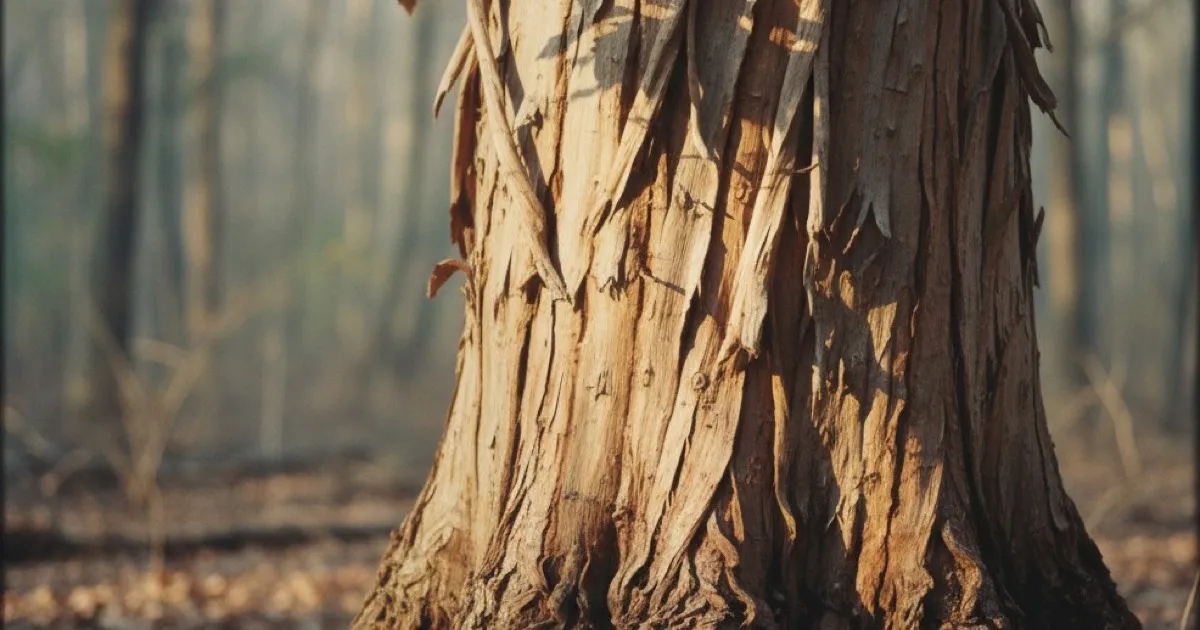
The bark is the fastest visual cue. Shagbark and shellbark hickories carry long, loose plates that pull away from the trunk in curving strips, so the tree looks mid-shed. The remaining species hold bark tight in deep ridges and furrows, gray to grayish-brown, sometimes darkening to near-black on older pecans.
In fall, hickory foliage turns a clean, uniform yellow, occasionally edging toward golden-brown. The compound leaves (5 to 17 leaflets depending on species) flutter distinctively in a breeze because each leaflet moves along the central stalk independently. Watching a hickory from a distance in the wind, that articulated leaf shimmer is a reliable tell before you ever read the bark.
What Is a Hickory Tree?
A hickory is any tree in the genus Carya, part of the walnut family (Juglandaceae). Roughly a dozen species are native to North America, with a few more scattered across Mexico and East Asia. They’re slow-growing deciduous hardwoods that can live 200 years or more, and a mature hickory tree sinks a deep taproot that makes it stubborn to transplant and tough through a drought.
Two features give the genus away before you ever reach a single species. First, the leaves are pinnately compound: several leaflets line up in pairs along a central stalk, with one leaflet capping the tip. Second, every hickory drops a hard nut wrapped in a woody husk that peels or splits open in fall. Add the bark, which ranges from smooth gray to wildly shaggy depending on species, and you’ve got the three clues that carry the rest of this guide.
The genus Carya includes roughly 18 species worldwide: 12 native to North America, 4 in China and Indochina, and 2 in Mexico. North American hickories span USDA hardiness zones 4 through 9, from southern Quebec to central Texas. Their wood ranks among the densest of any eastern hardwood: shagbark hickory (Carya ovata) records a Janka hardness of 1,880 lbf, harder than white oak (1,360 lbf) and nearly twice the rating of white pine (380 lbf). A mature hickory adds roughly 1 foot of height per year in its first decades, then slows past age 50. Most live 200 to 300 years, and some specimens have been documented past 500. The genus name Carya comes from the Greek word for walnut, reflecting the Juglandaceae family relationship established in 1789. Hickories provide mast crops for white-tailed deer, wild turkeys, black bears, and at least 25 species of songbirds across the eastern forest.
How Hickory Tree Identification Starts: The Basics
All hickories belong to the genus Carya and share a few traits. They’re deciduous hardwoods that produce compound leaves with an odd number of leaflets arranged along a central stem. Every hickory produces a nut enclosed in a husk that splits open when ripe. And all of them develop strong, dense wood prized for tool handles, smoking meat, and firewood.
But within those shared traits, each species has distinct characteristics. The bark can be smooth, furrowed, or peeling in dramatic strips. Leaflet count ranges from five to seventeen. Nuts vary from sweet and edible to so bitter that even squirrels ignore them.
The fastest way to narrow down a hickory is to combine two or three clues. Bark alone can fool you, since young hickories of different species sometimes look similar. But bark plus leaflet count plus nut shape will give you a confident identification almost every time.
Each of the main species has its own deep-dive if you want to go further: shagbark, mockernut, pignut, and bitternut hickory, plus pecan.
Identifying Hickory Trees by Bark
Bark is the first thing most people notice, and hickory bark is some of the most distinctive of any North American tree. The differences between species are dramatic once you know the patterns.
Shagbark hickory (Carya ovata) has the most recognizable bark of any hickory. The bark peels away in long, vertical strips that curve outward at both ends, giving the trunk a rough, shaggy appearance. On mature trees, these strips can be a foot or more in length. Young shagbarks have smooth gray bark that hasn’t started peeling yet, which can cause confusion.
Shellbark hickory (Carya laciniosa) produces bark similar to shagbark, but the strips are broader, flatter, and less dramatically curved. Shellbark trees also tend to be larger, sometimes reaching 100 feet or more.
Mockernut hickory (Carya tomentosa) develops tight, interlocking ridges without any peeling. The bark is gray and deeply furrowed with a pattern that resembles woven rope. It never shags; the ridges stay firmly attached to the trunk.
Pignut hickory (Carya glabra) has tight bark with a diamond-shaped ridge pattern. The ridges intersect to create shallow, diamond-like shapes across the trunk. On older trees, some bark may develop slight flaking at the ridge tops, but nothing approaching shagbark’s dramatic strips.
Bitternut hickory (Carya cordiformis) has the smoothest and thinnest bark of any common hickory. It’s grayish and develops shallow, narrow ridges with age. Younger trees have noticeably smooth bark that might not immediately read as hickory at all.
Pecan (Carya illinoinensis) develops dark, deeply furrowed bark with prominent vertical ridges. Pecan bark darkens significantly with age, sometimes appearing almost black on old trees.
Shagbark vs Shellbark Hickory
These two get mixed up constantly, and for good reason: both peel into long plates. Shagbark strips are narrower and curl hard at the top and bottom, so the trunk looks like it’s shedding armor. Shellbark plates are wider, flatter, and hug the trunk more tightly. Leaflet count settles most arguments: shagbark almost always shows 5 leaflets, shellbark 7. Shellbark also runs bigger overall and sticks to wet bottomland, while shagbark climbs drier upland slopes. If the strips are dramatically loose and the tree is on a hillside, bet on shagbark.
For a deeper dive into reading bark patterns across many tree families, the bark identification guide covers the fundamentals, and the trees with peeling bark roundup shows which other species shed like the shaggy hickories.
Identifying Hickory Trees by Leaves
Hickory leaves are pinnately compound, which means each leaf is built from several leaflets running along a central stalk with a single leaflet at the tip. (Plenty of other trees share this layout; the trees with compound leaves guide covers the wider group and how to tell them apart.) Counting the leaflets and noting their size, shape, and texture will quickly separate one hickory species from another.
Shagbark hickory produces leaves with 5 leaflets (occasionally 7). The upper three leaflets are noticeably larger than the lower two. Each leaflet is 4 to 8 inches long with finely serrated edges and a mostly smooth surface on both sides.
Shellbark hickory has 7 leaflets (sometimes 9). The leaflets are very large, sometimes exceeding 8 inches, making shellbark leaves the biggest of any hickory.
Mockernut hickory has 7 to 9 leaflets that are densely hairy on the undersides. Crush a mockernut leaf and you’ll notice a spicy, resinous scent, one of the most reliable field tests for this species. The leaflets are dark yellowish-green and feel noticeably fuzzy underneath.
Pignut hickory carries 5 leaflets (rarely 7) that are smooth and hairless on both sides. The leaflets are smaller and narrower than shagbark, typically 3 to 6 inches long, with a clean, polished look.
Bitternut hickory is the easiest to identify by its leaves alone. It has 7 to 11 narrow, lance-shaped leaflets with a feathery, open appearance. The leaflets are relatively small (3 to 6 inches). In fall, bitternut leaves turn a clear golden-yellow, one of the brightest fall colors in the hickory family.
Pecan has the highest leaflet count of any hickory: 9 to 17 leaflets per leaf. The leaflets are long, narrow, and slightly curved like small sickles. If you’re looking at a hickory with more than 11 leaflets, it’s almost certainly a pecan.
Quick Leaflet Count Reference
| Species | Leaflets | Size | Key Detail |
|---|---|---|---|
| Shagbark | 5 (rarely 7) | 4-8 inches | Upper 3 leaflets much larger |
| Shellbark | 7 (rarely 9) | 6-10 inches | Largest leaves of any hickory |
| Mockernut | 7-9 | 4-8 inches | Fuzzy undersides, spicy scent |
| Pignut | 5 (rarely 7) | 3-6 inches | Smooth, hairless both sides |
| Bitternut | 7-11 | 3-6 inches | Narrow, lance-shaped, feathery |
| Pecan | 9-17 | 4-7 inches | Sickle-curved, highest count |
Hickory Tree Identification by Nuts and Husks
Hickory nuts ripen in the fall and drop from the tree still enclosed in husks. The husk’s thickness, how it splits, and the nut inside are all identification gold.
Shagbark hickory nuts are enclosed in a thick husk (about a quarter inch) that splits cleanly into four sections when ripe. The nut inside is light tan, slightly flattened, with a thin shell. These are the sweetest wild hickory nuts and have been eaten by people for thousands of years.
Shellbark hickory nuts are the largest hickory nuts, sometimes over 2 inches long. The husk is very thick (up to half an inch) and also splits into four sections. The nut is angular with a thicker shell than shagbark, but the meat is sweet.
Mockernut hickory gets its name from the nut. The husk looks impressive, but the shell inside is extremely thick and hard, leaving very little edible meat. If you crack open a big hickory nut and find almost nothing inside, you’ve got a mockernut.
Pignut hickory produces small, pear-shaped nuts with thin husks that split only partway or not at all. The nut is smooth and slightly bitter. Pigs were historically fed these nuts, which is where the common name comes from.
Bitternut hickory has thin, yellow-green husks with four ridges running from tip to base. The husk barely splits open, and the nut inside is intensely bitter. Those bright, ridged husks make bitternut one of the easiest hickories to identify from the nut alone.
Pecan nuts are elongated and smooth with thin shells, enclosed in thin husks that split into four sections. Wild pecans are smaller than commercial varieties but have the same rich, buttery flavor. If you find an elongated, thin-shelled hickory nut in the southeastern United States, it’s a pecan.
How Big Does a Hickory Tree Get?
Most hickories mature at 60 to 80 feet tall, carrying a straight trunk and a fairly narrow, rounded crown. Shagbark and shellbark can push past 100 feet on good bottomland sites, and pecan, the giant of the family, sometimes tops 120 feet with a trunk several feet across.
Growth is slow. A hickory tree might add a foot of height a year in its early decades, far behind a fast grower like silver maple. What it gives up in speed it banks in staying power: many hickories live 200 to 300 years, and the wood they lay down is among the densest of any North American hardwood. That deep taproot also means a young hickory spends its first seasons building roots more than shoot, so a knee-high seedling can already be several years old.
Where Different Hickory Species Grow
Geography can help confirm your identification. Hickory species have overlapping but distinct ranges across eastern and central North America.
Shagbark hickory has the widest range, growing from Quebec south to Georgia and west to Iowa. It thrives in moist, well-drained upland soils and is a common component of oak-hickory forests.
Shellbark hickory is more limited, concentrated in the Ohio and Mississippi River valleys. It prefers rich bottomland soils near rivers, wetter sites than shagbark tolerates.
Mockernut hickory is the most common hickory in the Southeast, growing from Massachusetts to Florida. It tolerates drier, sandier soils than most hickories.
Pignut hickory ranges across the eastern United States, often on dry ridges and hillsides alongside oaks.
Bitternut hickory has the most northern range, extending from southern Quebec to Minnesota. It prefers moist soils along streams and in bottomlands.
Pecan is native to the Mississippi River valley and central Texas but has been planted widely across the southern states. If you find a hickory in a yard or farm in the South, there’s a good chance it’s a planted pecan.
Hickory wood is among the strongest and hardest of North American species. If you’re interested in how hickory compares to other woods, the hardwood comparison guide breaks down the differences.
Hickory Tree Lookalikes: Walnut, Ash, and Pecan
A few trees fool people into calling them hickories. Here’s how to sort them out.
Walnut. Black walnut and butternut sit in the same family as hickory and carry similar pinnately compound leaves, so the mix-up is common. The tiebreaker lives inside the twig: slice one lengthwise and walnut shows chambered pith, a stack of tiny hollow rooms, while hickory pith stays solid. Walnut also runs more leaflets (15 to 23) and drops a round, green, tennis-ball husk instead of a ridged or four-part hickory husk. The black walnut guide walks through the details.
Ash. Ash trees also have compound leaves and get mistaken for young hickories at a glance. The giveaway is branching. Ash leaves and twigs grow opposite each other in matched pairs, while hickory leaves and buds alternate up the stem. Spot opposite branching and you can rule out hickory on the spot. The ash tree guide covers the rest.
Pecan. This one’s a trick question, because pecan is a hickory (Carya illinoinensis). It just looks different enough, with its long sickle-shaped leaflets and smooth elongated nuts, that people treat it as a separate tree. If you’re in the South and counting 11 or more leaflets, the pecan guide has the specifics.
How Tree Identifier Can Help with Hickory Trees
Hickory identification gets tricky when you’re looking at a young tree without nuts, or when bark hasn’t developed its mature pattern. A 15-year-old shagbark that hasn’t started peeling yet looks similar to a young pignut or mockernut.
Tree Identifier handles this kind of ambiguity. Snap a photo of the bark, a compound leaf, or a nut on the ground, and the AI returns a species identification with a confidence score. The app identifies from multiple input types, so if the bark is inconclusive, try a leaf photo instead. It works with all six hickory species in this guide, along with thousands of other trees.
You get 2 free identifications per day, enough to confirm a few mystery trees on a hike. And if you’re exploring wooded areas without cell service, offline mode lets you download species data before you head out.
Frequently Asked Questions
Are hickory nuts safe to eat?
Shagbark, shellbark, and pecan produce sweet, edible nuts that people have eaten for thousands of years. Mockernut nuts are edible but barely worth the effort because the shells are so thick. Pignut nuts are mildly bitter, and bitternut nuts are too bitter for most people. None of the common hickory species produce toxic nuts, but taste varies widely.
How can I tell a hickory tree from a walnut tree?
Hickories and walnuts are closely related and share compound leaves. The fastest way to tell them apart: check the pith inside a twig. Cut a small branch lengthwise. Walnut twigs have chambered pith (a series of tiny rooms), while hickory twigs have solid pith. Walnut bark also tends to be darker with deeper furrows.
Do all hickory trees have shaggy bark?
Only shagbark and shellbark hickories develop peeling, shaggy bark. Mockernut, pignut, bitternut, and pecan all have bark that stays firmly attached to the trunk in ridges, furrows, or relatively smooth surfaces. Bark texture alone can quickly sort hickories into two groups: the “shaggy” species and the “tight bark” species.
When is the best time of year to identify hickory trees?
Late summer through early fall gives you the most clues at once: mature leaves, developing or fallen nuts, and fully developed bark. But each season has value. Winter bark identification works well because the shaggy species are unmistakable even without leaves. Spring buds also help: bitternut hickory has distinctive bright yellow buds that no other hickory shares. For tips on winter tree identification, check the winter identification guide.
How big does a hickory tree get?
Most hickories mature at 60 to 80 feet tall. Shagbark and shellbark can pass 100 feet on rich bottomland, and pecan occasionally reaches 120 feet. They grow slowly, often under a foot of height per year in their early decades, but many live 200 to 300 years.
How do you tell a hickory tree from an ash tree?
Look at how the leaves and buds attach to the twig. Ash grows them opposite each other in matched pairs, while hickory arranges them alternately up the stem. Both have compound leaves, so opposite-versus-alternate branching is the fastest way to separate the two.
Putting It All Together
Hickory tree identification follows a simple sequence. Start with the bark. If it’s peeling in long strips, you’re looking at a shagbark or shellbark. If the bark is tight, check the leaves. Five smooth leaflets points to pignut. Seven to nine fuzzy, fragrant leaflets means mockernut. Nine or more narrow leaflets suggests bitternut or pecan. And if nuts are on the ground, their size and husk thickness will confirm the species.
After identifying a handful of hickories, the patterns start clicking. And on the days when a tree doesn’t fit neatly into one category, a quick photo with Tree Identifier can settle the question before you finish your hike.
Identify a tree from your photo — free
Upload a leaf, bark, or whole-tree photo and get the species in seconds. No signup.
Confidence:
Unlock the full species profile
Free in the app — with unlimited identifications.


AI result for guidance — the app gives full species details and works offline.
Want unlimited identifications?
Get the full species profile, photos and details — free in the app, with unlimited scans.
- Unlimited identifications
- Full species profiles & details
- Works offline, anywhere
- Save and revisit your finds
Elena Torres
Tree Identifier Team