Mulberry Tree Identification: Leaves, Bark, and Fruit
If you’ve ever found your driveway or sidewalk stained dark purple in late spring, you’ve already met a mulberry tree. These fast-growing deciduous trees spread across most of North America without anyone planting them. Birds eat the fruit and drop seeds in fence lines, backyards, and roadsides, so mulberries colonize wherever they land.
Mulberry identification trips people up because the leaves look completely different from branch to branch on the same tree. One branch has unlobed, oval leaves. A few branches over, the same tree grows leaves with two or three distinct lobes cut into them. This variability is the key identification trait, not a problem.
This guide covers the three mulberry species found in North America, how to tell them apart by leaf, bark, and fruit, and which clues work best in each season.
To identify a mulberry tree, look for three things: variable leaves with 1-5 lobes that can appear on the same branch, elongated fruit clusters resembling blackberries, and bark that reveals orange-brown wood when scratched. Three species grow in North America: native red mulberry, invasive white mulberry, and the rarely planted black mulberry.
Standing in front of one? Identify it from a photo in seconds. Free, no sign-up needed.
What Does a Mulberry Tree Look Like?
A mature mulberry tree is a medium-sized deciduous tree, usually 30 to 50 feet tall, with a rounded, spreading crown that’s often nearly as wide as the tree is tall. Red mulberry can push past 60 feet in rich bottomland soil. White mulberry usually stays shorter and bushier.
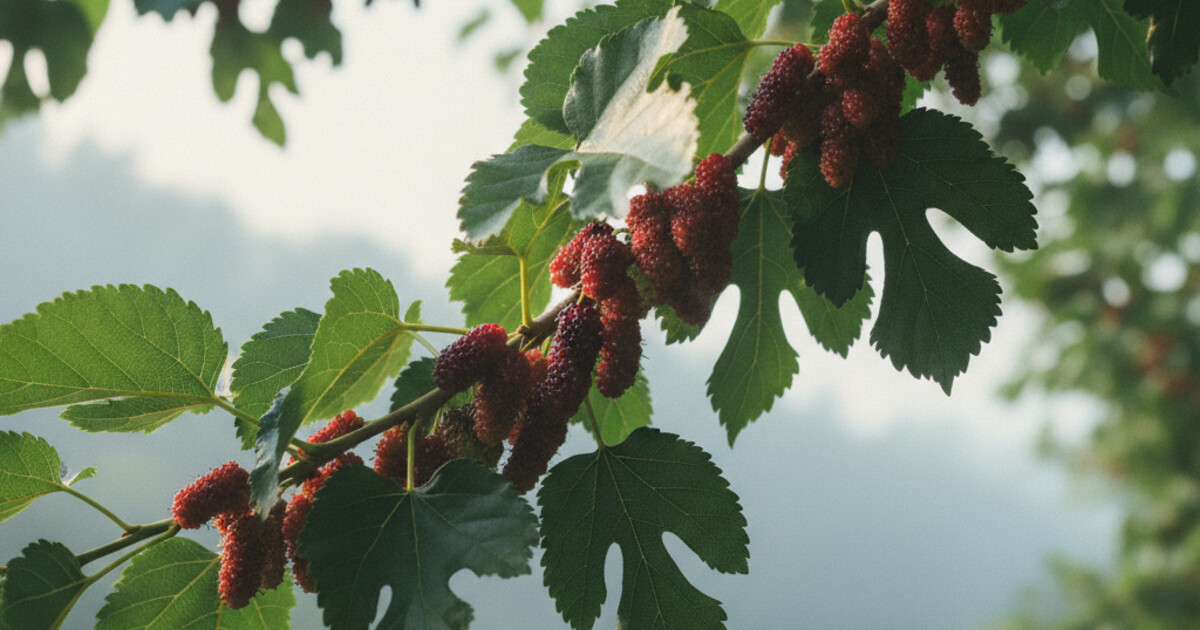
The leaves give it away, and they’re strange. On a single mulberry tree you’ll find heart-shaped, unlobed leaves growing right next to leaves split into 2, 3, or even 5 mitten-like lobes. Both types run 2 to 8 inches long, taper to a pointed tip, and have coarsely toothed edges. They sit alternately along the twig, never in opposite pairs. That mix of lobed and unlobed leaves on one plant is unusual enough that it’s worth knowing the pattern from our guide to trees with lobed leaves.
Snap a leaf stalk or a young twig and a bead of white, milky sap weeps from the cut. That sap is one of the most dependable mulberry tells, and it rules out most lookalikes on the spot.
The bark on a young tree is smooth and gray-brown with nothing distinctive. On an older trunk it splits into long, narrow, tan-to-orange ridges that interlace in a woven pattern. Scratch through the outer layer and the wood underneath glows orange-brown to yellow.
The fruit settles it. Mulberries look like short, plump blackberries, 0.5 to 1.5 inches long, hanging singly from a short stalk. They ripen from green through red to deep purple-black on most trees, though white mulberry often stays pale pink or nearly white when fully ripe.
Put it together: a spreading medium tree, a mix of lobed and unlobed toothed leaves, milky sap at every cut, orange-brown wood under the bark, and blackberry-shaped fruit. Match all five and you’re almost certainly looking at a mulberry.
The 3 Mulberry Species Found in North America
Three species account for nearly all mulberry trees you’ll encounter in the US and Canada.
Red mulberry (Morus rubra) is the only native species. It grows from the eastern Great Plains to the Atlantic coast and south through Texas and Florida. The leaves are large (up to 9 inches), rough on top like fine sandpaper, and often heavily lobed on younger growth.
White mulberry (Morus alba) arrived from China centuries ago, originally planted to support silk production. That industry failed; the trees didn’t. White mulberry has spread across all 48 contiguous states and is now classified as invasive in many regions. Its leaves are smaller and glossy rather than rough.
Black mulberry (Morus nigra) comes from western Asia. It’s the least common of the three, mostly found in warmer parts of California, Texas, and the Southeast. The fruit is the darkest and richest in flavor. Leaves are heart-shaped at the base, similar to red mulberry, but the surface texture is softer.
Mulberry trees belong to the Moraceae family alongside figs and osage orange. All three North American species share the same basic identification framework, with the real differences showing up in leaf texture, fruit color at maturity, and the underside of the leaves. Red mulberry fruits ripen to deep red or purple. White mulberry fruits stay white, pale pink, or lavender at maturity (which surprises most people who expect dark fruit). Black mulberry fruits are deep purple-black with the most intense flavor. Mature trees reach 30-70 feet tall in suitable conditions, with white mulberry tending shorter and red mulberry reaching taller heights. Growth is fast: 10-15 feet in the first 5 years under good conditions. One identification fact that holds across all three species: break a leaf stem and you’ll see a white, milky sap weep from the cut. That sap rules out most lookalikes immediately.
Distinguishing red from white mulberry is the practical challenge for most people. The clearest tell: turn a red mulberry leaf over and feel the underside. It’s covered in fine, velvety hairs. White mulberry leaves are smooth or nearly so underneath.
How to Identify Mulberry by Leaf
The leaf is the first thing most people check, and with mulberry, it causes immediate confusion.
Mulberry leaves grow alternately on the stem (not in opposite pairs) and are simple rather than compound. But their shape changes dramatically based on where they sit on the tree and how much sun they receive. Sun-exposed leaves on the upper canopy are often unlobed and broadly oval. Shaded leaves on lower branches develop 2-5 lobes that look almost mitten-shaped or faintly maple-like.
Size varies from 2-8 inches depending on species and the age of the branch. Younger growth tends to produce larger, more lobed leaves.
The quick texture test separates the two common species reliably:
- Red mulberry, top surface: rough and sandpapery
- Red mulberry, underside: soft, velvety, covered in fine hairs
- White mulberry, top surface: glossy, smooth, almost waxy
- White mulberry, underside: smooth to slightly hairy only along vein axils
If you’re looking at fallen leaves on the ground rather than a live branch, size is your best guide. Red mulberry leaves average 4-6 inches. White mulberry leaves run 2-4 inches on average.
For reading leaf shapes across other tree species, see our Tree Identification by Leaf Shape: A Visual Field Guide.
Mulberry Bark: The Year-Round Clue
Bark becomes especially useful when there’s no fruit and leaves haven’t emerged yet.
Young mulberry saplings under 5 years old have smooth, gray-brown bark with nothing distinctive. Mature mulberry bark is a different story. It develops long, narrow ridges that interlock in a woven pattern, somewhat like a looser version of ash tree bark. The outer color ranges from gray to gray-brown.
The scratch test is the most reliable bark clue on a mature tree. Use your thumbnail or a knife to scrape away the outer bark layer. Underneath, you’ll find bright orange-brown to yellow-orange wood. Few other common trees in the mulberry’s range show that specific color combination beneath the surface.
Old specimens develop shallow furrows between the ridges, giving the trunk a layered, almost braided look from a distance.
For bark identification across other tree families, see How to Identify Trees by Their Bark.
Mulberry Fruit: The Easiest Identification
When fruit is present, identification takes about 10 seconds.
Mulberries produce elongated clusters of small drupelets, structurally identical to blackberries and raspberries. Each fruit runs 0.5-1.5 inches long, made up of 20-40 small segments packed together. They ripen from green or white through red, then deep purple or black on red and black mulberry. White mulberry stays lighter at maturity: white, pale pink, or lavender.
Ripening runs from May through July depending on location. In the South, white mulberry starts producing in early May. In northern states, red mulberry fruits ripen by late June or early July.
The staining has its own reputation. Mulberry juice is a deep purple-red that’s genuinely hard to wash off concrete, fabric, or skin. If there’s a purple mess on your driveway, look up before you start wondering what’s wrong with your birds.
Because the ripe fruit reads as a berry from a distance, mulberry gets confused with several other species. Our roundup of trees with red berries covers the common mix-ups, and if you’re cataloging what’s fruiting in your yard, the broader fruit tree identification guide walks through apples, cherries, persimmons, and more. Unlobed mulberry leaves also get mistaken for linden (basswood) — linden’s asymmetric leaf base and the absence of milky sap settle that one fast.
One clarification: Tree Identifier identifies mulberry species from photos of the leaf, bark, or fruit. It doesn’t assess whether fruit is safe to eat. If you’re foraging, pair any identification app with a dedicated foraging guide.
White Mulberry: The Invasive Species Context
White mulberry deserves specific attention because it’s the species most people encounter, and its spread concerns ecologists.
After the failed colonial silk industry, white mulberry established itself across the entire country. It cross-pollinates freely with native red mulberry, and some botanists are tracking the effect on red mulberry genetic populations in regions where both species overlap.
You don’t need to remove every white mulberry you find. But if you’re planting trees or trying to support native ecosystems in your yard, red mulberry is the better choice.
See our guide to Invasive Tree Species: How to Identify and Why They Matter for more on trees that compete with native species.
How to Identify a Mulberry Tree With the App
Mulberry’s variable leaves make it trickier than most species to identify from a single photo, but the app handles it well.
Take a photo of the leaf (either side works, though the underside texture is worth capturing separately), the bark on a mature trunk, or the fruit clusters if they’re present. Tree Identifier processes the image and returns the species with confidence scores.
If you’re trying to distinguish red from white mulberry specifically, photograph the underside of a leaf. The velvety-versus-smooth texture difference shows up clearly in a close photo.
The app works offline, so you can identify mulberries on rural properties and remote hikes without cell service. You get 2 free identifications per day with no subscription required to start.
Frequently Asked Questions
What does a mulberry tree look like? A mulberry tree is a medium deciduous tree, usually 30 to 50 feet tall, with a rounded, spreading crown. Its leaves are the standout feature: one tree carries both heart-shaped unlobed leaves and leaves cut into 2 to 5 mitten-like lobes, all with toothed edges. Snap a stalk and you’ll see milky white sap. The bark is gray-brown with orange-toned ridges on older trunks, and the fruit looks like a stubby blackberry.
What are the main mulberry species? Three mulberry species cover almost every tree you’ll meet in North America: red mulberry (Morus rubra), the only native, with rough-topped leaves and dark purple-red fruit; white mulberry (Morus alba), an introduced and now invasive species with glossy leaves and pale fruit; and black mulberry (Morus nigra), a warm-climate species with the darkest, richest-flavored fruit. All three share milky sap, alternate leaves, and blackberry-shaped fruit.
Are mulberry fruits safe to eat? Red and black mulberry fruits are widely foraged and safe to eat when fully ripe. White mulberry fruit is edible but milder. Unripe mulberry fruit contains compounds that cause stomach upset, so only eat darkly colored, soft, fully ripe fruit. Tree Identifier identifies species; it doesn’t evaluate edibility.
How do I tell mulberry from blackberry? Mulberry grows on a tree, not a bramble vine. Blackberry canes are thorny and stay close to the ground. Mulberry fruit has a small stem where it attached to the branch; blackberry fruit doesn’t. If it’s hanging 20 feet in the air, it’s mulberry.
What’s the clearest way to tell red from white mulberry? Rub the underside of a leaf. Red mulberry leaves feel velvety, covered in fine hairs. White mulberry leaves are smooth or nearly so. Fruit color at maturity confirms it: red mulberry turns dark purple-red, while white mulberry stays white, pale pink, or lavender.
Can I identify a mulberry tree in winter without leaves or fruit? Yes. Use the bark scratch test: scrape the outer bark and look for orange-brown wood underneath. The interlocking-ridge bark pattern is visible year-round on mature trees, and dried fruit stalks often remain on branches through winter.
Is mulberry an invasive species? White mulberry (Morus alba) is invasive across North America, spreading from failed colonial silk farming attempts. Red mulberry is native. If you’re planting, red mulberry supports local ecosystems better than white mulberry.
Wrapping Up
Mulberry identification comes down to three things: the variable leaf shape (check the underside texture to separate red from white), the blackberry-like fruit clusters, and the orange-brown scratch test on the bark.
In late spring and early summer, the fruit makes identification simple. In winter, the bark scratch test works year-round. If you find a purple stain on the sidewalk, look up and check the tree overhead.
Tree Identifier can help you confirm the exact species from a photo of the leaf, bark, or fruit. Download the app and use your first 2 identifications free.
Identify a tree from your photo — free
Upload a leaf, bark, or whole-tree photo and get the species in seconds. No signup.
Confidence:
Unlock the full species profile
Free in the app — with unlimited identifications.


AI result for guidance — the app gives full species details and works offline.
Want unlimited identifications?
Get the full species profile, photos and details — free in the app, with unlimited scans.
- Unlimited identifications
- Full species profiles & details
- Works offline, anywhere
- Save and revisit your finds
Elena Torres
Tree Identifier Team