Invasive Tree Species: How to Identify and Why They Matter
You’re walking through a local park when you notice a tree that doesn’t quite fit. The leaves look different from the oaks and maples you know. The bark has an odd texture. That unfamiliar tree might be an invasive species—and understanding which trees don’t belong in your ecosystem matters more than you’d think.
Invasive tree species cost North America billions in damage each year. They crowd out native trees, disrupt wildlife habitats, and can even make forests more vulnerable to pests. Knowing how to identify these trees helps you understand your local forest health and report problem species before they spread.
Spot an unfamiliar weed or aggressive seedling? Our free weed identifier tool names it from a photo.
What Makes a Tree Species Invasive?
An invasive tree species is a non-native tree that spreads aggressively and harms the local ecosystem. Not all non-native trees are invasive—your neighborhood might have Japanese cherry trees that bloom beautifully without causing problems. Invasive trees are the ones that escape cultivation, reproduce rapidly, and outcompete native species for resources.
The key difference comes down to behavior. A non-native tree that stays where it’s planted is just exotic. An invasive tree spreads into forests, parks, and natural areas where it wasn’t planted. It changes soil chemistry, blocks sunlight from native plants, and reduces biodiversity.
Invasive trees usually share certain traits. They grow fast, produce thousands of seeds, tolerate poor soil, and have no natural predators in their new environment. Without the insects, diseases, or browsing animals that kept them in check back home, they spread unchecked.
Some invasive trees were introduced intentionally. Tree of Heaven came to the US in the 1700s as an ornamental. Norway Maple was planted along streets for shade. Russian Olive was used for erosion control. These well-meaning introductions turned into ecological problems decades later.
Most Common Invasive Tree Species in North America
Tree of Heaven (Ailanthus altissima)
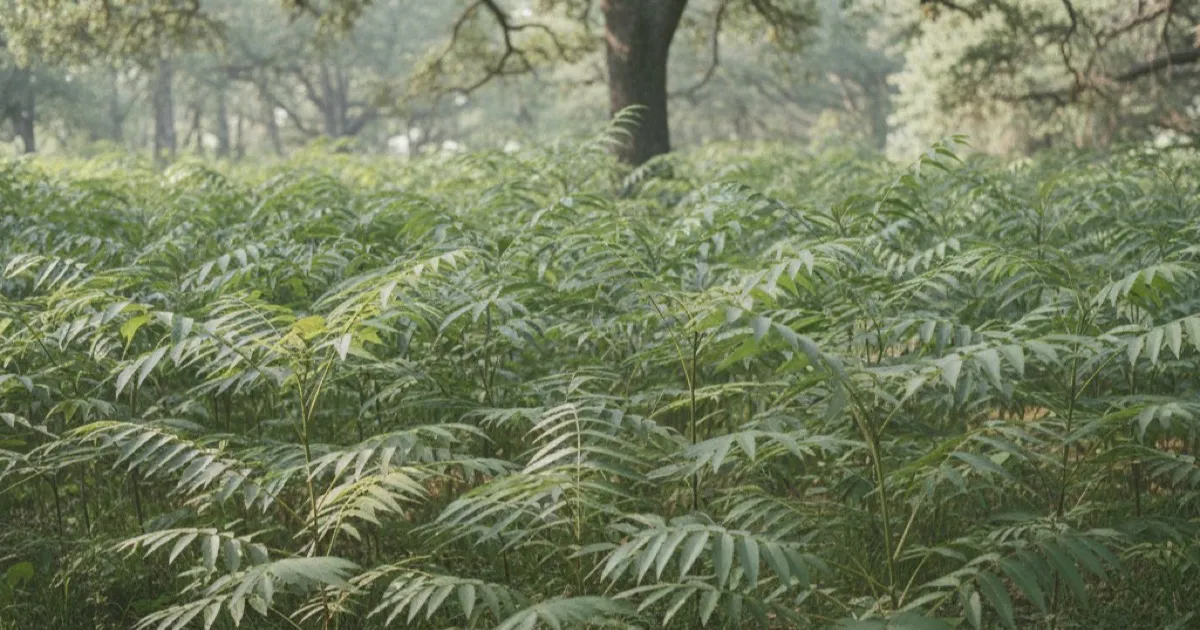
Tree of Heaven tops most invasive species lists. Native to China, it spreads aggressively through root suckers and wind-dispersed seeds. You can spot it by its compound leaves with 11-25 leaflets, each with a notch at the base. The bark is smooth and gray with light streaks.
Crush a leaf and you’ll notice a strong smell—people describe it as peanut butter mixed with something rotten. That distinctive odor is your clearest identification clue. The tree produces thousands of winged seeds that spin like helicopter blades in the fall.
Tree of Heaven tolerates terrible soil and grows in cracks in pavement. It releases chemicals that inhibit other plants from growing nearby. Female trees produce up to 300,000 seeds per year, and the tree can resprout from small root fragments.
Norway Maple (Acer platanoides)
Norway Maple looks similar to native Sugar Maple, which makes it tricky to identify. The giveaway is the leaf sap. Break a leaf stem—if milky white sap oozes out, it’s Norway Maple. Sugar Maple sap is clear.
The leaves are also slightly different. Norway Maple leaves have more pointed lobes and the sinuses between lobes are shallower. The tree was popular for urban landscaping because it tolerates pollution and poor soil better than native maples.
The problem is that Norway Maple creates dense shade that prevents native plants from growing underneath. Its shallow roots make it hard for other species to compete. Seeds germinate easily in forest understories, where the tree gradually replaces native Sugar Maple and other hardwoods.
Black Locust (Robinia pseudoacacia)
Black Locust is native to the Appalachian region but has become invasive across much of North America outside its natural range. It spreads through root suckers, forming dense thickets that exclude other vegetation.
You can identify Black Locust by its compound leaves with 7-19 small oval leaflets. The bark is deeply furrowed with a rope-like texture. In spring, the tree produces hanging clusters of fragrant white flowers that smell like sweet peas.
The tree has pairs of sharp thorns at the base of each leaf. These thorns remain on branches even after leaves fall, which is a useful winter identification feature. Black Locust grows fast and fixes nitrogen in the soil, changing soil chemistry in ways that favor itself over native species.
Russian Olive (Elaeagnus angustifolia)
Russian Olive looks distinctive with its narrow, silvery-gray leaves. The undersides of leaves are covered in silvery scales that give the whole tree a shimmering appearance. Small yellow flowers in spring produce olive-like fruits in fall.
The tree forms dense stands along waterways in the western United States, crowding out native cottonwoods and willows. Wildlife eats the fruits, which helps spread seeds. Russian Olive also has thorns—sharp spines on branches that can be several inches long.
Native wildlife doesn’t benefit much from Russian Olive. The fruits provide calories but lack the nutritional diversity that native plants offer. Dense Russian Olive thickets also block access to water and change how rivers flow.
Siberian Elm (Ulmus pumila)
Siberian Elm, also called Chinese Elm, is smaller than native American Elm but spreads faster. It has small leaves with uneven bases—one side of the leaf attaches lower on the stem than the other side, which is typical of elm species.
The tree produces seeds in spring rather than fall like native elms. These seeds germinate quickly, and seedlings can establish in harsh conditions. Siberian Elm tolerates drought, cold, and poor soil, which helped it spread across the Great Plains.
The bark is rough and dark gray with irregular furrows. The tree often has multiple trunks and a scraggly appearance. It hybridizes with native elms, which dilutes the genetics of American Elm populations already stressed by Dutch elm disease.
How to Identify Invasive Trees
Start with leaves. Many invasive trees have compound leaves—leaves made up of multiple leaflets on a single stem. Tree of Heaven, Black Locust, and some invasive ashes all show this pattern. Look at the number of leaflets, their shape, and whether the leaf has an odd or even number.
Check the bark texture. Smooth bark with light streaks suggests Tree of Heaven. Deeply furrowed, rope-like bark indicates Black Locust. The bark can help with winter identification when leaves are gone.
Look for unique features. Thorns point to Black Locust or Russian Olive. Silvery leaves mean Russian Olive. A strong smell when you crush leaves identifies Tree of Heaven. Milky sap from a broken maple leaf stem confirms Norway Maple.
Pay attention to where the tree is growing. Invasive species often pop up in disturbed areas—along roadsides, in vacant lots, at forest edges, or near water. If you see a dense cluster of the same unfamiliar tree, that’s a red flag.
Seasonal timing helps too. Tree of Heaven leafs out late in spring, often after native trees already have leaves. Russian Olive blooms in late spring with small yellow flowers. Seeds from Tree of Heaven hang on branches through winter, making identification easier.
The Ecological Impact of Invasive Trees
Invasive trees reduce biodiversity by crowding out native plants. When a Norway Maple spreads into a forest, its dense canopy and shallow roots prevent native wildflowers, shrubs, and tree seedlings from growing. Over time, the forest understory becomes bare dirt and invasive saplings.
Native wildlife suffers when invasive trees take over. Birds, insects, and mammals evolved alongside native trees and depend on them for food. A single native oak can support over 500 species of caterpillars, which feed baby birds—one reason oaks are among the best trees for attracting wildlife. An invasive Tree of Heaven supports far fewer insect species, which means less food for birds.
Invasive trees can make forests more vulnerable to pests. Tree of Heaven hosts the spotted lanternfly, an invasive insect that damages grape vines, fruit trees, and hardwoods. The emerald ash borer, a beetle that has killed millions of ash trees, spreads more easily in forests already stressed by invasive competition.
Some invasive trees change soil chemistry. Black Locust adds nitrogen to soil, which sounds good but actually favors fast-growing weeds over native forest plants. Russian Olive does the same thing along rivers, changing plant communities that took centuries to develop.
Invasive trees also affect water. Russian Olive uses more water than native cottonwoods and willows, which can lower water tables in western states where water is already scarce. Dense thickets of invasive trees along streams can increase erosion by changing how water flows.
The economic cost is massive. Managing invasive species costs billions annually. Property values drop when invasive trees take over parks and natural areas. Timber production suffers when invasive trees replace valuable native hardwoods.
How Tree Identifier Helps Spot Invasive Species
When you spot an unfamiliar tree in the wild, quick identification matters. Knowing how to take clear photos for tree ID will help you get accurate results from the app. Tree Identifier uses AI to identify tree species from a photo of leaves, bark, or the whole tree. The app recognizes thousands of species, including common invasive trees.
Take a clear photo of the distinctive features—the compound leaves of Tree of Heaven, the silvery foliage of Russian Olive, or the furrowed bark of Black Locust. The app processes the image and provides species identification with details about the tree’s characteristics and native range.
The offline mode works without cell service, which is useful when you’re hiking in remote areas where invasive trees often establish first. Download species data before your hike and identify trees even without an internet connection.
Once you identify an invasive species, you can report it to local conservation organizations. Many states have invasive species reporting programs that track where problem trees are spreading. Early detection helps land managers respond before a small invasion becomes a major infestation.
Frequently Asked Questions
What is the most invasive tree species in the US?
Tree of Heaven (Ailanthus altissima) is widely considered the most invasive tree in the United States. It spreads rapidly through both seeds and root suckers, tolerates terrible growing conditions, and releases chemicals that prevent other plants from growing nearby. The tree hosts spotted lanternfly, an invasive pest that damages crops and native trees. Tree of Heaven is found in every state except North Dakota, Wyoming, and Alaska.
Should I remove invasive trees from my property?
Removing invasive trees from your property helps prevent their spread to natural areas. Small saplings can be pulled by hand or cut and treated with herbicide to prevent regrowth. Mature trees are harder to remove and may require professional help. Check with your local extension service first—they can confirm the tree’s identity and recommend the best removal methods for your situation. Never dispose of invasive tree parts in natural areas where they might resprout.
How do invasive trees spread?
Most invasive trees spread through wind-dispersed seeds that travel long distances. Tree of Heaven and Norway Maple both produce thousands of winged seeds each year. Birds and mammals eat fruits from Russian Olive and Siberian Elm, then deposit seeds in their droppings. Some species like Tree of Heaven and Black Locust also spread through root suckers—new trees sprout from the root system of existing trees. This makes them hard to control since cutting down one tree can trigger dozens of new sprouts.
Can invasive trees be beneficial?
Invasive trees provide some benefits but the harm outweighs them. They offer shade, prevent erosion on steep slopes, and produce some food for wildlife. However, native trees provide all these benefits plus much more. Native species support far more insect diversity, which feeds birds and other wildlife. They’re adapted to local climate and soil, making them more resilient during droughts and storms. Planting native trees instead of invasive species gives you the benefits without the ecological damage.
Conclusion
Invasive tree species reshape forests in ways that reduce biodiversity and harm native ecosystems. Learning to identify trees like Tree of Heaven, Norway Maple, and Russian Olive helps you understand what’s happening in your local forests. When you spot an invasive tree spreading into natural areas, early identification and reporting can help control its spread before it becomes unmanageable.
If you’re out hiking and spot an unfamiliar tree, Tree Identifier can help you identify it quickly from a photo. Knowing which species belong in your ecosystem—and which don’t—makes you a better observer of the natural world.
Identify a tree from your photo — free
Upload a leaf, bark, or whole-tree photo and get the species in seconds. No signup.
Confidence:
Unlock the full species profile
Free in the app — with unlimited identifications.


AI result for guidance — the app gives full species details and works offline.
Want unlimited identifications?
Get the full species profile, photos and details — free in the app, with unlimited scans.
- Unlimited identifications
- Full species profiles & details
- Works offline, anywhere
- Save and revisit your finds
Rachel Nguyen
Tree Identifier Team