How to Identify a Pecan Tree: Leaves, Bark & Nuts
Pecans are one of North America’s few commercially important native trees. They grow wild in river bottoms from Iowa to Texas, produce some of the continent’s most recognizable nuts, and live for centuries. But standing in front of one in the field, most people can’t tell it apart from its hickory relatives. Pecan leaves look almost identical to a hickory’s or a black walnut’s. The bark can fool you. This guide gives you the field markers to make pecan tree identification straightforward, not guesswork.
Pecan trees are identified by compound leaves with 9-17 lance-shaped leaflets, deeply furrowed gray-brown bark on mature trees, and long cylindrical nuts with thin husks that split into 4 clean sections. Crush a leaflet and you’ll catch a mild butterscotch scent. Pecans grow in river bottoms and floodplains across the south-central US into Mexico.
Standing in front of one? Identify it from a photo in seconds. Free, no sign-up needed.
What Does a Pecan Tree Look Like?
A mature pecan tree is tall and straight-trunked with a broad, symmetrically oval crown. Most trees reach 70-100 feet, with trunks 2-4 feet in diameter on old-growth specimens. The crown spreads 40-75 feet wide in open settings, giving the tree a large, shading canopy that rivals most oaks.
The silhouette is distinctly upright in the lower trunk, widening into a rounded crown above. In river-bottom forests, where pecans grow beside sycamores, cottonwoods, and elms, the clean high trunk and spreading canopy let you pick them out at a distance before you’re close enough to read the leaves.
Pecan (Carya illinoinensis) reaches 70-100 feet tall with a trunk diameter of 2-4 feet on old-growth trees. The crown spreads 40-75 feet wide, broadly oval to rounded, with a high canopy in forest stands and a fuller sweep in open-grown specimens. Leaves emerge bronze-green in early spring before hardening to dark glossy green by May; fall color is clear yellow, lasting 2-3 weeks before drop. Native range covers 16 states from Iowa south to the Texas Gulf Coast and into northern Mexico, always in river bottoms, floodplains, and creek drainages below 2,000 feet elevation. Trees start producing at 6-10 years and reach peak nut yields after age 20. Well-situated bottomland pecans commonly live 200-300 years, and some old-growth specimens approach 400 years. Georgia and Texas account for the majority of US commercial production, which totals roughly 300 million pounds of in-shell nuts in a strong harvest year.
Pecan Leaf Identification
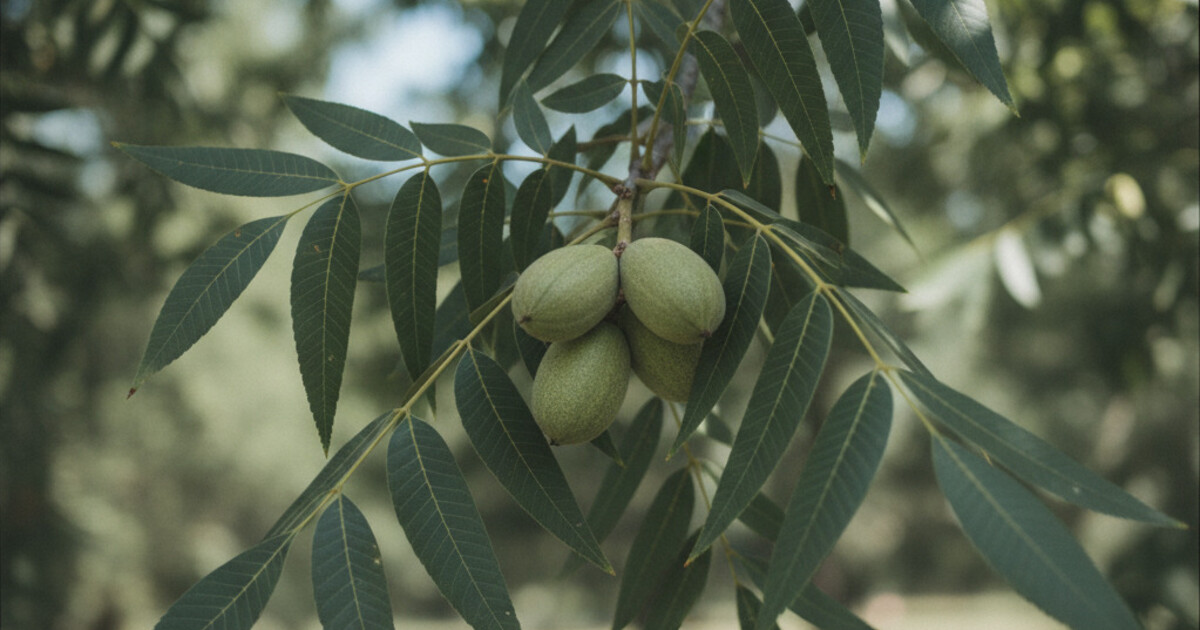
Pecan leaves are compound, which means each “leaf” is actually a stem holding many smaller leaflets. Each full leaf is 12-20 inches long, carrying between 9 and 17 individual leaflets.
The leaflets are lance-shaped (narrow, tapering to a pointed tip) and slightly curved like a sickle blade. Each one runs 4-7 inches long. Run your eye down the stem and you’ll usually count an odd number, with a single leaflet at the tip.
Edges are sharply toothed. The upper surface is dark green and slightly glossy. The underside is paler with soft hairs clustered along the veins.
In fall, pecan leaves turn yellow to golden, not the orange or red you’d see on a maple. Crush a leaflet between your fingers and you’ll catch a mild butterscotch or spice scent. Other hickories share a similar fragrance, but pecan’s tends to be the mildest of the group.
Pecan (Carya illinoinensis) belongs to the hickory genus, so you’re always comparing it against a family of trees with similar compound leaves and hard nuts. The key pecan leaf markers are the leaflet count (9-17, usually 11-15 on mature trees), the lance-shaped outline, and the curved asymmetry where one side of each leaflet base sits noticeably lower than the other. This feature is called an oblique leaf base. It appears across many hickories but is especially pronounced in pecan. Mature leaves are large by hickory standards, often reaching 18-20 inches on vigorous young growth. Each leaflet runs 4-7 inches long with sharply toothed edges and soft hairs along the underside veins. In spring, emerging leaves are bronze-green and slightly sticky with resin before they harden off to their summer dark green. That leaflet count alone eliminates most other hickory look-alikes once you know what to count.
Telling Pecan Leaves from Hickory and Walnut Leaves
Pecan, hickory, and black walnut all carry pinnately compound leaves: one long central stem lined with paired leaflets and usually a single leaflet at the tip. In summer, with a leaf in hand, a few features separate them.
Start with the leaflet count. A pecan leaf holds 9 to 17 leaflets, most often 11 to 15. Most hickories run lower, in the 5 to 9 range, while black walnut runs higher, often 15 to 23. Counting won’t always settle it on its own, but it points you in the right direction fast.
Next, look at leaflet shape. Pecan leaflets curve like a sickle blade, with a long tapering tip and a lopsided base where one side sits lower than the other. Black walnut leaflets are straighter and broadest near the middle. Hickory leaflets tend to be widest toward the outer third. That sickle curve is the most pecan-specific of the three.
The terminal leaflet is a quiet giveaway between pecan and walnut. A pecan leaf almost always ends in a full leaflet at the tip, giving an odd total count. Black walnut often drops or shrinks that end leaflet, so a walnut leaf can look blunt-ended or carry an even count. If the leaf tapers to one clear leaflet, lean pecan.
Then crush a leaflet. Pecan releases a mild butterscotch or spice note. Black walnut is sharper and more pungent, closer to citrus rind, and it lingers on your fingers. Hickories fall in between, with mockernut the strongest of the bunch.
The margins are toothed on all three, so edges alone won’t decide it. For the wider picture, our guides to trees with compound leaves and black walnut identification cover the other compound-leaved species you might be holding.
Pecan Bark: What Changes as the Tree Ages
Young pecan trees have relatively smooth, light gray bark with subtle shallow ridges. Give it 20-30 years and the bark thickens into something quite different.
On mature trees, the bark is gray-brown to reddish-brown with deep, interlacing furrows and flat-topped ridges running vertically up the trunk. The ridges are irregular and sometimes slightly scaly, but the bark stays tight to the tree. It doesn’t curl away or peel in large strips.
That last detail is the most useful comparison point. If you’re trying to decide between pecan and shagbark hickory, look at the trunk. Shagbark hickory has long, curved plates that peel away in dramatic strips you can spot from 30 feet. Pecan bark holds on. We cover the full hickory genus in our hickory tree identification guide, including the bark differences side by side.
Pecan Nuts: Shape, Husk, and Season
The nut is the most reliable single identifier once you know the shape.
Pecan nuts are long and cylindrical, typically 1.5 to 2 inches in length. They’re noticeably elongated compared to most other hickory nuts, which tend to be rounder or more egg-shaped.
The husk is thin and dark brown at maturity. It splits neatly into 4 sections (called valves) and falls away cleanly, leaving a smooth-shelled nut with a slightly pointed tip at both ends.
Crack the shell (it’s thin-walled) and you’ll find the familiar wrinkled kernel divided into two lobes. Wild pecan shells are thicker and the nuts smaller than commercial varieties, which have been selectively bred for decades to improve nut size and shell thinness.
Ripe nuts fall from September through November, depending on location. Trees begin producing meaningful quantities around 6-10 years of age, with peak production usually starting after 20 years.
Pecan vs. Other Hickories
Pecans belong to the hickory genus (Carya), so you’ll often be comparing them to closely related species. Here’s how the most common ones differ.
Shagbark hickory is the most likely confusion in eastern forests. It has 5-9 leaflets (far fewer than pecan), distinctly shaggy peeling bark, and round to oval nuts with very thick husks. Pecan has 9-17 leaflets, non-peeling bark, and elongated thin-husked nuts.
Bitternut hickory has 7-11 leaflets and is recognized by its bright sulfur-yellow bud scales, which you can spot in winter and early spring. Its nuts are small, round, and intensely bitter.
Mockernut hickory has 7-9 leaflets and intensely fragrant leaves when crushed, stronger than pecan’s. Its nuts are round with thick husks and a small kernel relative to shell size. Mockernut grows on drier ridges and upland slopes; pecan prefers moist bottomland.
Water hickory (Carya aquatica) is the closest look-alike in terms of habitat. It shares pecan’s river-bottom preference and has similarly many leaflets (7-15). The key difference: water hickory nuts are flattened and bitter, with a husk that stays closed longer rather than splitting cleanly.
Pecan Native Range and Habitat
The pecan’s natural range runs through the south-central United States: from Iowa, Illinois, and Indiana in the north, down through Missouri, Arkansas, Oklahoma, Kansas, and Texas, into Louisiana, Mississippi, Alabama, and Georgia, and south into Mexico.
Within that range, pecans grow naturally in river bottoms, floodplains, and along stream banks. They thrive in deep, moist, well-drained soil with full sun. You won’t find them naturally on dry hillsides or rocky slopes.
Outside the native range, pecans are planted commercially and ornamentally across the broader southeastern US, parts of California, and internationally. Georgia and Texas produce the majority of commercial pecans in the US.
Habitat is useful context. A large hickory-type tree in a low, moist river bottom in the south-central US is almost certainly pecan, water hickory, or one of the closely related bottomland Carya species. If the nuts are elongated and thin-shelled, that narrows it firmly to pecan.
Spring Field Signs: Catkins and New Leaves
Spring gives you two extra identification windows that aren’t available the rest of the year.
The male flowers are catkins: long, yellow-green drooping strands that hang in clusters of 3 from last year’s branches. They appear in April as the leaves are just opening. Female flowers are smaller reddish-green clusters at the tips of new growth.
Emerging leaves in early spring are bronze-green and slightly tacky from resin. That stickiness fades within a few weeks as the leaves harden off. The combination of drooping catkins, bronze new leaves, and a river-bottom location narrows your identification significantly.
By late April or May, the leaves are fully out and identification becomes a matter of leaflet count and shape.
Pecan Wood and Firewood
Pecan wood is a dense, hard hickory that burns hot and long. Its BTU rating runs around 25-28 million per cord, which puts it near the top tier of available firewood species. It also produces aromatic smoke that makes it popular for grilling and smoking meats.
We ranked pecan alongside other top options in our best firewood trees guide. If you’re identifying a recently cut or split log, the wood is pale cream-white to light tan with distinct rays visible in cross-section, and it has a mild sweet smell when freshly cut.
How Tree Identifier Can Help
Identifying pecans gets easier once you’ve seen the leaflet count and nut shape a few times. But if you’re standing in a river bottom trying to sort out a compound-leaved hickory, a photo can settle the question quickly.
Tree Identifier’s AI analyzes photos of leaf clusters, bark, nuts and husks, flowers, and whole tree shape to return a species identification in seconds. The app works from multiple angles and input types, so a close-up of the compound leaf laid flat on the ground works as well as a full tree shot.
It offers 2 free identifications daily and works offline, so no cell service is needed in the field. Download it free on iOS or Android at treeidentifier.app.
Frequently Asked Questions
How do I tell a pecan tree from other hickory trees?
The main markers: pecan has 9-17 leaflets (more than most hickories), elongated cylindrical nuts with thin husks that split into 4 clean sections, and deeply furrowed bark that stays tight to the tree. Shagbark hickory has 5-9 leaflets and distinctly peeling bark. Bitternut hickory has yellow-sulfur bud scales and small, bitter nuts.
What does pecan bark look like?
Young pecan bark is smooth and light gray. On trees older than 20-30 years, the bark develops deep interlacing furrows with flat-topped ridges, gray-brown to reddish-brown in color. It doesn’t peel in large plates, which separates it clearly from shagbark hickory.
When do pecan nuts ripen and fall?
Pecan nuts ripen from September through November depending on location and tree age. The husk turns brown and splits into 4 valves, dropping the nut. Trees younger than 6-10 years produce little or nothing; full production usually starts after age 20.
Are pecan trees native to my area?
Pecan’s native range covers the south-central US: Texas, Oklahoma, Kansas, Arkansas, Missouri, Louisiana, Mississippi, Alabama, Georgia, Illinois, Indiana, and Iowa, plus northern Mexico. Outside this range, pecans are widely planted commercially and ornamentally but aren’t native.
Can I identify a pecan tree in winter without leaves?
Yes, though it takes more effort. Look for the deeply furrowed bark, the dried husks of fallen nuts on the ground, and the distinctive stout twigs. Pecan twigs are light gray-brown with slightly pointed buds. Any remaining dried 4-valve husks under the tree are a strong indicator.
Pecan trees have more reliable field markers than most people expect. The combination of 9-17 lance-shaped leaflets, elongated cylindrical nuts with thin 4-valved husks, non-peeling furrowed bark, and a river-bottom habitat setting makes identification manageable once you’ve seen the tree a few times.
If you want to confirm an ID on your first encounter, Tree Identifier can analyze a photo of the leaves, nuts, or bark and return a species match in seconds, with habitat range and species notes included. It’s a free download on iOS and Android.
Identify a tree from your photo — free
Upload a leaf, bark, or whole-tree photo and get the species in seconds. No signup.
Confidence:
Unlock the full species profile
Free in the app — with unlimited identifications.


AI result for guidance — the app gives full species details and works offline.
Want unlimited identifications?
Get the full species profile, photos and details — free in the app, with unlimited scans.
- Unlimited identifications
- Full species profiles & details
- Works offline, anywhere
- Save and revisit your finds
Elena Torres
Tree Identifier Team