Aspen and Poplar Tree Identification: Leaves, Bark & Shape
Poplar trees line highways, shade riverbanks, and form vast clonal forests across North America. Yet poplar tree identification trips up beginners more than almost any other genus. The problem is that “poplar” covers trees that look nothing alike. Cottonwoods tower at 100 feet with deeply furrowed bark. Aspens stand in groves of thin, white-barked trunks with leaves that shimmer in the slightest breeze. Lombardy poplars shoot straight up in tight columns. And one of the most commonly searched “poplars,” the tulip poplar, isn’t a poplar at all.
This guide covers the major types of poplar trees in the genus Populus, explains how to tell them apart, and clears up the tulip poplar confusion once and for all.
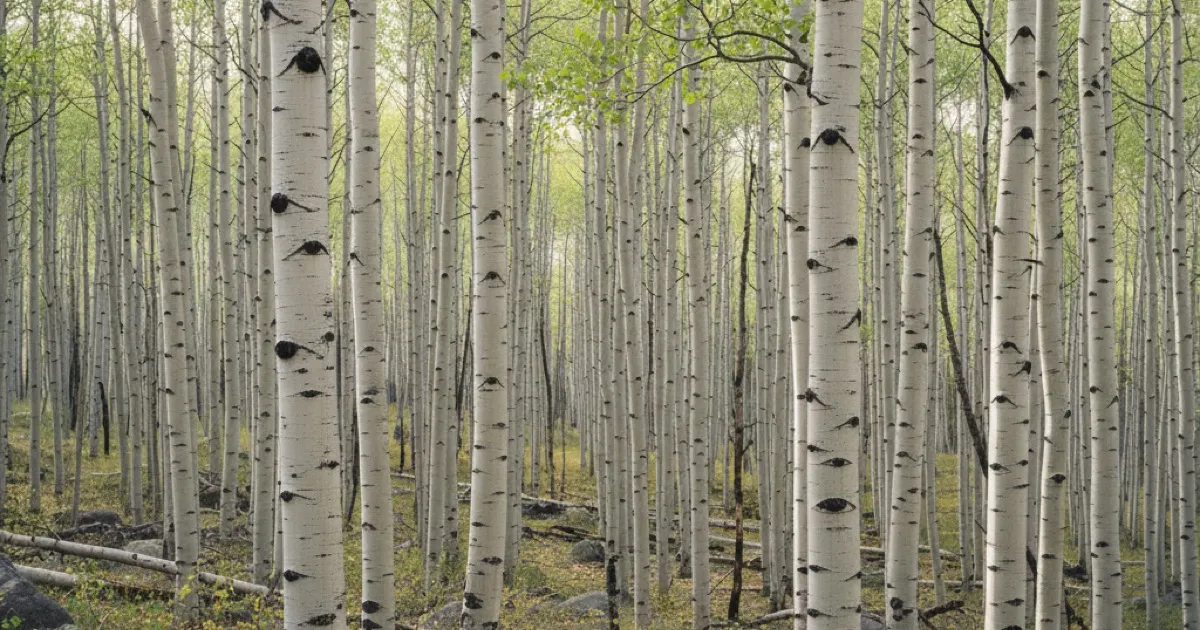
Aspen trees (Populus tremuloides) are the most recognizable member of the poplar family: smooth white bark marked with black knot scars, round leaves on flat stalks that quiver in the lightest breeze, and dense clonal groves that share a single root system underground. All true poplars and aspens belong to the genus Populus in the willow family (Salicaceae), and they share more identification traits than their different looks suggest.
Poplar Tree Identification Starts with the Genus
All true poplars belong to the genus Populus in the willow family (Salicaceae). Before sorting out individual species, it helps to know the traits that unite them.
Leaves. Most poplars have triangular, diamond-shaped, or heart-shaped leaves with toothed margins. The leaf stems (petioles) on many species are flattened side to side rather than round, which allows the leaves to twist and flutter in the wind. This flattened petiole is the reason aspens “quake.”
Catkins. Poplars produce drooping flower clusters called catkins in early spring before the leaves emerge. Male and female catkins grow on separate trees. Female catkins release cottony seeds in late spring, the white fluff that blankets sidewalks and clogs window screens in May and June.
Bark. Young poplars typically have smooth, pale bark, often white, greenish-white, or yellowish. With age, the bark darkens and develops deep furrows. The contrast between young and old bark on the same species can be dramatic enough to make them look like different trees.
Growth. Poplars grow fast, often adding 3 to 5 feet per year. They colonize disturbed ground quickly and many spread by root suckers, sending up new trunks to form dense groves or vast clonal colonies.
Poplar Leaves: How to Identify a Poplar by Its Leaves
For most people the leaves are the fastest way to identify a poplar tree. Poplar leaves share a family look even when the trees don’t, and a handful of traits show up again and again.
Shape. Poplar leaves run triangular, heart-shaped, diamond-shaped, or nearly round depending on the species. Cottonwood leaves are broad triangles. Aspen leaves are round coins. Lombardy and black poplar leaves are diamonds. White poplar breaks the pattern with maple-like lobes.
The flat stalk. Here’s the trait that ties them together. The leaf stalk (petiole) on many poplars is flattened side to side instead of round. That flat hinge lets the blade twist in the lightest breeze, so a poplar’s leaves flutter and flash while nearby trees sit still. Aspens do it best, but you’ll see it across the genus.
Undersides. Flip a poplar leaf over. Most species show a paler green or silvery underside, and white poplar goes further with a coat of white wool that looks almost painted on. When wind lifts the leaves, a poplar or aspen grove flickers silver.
Margins. The edges are toothed. Fine, even teeth point to quaking aspen. Coarse, rounded teeth point to bigtooth aspen or white poplar. Cottonwood teeth sit somewhere in between and curl inward.
Size. Poplar leaves usually run 2 to 6 inches long. Cottonwood leaves reach the top of that range; aspen leaves sit at the small end.
If you can grab only one clue, grab a leaf and check the stalk. A flattened petiole plus a pale underside narrows the field to poplars and aspens right away, before you even look at the bark or shape.
Eastern Cottonwood Identification
Eastern cottonwood (Populus deltoides) is the giant of the poplar family. If you’ve walked along a river bottom and looked up at a massive tree with deeply grooved bark dropping white fluff everywhere, you were probably standing under a cottonwood.
Size and shape. Mature cottonwoods reach 80 to 100 feet tall with trunk diameters of 3 to 5 feet. The crown is broad, open, and irregularly shaped. Old cottonwoods have a spreading, almost ragged silhouette.
Leaves. Triangular to diamond-shaped, 3 to 7 inches long, with coarsely toothed edges. The leaf base is straight or slightly curved, giving the leaf its classic delta shape (the species name deltoides refers to this). The petiole is flattened, so the leaves flutter in the wind.
Bark. Young cottonwoods have smooth, pale yellowish-gray bark. Mature trees develop thick, deeply furrowed bark with flat-topped ridges. The furrows can be 2 to 3 inches deep on old trunks, making bark one of the most useful features when you’re reading tree bark to sort out a species.
Seeds. Female cottonwoods produce enormous quantities of cottony seeds in late spring. The fluff piles up like snow in gutters and against buildings. Cottonwood tree identification in June is often accidental. People search for the source of the fluff and discover the tree overhead.
Related species. Plains cottonwood replaces eastern cottonwood on the Great Plains. Fremont cottonwood (Populus fremontii) fills the same niche in the American Southwest. For a closer look at this species alone, see our full cottonwood tree identification guide.
Quaking Aspen Identification
Quaking aspen (Populus tremuloides) is the most widely distributed tree in North America, covering more land than any other tree species on the continent. Its range runs from Alaska and the Yukon south through Canada and the Rocky Mountains into Mexico, growing across USDA hardiness zones 1–7. In the Rockies, aspens reach elevations up to 11,500 feet. The species reproduces primarily by root suckers rather than seed: a single underground root system sends up thousands of genetically identical stems, forming clonal groves that function as one organism. Pando, a colony in the Fishlake National Forest of central Utah, covers 106 acres with roughly 47,000 stems and weighs an estimated 13 million pounds, making it one of the largest organisms on earth by mass. Individual stems live 100 to 150 years, but the root system beneath them may be tens of thousands of years old. The bark contains chlorophyll, letting the tree keep photosynthesizing through winter after the leaves have dropped.
Size and shape. Aspens reach 40 to 70 feet tall with slender trunks 6 to 14 inches across. They almost always grow in dense groves of genetically identical clones, producing that signature wall-of-white-trunks look in mountain forests.
Leaves. Nearly circular, 1.5 to 3 inches across, with fine-toothed margins. The petiole is strongly flattened, which is why aspen leaves tremble and rustle in the faintest air movement. The sound of an aspen grove in a light breeze is unmistakable. Fall color ranges from brilliant gold to orange.
Bark. Smooth, white to cream-colored, marked with black knot-shaped scars and horizontal lines. It’s one of the most recognizable of the trees with white bark, and often mistaken for birch. The pale bark is photosynthetic, helping aspens survive long winters at high elevations. Older trunks develop rough, dark bark at the base, but the upper trunk stays smooth and white.
Where you’ll find them. Cool, moist environments from sea level to above 10,000 feet. Common in the Rockies, the northern Great Lakes states, New England, and across Canada.
Bigtooth Aspen and Balsam Poplar
Two more species round out the poplars you’ll encounter in northern and eastern forests.
Bigtooth aspen (Populus grandidentata) overlaps with quaking aspen in the northeastern United States and Great Lakes region. The key difference is in the leaves: bigtooth aspen has large, coarse, rounded teeth along the margin (5 to 15 per side, obvious from arm’s length). Quaking aspen has fine, regular teeth that are much smaller. This is one of those cases where leaf shape is the fastest path to identification. Bigtooth aspen bark starts smooth and olive-green, becoming gray and furrowed sooner than quaking aspen.
Balsam poplar (Populus balsamifera) is the northernmost hardwood in North America, growing across Canada and into Alaska. Its defining trait is scent: the buds are coated in sticky, reddish-brown resin that smells intensely sweet and balsamic. In spring, you can smell expanding balsam poplar buds from several feet away. The leaves are ovate, 3 to 6 inches long, dark green and glossy above, pale beneath. Unlike aspens, the petiole is round rather than flattened, so balsam poplar leaves don’t quake. You’ll find them along riverbanks and lakeshores, often alongside birch trees in northern forests.
Lombardy Poplar Identification
Lombardy poplar (Populus nigra ‘Italica’) is the easiest poplar to identify from any distance. This cultivar of black poplar was brought from Italy in the 1700s and planted widely as a windbreak.
Shape. Extremely narrow and columnar. All branches angle sharply upward and press close to the trunk, creating a tall, skinny silhouette. Trees reach 40 to 60 feet tall but only 10 to 15 feet wide. They’re often planted in rows along driveways and property lines.
Leaves. Triangular to diamond-shaped, 2 to 4 inches long, glossy dark green with fine teeth.
Lifespan. Lombardy poplars rarely survive past 30 years. They’re susceptible to canker diseases that kill branches and eventually the trunk. Dead or dying specimens with half their branches bare are a common sight along fence lines.
White Poplar Identification
White poplar (Populus alba) is the odd one out of the group. Introduced from Europe and western Asia, it’s now naturalized across much of North America, often escaping from old plantings and turning up in hedgerows and vacant lots.
Leaves. Unlike other poplars, white poplar leaves have 3 to 5 lobes and look a lot like a maple leaf. The top is dark green; the underside carries dense white hairs that give the tree its name. On a breezy day the whole crown flashes silver-white as the leaves turn over.
Bark. Smooth and greenish-white to chalky gray when young, dotted with dark diamond-shaped lenticels. It’s one of several trees with smooth gray bark that beginners mix up. Older trunks turn dark and ridged near the base while the upper bark stays pale.
Habit. White poplar spreads aggressively by root suckers, throwing up thickets of new stems around the parent tree. Many gardeners treat it as invasive for exactly that reason. It reaches 40 to 70 feet with a wide, rounded crown.
Tulip Poplar vs Poplar: Clearing Up the Confusion
Tulip poplar (Liriodendron tulipifera) is not a poplar at all. It belongs to the magnolia family (Magnoliaceae), making it more closely related to magnolias than to any Populus species. The common name “tulip poplar” persists because the tree’s tall, straight growth habit superficially resembles a true poplar.
How to tell them apart:
- Flowers. Tulip poplars produce large, tulip-shaped flowers with orange and green petals. No true poplar produces showy flowers; they all use catkins.
- Leaves. Tulip poplar leaves have a unique four-lobed shape with a flat or notched tip. No true poplar has lobed leaves.
- Bark. Mature tulip poplars have light gray bark with interlacing ridges forming shallow diamonds. True poplars have either smooth white bark (aspens) or deeply furrowed bark (cottonwoods).
- Seeds. Tulip poplars produce cone-like seed clusters that stand upright. True poplars release cottony seeds from catkins.
If someone says they have a “poplar” with tulip-shaped flowers, they have a tulip tree, not a poplar.
How Tree Identifier Handles the Poplar Family
The poplar family is a good test case for identification apps because the species look so different from each other, and the tulip poplar confusion adds an extra layer. Tree Identifier uses AI to analyze photos of leaves, bark, and overall tree form, returning a species-level match with a confidence score.
A photo of round, fine-toothed leaves on a white-barked trunk points to quaking aspen. A shot of large triangular leaves on deeply furrowed bark suggests cottonwood. The columnar silhouette of a Lombardy poplar is recognized from tree-shape photos taken at a distance. You can photograph whichever feature is most accessible: a single leaf, a section of bark, or the full silhouette. The app runs on iOS and Android with 2 free identifications per day. Offline mode works in remote aspen groves where cell service doesn’t reach.
Poplar Tree Identification by Season
Each season highlights different features for telling poplars apart.
Spring. Catkins emerge before the leaves in March or April. Balsam poplar buds give off their signature fragrance. Cottony seeds from female cottonwoods start drifting in late May.
Summer. Leaf-based identification is straightforward. Compare leaf shape (round for aspen, triangular for cottonwood, diamond for Lombardy), margin type (fine teeth vs. coarse teeth), and petiole shape (flattened vs. round).
Fall. Aspens produce spectacular fall color, gold to orange, and the clonal nature of the groves means entire stands change uniformly. Cottonwoods turn yellow. Lombardy poplars drop leaves early. For tips on identification after leaf drop, see our guide to identifying trees in winter.
Winter. Bark becomes the primary tool. Quaking aspen’s smooth white bark with black scars is distinctive year-round. Cottonwood’s deep furrows contrast with Lombardy’s dark, narrow ridges.
Frequently Asked Questions
What is the difference between a cottonwood and a poplar?
Cottonwoods are poplars. Eastern cottonwood (Populus deltoides) is a species within the genus Populus. “Cottonwood” is a common name for several large poplar species named for their cottony seeds. All cottonwoods are poplars, but not all poplars are cottonwoods. Aspens and balsam poplars belong to the same genus but aren’t called cottonwoods.
Is tulip poplar a real poplar?
No. Tulip poplar belongs to the magnolia family (Magnoliaceae), not the willow family where true poplars sit. It has tulip-shaped flowers, four-lobed leaves, and cone-like seed clusters, none of which appear on any true poplar species. The “poplar” in the name comes from the tree’s tall, straight trunk, which resembles true poplars at a distance.
How can I tell quaking aspen from birch trees?
Both have white bark, but the textures differ. Aspen bark is smooth and chalky with black knot scars, while birch bark peels in papery horizontal strips. Aspen leaves are round and flutter on flattened petioles. Birch leaves are more oval with doubly-serrated edges and do not quake.
Why do aspen leaves shake in the wind?
The leaf stalks (petioles) are flattened perpendicular to the blade. A round petiole holds a leaf steady, but a flat petiole acts like a hinge, letting the leaf twist in air currents as light as 1 to 2 mph. This feature is most pronounced in quaking and bigtooth aspen.
Are poplar trees good for firewood?
Poplar wood is lightweight and burns fast, producing less heat per cord than dense hardwoods like oak or hickory. Cottonwood and aspen work as kindling or for quick campfires but aren’t ideal as primary heating fuel. For a full comparison, see our guide to the best firewood trees.
Putting It All Together
Poplar tree identification starts with the big picture. Is the tree columnar (Lombardy), growing in a white-barked grove (aspen), towering over a riverbank with furrowed bark (cottonwood), or producing fragrant sticky buds in a northern forest (balsam poplar)? Next, check the leaves: round with fine teeth means quaking aspen, round with coarse teeth means bigtooth aspen, large and triangular means cottonwood, diamond-shaped means Lombardy. And if it has tulip-shaped flowers or four-lobed leaves, it’s not a poplar at all.
Spend a few walks paying attention to the poplars in your area. The differences between species become clear quickly, and the poplar family is one of the most rewarding groups to learn.
Identify a tree from your photo — free
Upload a leaf, bark, or whole-tree photo and get the species in seconds. No signup.
Confidence:
Unlock the full species profile
Free in the app — with unlimited identifications.


AI result for guidance — the app gives full species details and works offline.
Want unlimited identifications?
Get the full species profile, photos and details — free in the app, with unlimited scans.
- Unlimited identifications
- Full species profiles & details
- Works offline, anywhere
- Save and revisit your finds
Elena Torres
Tree Identifier Team