Shagbark Hickory Tree Identification: 7 Reliable Signs
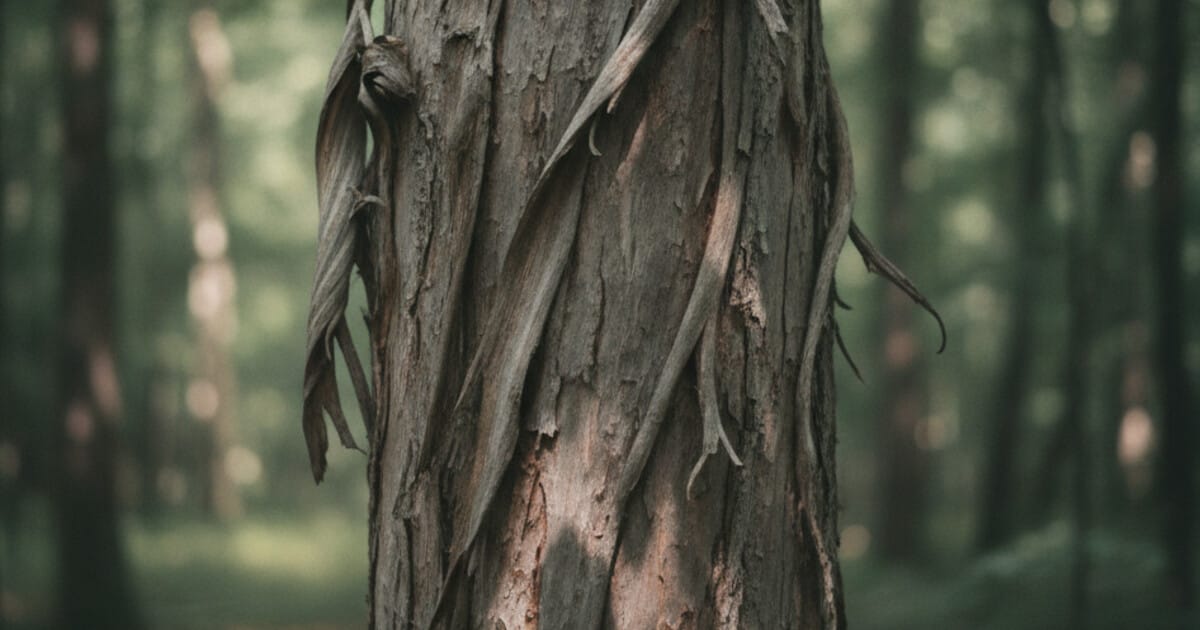
Walking through a mature eastern forest, you can spot the shagbark hickory from 50 feet away. The bark doesn’t just peel. It hangs in long, curved gray plates that bow outward from the trunk and flex when you tap them, like loose shingles on a century-old barn. If you’ve ever stopped mid-hike wondering “is that tree actually falling apart?”, you’ve probably found a shagbark hickory. Confirming the shagbark hickory tree identification takes checking a few more features alongside that bark, and this guide walks through all 7 of them.
Shagbark hickory (Carya ovata) is identified by its dramatically shaggy bark, which peels in long curved gray strips that stay attached at the middle. The leaves carry 5 leaflets (the 3 terminal ones noticeably larger), and the round nuts have a 4-parted husk that splits to the base when ripe. It’s native to eastern and central North America.
The Bark: Shagbark Hickory’s Most Unmistakable Sign
This is the feature that makes the shagbark hickory identification almost instant on mature trees. The bark strips are typically 1 to 2 feet long, curving outward at the top and bottom while staying anchored at the middle. Touch one and it flexes without breaking off, because it’s still alive and attached.
Shagbark hickory (Carya ovata) is one of the most visually distinctive trees in eastern North American forests. Its defining feature is the bark: long, flat plates of gray wood that curl outward from the trunk and hang loosely, giving the tree its shaggy appearance. These plates typically measure 1 to 2 feet in length and form when the tree reaches 20 to 30 years of age. The bark’s peeling habit provides important wildlife habitat; bat biologists have documented at least 25 species using shaggy-bark trees for roosting, and the federally endangered Indiana bat (Myotis sodalis) relies heavily on shagbark hickory stands in the eastern US. The trees grow slowly but live long: a 12-inch diameter shagbark is typically 80 to 100 years old, and specimens exceeding 300 years have been documented in the Appalachian region. Beyond the bark, shagbark hickory produces one of the highest-calorie wild nuts in eastern forests, with edible seeds consumed by more than 25 mammal and bird species.
Young shagbarks (under 20 years) don’t have this feature yet. Their bark looks more like other hickories: gray and ridged, with interlocking diamond patterns. Once maturity sets in, the shaggy plates develop and stay for the rest of the tree’s life.
One field note worth knowing: that loose bark is roosting habitat for bats. If you see bats emerging from a tree at dusk in the eastern US, look up at the bark. You’re probably standing under a shagbark hickory.
For a closer look at bark identification across many species, see our complete guide to identifying trees by their bark.
Shagbark Hickory Leaves: 5 Leaflets, 3 Bigger Than the Others
Shagbark hickory leaves are pinnately compound, meaning a central stem with leaflets attached along both sides. The standard count is 5 leaflets, which is one of the key features separating shagbark from most other hickory species that carry 7 to 11.
The arrangement has a clear pattern. The 3 terminal leaflets are noticeably larger than the 2 near the base of the stem. The largest terminal leaflet can reach 7 inches long. All 5 have finely serrated edges with a slight forward hook to the teeth.
In summer the leaves are medium to dark green on top, paler underneath with small tufts of hair at the vein junctions. By October they turn a clean golden yellow, sometimes bronze. The fall color is one of the brightest in the hickory family.
The leaves attach to the branch in an alternate pattern (each leaf at a different point, not directly across from another). Opposite leaves mean you’re looking at something else, likely a maple or ash.
Shagbark Hickory Buds and Twigs
Outside of leaf season, the buds become the best ID feature after the bark. Shagbark hickory terminal buds are large (often 3/4 inch to 1 inch), oval, and dark brown. They look oversized for the twig, with visible overlapping scales. The outer scales loosen before spring and sometimes fall away early.
No other common eastern hickory has buds this large and this dark. That size difference is obvious once you’ve seen it once.
The twigs are stout and reddish-brown, thick in proportion to the branch. This gives the tree a distinctive winter silhouette that’s useful when you’re working from bare branches alone.
Shagbark Hickory Nuts: 4-Parted Husk, Sweet Kernel
Shagbark hickory produces one of the better edible wild nuts in eastern North America. The nut is oval to round, about 1 to 1.5 inches across. The husk starts green, turns dark brown to black as it ripens in September and October, and splits into 4 sections all the way to the base.
That clean, base-splitting 4-parted husk is a reliable ID feature. Some other hickories have husks that split only partway, or have thick husks that barely open. Shagbark’s splits fully with no effort.
The shell inside is thin relative to other wild nuts, and the kernel is sweet. Indigenous peoples across the eastern US used shagbark hickory nuts for cooking, pressing boiled and pounded nuts to extract a rich oil called “hickory milk.” Squirrels, blue jays, wild turkeys, and deer all feed on the nuts heavily in fall.
How to Tell Shagbark Hickory Apart from Similar Species
The shaggy bark makes the ID easy on most mature trees. Three species cause regular confusion.
Shellbark hickory (Carya laciniosa) also has shaggy bark, so leaflet count is what separates them. Shellbark typically carries 7 leaflets; shagbark carries 5. Shellbark also prefers bottomland and floodplain sites, while shagbark grows on drier upland slopes and ridges.
Pignut hickory (Carya glabra) shares the 5-leaflet count but has tight, interlocking gray bark that never hangs in plates. If the bark isn’t peeling in long strips, it’s a different species.
Mockernut hickory (Carya tomentosa) carries 7 to 9 leaflets and has ridged bark that stays firmly attached. The leaf undersides are densely hairy, which you can feel by rubbing them.
Bitternut hickory (Carya cordiformis) is the easiest to rule out. Its buds are bright sulfur-yellow, unlike any other hickory. If the buds look dipped in mustard, you’ve found a bitternut.
For a broader comparison of the full hickory family, including bark textures and nut shapes across species, see the hickory tree identification guide.
Shagbark Hickory Habitat and Range
Shagbark hickory grows across a wide band of eastern and central North America. Its range runs from southern Quebec and Maine south through the Appalachians to Georgia and Alabama, then west through the Midwest to Nebraska and eastern Kansas.
It prefers well-drained soils on upland slopes, ridge tops, and dry valley floors above the floodplain. You’ll find it most often in mixed deciduous forests alongside oaks, maples, and tulip trees. It tolerates dry, rocky sites better than most hickories and appears regularly on south-facing slopes where other species thin out.
Mature trees reach 60 to 80 feet in height with a narrow, oval crown. Old-growth specimens with trunks 2 to 3 feet in diameter still exist in a few protected forests, though most stands today are younger.
Using Tree Identifier for Hickory ID in the Field
Hickory species can be tricky even with a field guide. Shagbark and shellbark share the shaggy bark. Young shagbarks don’t yet have developed bark plates. Leaflet counts require a close look and sometimes a recount.
Tree Identifier’s AI works by cross-referencing photos of multiple parts: bark, a full leaf, a leaflet close-up, a bud, and a nut if present. Snapping each separately gives the app enough data to distinguish species that look similar in any single photo. The species database includes Carya ovata with full habitat, range, and distinguishing feature notes.
The app runs offline, so it works mid-hike in dense eastern hardwood forest with no cell signal. You get 2 free identifications per day, which is enough for a typical walk where you’ve spotted 1 or 2 trees you can’t place. Download Tree Identifier on iOS or Android and bring hickory identification into the field.
Frequently Asked Questions
Is shagbark hickory the same as shellbark hickory?
Shagbark hickory (Carya ovata) and shellbark hickory (Carya laciniosa) are two separate species with similar-looking bark. The main differences: shagbark typically has 5 leaflets and grows on upland sites, while shellbark has 7 leaflets and favors bottomland and floodplain forests. Shellbark nuts are also noticeably larger.
Are shagbark hickory nuts edible?
Yes. Shagbark hickory nuts are among the sweetest and most nutritious wild nuts in eastern North America. They ripen and fall in September and October. The husk splits cleanly to the base when ripe, making the nuts straightforward to collect and shell compared to many other hickory species.
How long does it take for shagbark hickory to develop its shaggy bark?
The shaggy bark develops when the tree reaches roughly 20 to 30 years of age. Young shagbarks have gray, ridged bark that looks similar to other hickory species. On younger trees, focus on the 5-leaflet leaf count and the large, dark terminal buds rather than the bark.
What is the lifespan of a shagbark hickory tree?
Shagbark hickory is slow-growing and long-lived. Most trees survive 200 years under good conditions. Some specimens in protected old-growth forests are estimated at 300 to 350 years old. The wood is extremely hard and dense, which contributes to the tree’s structural durability over time.
Where does shagbark hickory grow?
Shagbark hickory grows across eastern and central North America, from southern Canada (Ontario and Quebec) south through the Appalachians to Alabama and Georgia, and west to Nebraska and Kansas. It favors well-drained upland slopes, ridge tops, and dry valley floors. Wet bottomland and floodplain sites are shellbark hickory territory, not shagbark.
Identify a tree from your photo — free
Upload a leaf, bark, or whole-tree photo and get the species in seconds. No signup.
Confidence:
Unlock the full species profile
Free in the app — with unlimited identifications.


AI result for guidance — the app gives full species details and works offline.
Want unlimited identifications?
Get the full species profile, photos and details — free in the app, with unlimited scans.
- Unlimited identifications
- Full species profiles & details
- Works offline, anywhere
- Save and revisit your finds
Elena Torres
Tree Identifier Team