Trees With Glossy Leaves: 8 Species Identified
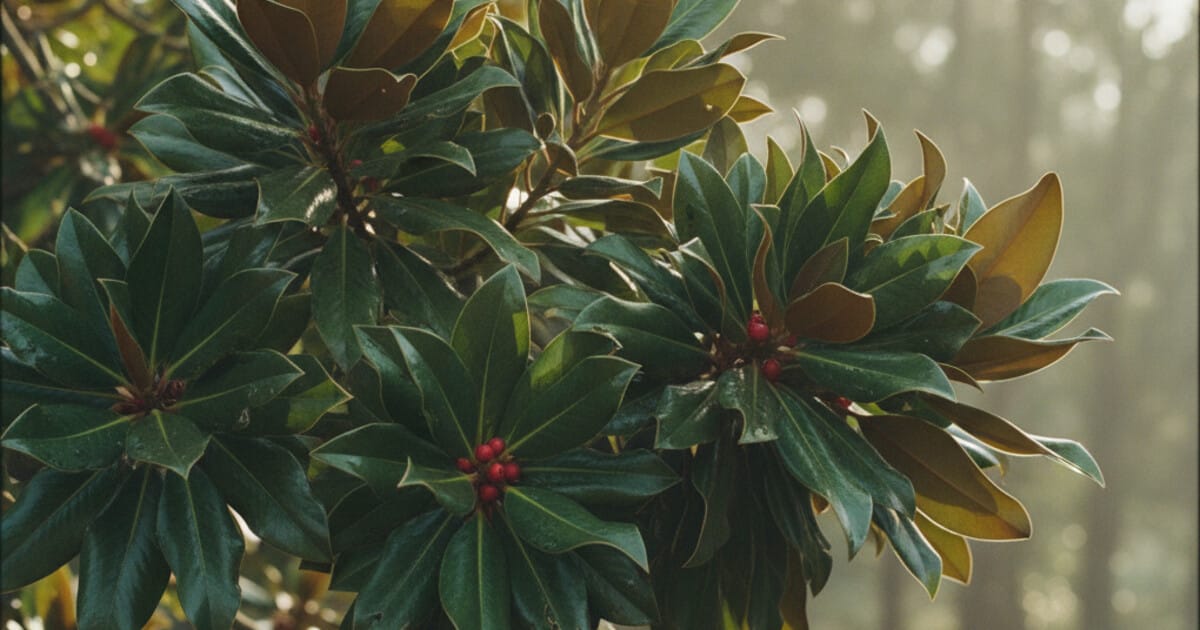
Walk through a summer yard or trail and glossy leaves catch the eye before anything else. That shine is more than visual. It’s one of the first identification signals a tree sends you.
Most glossy-leaved trees share a common trait: a thick waxy coating on the upper leaf surface that reflects light and cuts water loss. Many are evergreen for exactly this reason. Once you recognize the pattern, shiny leaves narrow down your candidate list fast.
This guide covers 8 trees with distinctively glossy leaves, from towering Southern Magnolias to native Wax Myrtles, with quick field ID tips for each.
Trees with glossy leaves include Southern Magnolia, American Holly, Live Oak, Cherry Laurel, Camphor Tree, Bay Laurel, Wax Myrtle, and Sweet Cherry. Most have a thick waxy cuticle on the upper surface that reflects light and reduces moisture loss. The majority of these species are evergreen or semi-evergreen, keeping their shiny leaves through winter.
Why Some Leaves Are Glossy
The shine comes from the epicuticular wax layer on the upper leaf surface. Think of it as a clear coat: protective and reflective. Trees that build a thick cuticle cut water loss, bounce back excess sunlight in hot climates, and resist fungal spores.
Most visibly glossy trees are adapted to warm, dry, or coastal conditions. Southern Magnolia and Live Oak are native to the humid Southeast. Bay Laurel is from the Mediterranean coast, where summer drought runs from June through September.
The texture check works even in low light: run your finger across the top of a glossy leaf. It feels firm, smooth, and slightly slick compared to a matte leaf.
Leaf gloss comes from the epicuticular wax layer, a protective coating secreted by epidermal cells on the upper surface of the leaf. It reduces transpiration, reflects a portion of incoming solar radiation to prevent overheating, and forms a barrier against fungal spores. Trees with particularly thick cuticles tend to live in environments with prolonged water stress or high UV exposure. The Mediterranean basin (home to Bay Laurel), the coastal American Southeast (Live Oak, Southern Magnolia, Wax Myrtle), and subtropical zones (Camphor Tree) all fit this pattern. The gloss isn’t incidental decoration. It’s a functional adaptation that lets these trees keep their leaves through dry summers and mild winters when deciduous neighbors drop theirs. Glossy-leaved trees account for the majority of evergreen broadleaf species in coastal and southeastern North America, where heat, humidity, and periodic drought make a durable leaf surface worth the energy investment.
8 Trees With Glossy Leaves
1. Southern Magnolia (Magnolia grandiflora)
Southern Magnolia is probably the most visibly glossy large tree in North America. The leaves are 5 to 8 inches long, thick and leathery, with a dark green upper surface so reflective that individual leaves flash in sunlight from across a yard.
The underside is completely different: rusty brown and felted, almost suede-like. That contrast between the glossy top and the velvety underside makes this one of the easiest IDs by touch alone.
The tree is evergreen and can reach 80 feet. Large, creamy-white flowers appear from May through June. If you’re in the Southeast and standing in front of big-leafed, glossy-topped, rusty-bottomed leaves, it’s almost certainly Southern Magnolia. Our magnolia tree identification guide covers the full species range from Sweetbay to Star Magnolia.
2. American Holly (Ilex opaca)
American Holly has some of the most recognizable glossy leaves in eastern North America: deep green, oval, 2 to 4 inches long, with spiny tips at each tooth. Even in shade, the leaves hold a shine that most species don’t match.
Holly stays evergreen year-round. In winter, when everything around it has dropped its leaves, the gloss stands out immediately. Female trees produce the classic red berries that persist through January or February.
The spines and gloss together make it distinct from most other glossy-leaved trees. No other common eastern tree combines spiny-toothed leaves with a high-gloss evergreen surface in quite the same way.
3. Live Oak (Quercus virginiana)
Live Oak has small, oval leaves about 2 to 5 inches long with smooth margins and a leathery, glossy upper surface. There’s no lobing, no serration. The gloss is subtler than Magnolia or Holly but distinct compared to most oaks, which have matte surfaces.
It’s an evergreen oak, which surprises people who expect all oaks to drop leaves in fall. Live Oak holds most of its leaves through winter into early spring, when new growth pushes the old leaves off.
The spreading, low-canopy silhouette is another reliable clue. Live Oaks tend to grow wide rather than tall, often with long horizontal limbs extending well beyond the trunk.
4. Cherry Laurel (Prunus laurocerasus)
Cherry Laurel is widely planted as a hedge or screen tree in temperate regions. The leaves are 4 to 6 inches long, broad-oval, dark green with a high gloss, and finely serrated. The top surface is so smooth it can look almost synthetic.
It’s evergreen. In spring it produces white flower spikes, followed by small fruits that turn black when ripe. Crush a leaf and catch a faint almond scent from prussic acid compounds in the tissue. That scent is specific to the Prunus genus.
The combination of large glossy leaves, white flower spikes, and dark berry clusters is distinctive among evergreen hedge trees.
5. Camphor Tree (Cinnamomum camphora)
Camphor Tree has oval leaves 2 to 4 inches long with three prominent veins running from near the base, a pattern botanists call triplinerved. The upper surface is glossy dark green when mature and pinkish on new growth.
Crush a leaf and it releases an unmistakable camphor scent. That smell identifies this species faster than any visual clue.
The tree is widely planted as a street and shade tree in Florida, California, and along the Gulf Coast. It’s considered invasive in Florida, spreading readily into natural areas. Trees grow large, often to 50 feet, with wide, dense canopies and deeply furrowed gray bark.
6. Bay Laurel (Laurus nobilis)
Bay Laurel is the source of the dried bay leaves used in cooking. The leaves are 2 to 4 inches long, narrow-oval, dark green, and glossy with slightly wavy (not serrated) margins. Crush a leaf and you’ll recognize the herb immediately.
In mild climates, Bay Laurel grows as a small tree or large shrub to about 30 feet. It’s commonly pruned into formal shapes for gardens. Small, pale yellow flowers appear in spring. Berries turn dark purple when ripe.
In the US, it’s planted mainly in California and the Pacific Northwest. It doesn’t handle extended hard winters.
7. Wax Myrtle (Myrica cerifera)
Wax Myrtle is a native southeastern US tree or large shrub with narrow, elongated leaves 1 to 3 inches long. The gloss comes partly from resin glands scattered across the leaf surface. Hold a leaf up to the light: you’ll see small translucent dots, which are the glands.
Crush the leaf and it releases a sharp, resinous scent, completely different from Bay Laurel, more pine-like than herbal.
It grows along coastal areas, wetland edges, and disturbed ground throughout the Southeast, tolerating salt spray and poor soils. The waxy berries were traditionally used to make bayberry candles.
8. Sweet Cherry (Prunus avium)
Sweet Cherry has oval leaves 3 to 5 inches long with a pointed tip, doubly serrated margins, and a moderately glossy upper surface. The gloss is softer than Holly or Magnolia but still noticeable. Look for one or two small reddish glands at the base of the leaf stalk. That gland detail is a consistent Prunus family trait.
In spring, white 5-petal flowers appear in clusters. The familiar red-to-black cherries follow by early summer. Young bark is reddish-brown with horizontal lenticels that look like pale dashes circling the trunk.
Our cherry tree identification guide covers how to distinguish Sweet Cherry from black cherry and ornamental varieties.
How to Identify Glossy-Leaved Trees in the Field
Gloss is a quick first filter. Use it to narrow down the list, then check secondary features.
Check leaf size. Southern Magnolia’s leaves are 5+ inches long. American Holly’s are 2 to 4 inches. Wax Myrtle’s are narrow and under 3 inches. Size separates the most common glossy species quickly.
Check the underside. Southern Magnolia has a rusty, felted underside. Most others have a plain, paler underside. That contrast is the single fastest check in this group.
Crush a leaf. Bay Laurel smells like cooking herbs. Camphor Tree smells like medicine. Wax Myrtle has a sharp, resinous scent. The smell check takes 3 seconds and often settles the ID.
Use geographic context. Wax Myrtle dominates coastal areas from Maryland to Texas. Camphor Tree is a planted street tree in Florida and California. Geography rules out a lot before you look at any leaf detail.
For a broader leaf identification framework that covers shape, edge type, and arrangement together, the tree identification by leaf shape guide walks through the full process. Leaf texture, including gloss, fits into that system as one of several parallel clues. If you’re also learning leaf arrangement, the trees with alternate leaves guide covers that clue, which most glossy-leaved trees share.
How Tree Identifier Helps
Tree Identifier works from a photo. Take a picture of a leaf, bark, or flower and the app returns the species name with a confidence score and full details about the tree.
For glossy-leaved trees, an upper-leaf photo usually gives enough to work with. If the result is unclear, bark helps. Southern Magnolia has smooth gray bark on young trees and furrowed bark on mature ones. Live Oak has deeply ridged, dark bark. Camphor Tree has furrowed gray bark. The app recognizes both leaf and bark photos.
Tree Identifier works offline, which matters in coastal areas and remote trails where connectivity is often unreliable. It gives you 2 free identifications daily and stores past IDs in a personal tree collection. Available on iOS and Android at treeidentifier.app.
Frequently Asked Questions
What makes a tree’s leaves look glossy?
Gloss comes from the epicuticular wax layer on the upper leaf surface. This coating reduces water loss, reflects excess sunlight, and protects against pathogens. Trees with thick cuticles tend to live in warm, dry, or coastal climates where keeping leaves year-round is worth the energy cost.
Are trees with glossy leaves always evergreen?
Most are. Southern Magnolia, American Holly, Live Oak, Cherry Laurel, Bay Laurel, Wax Myrtle, and Camphor Tree are all evergreen or semi-evergreen. Sweet Cherry is deciduous but still has a moderately glossy surface. The connection between gloss and evergreen habit is strong but not universal.
How do I tell Southern Magnolia from Cherry Laurel?
Southern Magnolia leaves are 5 to 8 inches long with a distinctive rusty, felted underside. Cherry Laurel leaves are 4 to 6 inches, finely serrated, with a plain pale-green underside. The underside comparison settles it almost immediately.
Can I identify glossy-leaved trees with an app?
Yes. Tree Identifier uses AI to identify trees from leaf, bark, flower, or full-tree photos. A clear photo of the upper leaf surface is usually enough. For harder cases, including a bark photo improves accuracy. The app covers all 8 species in this guide.
Spot a tree with shiny leaves on your next walk? Check the size, smell the leaf, and look at the underside. Those 3 checks cover most of the species here. For anything harder, snap a photo with Tree Identifier at treeidentifier.app and get the species name in seconds.
Identify a tree from your photo — free
Upload a leaf, bark, or whole-tree photo and get the species in seconds. No signup.
Confidence:
Unlock the full species profile
Free in the app — with unlimited identifications.


AI result for guidance — the app gives full species details and works offline.
Want unlimited identifications?
Get the full species profile, photos and details — free in the app, with unlimited scans.
- Unlimited identifications
- Full species profiles & details
- Works offline, anywhere
- Save and revisit your finds
Elena Torres
Tree Identifier Team