What Tree Has Helicopter Seeds? 8 Common Trees With Winged Seeds
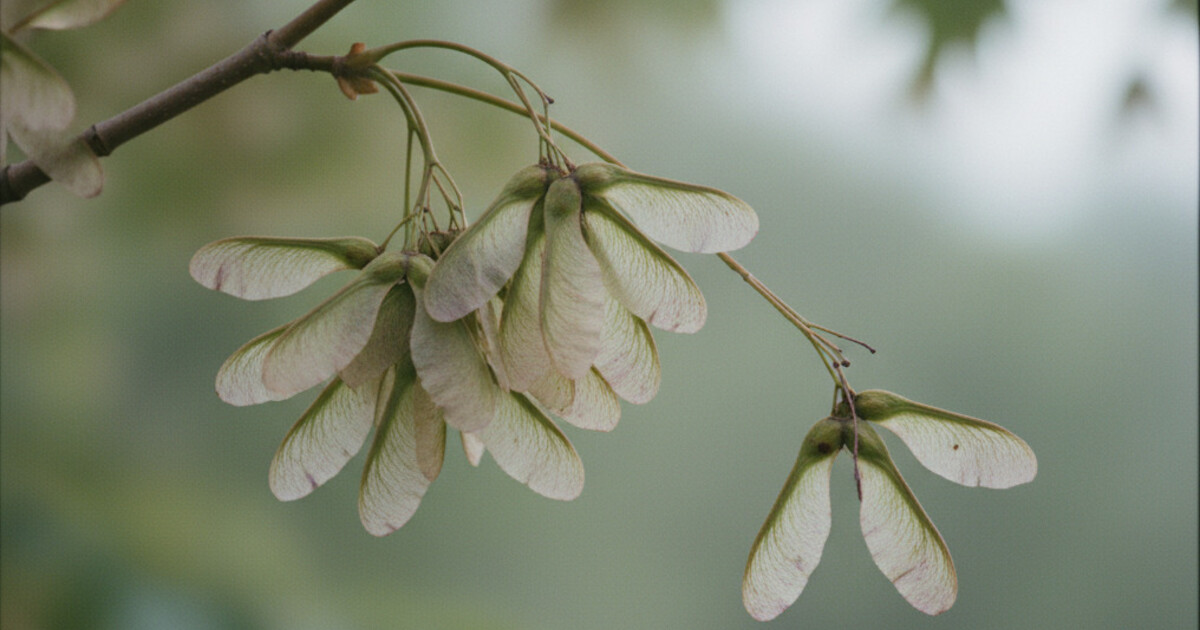
You’ve probably seen them on the sidewalk, stuck in your car wipers, or spinning down from somewhere overhead. Those winged seeds that helicopter their way to the ground are called samaras, and they come from more tree species than most people expect. If you’ve found a pile of them and want to know which tree they fell from, the shape and timing narrow it down quickly.
This guide covers the 8 most common trees with helicopter seeds in North America and the specific features that separate them in the field.
Trees with helicopter seeds, called samaras, include maples (sugar, silver, Norway, box elder), white and green ash, American elm, and tulip tree. The papery wing spins as the seed falls, slowing its descent so wind carries it away from the parent tree. Maple samaras come in paired wings; ash and elm produce single-winged seeds. Each species has a distinct shape and fall timing.
Standing in front of one? Identify it from a photo in seconds — free, no sign-up needed.
8 Common Trees With Winged Seeds (Helicopter Seeds)
Sugar Maple (Acer saccharum)
Sugar maple samaras come in pairs joined at the base, forming a U or horseshoe shape. Each wing runs about 1 to 1.5 inches long. They fall in late spring through early summer, usually after the leaves are fully open.
The paired U-shape is the quickest visual cue. When both seeds are still attached, the symmetry is obvious.
Silver Maple (Acer saccharinum)
Silver maple samaras are the largest of the common maples, sometimes stretching 2 inches. They drop in April or May, earlier than most other maples, and come in pairs with a wider angle between the wings.
A healthy silver maple can shed millions of seeds in a single season. If your yard is buried in helicopter seeds in early spring, silver maple is the most likely source.
Norway Maple (Acer platanoides)
Norway maple samaras spread nearly flat, with the two wings forming almost a straight horizontal line. The angle between the wings is much wider than sugar maple’s curved shape.
Norway maple is also invasive across much of the Northeast and Great Lakes region. Finding its seeds in natural areas near native trees is worth flagging.
Box Elder (Acer negundo)
Box elder is technically a maple, though the leaves look nothing like a maple’s. The samaras hang in long, dangling clusters and are slightly curved, with wings that meet at a narrower angle than other maples.
Box elder drops huge quantities. By the end of the season, the seeds can coat sidewalks in a thick layer.
White Ash (Fraxinus americana)
Ash samaras are single-winged, which immediately separates them from any maple. Each seed hangs alone from the branch in long clusters, with a paddle-shaped wing attached to a plump, elongated body.
They stay on the tree well into autumn and sometimes through winter. The single paddle shape is the fastest way to distinguish ash from maple when you’ve got a seed in hand.
Green Ash (Fraxinus pennsylvanica)
Green ash samaras look nearly identical to white ash. The difference shows up in the tree itself: green ash has slightly narrower leaflets and tends to grow in wetter spots along streams and floodplains.
Both ash species are heavily affected by the emerald ash borer, and millions of ash trees across North America have died or are dying. Location and tree health both matter when identifying ash. For deeper species-level detail, the ash tree identification guide covers white and green ash side by side.
American Elm (Ulmus americana)
Elm samaras are small, round, and flat, roughly the size of a fingernail, with a papery wing encircling the entire seed. They appear in early spring, often before any leaves have emerged.
That timing combined with the round shape separates elm from everything else on this list. No other common North American tree seeds this early with this shape.
Tulip Tree (Liriodendron tulipifera)
Tulip tree samaras grow in tight, upright cone-shaped clusters at the ends of branches. Individual seeds are narrow and elongated. The whole cluster stays intact through late summer before breaking apart in autumn.
When the seeds finally fall, each one spins individually. The cone-shaped cluster while still attached to the branch is one of the clearest identification features of this species in late summer.
Why Trees Grow Helicopter Seeds
Samaras solve a problem that’s fundamental for any plant: a seed that falls straight down lands in the shade of its parent tree. Growing up under an established adult means competing for the same light, water, and nutrients from day one. The odds aren’t good.
The papery wing changes the physics. When a samara spins as it falls, the rotation slows the descent from a free fall to a controlled spiral. Wind catches the seed during that extended time in the air, carrying it tens to hundreds of meters from the parent tree.
Wind dispersal, called anemochory, is one of the most efficient seed distribution strategies in temperate forests. Trees that rely on it can colonize open or disturbed ground quickly, which is why maples, ashes, and elms are typically among the first species to establish after land is cleared or after a forest fire. The seeds travel because the wing and seed body are precisely proportioned so the spin rate stays within an optimal range regardless of seed weight.
Studies on maple samaras have identified a leading-edge vortex forming on the spinning wing, the same aerodynamic principle found in helicopter rotors and some insect wings. Silver maple seeds have been tracked traveling over 100 meters in a moderate breeze. For a tree growing in open ground, that dispersal distance means landing in soil with more light, fewer competitors, and a much better chance of establishing.
Telling These Seeds Apart in the Field
A few features narrow the identification quickly.
Wing structure: Maple seeds come in pairs, two wings fused at the center. Ash seeds are single, with one paddle-shaped wing per seed. Elm seeds are small and round, with the wing wrapped around the entire seed.
Size: Silver maple has the largest samaras of the common maples. Elm seeds are by far the smallest.
Fall timing: Elms seed in early spring before their leaves come out. Silver maple follows in April. Most other maples drop seeds through late spring and summer. Ashes hold their seeds into fall and sometimes through winter.
Cluster shape: Tulip tree seeds grow in tight upright cones before breaking apart. Box elder seeds hang in loose, drooping clusters along the branches. Ash seeds droop in flat-topped bunches.
In most cases, the shape alone narrows it down to two or three candidates. Confirming with the bark or a leaf photo finishes the job.
The tree seed pod identification guide covers more species with size comparisons and seasonal timing if you want to go deeper on seeds beyond helicopter types.
How Tree Identifier Helps
If you’ve found helicopter seeds but can’t tell whether you’re looking at a Norway maple or a silver maple from the trunk alone, Tree Identifier can confirm the species from a photo.
Snap a photo of the bark, a nearby leaf, or the full tree shape. The app processes it with AI and returns an identification with a confidence score, plus detailed species information including characteristics, natural range, and habitat. It covers all 8 species in this guide and thousands more.
The offline mode works without cell service, so it’s useful on remote trails where coverage drops out. You get 2 free identifications per day with no subscription required to get started.
For more detail on the maples and elm species covered here, the guides on maple tree identification and elm tree identification go deep on each one.
Download Tree Identifier on iOS or Android at treeidentifier.app and put it to use the next time you find an unfamiliar seed.
Frequently Asked Questions
What trees have helicopter seeds? The most common trees with helicopter seeds in North America are maples (sugar, silver, Norway, box elder), ashes (white, green), American elm, and tulip tree. Maples produce seeds in joined pairs. Ashes and elms produce single-seeded samaras. Each species has a distinct wing shape and drops seeds at a different time of year.
Why do maple seeds spin like helicopters? Maple seeds spin because the wing is shaped so that air passing over it generates a rotating vortex as the seed falls. This slows the descent and extends the time the seed stays airborne, giving wind more time to carry it away from the parent tree. Research has shown the spinning produces the same leading-edge vortex found in helicopter rotors.
When do maple trees drop their helicopter seeds? It depends on the species. Silver maple drops seeds in early spring, often April. Sugar maple follows in late spring through early summer. Norway maple and box elder drop seeds from late summer through early fall. Some seeds stay on the tree into winter, especially on ash.
How do you tell maple seeds from ash seeds? Maple seeds come in pairs, two wings joined at the center. Ash seeds are single, with one paddle-shaped wing attached to a plump seed body. The paired versus single structure is the clearest field distinction. Ash seeds also tend to fall later in the season and stay on the tree longer than most maples.
Do trees with helicopter seeds produce them every year? Yes, a mature tree produces samaras every year. Output varies with weather and tree health, but a healthy silver maple can shed millions of seeds in a single season. Some years are heavier than others depending on late frost timing and pollination conditions.
If you keep finding seeds you can’t place, Tree Identifier can help. Take a photo of the bark or a nearby leaf and get an instant species ID with a confidence score. It works offline and gives you 2 free identifications per day.
Identify a tree from your photo — free
Upload a leaf, bark, or whole-tree photo and get the species in seconds. No signup.
Confidence:
Unlock the full species profile
Free in the app — with unlimited identifications.


AI result for guidance — the app gives full species details and works offline.
Want unlimited identifications?
Get the full species profile, photos and details — free in the app, with unlimited scans.
- Unlimited identifications
- Full species profiles & details
- Works offline, anywhere
- Save and revisit your finds
Elena Torres
Tree Identifier Team