Ash Tree Identification: White, Green, Black, and Blue Ash
Ash trees are in trouble. The emerald ash borer has killed hundreds of millions of ash trees across North America since 2002, and all 8 billion remaining ash trees on the continent are at risk. Ash tree identification is no longer just a hobbyist skill — it’s a conservation priority. If you can tell a white ash from a green ash, or spot an infested tree before the beetles spread, you’re contributing to efforts that could save entire species.
This guide covers the four major North American ash species — white, green, black, and blue — along with the traits that separate them and the signs of emerald ash borer infestation that every tree-aware person should recognize.
How to Identify an Ash Tree: The Basics
Before sorting out individual species, confirm you’re looking at an ash. Three traits define the genus Fraxinus:
- Opposite branching. Branches and buds grow in pairs directly across from each other on the stem. Most trees have alternate branching, so opposite arrangement narrows the field fast. Only maples, dogwoods, and a few others share this trait.
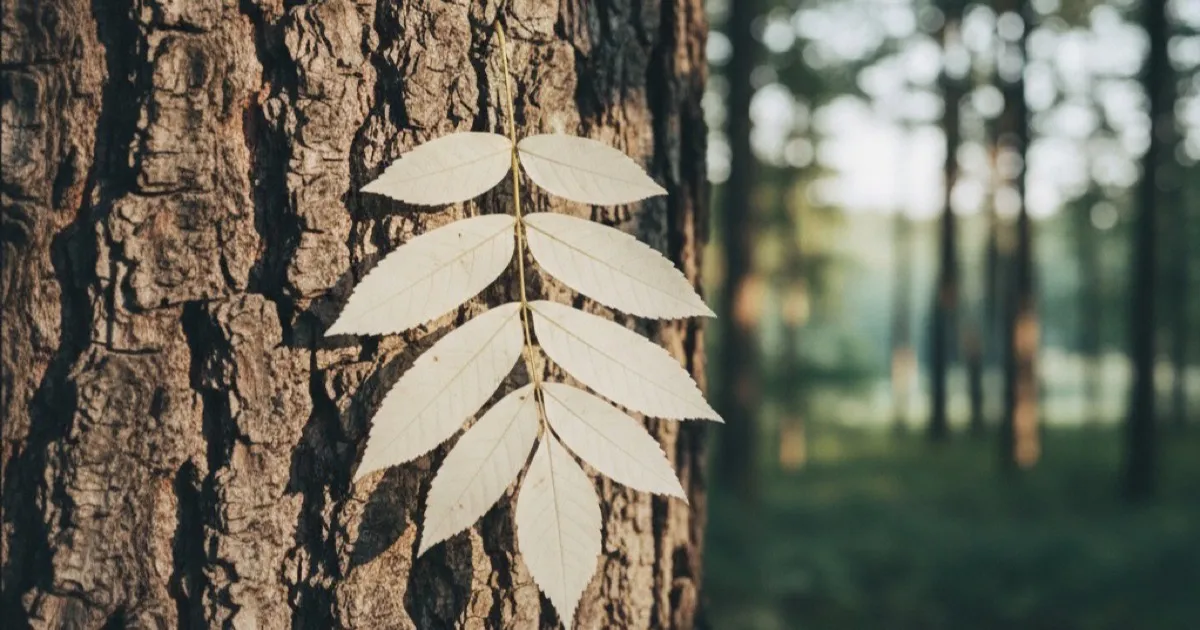
- Compound leaves. Each ash leaf is made up of 5 to 11 individual leaflets arranged along a central stalk. The leaflets sit in pairs with a single leaflet at the tip (odd-pinnate). If you’re familiar with leaf-based identification, compound leaves with opposite branching almost always mean ash.
- Diamond-patterned bark. Mature ash bark forms a distinctive pattern of tight, interlocking diamond shapes created by intersecting ridges. The pattern is most pronounced on white and green ash. For more on reading bark as an identification tool, the ash pattern is one of the most recognizable in eastern forests.
If a tree has all three of these features, you’re looking at an ash. Now the question is which species.
White Ash (Fraxinus americana)
White ash is the largest and most commercially valuable North American ash, reaching 60 to 80 feet tall with straight trunks and rounded crowns. The wood is the classic choice for baseball bats and tool handles.
Leaves. Compound, with 5 to 9 leaflets (usually 7). The key detail: leaflet undersides are noticeably paler than the tops, giving the foliage a two-toned look when the wind flips the leaves. Leaflets are 3 to 5 inches long, oval with pointed tips, and each sits on a short stalk (petiolule). Fall color ranges from deep purple to burgundy — white ash is one of the few trees that turns purple in autumn.
Bark. Gray-brown with tight, diamond-shaped ridges formed by deep intersecting furrows. The pattern looks like braided rope or a woven basket on mature trunks.
Buds and twigs. Dark brown buds sit snugly inside a C-shaped leaf scar. The twigs are smooth and gray-green. This C-shaped scar is a reliable winter identification clue.
Range. Eastern North America from Nova Scotia to Minnesota, south to Florida and Texas. Prefers well-drained upland soils, hillsides, and mixed hardwood forests.
Green Ash (Fraxinus pennsylvanica)
Green ash is the most widely distributed ash in North America and was planted heavily as a street tree through the mid-20th century. Its tolerance for poor soils and wet conditions made it an urban favorite — and left it directly in the path of the emerald ash borer.
Leaves. Compound, with 5 to 9 leaflets (usually 7). The difference from white ash: green ash leaflets are the same color on both sides, with no contrast between top and underside. Leaflets are slightly narrower with more obviously serrated edges. Fall color is bright yellow.
Bark. Similar diamond pattern to white ash but with narrower, more tightly packed ridges and more horizontal cracking.
Buds and twigs. Brown buds sit inside a D-shaped leaf scar (compared to white ash’s C-shape). In practice, the C vs. D distinction takes patience — bring a hand lens.
Range. From Alberta to Nova Scotia, south to Florida and west to Texas. Found along streams and floodplains, and planted in cities far outside its natural range.
Black Ash (Fraxinus nigra)
Black ash is a wetland specialist found in swamps, bogs, and seasonally flooded lowlands across the northern United States and southern Canada. Smaller than white or green ash at 40 to 50 feet tall, it has deep cultural significance for Indigenous communities — the wood splits cleanly along its growth rings when pounded, producing flexible strips used in traditional basket weaving.
Leaves. Compound, with 7 to 11 leaflets. The defining trait: black ash leaflets attach directly to the central stalk with no individual stems (sessile). White and green ash leaflets each have their own short stalks. If the leaflets sit right on the rachis with no petiolule, you’re looking at black ash.
Bark. Gray, soft, and corky on young trees, with rounded ridges you can press in with your thumb. Older bark becomes scaly with thin vertical strips — distinctly softer than the hard diamond ridges of white or green ash.
Buds. Dark brown to nearly black, with a velvety texture.
Range. Newfoundland to Manitoba, south to Iowa and Virginia. Almost always in wet soils — if you find an ash in standing water or a peat bog, black ash is the most likely species.
Blue Ash (Fraxinus quadrangulata)
Blue ash is the rarest of the four major species and the easiest to identify in the field. It grows primarily in the limestone soils of the central United States, particularly in Kentucky, Tennessee, Ohio, and Indiana.
The square twig. Blue ash twigs have four corky ridges running along their length, giving them a square cross-section. No other eastern ash has this feature. Roll a twig between your fingers — if it feels square, you have blue ash.
Leaves. Compound, with 5 to 11 leaflets (usually 7), coarsely serrated. Similar to white ash, so leaves alone won’t confirm blue ash. Check the twigs.
Bark. Light gray with irregular, shaggy plates — different from the tight diamond ridges of white and green ash. The inner bark produces a blue dye in water, which gives the tree its common name.
Conservation note. Blue ash shows more resistance to the emerald ash borer than other North American species. Survival rates of 60 to 70 percent have been documented in areas where green and black ash suffered near-total losses. This relative resistance makes blue ash identification especially important for conservation tracking.
The Emerald Ash Borer Crisis: Why Ash Tree Identification Matters Now
The emerald ash borer (EAB), Agrilus planipennis, is a metallic green beetle native to eastern Asia, first detected in Michigan in 2002. It has since spread to 37 states and 6 Canadian provinces, killing hundreds of millions of ash trees.
EAB larvae feed beneath the bark, carving S-shaped galleries through the phloem and cambium that transport water and nutrients. As larvae multiply, these galleries girdle the trunk, cutting off the tree’s circulatory system. Most infested trees die within 2 to 4 years. The scale of loss parallels what happened to American elms under Dutch elm disease — except EAB threatens every ash species, not just one.
How to Spot an Infested Ash Tree
Knowing your tree is an ash is step one. Step two is checking for these EAB signs:
- Canopy thinning from the top down. EAB damage starts high. Leaves thin out and branches die back at the crown first. By the time the lower canopy shows damage, the infestation is advanced.
- D-shaped exit holes. Adult beetles leave small (1/8 inch), distinctly D-shaped holes in the bark — different from the round holes left by native borers.
- S-shaped galleries under the bark. Peel back loose bark on a dying ash and look for winding tunnels packed with fine sawdust (frass). These S-shaped galleries are diagnostic for EAB.
- Epicormic sprouting. Stressed ash trees push out clusters of new shoots directly from the trunk and major limbs — a last-ditch survival response.
- Woodpecker damage. Woodpeckers feed on EAB larvae, leaving blonde patches where they’ve stripped away outer bark. Heavy woodpecker activity on an ash tree is an early warning.
- Bark splitting. Vertical cracks reveal galleries beneath. Growth tissue swells around the larval tunnels, splitting the bark.
Report suspected infestations to your state’s department of agriculture or forestry. Early detection gives land managers time to treat high-value trees. The invasive species guide covers other pests affecting North American trees.
Which Ash Species Are Most Vulnerable?
Not all ash species face equal risk. Green ash and black ash have suffered the highest mortality rates — in some infested areas, 99 percent of these trees are dead. White ash is similarly vulnerable, though its upland habitat means populations overlap less with the beetle’s initial spread corridors along rivers and highways.
Black ash losses hit especially hard. These trees anchor wetland ecosystems, and their disappearance triggers increased flooding, plant community shifts, and the loss of traditional basket-making material for Anishinaabe and other Indigenous communities.
Blue ash is the bright spot. With 60 to 70 percent survival rates in infested areas, it shows natural resistance. Researchers are studying its genetics to understand whether those traits can be bred into other species.
Quick Identification Reference
| Feature | White Ash | Green Ash | Black Ash | Blue Ash |
|---|---|---|---|---|
| Leaflets | 5-9 | 5-9 | 7-11 | 5-11 |
| Leaflet stalks | Stalked | Stalked | Sessile | Stalked |
| Leaf underside | Pale | Same as top | Dark green | Dark green |
| Fall color | Purple | Yellow | Yellow | Yellow |
| Bark | Tight diamonds | Narrow diamonds | Soft, corky | Shaggy plates |
| Twigs | Round | Round | Round | Square |
| Leaf scar | C-shaped | D-shaped | D-shaped | Half-moon |
| Habitat | Upland | Floodplains | Wetlands | Limestone |
| EAB risk | High | Very high | Very high | Moderate |
Ash Tree Identification in Winter
Ash trees drop their compound leaves in fall, but winter identification is still straightforward. Opposite branching persists year-round and rules out most species immediately. Ash buds are short, rounded, and dark brown to black, sitting in pairs at each node. The C-shaped (white ash) and D-shaped (green ash) leaf scars stay visible on twigs. Blue ash’s square twigs are obvious without leaves. Ash samaras often cling to branches into winter, and the diamond bark pattern on white and green ash reads clearly without foliage in the way.
How Tree Identifier Can Help
Telling white ash from green ash takes practice, and most people encounter ash trees when they suspect EAB damage and need a fast answer. Tree Identifier uses AI to analyze photos of leaves, bark, and tree form, returning a species match with a confidence score.
Photograph the compound leaves up close, showing leaflet arrangement and any color difference between top and underside. If leaves aren’t available, a clear bark photo works — the app handles bark-based identification across thousands of species.
It runs on iOS and Android with 2 free identifications per day. Offline mode means it works in remote wetlands where black ash grows and cell service doesn’t reach.
Frequently Asked Questions
How can I tell if my tree is an ash?
Check for three features together: opposite branching (branches grow in pairs across from each other), compound leaves with 5 to 11 leaflets, and bark with a diamond-shaped ridge pattern. If all three are present, you have an ash. The opposite branching alone rules out most other trees — only maples, dogwoods, and a few other genera share this trait.
What is the difference between green ash and white ash?
The fastest field test is leaf color. Flip a leaflet over: white ash has noticeably pale, almost whitish undersides, while green ash leaflets are roughly the same green on both sides. Fall color also differs — white ash turns purple or burgundy, green ash turns yellow. The leaf scars provide another clue: C-shaped for white ash, D-shaped for green ash.
Can ash trees survive the emerald ash borer?
Some can. Blue ash shows natural resistance, with 60 to 70 percent of trees surviving in infested areas. Individual white and green ash trees occasionally survive too, and their genetics are being studied for breeding resistant cultivars. Chemical treatments (systemic insecticides) can protect individual high-value trees if applied before heavy infestation, but treatment isn’t practical at a forest scale.
How do I report a suspected emerald ash borer infestation?
Contact your state’s department of agriculture or cooperative extension service. Note the tree’s location, the signs you observed (D-shaped exit holes, canopy thinning, bark splitting), and take photos. Many states have online reporting tools for EAB. Early detection in new areas is especially valuable for slowing the beetle’s spread.
The next time you see a tree with opposite branches and compound leaves, take a closer look. Check the leaflet undersides. Feel the twig for square ridges. Look up into the canopy for thinning. Ash tree identification feeds data to conservation programs, helps homeowners make treatment decisions, and keeps a record of which trees survive where. That two-minute observation could matter more than you’d expect.
Identify a tree from your photo — free
Upload a leaf, bark, or whole-tree photo and get the species in seconds. No signup.
Confidence:
Unlock the full species profile
Free in the app — with unlimited identifications.


AI result for guidance — the app gives full species details and works offline.
Want unlimited identifications?
Get the full species profile, photos and details — free in the app, with unlimited scans.
- Unlimited identifications
- Full species profiles & details
- Works offline, anywhere
- Save and revisit your finds
Elena Torres
Tree Identifier Team