White Ash Tree Identification: 7 Reliable Signs
White ash is one of the most common hardwood trees in eastern North America, ranging from Maine to northern Florida and west to eastern Kansas. It dominated urban street plantings for most of the 20th century and still fills the understories of mixed hardwood forests across the region. White ash tree identification has become more urgent in recent years: the emerald ash borer, an invasive beetle from Asia, has killed billions of ash trees since arriving in Michigan in 2002. Spotting the species early gives property owners and land managers options while treatment is still viable.
If you’ve seen a large tree with opposite compound leaves and deeply furrowed gray bark, you’re probably looking at an ash. Confirming it’s specifically white ash, rather than green or black ash, takes a few additional clues.
White ash (Fraxinus americana) is identified by its opposite, pinnately compound leaves with usually 7 leaflets that are distinctly pale or whitish on the underside, narrow wings on the petiolules (the small stems attaching each leaflet to the midrib), diamond-patterned gray bark with interlocking ridges, and paddle-shaped single-winged samaras hanging in clusters. Vivid purple to maroon fall color sets it apart from most other eastern hardwoods.
What White Ash Looks Like in the Field
White ash grows 60 to 80 feet tall at maturity, occasionally reaching 100 feet on excellent sites. The trunk runs straight and clean, often 2 to 3 feet in diameter, with a rounded to oval crown that opens up as the tree ages.
White ash (Fraxinus americana) is a major eastern hardwood native to forests from Nova Scotia south to northern Florida, west to eastern Kansas. Mature trees reach 60 to 80 feet, with trunks typically 2 to 3 feet in diameter and an open oval crown. The species prefers moist, well-drained soils on upland slopes and coves, growing alongside sugar maple, yellow birch, red oak, tulip poplar, and hickory. White ash produces some of the hardest, most elastic wood of any North American hardwood: density averages around 41 pounds per cubic foot (specific gravity 0.60), making it the traditional choice for baseball bats, tool handles, hockey sticks, and canoe paddles. The species is now threatened across its entire range by the emerald ash borer (Agrilus planipennis), a metallic green beetle from Asia that has killed an estimated 8 billion ash trees across North America since its US discovery near Detroit in 2002.
White ash belongs to the olive family (Oleaceae), placing it closer to lilacs and privet than to oaks or maples, despite its similar stature. Trees are dioecious: individual trees are either male or female, and only females produce seeds. Both sexes bloom in small, inconspicuous clusters before the leaves fully emerge in spring.
White Ash Leaves: The Clearest Feature for White Ash Tree Identification
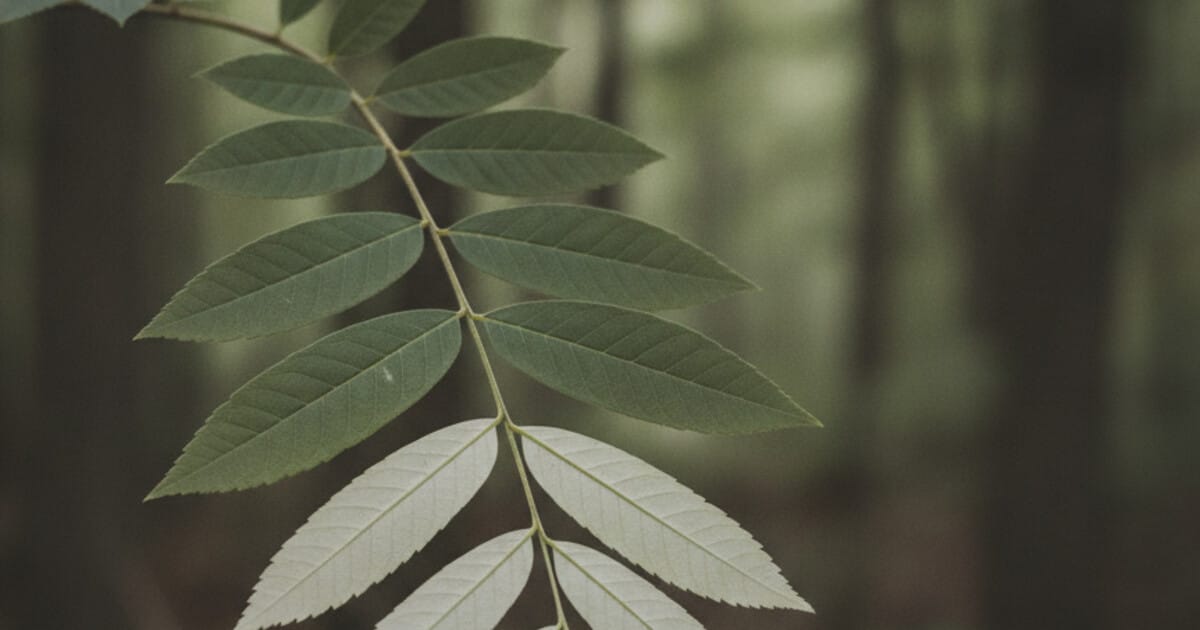
The leaves are opposite and pinnately compound, 8 to 15 inches long overall. Each leaf typically carries 7 leaflets, though 5 or 9 aren’t unusual. Leaflets run 2.5 to 5 inches long, oval to lance-shaped, with finely toothed margins and pointed tips.
The most reliable clue is the underside. White ash leaflets are distinctly pale, often described as whitish or glaucous below. Rub the underside and you’ll feel a slight waxy coating. This pale underside is literally where the common name comes from.
Look closely at the petiolules, the small stems connecting each leaflet to the central midrib. In white ash, each petiolule has a narrow wing, a thin ribbon of green tissue running along its length. The wings are subtle but consistent. Green ash petiolules are round and plain, with no wing at all. This single character separates the two species reliably when you have a leaf in hand.
White ash delivers some of the most striking fall color of any eastern hardwood. The leaves turn purple, red, or deep maroon before dropping, which surprises most people expecting dull yellow from a forest tree.
Bark, Twigs, and the Opposite Branch Test
White ash bark on mature trees is gray with a distinctive diamond or X pattern: interlocking ridges that cross each other diagonally to form diamond-shaped compartments. Young trees start with smoother bark and develop this pattern as they age past 10 to 15 years. The furrows run deep on old trees, giving the trunk a rough, corded look.
The twigs are gray-brown, stout, and hairless. At each leaf attachment point, you’ll find a D-shaped leaf scar with a small notch cut into the top edge. Inside the scar, pale bundle scars arrange themselves in a C or U shape.
The branching pattern is the fastest field clue. White ash, like all native ashes, has opposite branching: buds and branches emerge in pairs directly across from each other. Most trees in eastern forests have alternate branching. If you look up the trunk and see branches mirroring each other on both sides, you’ve already narrowed the field to a handful of species (ash, maple, dogwood, and horse chestnut share this pattern).
For more on using bark patterns to tell hardwoods apart, the tree bark identification guide walks through what to look for across common eastern species.
White Ash Seeds and Fall Color
Female white ash trees produce paddle-shaped samaras with a single wing. Each samara is 1 to 2.5 inches long, hanging in dense clusters that ripen to tan in late summer. They often stay on the tree through fall and into winter, making them useful for cold-season identification.
Ash samaras differ from maple samaras. Maple seeds come in matched pairs joined at the base, with wings spreading in a V shape. Ash seeds are single, with one wing attached at one end of the seed body, shaped more like a small oar or paddle.
Fall color on white ash ranges from yellow through orange to deep purple or maroon, varying noticeably between individual trees. Some turn a rich burgundy that rivals red maple. Most people spot the leaves on the ground before they look up, and the color alone can flag the species from a distance.
How to Separate White Ash from Green Ash and Other Look-Alikes
Green ash (Fraxinus pennsylvanica) causes the most confusion, and the two species overlap across most of their ranges. The fastest check: flip a leaflet. Green ash leaflets are roughly the same green color on both sides, or only slightly paler below. White ash leaflets are clearly pale, sometimes almost silvery on the underside. The petiolule wings confirm it: white ash has them, green ash doesn’t. Green ash also tolerates wetter, floodplain conditions more than white ash does.
Blue ash (Fraxinus quadrangulata) is easy to separate: its twigs are distinctly 4-sided, giving them a square cross-section. No other native ash has this. Its range centers on the Midwest and central Appalachians.
Black ash (Fraxinus nigra) grows in swamps and wet woods. Its leaflets are sessile, meaning they attach directly to the midrib with no petiolule at all. If the leaflets sit flush against the central stem without any connecting stalk, you’re probably looking at black ash in wet ground.
Box elder (Acer negundo) also has opposite compound leaves and sometimes trips up beginners. It has 3 to 5 leaflets (not 7), V-shaped paired maple keys rather than single paddle samaras, and it belongs to the maple family. The seeds settle any doubt.
The ash tree identification guide covers the full family-level features shared across all native North American ash species.
Emerald Ash Borer: Why White Ash Identification Matters Now
The emerald ash borer is a metallic green beetle about half an inch long, originally from northeast Asia, first confirmed in North America near Detroit in 2002. It has spread to more than 35 states and is present throughout most of white ash’s native range.
The beetle’s larvae bore S-shaped feeding galleries just under the bark, cutting off the flow of water and nutrients between roots and crown. Infected trees die within 3 to 5 years. Signs of infestation include D-shaped exit holes about an eighth of an inch wide punched through the outer bark, increased woodpecker activity on the trunk (birds drilling for larvae), crown dieback starting at the top of the tree, and clusters of small sprouts shooting from the base or lower trunk of a stressed tree.
Identifying white ash correctly matters because treatment options exist, but only for trees that are still largely healthy. Systemic insecticide treatments applied as soil drenches or trunk injections can protect a tree for several years. A tree already showing significant crown dieback and heavy exit hole activity is past the point where treatment is cost-effective.
If you own an ash tree, confirming the species is the first step. Ash trees that don’t yet show infestation signs in heavily impacted areas are candidates for preventive treatment.
How Tree Identifier Helps Confirm White Ash
White ash can be tricky to identify with confidence. The leaves, bark, seeds, and branching pattern each tell part of the story, and pulling them all together in the field takes practice.
Tree Identifier handles this from a single photo. Point the app at the leaves, bark, or seed clusters and it cross-references your image against thousands of species profiles to return a confidence-scored match in seconds. It works offline, so it’s useful on forest walks where cell service is unreliable. You get 2 free identifications per day with no subscription required.
If you’re trying to confirm whether a tree in your yard or neighborhood is white ash, a photo identification from bark or leaves is the fastest route to a confident answer, before you call an arborist or decide whether to treat.
Frequently Asked Questions
How do I tell white ash from green ash?
Flip a leaflet and look at the underside. White ash leaflets are distinctly pale or whitish below; green ash leaflets are roughly the same green color on both sides. Also check the petiolules: white ash has a narrow green wing running along each one, while green ash petiolules are round and plain. Both clues together make the ID reliable without needing to see seeds or bark.
What does white ash bark look like?
Mature white ash bark is gray with interlocking ridges that cross diagonally to form diamond-shaped or X-shaped compartments across the trunk. Young trees have smoother bark that gradually develops this diamond pattern with age. The ridges run deep and rough on older trees, giving the trunk a corded texture distinct from the flatter, more scaly bark of elms or the shaggy bark of shagbark hickory.
Is my ash tree likely to survive the emerald ash borer?
Without treatment, probably not. The emerald ash borer has spread to 35+ states and continues to expand. Untreated ash trees in infested areas typically die within 3 to 5 years of first infestation. Systemic insecticide treatments can protect healthy trees for several years if applied before the tree shows heavy infestation signs. Start treatment before crown dieback appears.
What’s the difference between ash tree samaras and maple seeds?
Ash samaras are single seeds with one wing attached at one end, shaped like a small paddle or oar. They hang in clusters. Maple samaras come in joined pairs with wings spreading in a V or helicopter shape. The single vs. paired seed structure is visible from a short distance and settles the family-level ID quickly.
What is white ash wood used for?
White ash produces hard, dense, and highly shock-resistant wood (specific gravity 0.60). It’s the standard material for baseball bats, hockey sticks, tool handles, and canoe paddles because it absorbs impact without splitting. It also machines and finishes cleanly, making it a traditional choice for furniture, flooring, and millwork throughout the eastern US.
White ash tree identification comes down to 4 reliable features: pale leaflet undersides, winged petiolules, diamond-patterned gray bark, and opposite compound leaves with 7 leaflets. The emerald ash borer has made knowing this species more than an academic exercise. If you’ve got a large hardwood you’re trying to place, the Tree Identifier app can confirm it from a photo in seconds. Download it on iOS or Android and use your first 2 identifications free.
Identify a tree from your photo — free
Upload a leaf, bark, or whole-tree photo and get the species in seconds. No signup.
Confidence:
Unlock the full species profile
Free in the app — with unlimited identifications.


AI result for guidance — the app gives full species details and works offline.
Want unlimited identifications?
Get the full species profile, photos and details — free in the app, with unlimited scans.
- Unlimited identifications
- Full species profiles & details
- Works offline, anywhere
- Save and revisit your finds
Elena Torres
Tree Identifier Team