Cottonwood Tree Identification: A Complete Field Guide
You’ve seen it happen every late spring. The air fills with fluffy white tufts that look like snow in May. Cars get dusted with it. Sidewalks collect it in drifts. Most people have no idea what tree it’s coming from. That tree is the cottonwood tree, one of the most widespread and fastest-growing trees in North America.
If you want to identify a cottonwood tree in the field, you need to know what to look for. The leaves, bark, buds, and seeds each tell a different part of the story, and cottonwoods look quite different depending on their age and the season you find them.
To identify a cottonwood tree, look for a large tree near water with triangular leaves on flattened stems that flutter in the breeze. Mature trees have deeply furrowed, gray bark. Female trees release fluffy white seeds in late spring. Leaf shape, bark texture, and riparian habitat together make cottonwood one of North America’s more straightforward trees to ID.
How to Identify a Cottonwood Tree
Cottonwood trees (Populus species) are among the most reliably identified riparian trees in North America. The features that consistently separate a cottonwood tree from similar species are leaf shape, petiole structure, and habitat. Cottonwood leaves are distinctly triangular with coarsely toothed margins and flattened petioles that make the leaves flutter in light wind. The bark on mature trees is thick, deeply furrowed, and ash-gray with interlacing ridges, distinctly different from the smooth, white-patched bark of sycamore or the greenish bark of young box elder. Cottonwoods grow almost exclusively in riparian zones: riverbanks, floodplain forests, and stream corridors. Finding a large tree with these leaf and bark characteristics within 100 feet of a water source narrows identification to a cottonwood with high confidence. The cottony seed release from female trees in May and June, plus the sticky, resinous smell of the spring buds, are extra confirmation.
What Does a Cottonwood Tree Look Like?
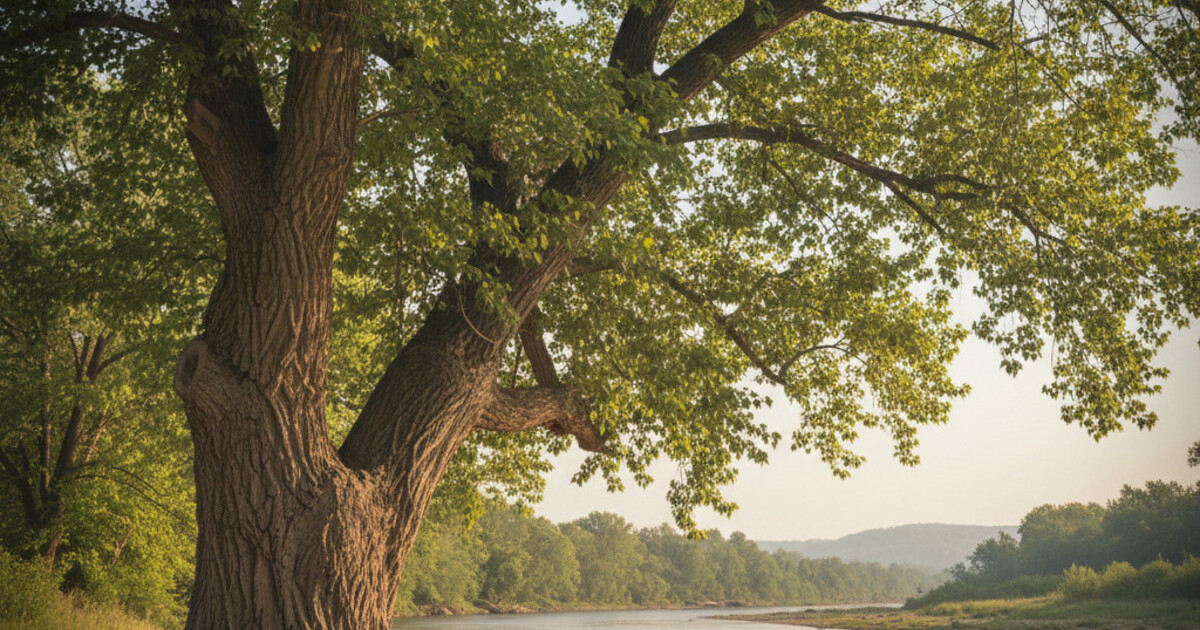
From a distance, a mature cottonwood has a silhouette you can read before you’re close enough to see a leaf. It’s a big tree: 80 to 100 feet tall with a broad, irregular crown that spreads wide rather than stays narrow. Old trunks run 3 to 5 feet across at chest height, with thick grayish-brown bark visible from across a field.
In summer the canopy holds deep, glossy green leaves that shimmer and flip in the lightest breeze. That constant motion comes from the flattened leaf stems, which pivot in air from any direction. A cottonwood grove sounds like rustling rain even on a calm day.
In late spring, female trees release the white cottony seeds that give the tree its name. Drifts collect along curbs and fences. In fall the entire crown turns a clean yellow, without the orange-and-red mix you’d see on a maple. Both the spring cotton and the fall color make cottonwood easy to spot across a large area, often before you’re anywhere close to the tree.
How to Identify Cottonwood Leaves
Cottonwood leaves are the fastest tell in the field. They’re triangular, broad across the base and tapering to a point at the tip. Botanists call this shape “deltoid,” which is exactly where Eastern Cottonwood gets its scientific name, Populus deltoides.
Run a finger along the edge and you’ll feel coarse, rounded teeth the whole way around. They’re blunt and curved rather than sharp, closer to a scalloped edge than a saw blade. For the broader category, see our guide to trees with serrated leaves.
Now check the petiole, the thin stalk joining the leaf to the twig. On a cottonwood it’s flattened side-to-side instead of round. That flat stalk works like a tiny hinge, so the leaf twists and trembles in the lightest breeze. Stand under a cottonwood on a dead-still day and you’ll still hear the leaves rustling when nothing else moves. Aspens pull the same trick, which is why both trees seem to shimmer.
A mature cottonwood leaf runs about 3 to 5 inches long and nearly as wide, glossy dark green on top and a shade paler underneath. Vigorous young shoots and stump sprouts push out much bigger leaves, sometimes 7 or 8 inches across. In fall the whole crown turns a clear yellow before the leaves drop.
One fast check: cottonwood leaves are always simple, a single blade on each stalk. If you find leaves split into several leaflets, you’re looking at something else, probably box elder, which shares the same riverbank habitat.
How to Identify Cottonwood Bark
Cottonwood bark changes so much with age that one tree can look like two different species over its lifetime. On saplings and young trees, the bark is smooth and yellowish-green, almost lime-colored on some species. As the tree matures, it shifts to gray and starts to develop shallow furrows.
On fully grown trees (which reach 80 to 100 feet tall), the bark turns deeply ridged and ash-gray, with thick, interlacing cords that look almost rope-like up close. The furrows get deep enough to lay a finger in. If you’re reading bark to ID a tree, our tree bark identification guide covers the full range of textures and what they signal.
Bark texture also varies by species. Eastern Cottonwood bark turns fully furrowed by the time the trunk reaches 6 to 8 inches in diameter. Black Cottonwood in the Pacific Northwest develops similar deep furrows but sometimes stays a shade smoother near the base. Fremont Cottonwood in the Southwest shows ash-gray bark with a reddish tint on exposed ridges. All three share the same progression: smooth and pale when young, thick and deeply ridged when mature.
The Cottony Seeds That Give the Tree Its Name
In late spring, female cottonwood trees let go of the fluff the tree is named for. Each seed capsule splits open and releases hundreds of tiny seeds, and every seed trails a tuft of silky white hair that works like a parachute. On a breezy day the air fills with it, and it drifts into piles along curbs and window screens like snow in the wrong season.
Only female trees make cotton. Male cottonwoods flower with reddish catkins in early spring and never produce fluff, which is why nurseries sell cottonless male clones for the rare yard that wants one. The timing runs from late May through June across most of the range, earlier in the South and later up north. If the cotton’s already flying, you’ve confirmed the ID before you’ve even looked at a leaf.
The 4 Main Cottonwood Species in North America
Cottonwood is a group of species within the Populus genus, which also includes poplars and aspens. If you want to go deeper on the broader poplar family, our poplar tree identification guide covers the full picture.
Here are the 4 cottonwood species you’re most likely to encounter:
Eastern Cottonwood (Populus deltoides) is the most widespread. It grows across the eastern two-thirds of the United States, from the Atlantic coast to the Rocky Mountain foothills. It’s the classic big river cottonwood: massive trunk, broad spreading crown.
Plains Cottonwood (Populus deltoides subsp. monilifera) occupies the Great Plains and is technically a subspecies of Eastern Cottonwood. The leaves tend to be a bit narrower, and it handles the drier, windier plains climate better.
Fremont Cottonwood (Populus fremontii) covers the Southwest and California. It’s the cottonwood you’ll find along desert rivers and canyon streams from Arizona to California. Leaves are more kidney-shaped at the base compared to Eastern Cottonwood.
Black Cottonwood (Populus trichocarpa) is the one to know if you’re in the Pacific Northwest. It’s the largest native hardwood in western North America, capable of reaching 150 feet. The leaves are similar but slightly more elongated, and the underside often has a pale, whitish tone.
Cottonwood Tree vs. Trees That Look Similar
A few common trees get confused with cottonwood regularly.
Cottonwood vs. Aspen: Both are Populus species with fluttering leaves. Aspen leaves are smaller and more rounded (almost circular), while cottonwood leaves are clearly triangular. Aspen bark stays smooth and whitish-green on mature trees. Cottonwood bark furrows deeply with age. Aspens also tend to grow in dense groves at higher elevations, while cottonwoods stick close to water at lower elevations.
Cottonwood vs. Poplar: Poplars and cottonwoods overlap significantly because cottonwood is a poplar. The name “cottonwood” applies to the Populus species that produce the most dramatic cottony seed fluff. Non-cottonwood poplars like Lombardy Poplar and Bigtooth Aspen have distinctly different leaf shapes and don’t release nearly as much cotton.
Cottonwood vs. Sycamore: Both grow large near water, so people mix them up from a distance. Up close, they’re easy to separate. Sycamore has large, maple-shaped lobed leaves and bark that peels in jigsaw-puzzle patches of white, tan, and olive green. Cottonwood leaves are triangular and unlobed, and the bark furrows instead of peeling.
Cottonwood vs. Box Elder: Box elder (Acer negundo) also grows near water and gets confused with cottonwood when young. The giveaway: box elder has compound leaves with 3 to 5 leaflets, while cottonwood leaves are always simple (single blade). Box elder also produces paired, winged seeds (the helicopter seeds kids toss in the air), not the fluffy cotton that cottonwoods are known for.
Identifying trees by leaf shape is one of the most reliable methods, and the triangular cottonwood leaf is hard to confuse once you’ve seen it a few times.
Where Cottonwood Trees Grow (and Why)
Cottonwoods need water. Almost every cottonwood you’ll ever find is growing within easy reach of a river, stream, lake shore, or seasonal floodplain. They need moist soil and can’t tolerate prolonged drought.
They’re also sun-hungry trees. Cottonwood seedlings can’t compete in dense shade, which is why they colonize open, disturbed riverbanks where floods have cleared the competition. A fresh gravel bar on a river will often be colonized by cottonwood within 2 to 3 years of exposure.
Growth rate is genuinely impressive. Young cottonwoods can put on 6 feet of height per year under good conditions, making them one of the fastest-growing native trees on the continent. For more on trees with exceptional growth rates, see our fast-growing trees guide.
How Tree Identifier Helps with Cottonwood ID
When you’re standing next to a large river tree and aren’t sure what you’re looking at, Tree Identifier can confirm it quickly. Take a photo of the leaf (the triangular shape and flat petiole photograph well), the bark, or both. The app accepts photos of leaves, bark, and whole tree shapes.
Tree Identifier works offline, which matters when you’re on a remote riverbank or hiking a canyon far from cell service. Download the species data before you go and it runs without a connection. Results come back with the species name, confidence score, and details on characteristics, habitat, and range.
The app is free to start with 2 identifications per day, available on iOS and Android at treeidentifier.app.
Frequently Asked Questions
What do cottonwood leaves look like?
Cottonwood leaves are triangular (deltoid), broad at the base and pointed at the tip, with coarse rounded teeth around the edge. They run about 3 to 5 inches long, glossy green on top and paler underneath, and they hang from a flattened stalk that makes them flutter and rustle in the lightest wind. Each leaf is a single simple blade, never split into leaflets.
How do I tell a cottonwood from a poplar?
Cottonwood is a type of poplar; both belong to the Populus genus. The name “cottonwood” specifically refers to Populus species that produce heavy cottony seed fluff in spring. If you’re trying to separate Eastern Cottonwood from a non-native ornamental poplar like Lombardy Poplar, look at the leaf shape: cottonwood leaves are broad and triangular, while Lombardy Poplar leaves are smaller, more diamond-shaped, and the tree has a very narrow, columnar form.
When do cottonwood trees release their cotton?
Female cottonwood trees release their seeds from late May through June across most of their range, though it can start as early as late April in the South and run into July in northern areas. The cotton is the seed’s dispersal mechanism: each tiny seed is attached to a silky fiber that lets it travel miles on the wind. Only female trees produce it.
Are cottonwood trees good for yards?
Cottonwoods are generally a poor choice for residential yards. Their root systems are aggressive and seek out water sources, which means they can damage pipes, foundations, and pavement. They drop large branches in storms and produce enormous amounts of cotton in spring. They’re also short-lived for a large tree, typically 70 to 100 years in ideal conditions and less in urban settings. They’re best appreciated along rivers, not planted next to houses.
What does cottonwood bark look like?
Young cottonwood bark is smooth and yellowish-green or pale gray. As the tree ages, the bark thickens and develops deep, interlacing furrows that give it a rope-like or corded texture. Fully mature trees have ash-gray bark with thick ridges separated by deep channels. The bark gets thicker and more deeply furrowed the older the tree gets.
Conclusion
Cottonwood trees are identifiable once you know the 3 things to check: triangular leaves with flattened stems, deeply furrowed gray bark on mature trees, and proximity to water. The spring cotton release is a bonus confirmation, though by then you’ve probably already figured out what you’re looking at.
If you want a second opinion in the field, Tree Identifier can confirm a cottonwood ID from a single leaf or bark photo. Download it at treeidentifier.app and use it offline on your next hike along the river.
Identify a tree from your photo — free
Upload a leaf, bark, or whole-tree photo and get the species in seconds. No signup.
Confidence:
Unlock the full species profile
Free in the app — with unlimited identifications.


AI result for guidance — the app gives full species details and works offline.
Want unlimited identifications?
Get the full species profile, photos and details — free in the app, with unlimited scans.
- Unlimited identifications
- Full species profiles & details
- Works offline, anywhere
- Save and revisit your finds
Elena Torres
Tree Identifier Team