Dogwood Tree Identification: Leaves, Bark & Bracts
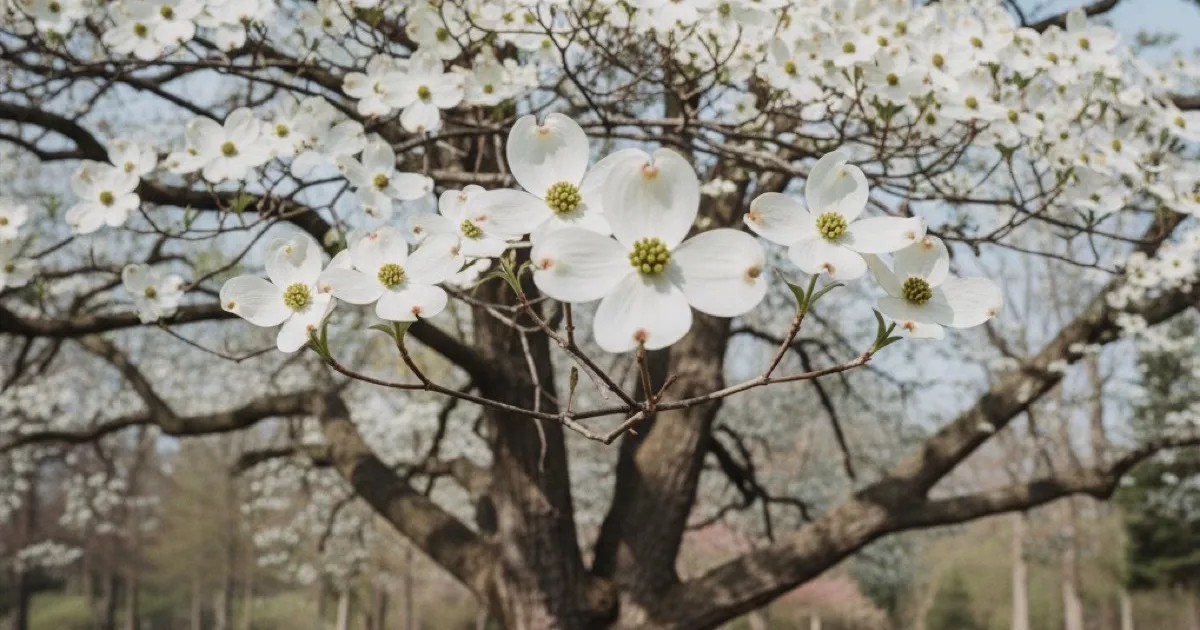
Dogwood trees rank among the most recognizable spring-flowering trees in North America. Dogwood tree identification starts with a few reliable markers: four showy bracts that look like petals, opposite leaves with distinctively curved veins, and bark that develops a rough, blocky pattern with age. Once you learn these features, you can separate the major dogwood species from one another and from every other flowering tree in your neighborhood.
This guide covers the four dogwood species you’re most likely to encounter: Flowering Dogwood, Kousa Dogwood, Pacific Dogwood, and Cornelian Cherry Dogwood. Each has its own bloom timing, bract shape, and fruit type.
Dogwood trees (genus Cornus) produce four showy bracts around a tight cluster of tiny true flowers, opposite leaves with distinctively curved veins that arc inward toward the leaf tip, and blocky alligator-skin bark on mature specimens. The four most common species in North American landscapes are Flowering Dogwood, Kousa Dogwood, Pacific Dogwood, and Cornelian Cherry Dogwood, blooming in sequence from February through June.
What Does a Dogwood Tree Look Like?
Dogwood trees are small to medium ornamental trees with a layered, spreading canopy and some of the most recognizable spring flowers in North America. In spring, clusters of four large bracts surround tiny yellowish true flowers at the center; the bracts do the visual work that petals do in other trees. In summer, oval dark-green leaves with curved veins fill out a broad, horizontal silhouette. In fall, those leaves turn deep red to purple, and clusters of glossy berries ripen. In winter, the blocky alligator-skin bark of mature Flowering Dogwoods is visible from across the street.
Dogwood trees (genus Cornus) grow as small ornamental or understory trees across North America, Europe, and East Asia. The most common landscaping species reach 15 to 30 feet tall with a layered, spreading canopy. Flowering Dogwood (Cornus florida) is native to USDA zones 5 to 9, from southern Maine to central Florida and west to eastern Kansas. It’s the state tree of Virginia and Missouri and the state flower of North Carolina. The Cornus genus contains roughly 30 to 60 species worldwide, with about 17 native to North America. All dogwoods bloom between February and June depending on species, with four to six showy bracts per flower cluster providing the color show. In fall, red-purple foliage and glossy red berries make dogwoods some of the most recognizable trees in eastern woodlands. Dogwood anthracnose (Discula destructiva) has severely affected Flowering Dogwoods in the Appalachian region since the late 1970s, but Kousa Dogwood and hybrid crosses show strong resistance.
For a broader look at trees that put on a spring show, see our flowering tree identification guide.
The Feature That Defines All Dogwoods: Curved Leaf Veins
Before getting into individual species, it helps to know the one trait that ties nearly every dogwood together. Dogwood leaves are opposite, meaning two leaves attach at the same point on the stem, one on each side. The single exception is pagoda dogwood (Cornus alternifolia), which has alternate leaves.
More distinctive than the arrangement is the vein pattern. Each dogwood leaf has 4 to 6 lateral veins branching from the central midrib, and these veins curve smoothly inward toward the leaf tip rather than running straight to the margin. This arcuate venation is visible at a glance and separates dogwoods from most other broadleaf trees. If you see opposite leaves with parallel, curving veins, you’re almost certainly looking at a dogwood.
Leaf shape is oval to elliptical, 3 to 5 inches long, with smooth (untoothed) edges. The leaves feel slightly papery and turn deep red to purple in fall, producing some of the richest autumn color of any ornamental tree.
Flowering Dogwood (Cornus florida): The Eastern Classic
Flowering Dogwood is native to eastern North America, found from southern New England to Florida and west to Texas. It’s the state tree of Virginia and Missouri, and it’s the species most people picture when they hear “dogwood.”
Bracts, not petals. What looks like a four-petaled white flower is actually four large bracts (modified leaves) surrounding a tight cluster of tiny, yellowish-green true flowers in the center. Each bract is rounded with a distinctive notch at the tip. The bracts are typically white in wild trees, though cultivars produce pink and even red forms.
Bloom timing. Flowering Dogwood blooms in mid to late April in most areas, before or just as its leaves emerge. That bare-branch backdrop makes the white bracts especially striking. Peak bloom lasts about two weeks.
Bark. Young trees have smooth, gray bark. Mature Flowering Dogwoods develop the species’ signature look: thick, deeply ridged bark broken into small, square-ish blocks that resemble alligator skin. This pattern is one of the most reliable year-round identification features and works even when the tree is leafless. For more on using bark to identify trees, see our bark identification guide.
Fruit. Clusters of glossy red berries appear in fall, each about a third of an inch long. Birds eat them quickly, so you may only spot them for a few weeks.
Size. Typically 15 to 25 feet tall with a broad, layered canopy. Flowering Dogwood grows as an understory tree beneath taller oaks and maples, so it thrives in partial shade.
Kousa Dogwood (Cornus kousa): The Asian Counterpart
Kousa Dogwood is native to Japan, Korea, and China. It has been planted heavily in North American landscapes since the 1980s, partly because it resists the anthracnose disease that devastated native Flowering Dogwoods.
Pointed bracts. Kousa bracts come to a sharp point rather than having the rounded, notched tips of Flowering Dogwood. The four bracts overlap at the base and taper to a narrow tip, giving the whole inflorescence a more angular, star-like shape.
Bloom timing. Kousa blooms two to four weeks later than Flowering Dogwood, typically in late May or June. By then, the leaves are fully out, so you see white bracts set against a green canopy rather than bare branches. This timing difference alone can separate the two species from across a street.
Bark. Mature Kousa Dogwood bark looks nothing like Flowering Dogwood. Instead of alligator-skin blocks, Kousa bark exfoliates in patches, revealing a mosaic of gray, tan, and brown. The mottled, peeling bark provides winter interest and becomes more dramatic as the tree ages.
Fruit. This is the easiest difference. Kousa produces round, bumpy, raspberry-like fruits about an inch across, hanging on long stalks. They ripen from green to pinkish-red in late summer. Flowering Dogwood, by contrast, produces small, smooth, clustered berries. If you see a dogwood with bumpy, dangling fruit, it’s a Kousa.
Size. Reaches 20 to 30 feet tall with an upright to vase-shaped canopy. Kousa tends to grow more vertically than the spreading, horizontal-branched Flowering Dogwood.
Dogwood Tree Identification: Flowering vs. Kousa
These two species confuse more people than any other dogwood pair. Here’s a quick-reference comparison.
Bract tip: Flowering Dogwood has rounded bracts with a notch. Kousa has pointed bracts with no notch.
Bloom season: Flowering Dogwood blooms April to early May on bare branches. Kousa blooms late May to June after leaves are fully out.
Bark on mature trees: Flowering Dogwood has blocky, alligator-skin bark. Kousa has exfoliating, mottled bark.
Fruit: Flowering Dogwood produces small, smooth red berries in clusters. Kousa produces large, round, bumpy fruit on long stalks.
Disease resistance: Flowering Dogwood is susceptible to dogwood anthracnose. Kousa is largely resistant.
If you’re comparing two dogwoods side by side, bract shape and bloom timing are the fastest identifiers. If you’re looking at a tree in winter, bark texture tells you everything.
Pacific Dogwood (Cornus nuttallii): The West Coast Species
Pacific Dogwood grows in the forests of the Pacific Northwest, from British Columbia down through Washington, Oregon, and into Northern California. It’s the provincial flower of British Columbia.
Bracts. Pacific Dogwood stands out because it produces four to six bracts per inflorescence, rather than the strict four found on Flowering and Kousa Dogwoods. The bracts are white, sometimes tinged pink, and can reach 2 to 3 inches long. A six-bracted dogwood “flower” is larger and showier than either eastern species.
Bloom timing. Mid to late spring, with some trees producing a second, lighter bloom in early fall.
Bark. Thin, smooth, and gray when young, developing shallow rectangular scales and blocks with age. It never reaches the deep alligator texture of Flowering Dogwood.
Fruit. Clusters of bright red drupes form a bumpy ball, similar in structure to Kousa fruit but smaller and tighter.
Habitat. Pacific Dogwood grows in moist, shaded conifer forests, reaching 20 to 40 feet as an understory tree. In the wild, it’s found beneath Douglas fir, western red cedar, and western hemlock. If you’re exploring the forests of the Pacific Northwest, this is the dogwood you’ll encounter. Our Pacific Northwest tree guide covers the region’s other signature species.
Pacific Dogwood faces the same anthracnose threat as its eastern relative and has declined in parts of its range.
Cornelian Cherry Dogwood (Cornus mas): The Early Bloomer
Cornelian Cherry Dogwood looks nothing like the other three species, which is why many people don’t realize it’s a dogwood at all. Native to southern Europe and western Asia, it’s been planted in North American parks and gardens for centuries.
Flowers. Instead of large bracts, Cornelian Cherry produces small clusters of tiny, star-shaped yellow flowers. The blooms appear in late February to March, well before the leaves, making this one of the earliest flowering trees of the year. The yellow color immediately separates it from every other dogwood.
Leaves. Opposite, oval, 2 to 4 inches long, with the same curved venation as other dogwoods. The leaves are glossy and dark green.
Bark. Gray-brown, developing an exfoliating, flaky texture on older trunks. The bark peels in thin sheets, revealing orange-brown patches underneath.
Fruit. Oblong, cherry-like red drupes about three-quarters of an inch long, ripening in late summer. They’re edible, with a tart, slightly sour flavor. The fruits have been used for preserves in eastern Europe for centuries.
Size and form. Multi-stemmed, growing 15 to 25 feet tall. Cornelian Cherry often looks more like a large shrub than a tree. It’s commonly used as a hedge or specimen planting in parks.
Dogwood Anthracnose: A Threat Worth Understanding
Dogwood anthracnose, caused by the fungus Discula destructiva, arrived in North America from Asia in the late 1970s and has killed large numbers of native Flowering Dogwoods, especially in the Appalachian Mountains.
Symptoms start with tan leaf spots ringed in purple. The infection moves from leaves to twigs, creating cankers that girdle branches. Over several years, the disease works from the lower canopy upward, killing the tree.
Flowering Dogwood and Pacific Dogwood are the most vulnerable species. Kousa Dogwood shows strong resistance, which is one reason nurseries and landscapers increasingly favor it. Hybrid crosses between Flowering and Kousa Dogwoods (Cornus x rutgersensis, sold under names like ‘Stellar Pink’ and ‘Aurora’) combine the native look with better disease resistance.
If you spot a dogwood with brown, wilted leaves and dying lower branches, anthracnose is a likely cause. Trees in shaded, humid locations with poor air circulation are most at risk.
Dogwood Tree Identification with Your Phone
When you encounter a dogwood and want to confirm the species, a photograph captures the details that matter: bract shape, vein pattern, bark texture, and fruit structure.
Tree Identifier uses AI to analyze photos of leaves, bark, flowers, fruit, or the whole tree silhouette. Snap a close-up of those pointed Kousa bracts or the alligator-skin bark of a mature Flowering Dogwood, and the app returns a species identification with a confidence score. It works on both iOS and Android and gives you 2 free identifications per day.
Dogwoods are strong candidates for photo identification because each species has such distinct visual markers. The difference between rounded and pointed bracts, or between smooth berries and bumpy fruit, gives the AI clear signals. If you’re visiting a park or arboretum with no cell service, the app’s offline mode lets you download species data in advance and identify trees without an internet connection.
For tips on getting the clearest possible photos, see our guide on how to take the best tree photos.
Frequently Asked Questions
How do I tell the difference between Flowering Dogwood and Kousa Dogwood?
Check three things. First, bract shape: Flowering Dogwood bracts are rounded with a notch at the tip, while Kousa bracts taper to a sharp point. Second, bloom timing: Flowering Dogwood blooms in April on bare branches, Kousa in late May or June after leaves are out. Third, fruit: Flowering Dogwood has small, smooth red berries, while Kousa produces large, bumpy, raspberry-like fruit on long stalks.
When do dogwood trees bloom?
It depends on the species. Cornelian Cherry Dogwood blooms earliest, in late February to March with yellow flowers. Flowering Dogwood follows in April to early May. Kousa Dogwood blooms last, in late May to June. Pacific Dogwood blooms in mid to late spring and sometimes again in early fall.
What does dogwood bark look like?
Each species has different bark. Mature Flowering Dogwood has thick, blocky bark with an alligator-skin pattern (small square-ish blocks that resemble alligator scales). Kousa Dogwood bark exfoliates in patches of gray, tan, and brown. Pacific Dogwood bark is thin and gray with shallow scales. Cornelian Cherry bark flakes in thin sheets, revealing orange-brown beneath.
Is dogwood anthracnose killing all dogwoods?
Dogwood anthracnose primarily threatens Flowering Dogwood and Pacific Dogwood. It has caused significant losses in the Appalachian region since the 1980s. Kousa Dogwood is largely resistant. Hybrid varieties bred from Flowering and Kousa Dogwoods offer improved resistance while keeping the native appearance.
How do I identify a dogwood tree by its leaves?
Dogwood leaves are opposite (two per stem node) and oval to elliptical, 3 to 5 inches long with smooth, untoothed edges. The definitive feature is arcuate venation: 4 to 6 lateral veins branch from the midrib and curve inward toward the leaf tip rather than running straight to the margin. In fall, dogwood leaves turn deep red to purple.
Bloom Season Is the Best Time to Start
Dogwoods bloom from late February through June, depending on the species. That four-month window is your best opportunity to see bracts, compare shapes, and lock in the visual differences between species. Walk your neighborhood this spring, visit a botanical garden, and photograph every dogwood you find. The curved veins and opposite leaves will confirm the genus, and the bracts, bark, and fruit will tell you exactly which species you’re looking at.
Identify a tree from your photo — free
Upload a leaf, bark, or whole-tree photo and get the species in seconds. No signup.
Confidence:
Unlock the full species profile
Free in the app — with unlimited identifications.


AI result for guidance — the app gives full species details and works offline.
Want unlimited identifications?
Get the full species profile, photos and details — free in the app, with unlimited scans.
- Unlimited identifications
- Full species profiles & details
- Works offline, anywhere
- Save and revisit your finds
Elena Torres
Tree Identifier Team