How to Tell If a Tree Is Dying: 7 Warning Signs
How to Tell If a Tree Is Dying: 7 Warning Signs
That big oak in the backyard looked fine last summer. Now a whole section of branches has no leaves, bark is peeling off the lower trunk, and there’s a shelf-like fungus growing near the base. Is the tree dying, or just stressed?
Telling the difference matters. A stressed tree can recover with the right care. A dying tree can drop limbs on your house, your car, or your family. Knowing how to tell if a tree is dying early gives you time to act, whether that means treatment, pruning, or safe removal.
This guide walks through seven visible warning signs, explains what each one means, and helps you decide when to call a professional arborist.
Dead Branches in the Canopy
Dead branches are the most obvious sign of a tree in decline. A single dead limb on an otherwise healthy tree is normal. Trees shed branches they can no longer support, especially lower ones shaded out by the canopy above. That process is called self-pruning, and it is not a cause for concern.
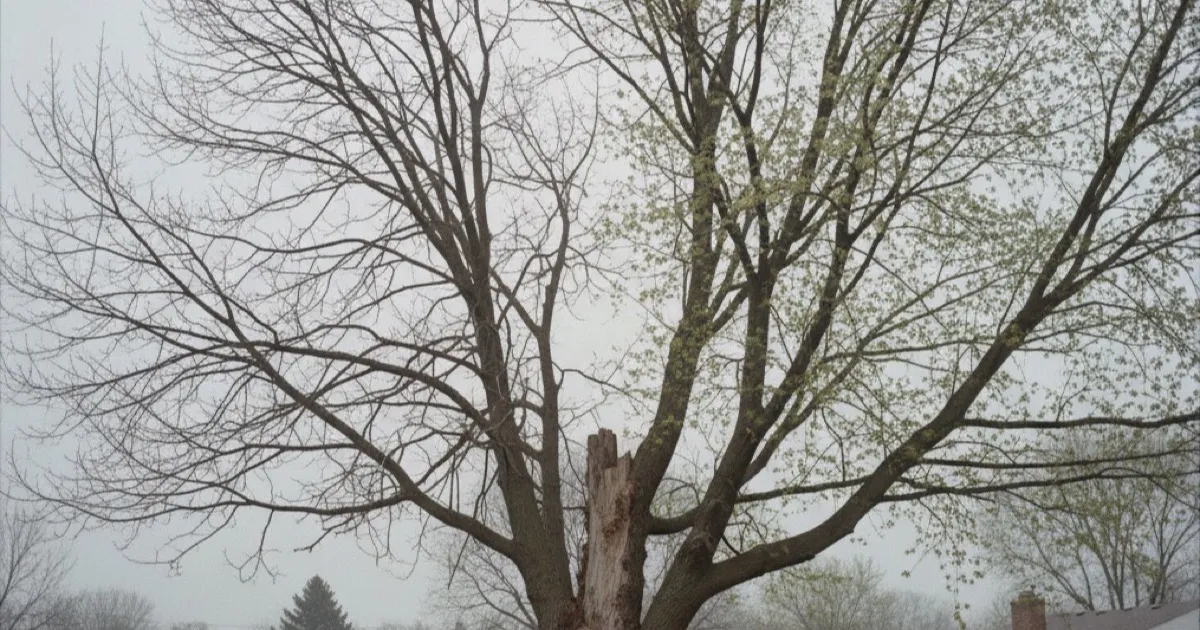
What should worry you is a pattern. Multiple dead branches scattered throughout the upper canopy, dead tips on many branches (called dieback), or an entire section of the crown with no foliage all point to a deeper problem.
How to check: Look up at the crown from a distance. In summer, dead branches stick out because they have no leaves or carry only brown, shriveled leaves. In winter, dead wood looks gray and brittle compared to live wood, which stays flexible and shows small buds along the twigs. Snap a small branch. If it breaks clean and dry with no green under the surface, it is dead.
How serious is it? Isolated dead branches are a 2 out of 10. Crown dieback exceeding 25% of the canopy is a 7 or 8. If half the crown is dead, the tree is likely beyond saving.
Bark Falling Off the Trunk
Bark protects a tree the way skin protects you. It shields the living tissue underneath, called the cambium, from disease, insects, and weather. When bark falls off, that protective layer is gone.
Some shedding is normal. Sycamores, birches, and certain eucalyptus species peel bark as part of their natural growth cycle. Knowing your tree species by its bark is the first step in deciding whether peeling is normal or alarming.
Abnormal bark loss looks different. Watch for:
- Large patches of missing bark exposing smooth, pale, or discolored wood beneath
- Bark that is soggy, dark, or foul-smelling (a sign of bacterial infection)
- Vertical cracks or splits running up the trunk, especially if they widen over time
- Bark separating from the trunk but still hanging loosely in sheets
How serious is it? A small patch of missing bark on a large, healthy tree is manageable. When bark loss circles more than a third of the trunk’s circumference at any point, the tree cannot transport water and nutrients past that point. Arborists call this “girdling,” and it is often fatal.
Fungus on the Tree Trunk or Base
Mushrooms and shelf fungi growing on a living tree are not decorative. They are the fruiting bodies of wood-decay fungi that have been feeding on the tree’s internal wood for months or years before producing anything visible on the surface.
Common culprits include:
- Bracket fungi (shelf fungi): Hard, semi-circular shelves growing from the trunk or major branches. Species like Ganoderma and Fomes indicate advanced internal decay
- Honey mushrooms (Armillaria): Clusters of tan-capped mushrooms at the base of the tree. These attack living roots and are one of the most destructive tree pathogens in North America
- Artist’s conk (Ganoderma applanatum): A flat, woody bracket with a white underside. Finding one means significant heartwood rot
How serious is it? Fungi on the trunk is a reliable indicator that the tree has been rotting internally for a long time. The visible mushroom is just the tip of the problem. A tree with large bracket fungi on the main trunk is a 9 out of 10 in terms of concern. Get an arborist involved immediately, because a tree with extensive internal decay can fail without warning.
Leaf Problems: Yellowing, Wilting, and Early Drop
Healthy leaves are the clearest sign of a healthy tree. When leaves change color out of season, wilt during mild weather, or drop months early, the tree is telling you something is wrong underground or inside the trunk.
Yellowing leaves (chlorosis): Leaves that turn pale yellow while veins stay green often signal nutrient deficiency, root damage, or compacted soil. This is common in oaks planted in alkaline soils, where they struggle to absorb iron.
Wilting during wet weather: If the soil is moist but leaves hang limp, the roots may be damaged or diseased. Root rot from waterlogged soil is a frequent cause.
Early leaf drop: Deciduous trees that shed leaves in July or August instead of fall are under severe stress. Drought, root damage, and vascular diseases like Dutch elm disease (a major threat to elms) can all trigger premature defoliation.
Undersized leaves: Leaves noticeably smaller than normal suggest the root system can no longer supply enough water and nutrients to support full-sized foliage.
How serious is it? Leaf symptoms range widely. Mild chlorosis from a nutrient deficiency is fixable. Widespread wilting combined with other symptoms on this list is serious. Watch for patterns over weeks, not days, because a single hot afternoon can wilt leaves temporarily on a perfectly healthy tree.
Trunk Cavities and Hollows
A hole in the trunk looks alarming, but context matters. Many trees live for decades with cavities. Owls nest in them, bees colonize them, and the tree compartmentalizes the decay to prevent it from spreading.
The concern arises when:
- The cavity is large relative to the trunk diameter (a hole that spans more than a third of the trunk width weakens the structure significantly)
- The wood around the cavity is soft, wet, or crumbling
- Multiple cavities exist on the same trunk
- The cavity connects to a visible crack or the trunk leans in the direction of the opening
- Carpenter ants or other wood-boring insects are active inside
How serious is it? A small, dry cavity on a large tree is a 3 out of 10. A large cavity on a trunk that also leans toward a house is an 8 or 9. The structural risk depends on how much solid wood remains. An arborist can use a resistograph or sonic tomography to measure internal decay without cutting into the tree.
Root Damage and Soil Changes
Roots are invisible, which makes root problems easy to miss until the tree is already in serious trouble. Since roots anchor the tree and absorb all its water and nutrients, root damage can kill a tree faster than almost anything else.
Signs of root problems:
- Soil heaving or cracking on one side of the tree (roots may be failing, allowing the tree to shift)
- Mushrooms growing in a ring or line around the base (root-decay fungi)
- Recent construction, trenching, or soil grading within the tree’s drip line
- Severed roots from digging projects
- Circling roots visible at the base (girdling roots that strangle the trunk over time)
- Soil compaction from heavy equipment or foot traffic that cuts off oxygen to roots
How serious is it? Root problems are among the most dangerous because they affect both the tree’s health and its stability. A tree with a compromised root system can topple in a storm with little warning. If you notice soil heaving combined with a new lean, keep people and vehicles away from the fall zone and call an arborist the same day.
New or Worsening Lean
Trees do not grow perfectly vertical. Many lean slightly and have done so their entire lives. That kind of lean is stable because the tree grew its root system and trunk wood to support the angle.
A new lean, or a lean that has gotten worse recently, is different. It means something has changed underground. Common causes include root failure, soil erosion, saturated soil after heavy rain, and root severance from nearby construction.
Red flags:
- The tree leaned noticeably after a storm
- Soil is cracked or lifted on the side opposite the lean
- The lean has increased over the past year
- Exposed roots are visible on the lifted side
How serious is it? A new lean is an emergency. Trees that develop a sudden lean after a storm can fail completely in the next storm, or even on a calm day as roots continue to pull free. This is one of the few situations where you should not wait to schedule an arborist. Call immediately.
When to Call an Arborist
Not every symptom on this list requires professional help. A few dead twigs, a small bark wound, or slight leaf yellowing during a hot summer are things most trees handle on their own.
Call a certified arborist when you see:
- Crown dieback covering more than a quarter of the canopy
- Large bracket fungi on the trunk
- Bark loss girdling more than a third of the trunk
- Any new lean, especially after a storm
- Soil heaving or cracking near the base
- Multiple symptoms from this list appearing together
Look for an ISA (International Society of Arboriculture) certified arborist. Certification means they passed an exam on tree biology, diagnosis, and care. Avoid anyone who calls themselves a “tree expert” but cannot show credentials.
A certified arborist can assess internal decay with specialized tools, diagnose diseases, recommend treatment where possible, and determine if removal is the safest option.
How Tree Identifier Can Help
When you notice something wrong with a tree, the first question is usually: “What kind of tree is this?” That question matters more than it seems, because tree diseases and vulnerabilities are species-specific.
Dutch elm disease kills elms but not oaks. Emerald ash borer devastates ash trees but ignores maples. Oak wilt spreads through red oaks fast but moves slowly in white oaks. Knowing the species gives you the right search terms, the right treatment guides, and helps your arborist narrow the diagnosis faster.
Tree Identifier identifies tree species from photos of leaves, bark, flowers, fruit, or the whole tree shape. Snap a photo, and the app returns the species with a confidence score and detailed information. You get 2 free identifications per day, no subscription required, and it works on both iOS and Android. If you are heading out to check on trees in a remote area, the offline mode lets you download species data and identify trees without cell service.
Identifying the species will not diagnose what is wrong with your tree. But it is the necessary first step. Once you know the species, you can research the specific diseases, pests, and care requirements that apply to that tree and have a more productive conversation with your arborist.
Frequently Asked Questions
Can a dying tree be saved?
It depends on how far the decline has progressed. Trees with moderate crown dieback, nutrient deficiencies, or early-stage root problems often respond to proper watering, mulching, fertilization, and pruning. Trees with extensive internal decay, more than 50% crown loss, or severe root failure are usually past the point of recovery. An arborist can tell you whether treatment is worth the investment.
How long does it take for a tree to die?
Some trees decline over years, slowly losing branches and vigor. Others fail in weeks from aggressive diseases like bacterial leaf scorch or oak wilt. Fast-acting root pathogens like Armillaria can kill a tree in a single growing season once symptoms appear. The speed depends on the cause, the species, and the tree’s overall health before the problem started.
Is a tree dead if it has no leaves in summer?
Not necessarily. Deciduous trees that lose their leaves in summer may be in severe stress rather than dead. Scratch the bark on a small branch with your thumbnail. If you see green tissue underneath, the branch is alive. Check several branches across different parts of the canopy. If every branch you test shows only dry, brown tissue, the tree is dead.
Should I remove a dead tree or leave it standing?
Dead trees near structures, power lines, walkways, or roads should be removed. Falling limbs and trunk failure are real hazards. In wild or undeveloped areas, dead standing trees (called snags) provide critical habitat for woodpeckers, owls, bats, and dozens of insect species. If the dead tree poses no safety risk, leaving it standing benefits local wildlife.
Identify a tree from your photo — free
Upload a leaf, bark, or whole-tree photo and get the species in seconds. No signup.
Confidence:
Unlock the full species profile
Free in the app — with unlimited identifications.


AI result for guidance — the app gives full species details and works offline.
Want unlimited identifications?
Get the full species profile, photos and details — free in the app, with unlimited scans.
- Unlimited identifications
- Full species profiles & details
- Works offline, anywhere
- Save and revisit your finds
Rachel Nguyen
Tree Identifier Team