How Trees Survive Winter
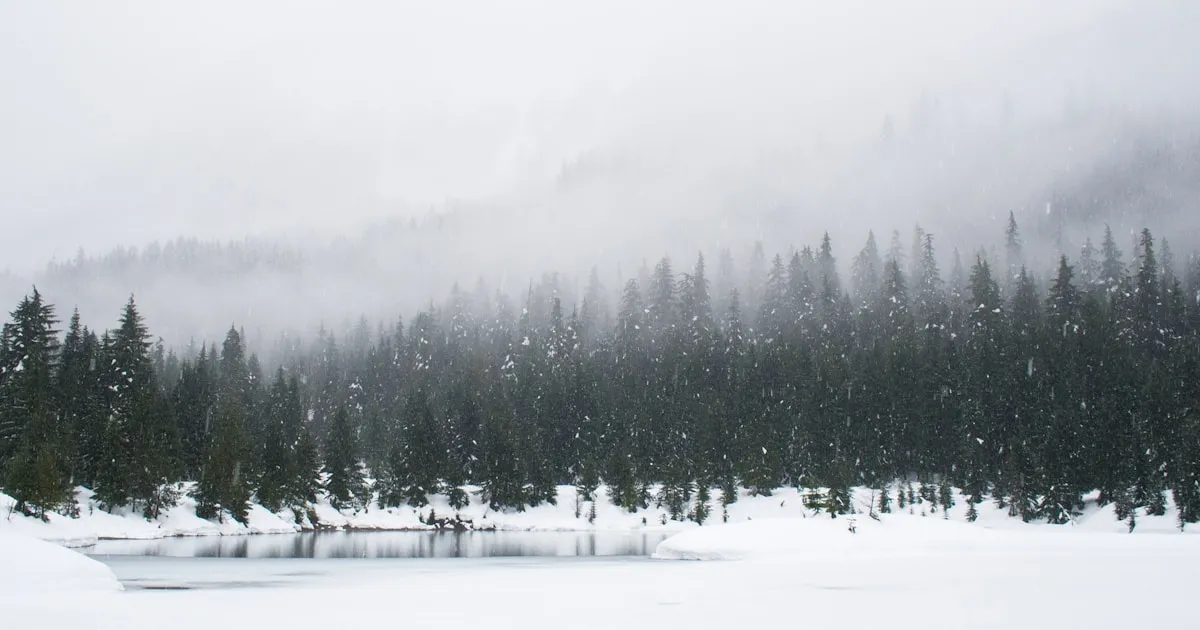
A maple tree in Minnesota might experience temperatures of -30°F. It can’t migrate south like birds. It can’t dig a burrow like squirrels. It just stands there, enduring months of conditions that would kill most living things in minutes.
How does a bag of water (which is essentially what a tree is) survive being frozen solid?
The answer involves months of preparation, chemical antifreeze, controlled dehydration, and strategies refined over millions of years.
The Problem With Freezing
Water expands when it freezes. If the water inside a tree’s cells froze solid, ice crystals would rupture cell membranes like pipes bursting in an unheated house. The cells would die. The tree would die.
This is exactly what happens when you forget tomatoes in the freezer. The cells burst and you get mush.
Trees face this problem across billions of cells. Every cell must survive, or at minimum, enough cells must survive for the tree to recover in spring.
Different trees solve this problem differently.
Deciduous Trees: Strategic Retreat
Deciduous trees—the ones that lose their leaves—take a dramatic approach. They shut down operations, abandon their solar panels, and wait out winter in a state of near-suspended animation.
Step 1: Stop Growing
Starting in late summer, trees begin responding to shorter days. Even before temperatures drop, the reduced daylight triggers hormonal changes that slow growth and begin winter preparation.
This is called “hardening off.” A tree that kept growing until the first freeze would be caught with soft, vulnerable tissues. By hardening early, trees convert tender new growth to winter-ready mature wood.
Step 2: Shed the Leaves
Leaves are liabilities in winter. They lose water constantly through transpiration, even when it’s cold. But frozen soil can’t supply water to replace what’s lost.
A fully-leafed tree in winter would dehydrate and die.
So deciduous trees cut their losses. A corky layer forms where each leaf stem meets the branch, sealing off water and nutrient flow. The leaf dies, falls, and the tree seals the wound.
This isn’t a panicked response to cold. It’s controlled demolition, executed on schedule.
Step 3: Chemical Antifreeze
This is where it gets interesting. Trees produce compounds that lower the freezing point of cell contents.
Sugars are the primary antifreeze. Starch stored in cells converts to sugar in fall. Higher sugar concentration depresses the freezing point—like salt on icy roads, but internal and biological.
Proteins that bind to ice crystals prevent those crystals from growing large. Small ice crystals are less damaging than big ones.
Dehydration of cells helps too. Water moves out of cells into intercellular spaces, where it can freeze without rupturing cell membranes. The remaining cellular fluid, concentrated with sugars, stays liquid at much lower temperatures.
Step 4: Controlled Ice Formation
Trees don’t prevent all freezing—they control where ice forms. Ice in the spaces between cells is far less damaging than ice inside cells.
Cell membranes are designed to allow water to move out into intercellular spaces as temperatures drop. Ice crystals form in these spaces, outside the vulnerable cellular machinery.
The cells themselves become concentrated packets of sugary solution, capable of remaining liquid at temperatures well below water’s normal freezing point.
Step 5: Dormancy
With leaves gone, photosynthesis stops. The tree enters dormancy—metabolic activity drops to minimal levels. The tree essentially sleeps through winter, burning stored energy slowly to keep essential functions running.
Dormancy isn’t just about surviving cold. Trees actually require a certain number of cold hours (chill hours) to complete dormancy properly. If winter doesn’t provide enough cold, trees may break dormancy too early, leaf out during a warm spell, and then get damaged by late frosts.
This is why southern trees struggle in the north (not enough heat to grow) and northern trees struggle in the south (not enough cold to complete dormancy).
Evergreen Strategies
Evergreens keep their leaves through winter—a risky strategy that requires different adaptations.
Needle Design
Conifer needles minimize water loss. Their small surface area, thick waxy coating, and recessed pores (stomata) all reduce transpiration. A pine needle loses far less water than a maple leaf of equivalent photosynthetic area.
The shape matters too. Narrow needles shed snow more easily than broad leaves. Snow load can break branches—narrow needles reduce accumulation.
Antifreeze in Place
Evergreen needles use the same antifreeze chemistry as deciduous buds, but applied to persistent leaves. High sugar concentrations, antifreeze proteins, and controlled cellular dehydration protect needles from freeze damage.
Needles typically survive temperatures several degrees lower than the surrounding air. Damage appears as brown needle tips in spring—the parts that couldn’t quite handle the coldest temperatures of winter.
Continued Photosynthesis
On mild winter days, evergreens can photosynthesize while deciduous trees sit dormant. This gives them an advantage in spring—they can begin growing immediately, using energy generated during winter warm spells.
The advantage is small in cold climates but significant in moderate ones. Pacific Northwest conifers, growing in mild winters, may photosynthesize nearly year-round.
Broadleaf Evergreens
Some broadleaf trees keep their leaves through winter—rhododendrons, live oaks, hollies. These typically grow in milder climates or have specialized adaptations.
Rhododendron leaves curl and droop in cold weather, reducing exposed surface area. Live oaks in the South never face severe freezes. Southern magnolias have thick, waxy leaves that resist water loss.
What About Frozen Solid?
Some extremely cold-tolerant trees can actually survive being frozen solid—cells and all. Willow and birch twigs in Siberia have survived experimental temperatures below -100°F.
These trees survive through a process called “intracellular ice formation tolerance”—their cells can freeze internally without dying. Glass-like ice forms inside cells so quickly that large, damaging crystals can’t develop.
This extreme tolerance requires extensive preparation and is limited to certain species and tissues. A willow twig can handle internal freezing; the tree’s trunk cannot.
Spring Recovery
When temperatures rise and days lengthen, dormancy breaks. Sugars convert back to starch, water flows into cells, and growth resumes.
This transition is dangerous. Cells that were safely dormant become vulnerable to late freezes. A tree that breaks dormancy too early, lured by warm weather, may be caught by a hard frost and suffer significant damage.
Different species have different sensitivity to false springs. Maples tend to leaf out early and suffer late frost damage more often. Oaks leaf out later and more cautiously. These seasonal patterns are explored more fully in how trees change through the seasons.
Winter Damage Signs
Even well-adapted trees sometimes lose the battle:
Winter burn: Brown, dead foliage on evergreens, especially on the south side where sun and wind cause dehydration.
Frost cracks: Vertical splits in bark, caused by rapid temperature changes. The outer bark contracts faster than inner wood, creating tension that splits the bark.
Dieback: Dead branch tips where hardening-off didn’t complete properly or temperatures exceeded the tree’s tolerance.
Snow and ice damage: Broken branches from accumulated weight. Narrow-angled crotches are especially vulnerable.
Regional Adaptations
Trees from cold climates can’t just be planted anywhere. A tree from Minnesota expects cold winters. Planted in Georgia, it may never receive enough chill hours to complete dormancy properly.
Similarly, a tree from Georgia lacks the cold tolerance for Minnesota winters. It didn’t evolve the chemical antifreeze or controlled dehydration mechanisms needed to survive extended deep cold.
This is why nurseries specify hardiness zones. The zones reflect average minimum temperatures and help match trees to climates they can survive.
Observing Winter Trees
Winter offers opportunities to study trees that summer hides, and identifying trees in winter is a rewarding skill to develop while leaves are gone.
Look at bark patterns without leaf distraction. Notice bud shapes and arrangements that predict spring growth. Observe the overall architecture—branching patterns stand out clearly.
With the Tree Identifier app, you can photograph bark and buds for winter identification. These features are often more consistent and diagnostic than summer leaves, which vary with growing conditions.
Winter also reveals which trees in your area are pushing their hardiness limits. Those brown evergreen needles and dead branch tips tell stories about the last few winters. Healthy trees handled it fine. Marginal trees show the strain.
The trees standing green and intact through winter? They’ve earned their place through millions of years of evolutionary testing, solving the freezing problem in ways that still inspire scientists studying cryopreservation and cold tolerance.
They make it look easy. It isn’t.
Identify a tree from your photo — free
Upload a leaf, bark, or whole-tree photo and get the species in seconds. No signup.
Confidence:
Unlock the full species profile
Free in the app — with unlimited identifications.


AI result for guidance — the app gives full species details and works offline.
Want unlimited identifications?
Get the full species profile, photos and details — free in the app, with unlimited scans.
- Unlimited identifications
- Full species profiles & details
- Works offline, anywhere
- Save and revisit your finds
Rachel Nguyen
Tree Identifier Team