Magnolia Tree Identification: Leaves, Bark & Flowers
Magnolia trees are among the oldest flowering plants on Earth. Fossils date back over 100 million years, predating bees by tens of millions of years. That ancient lineage means magnolias evolved to be pollinated by beetles, which explains their thick, waxy petals and sturdy flower structure. Today, magnolia tree identification matters for gardeners, landscapers, and anyone who spots those massive white or pink blooms in spring and wants to know exactly which species they’re looking at.
The genus Magnolia contains roughly 210 species. This guide covers the six you’re most likely to encounter in North America, with specific identification features for each. If you’re also trying to tell apart other spring bloomers like dogwoods and redbuds, our flowering tree identification guide covers those species.
Magnolia trees are identified by their large cup- or star-shaped flowers in white or pink, glossy evergreen or deciduous leaves, and cone-like fruit with red seeds. The fastest field split: Southern Magnolia stays evergreen year-round with rusty-brown leaf undersides, while all other common species drop their leaves in fall.
What Does a Magnolia Tree Look Like?
Magnolias range from 15-foot multi-stemmed shrubs to 80-foot canopy trees, but several features carry across the genus regardless of species or size.
Flowers are the most recognizable feature. They’re large (2 to 14 inches depending on species) with thick, waxy tepals (fused sepals and petals) in white, pink, or pale yellow. Most species bloom in spring, either on bare branches before leaves appear or alongside fully emerged leaves.
Leaves on evergreen species are large, leathery, and glossy dark green with a distinctive underside color: rusty-brown felt on Southern Magnolia, silvery-white on Sweetbay. Deciduous species have thinner, medium-green leaves that drop in fall.
Bark is smooth and gray on young trees across virtually all species. Older trunks develop thin, scaly plates rather than the deep furrowed ridges you’d see on an oak or ash.
Fruit looks like a bumpy cone or small cucumber, 2 to 5 inches long. In fall it splits open to reveal bright red or orange-red seeds, often dangling from thin threads.
Buds are large, fuzzy, and felt-coated, which makes magnolias recognizable even in winter when flowers and leaves are absent.
Evergreen vs. Deciduous: The First Magnolia Tree Identification Split
Before getting into individual species, the single most useful starting question is: does this tree keep its leaves year-round, or drop them in fall?
Most magnolias in North America are deciduous. They lose their leaves each autumn and produce flowers on bare branches in early spring, often weeks before the first leaves appear. The Southern Magnolia is the major exception. It’s evergreen, holds its thick glossy leaves through winter, and blooms in late spring and summer rather than early spring.
This one distinction eliminates half the possibilities immediately. If you’re standing in front of a magnolia with leaves in January, it’s almost certainly a Southern Magnolia or the closely related Sweetbay Magnolia. If the tree is bare-branched with bold flowers in March or April, you’re looking at a deciduous species like Saucer Magnolia or Star Magnolia.
The Magnolia genus contains roughly 210 species across Asia and the Americas, with 8 species native to the United States. The genus ranks among the oldest flowering plant lineages: fossil evidence dates magnolia flowers to the Cretaceous period, over 100 million years ago, predating modern bees by tens of millions of years. That ancient ancestry explains their unusual flower anatomy. Magnolia petals are technically tepals (sepals and petals fused into a single structure) and evolved for beetle pollination, which is why they’re thick, waxy, and structurally robust enough to support a beetle moving across them. In North America, magnolias span USDA zones 4 through 10 depending on species. Southern Magnolia (Magnolia grandiflora) thrives in zones 7 to 9. Saucer Magnolia (Magnolia x soulangeana) tolerates zones 5 to 9, making it the most widely planted ornamental magnolia in the world. Star Magnolia (Magnolia stellata) survives to zone 4, the hardiest ornamental option for northern gardens.
Southern Magnolia (Magnolia grandiflora)
The Southern Magnolia is the iconic magnolia of the American South, native from Virginia to eastern Texas. It’s an evergreen that can reach 60 to 80 feet tall with a dense, pyramidal crown.
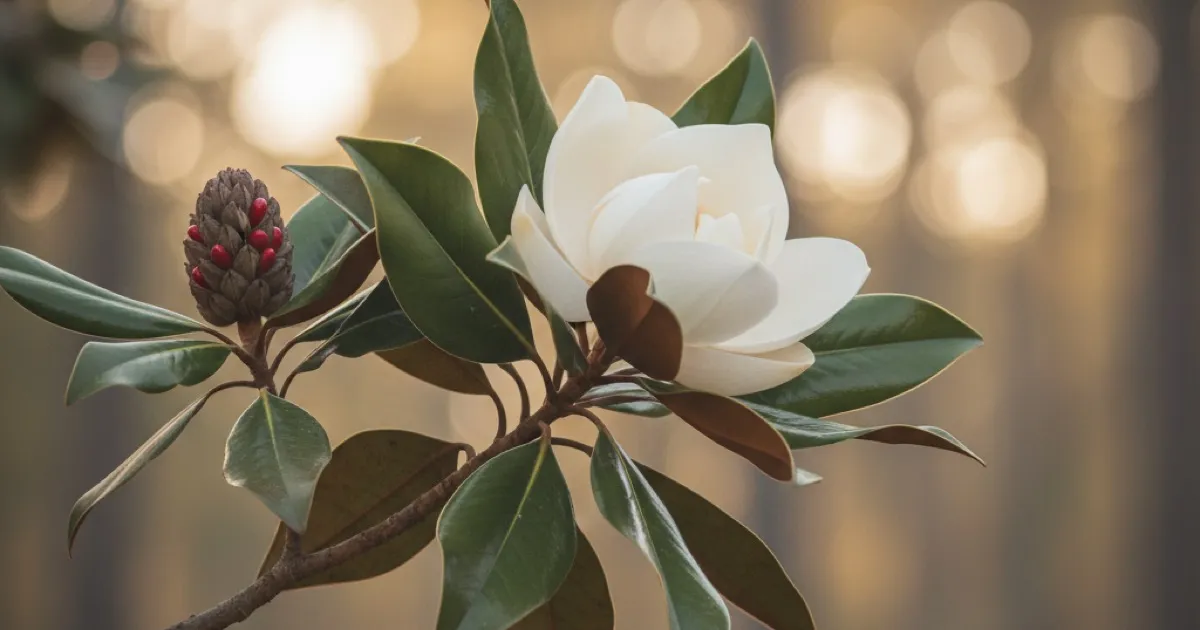
Leaves. Large, leathery, and glossy dark green on top, measuring 5 to 10 inches long. Flip a leaf over and you’ll see a distinctive fuzzy, rusty-brown underside covered in dense felt-like hairs. No other common landscape tree in North America has this combination of glossy upper surface and brown fuzzy lower surface.
Flowers. Creamy white, cup-shaped, and enormous, measuring 8 to 12 inches across. Each flower has 6 to 12 thick, waxy petals and produces a strong, sweet, lemony fragrance. Flowers appear from late May through July, one at a time rather than all at once.
Fruit. A cone-like aggregate fruit, 3 to 5 inches long, covered in bumpy follicles. When it matures in fall, the cone splits open to reveal bright red seeds that hang from thin threads. This red-seeded cone is one of the most distinctive fruits of any North American tree.
Bark. Smooth and gray on young trees. Mature trees develop thin, scaly plates that remain relatively smooth compared to oaks or elms.
Southern Magnolias thrive as ornamentals as far north as New Jersey and the Pacific Northwest. If you see an evergreen broadleaf tree with massive white flowers in a Southern or mid-Atlantic landscape, this is your tree.
Saucer Magnolia (Magnolia x soulangeana)
The Saucer Magnolia is a hybrid created in 1820 by crossing a Chinese Yulan Magnolia with a Japanese Lily Magnolia. It’s now the most widely planted ornamental magnolia in the world.
Flowers. Large, tulip-shaped, 5 to 10 inches across, in shades from white to pink to deep purplish-pink. The outside of each petal (technically tepal) is typically darker pink or purple, while the inside is white or pale pink. Flowers appear in early spring on completely bare branches.
Leaves. Deciduous, medium green, obovate (wider toward the tip), 3 to 6 inches long. Leaves appear after the flowers have already opened.
Size. Typically 20 to 30 feet tall with a rounded, spreading crown. Many cultivars stay smaller, making this a popular choice for residential yards.
Bark. Smooth and gray, similar to a beech tree.
The Saucer Magnolia’s defining trait is its bloom timing. Those pink-and-white flowers on bare gray branches in late March or early April, before anything else in the landscape has leafed out, are unmistakable. The risk: late frosts can brown the flowers overnight, which is a common frustration for growers in USDA zones 5 and 6.
The ‘Jane’ magnolia is one of the most popular compact alternatives. Part of the U.S. National Arboretum’s Little Girl hybrid series (Magnolia liliiflora x Magnolia stellata), ‘Jane’ grows 10 to 15 feet tall, produces deep reddish-purple flowers about 3 inches across, and blooms two to three weeks later than Saucer Magnolia. That later bloom window cuts frost damage significantly for gardeners in zones 4 to 8.
Star Magnolia (Magnolia stellata)
Star Magnolia is native to Japan and one of the earliest magnolias to bloom each spring, often flowering in late February or March depending on climate.
Flowers. The name says it all. Each flower has 12 to 18 narrow, strap-like petals that radiate outward in a star pattern, 3 to 4 inches across. Flowers are white, sometimes with a faint pink blush, and appear on bare branches before the leaves.
Leaves. Deciduous, narrower than Saucer Magnolia, 2 to 4 inches long, dark green.
Size. Compact, typically 15 to 20 feet tall, often growing as a multi-stemmed large shrub rather than a single-trunked tree. This makes Star Magnolia a common foundation planting near houses.
How to tell it from Saucer Magnolia. Saucer Magnolia has 6 to 9 broad tepals forming a cup shape. Star Magnolia has 12 to 18 narrow, ribbon-like petals creating a flat, starry shape. Star Magnolia is also significantly smaller and blooms slightly earlier.
Because it blooms so early, Star Magnolia is the species most often damaged by late frosts. If you see a small magnolia with browned, frost-bitten petals in early spring, there’s a good chance it’s this species.
Sweetbay Magnolia (Magnolia virginiana)
Sweetbay Magnolia is native to the eastern United States, from Massachusetts south to Florida and west to Texas. It’s one of the few magnolias you’ll find growing wild in swamps, stream banks, and low-lying wet areas.
Leaves. Semi-evergreen in the South (holding leaves through mild winters) and deciduous in the North. Leaves are 3 to 5 inches long, glossy green above with a silvery-white underside. The silver undersides flash in the wind and make Sweetbay easy to spot from a distance. This silver-white color is different from the rusty-brown felt of Southern Magnolia.
Flowers. Small for a magnolia, about 2 to 3 inches across, creamy white, with a strong lemony fragrance. They bloom from late May through July, similar to Southern Magnolia but much smaller.
Size. Variable. In the North, it’s typically a multi-stemmed small tree reaching 15 to 35 feet. In the Deep South, it can grow to 60 feet with a single trunk.
Habitat. This is the magnolia you’ll find in wetlands. If you’re walking along a stream or through a boggy area in the eastern U.S. and spot silvery-backed leaves with small white flowers, Sweetbay is the most likely species. For more on identifying trees by their natural habitat, see our guide to New England trees. For a deeper look at this species, see our Sweetbay Magnolia identification guide.
Cucumber Tree (Magnolia acuminata)
The Cucumber Tree is the only magnolia native to the majority of the eastern United States, ranging from southern Ontario to Georgia and west to Arkansas. It’s also the least “magnolia-looking” of the common species, which is why many people walk right past it.
Flowers. Small (2 to 3 inches), yellowish-green, and easy to miss among the leaves. Unlike the showy blooms of other magnolias, Cucumber Tree flowers blend into the canopy. They bloom in late spring after the leaves have fully emerged.
Leaves. Large, 6 to 10 inches long, deciduous, with a pointed tip (the species name acuminata means “pointed”). Bright green and thinner than the leathery Southern Magnolia leaves.
Fruit. The common name comes from the immature fruit: bumpy, green, and shaped like a small cucumber, about 2 to 3 inches long. It matures to red in fall, splitting to reveal orange-red seeds.
Size. The largest native magnolia, reaching 60 to 80 feet tall in forest settings. It grows as a straight-trunked forest tree rather than a rounded ornamental.
Bark. Gray-brown with long, narrow, furrowed ridges. For more on reading bark patterns, our tree bark identification guide covers the basics.
Bigleaf Magnolia (Magnolia macrophylla)
Bigleaf Magnolia holds the record for the largest simple leaf and largest single flower of any native North American tree. It’s uncommon in cultivation but grows wild in scattered populations from Ohio to Florida.
Leaves. Massive, 12 to 32 inches long and 7 to 12 inches wide, with two ear-like lobes at the base. The sheer size makes Bigleaf Magnolia impossible to confuse with any other species. The upper surface is bright green; the underside is silvery and slightly hairy.
Flowers. Creamy white, cup-shaped, 8 to 14 inches across. They bloom in late spring after the leaves appear.
Size. Typically 30 to 40 feet tall, with a wide-spreading, open crown.
If you spot a tree with leaves longer than your forearm, each with two ear-like basal lobes, you’ve found a Bigleaf Magnolia.
Magnolia Tree Identification at a Glance
Here’s a quick reference table for field identification.
| Species | Leaf Type | Leaf Underside | Flower Size | Flower Color | Bloom Time |
|---|---|---|---|---|---|
| Southern Magnolia | Evergreen, 5-10 in. | Rusty-brown felt | 8-12 in. | White | Late spring-summer |
| Saucer Magnolia | Deciduous, 3-6 in. | Green | 5-10 in. | Pink/white | Early spring (bare branches) |
| Star Magnolia | Deciduous, 2-4 in. | Green | 3-4 in. | White | Very early spring (bare branches) |
| Sweetbay Magnolia | Semi-evergreen, 3-5 in. | Silvery-white | 2-3 in. | White | Late spring-summer |
| Cucumber Tree | Deciduous, 6-10 in. | Green | 2-3 in. | Yellow-green | Late spring (with leaves) |
| Bigleaf Magnolia | Deciduous, 12-32 in. | Silvery | 8-14 in. | White | Late spring (with leaves) |
How Tree Identifier Helps with Magnolia Identification
Magnolia species can look remarkably similar when they’re not in bloom. Saucer and Star Magnolia have near-identical bark and similar leaves once the flowers drop. Sweetbay and Southern Magnolia can overlap in size and form in the coastal South. And Cucumber Tree barely looks like a magnolia at all without its flowers.
Tree Identifier uses AI-powered photo recognition to identify magnolia species from any available feature: flowers, leaves, bark, fruit, or the overall tree shape. Snap a photo of a glossy leaf, flip it over to capture the rusty-brown or silver underside, and the app returns a species match with a confidence score. It processes images in seconds and works with multiple input types, so you can photograph whatever part of the tree is accessible.
The app gives you 2 free identifications per day on iOS and Android. For hikes in areas without cell coverage, offline mode lets you download species data ahead of time. Whether you’re standing in front of a 60-foot Southern Magnolia in a Savannah park or trying to confirm a small Star Magnolia in a suburban yard, a quick photo saves you from flipping through field guides.
Frequently Asked Questions
How do I tell the difference between a Saucer Magnolia and a Star Magnolia?
Count the petals. Saucer Magnolia has 6 to 9 broad tepals forming a cup shape, 5 to 10 inches across, in pink and white. Star Magnolia has 12 to 18 narrow, strap-like petals in a flat star pattern, only 3 to 4 inches across, usually pure white. Star Magnolia is also smaller: 15 to 20 feet versus 20 to 30 feet.
Why do magnolia flowers turn brown in spring?
Late frost damage. Deciduous magnolias like Saucer and Star bloom very early, sometimes in late February or March, when nighttime temperatures can still drop below freezing. A single frost event after the flowers open will brown the petals overnight. The tree itself is fine and will bloom again next year, but the current season’s flower display is lost.
Are magnolias related to other common trees?
Magnolias belong to the family Magnoliaceae, one of the most ancient flowering plant families. They’re not closely related to oaks, maples, or cherries. The fossil record shows magnolia-like flowers from the Cretaceous period, over 100 million years ago. Magnolias evolved before bees existed, which is why their flowers are structured for beetle pollination.
How can I identify a magnolia in winter when there are no flowers or leaves?
Look for the buds and fruit. Magnolia flower buds are large, fuzzy, and covered in a soft, felt-like coating. They’re typically positioned at the tips of branches and are much larger than the buds of most other deciduous trees. If you’re identifying trees in the colder months, our winter tree identification guide covers additional strategies using buds, bark, and branching patterns.
What is a Jane magnolia tree?
The ‘Jane’ magnolia is a compact hybrid (Magnolia liliiflora x Magnolia stellata) from the U.S. National Arboretum’s Little Girl series. It grows 10 to 15 feet tall, which makes it practical for smaller yards and foundation plantings (USDA zones 4-8). Its deep reddish-purple flowers appear 2 to 3 weeks later than Saucer Magnolia, which cuts the risk of frost-browned blooms considerably.
Start with the Leaves
Magnolia tree identification gets straightforward once you build a mental checklist. First, check whether the tree is evergreen or deciduous. Then flip a leaf over and look at the underside: rusty-brown felt means Southern Magnolia, silvery-white means Sweetbay or Bigleaf, plain green means Saucer, Star, or Cucumber Tree. When flowers are present, their size, shape, and color narrow it to one species. And when the tree is between seasons, the large fuzzy buds and cone-like fruit keep magnolias identifiable year-round.
Next time you spot a magnolia in your neighborhood or on a trail, grab a quick photo and put these features to the test.
Identify a tree from your photo — free
Upload a leaf, bark, or whole-tree photo and get the species in seconds. No signup.
Confidence:
Unlock the full species profile
Free in the app — with unlimited identifications.


AI result for guidance — the app gives full species details and works offline.
Want unlimited identifications?
Get the full species profile, photos and details — free in the app, with unlimited scans.
- Unlimited identifications
- Full species profiles & details
- Works offline, anywhere
- Save and revisit your finds
Elena Torres
Tree Identifier Team