Native Keystone Trees: Species That Hold Ecosystems Together
Native Keystone Trees: The Species That Hold Ecosystems Together
Not all trees are created equal. Some provide shade. Some look nice in a front yard. But a small group of native keystone trees do something far more important: they feed the caterpillars that feed the birds that keep entire food webs from collapsing.
The concept comes from entomologist Doug Tallamy at the University of Delaware, whose research found that just 14% of native plant genera support roughly 90% of caterpillar species in any given region. He calls these plants “keystones” because removing them would cause the local food web to fall apart, the same way pulling a keystone from an arch brings the whole structure down.
If you care about birds, pollinators, or the health of your local ecosystem, the trees you plant matter more than you might think. Here is the science behind keystone species trees, which genera top the list, and how to find them where you live.
Why Caterpillar Counts Define a Keystone Tree
The logic is simple but powerful. Caterpillars are the primary protein source for 96% of North American songbird species. A single clutch of chickadee chicks needs between 6,000 and 9,000 caterpillars before they fledge. No caterpillars, no baby birds.
Most caterpillars are specialists. They can only eat plants they have co-evolved with over thousands of years. A monarch caterpillar eats milkweed and nothing else. A luna moth caterpillar feeds on birch, walnut, and hickory leaves. Non-native ornamental trees like Bradford pears or crepe myrtles? Almost no native caterpillars can digest them.
So when Tallamy ranks keystone trees, he counts the number of Lepidoptera (butterfly and moth) species each tree genus hosts as larvae. The higher that number, the more food that tree creates for the birds and other animals above it in the food chain.
This is not abstract ecology. It is the measurable backbone of the places where wildlife still thrives.
The Top Native Keystone Tree Genera
Tallamy’s research produced a ranked list of tree genera by the number of Lepidoptera species they support across the contiguous United States. The numbers below represent caterpillar species documented feeding on each genus.
Oaks (Quercus) — 521 Lepidoptera species
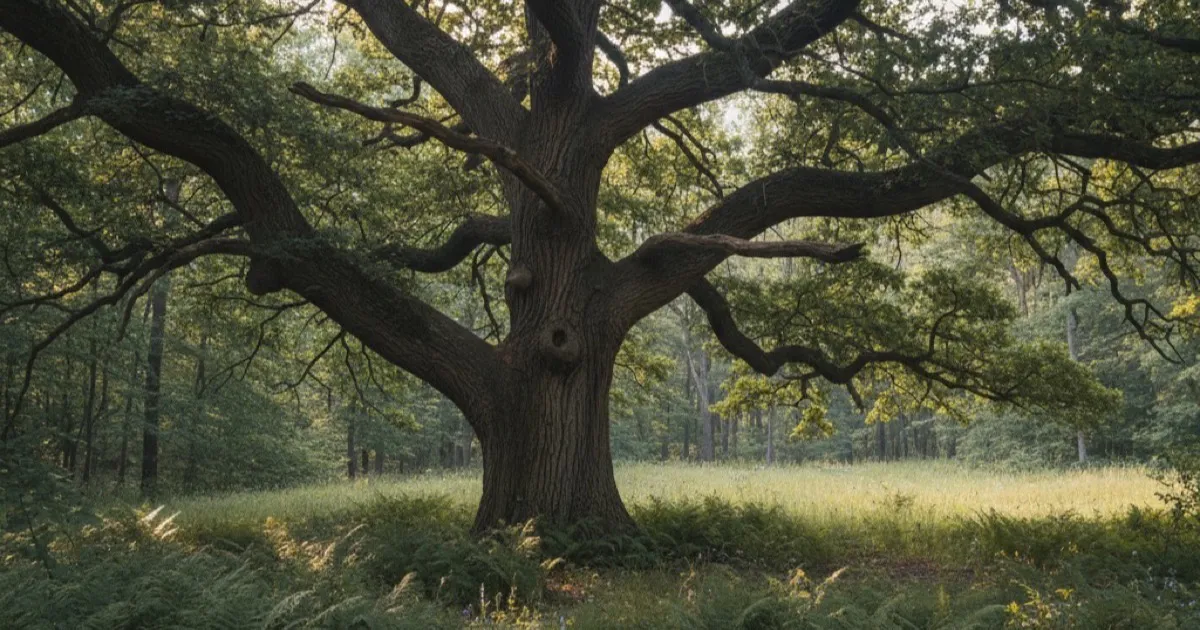
Oaks sit at the top by a wide margin. No other tree genus in North America supports more caterpillar species. White oaks, red oaks, live oaks, pin oaks, bur oaks — every native oak species contributes to this count.
Beyond caterpillars, oaks produce acorns that feed deer, turkeys, squirrels, and jays. Their bark hosts lichens and insects. Their canopies shelter nesting birds. If you plant one tree for wildlife, make it a native oak.
Cherries and Plums (Prunus) — 455 Lepidoptera species
Wild black cherry, chokecherry, and American plum rank second. These trees also produce fruit eaten by over 40 bird species, making them double contributors to local food webs.
Willows (Salix) — 431 Lepidoptera species
Willows punch well above their weight. They grow fast, tolerate wet soils, and support an enormous number of caterpillar species. Pussy willows, black willows, and weeping willows native to your area all count. Willows also support 14 specialist bee species, adding pollinator value on top of caterpillar hosting.
Birches (Betula) — 410 Lepidoptera species
Birch trees are workhorses for northern ecosystems. Paper birch, river birch, and yellow birch all host hundreds of moth and butterfly species. Their peeling bark also provides nesting material for birds and habitat for insects year-round.
Poplars and Aspens (Populus) — 360 Lepidoptera species
Cottonwoods, aspens, and other poplars are among the fastest-growing native trees and support a massive caterpillar community. Quaking aspens form clonal colonies that can live for thousands of years, providing habitat continuity that few other trees match.
Maples (Acer) — 295 Lepidoptera species
Sugar maples, red maples, and silver maples are already popular yard and street trees. The good news: if yours is a species native to your region, it is already doing keystone work. Non-native ornamental maples from Japan or Norway do not offer the same caterpillar support.
Pines (Pinus) — 259 Lepidoptera species
Conifers often get overlooked in keystone conversations, but native pines host plenty of caterpillar species. They also provide year-round shelter and seeds for overwintering birds.
Alders (Alnus) — 261 Lepidoptera species
Alders thrive along streams and wet areas. They fix nitrogen in the soil, improving conditions for surrounding plants while feeding hundreds of caterpillar species.
Hickories (Carya) — 238 Lepidoptera species
Hickories are slower growing but worth the wait. They support caterpillars, produce nutritious nuts for wildlife, and their strong wood resists storm damage. Shagbark hickory is easy to identify by its distinctive peeling bark plates.
Elms (Ulmus) — 201 Lepidoptera species
Elm trees were devastated by Dutch elm disease in the 20th century, but resistant cultivars of American elm are making a comeback. They remain important keystone trees, supporting over 200 caterpillar species and providing dense canopy shade.
How the 14% Rule Works
Tallamy’s most striking finding is the lopsidedness. Across any region, about 5% of native plant genera produce 75% of the caterpillar food. Expand to 14%, and you cover 90%. His peer-reviewed 2020 paper in Nature Communications confirmed this pattern holds across the entire contiguous United States, not just the Mid-Atlantic where his initial research began.
The remaining 86% of native plants still matter for other reasons: nectar, fruit, soil stabilization, beauty. But if your goal is to support the most wildlife with the fewest plantings, keystone genera give you the biggest return.
This matters for homeowners because the average residential lot has room for only a handful of trees. Choosing two or three keystone genera over ornamental non-natives can shift your yard from an ecological desert into a functioning habitat node. A yard with a single mature oak, for example, supports more caterpillar biomass than an entire street lined with non-native ornamentals.
Native Keystone Trees and the 2026 Planting Movement
Interest in planting native trees has surged over the past few years, and 2026 is accelerating the trend. Municipal governments from Portland to Charlotte now offer rebates for planting native keystone species. The Homegrown National Park initiative, co-founded by Tallamy, has registered over 35 million square feet of converted habitat across all 50 states.
Nurseries report that demand for native oaks, birches, and willows has doubled since 2023. The shift reflects a growing understanding that sustainability is not just about solar panels and electric cars. It starts in the soil, with the trees that feed wildlife at the base of the food chain.
Several states now include keystone plant recommendations in their pollinator action plans. Maryland, Virginia, and Minnesota have published official keystone native plant lists tied to their specific ecoregions. The National Wildlife Federation now maintains searchable keystone plant lists for 10 ecoregions, making it easier than ever to match species to your zip code.
The trend is not limited to backyard gardeners. Developers and land trusts are writing keystone planting requirements into conservation easements. Schools are replacing turf lawns with native plantings anchored by oaks and willows. The idea is spreading because the science is clear and the results are visible within a few growing seasons.
How to Find Native Keystone Trees in Your Area
Keystone genera stay the same across most of North America, but the specific species within each genus vary by region. A bur oak is the right oak for the Great Plains. A live oak fits the Gulf Coast. A white oak belongs in the eastern forests.
Here is how to figure out which keystone trees are native to your area:
- National Wildlife Federation’s keystone plant lists: NWF publishes ranked lists for 10 different ecoregions. Search “NWF keystone plants by ecoregion” to find yours.
- County extension offices: Your local cooperative extension can recommend specific species suited to your soil and climate.
- Native plant societies: Nearly every state has one. They maintain local plant lists and often hold sales in spring and fall.
- Observe what grows wild nearby: Walk through local parks and natural areas. The trees growing there without human help are adapted to your conditions.
When you find a tree you do not recognize, snap a photo of the leaves, bark, or overall shape. Identifying the species tells you whether it belongs to a keystone genus and how much wildlife value it provides.
How Tree Identifier Can Help
Knowing which trees are native keystones is one thing. Spotting them in the field is another. Tree Identifier makes the connection between what you see and what it means for your local ecosystem.
Take a photo of a leaf, a piece of bark, a flower, or the whole tree shape, and the app returns an instant species identification with a confidence score. You will get detailed information about the species, including its characteristics and habitat. That is often enough to confirm whether the tree you are looking at belongs to a keystone genus.
The app works on both iOS and Android, and you get 2 free identifications per day with no subscription required. If you are hiking through a forest or scouting trees at a nursery, you can also download species data for offline use so it works without cell service.
Whether you are planning a native planting project or just curious about the trees already growing in your neighborhood, identifying species is the first step toward understanding your local ecosystem.
Frequently Asked Questions
What makes a tree a “keystone” species?
A keystone tree belongs to a plant genus that supports a disproportionately large number of caterpillar (Lepidoptera) species. Caterpillars are the primary food for most songbird chicks. Doug Tallamy’s research shows that roughly 14% of native plant genera support 90% of caterpillar species, making these plants critical to the food web. Remove them, and bird populations decline.
Are non-native trees bad for wildlife?
Non-native trees are not necessarily harmful, but most support very few native caterpillar species. A Bradford pear or a Norway maple might look green and healthy, but native insects cannot eat their leaves. Replacing even one non-native ornamental with a native oak, birch, or willow adds measurable wildlife habitat to your property.
Which single tree supports the most wildlife in North America?
Native oaks in the genus Quercus support 521 Lepidoptera species, more than any other tree genus on the continent. They also produce acorns that feed dozens of mammal and bird species. If you have space for one keystone tree, an oak native to your region is the strongest choice.
How many keystone trees should I plant in my yard?
Even one native keystone tree makes a difference. Two or three from different genera, like an oak paired with a birch or a willow, will support a broader range of caterpillar species and the birds that depend on them. Tallamy recommends that native plants make up at least 70% of your landscape to sustain a breeding bird population.
Identify a tree from your photo — free
Upload a leaf, bark, or whole-tree photo and get the species in seconds. No signup.
Confidence:
Unlock the full species profile
Free in the app — with unlimited identifications.


AI result for guidance — the app gives full species details and works offline.
Want unlimited identifications?
Get the full species profile, photos and details — free in the app, with unlimited scans.
- Unlimited identifications
- Full species profiles & details
- Works offline, anywhere
- Save and revisit your finds
Rachel Nguyen
Tree Identifier Team