Osage Orange Tree Identification: 7 Reliable Signs
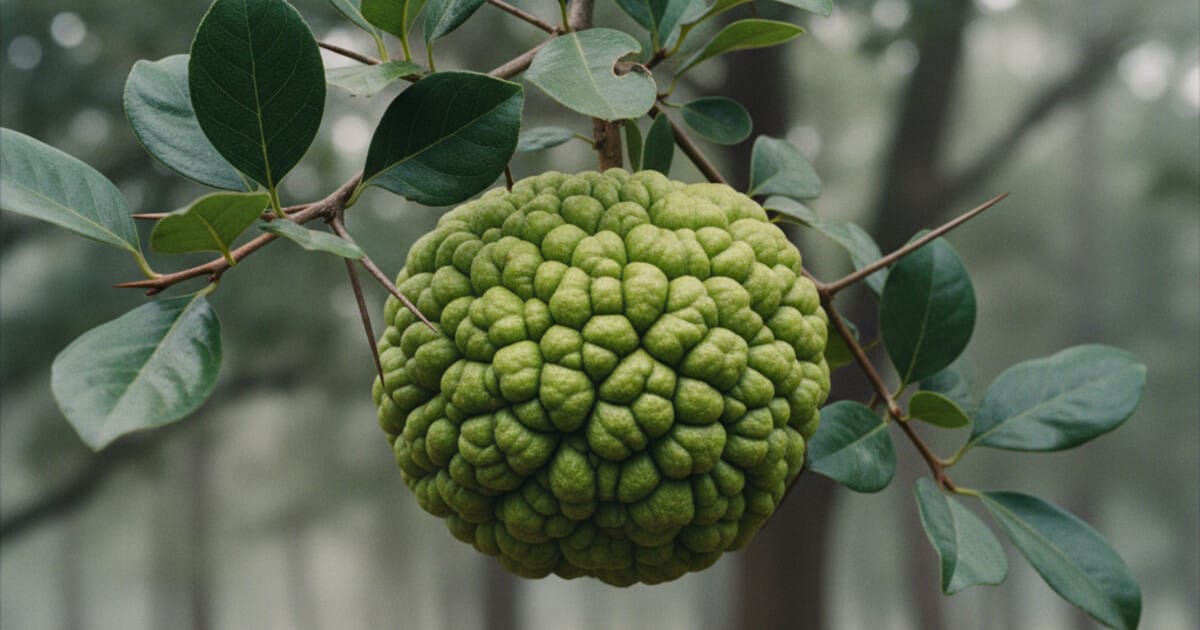
You found a weird green ball on the ground. Bumpy, the size of a softball, and heavy for its size. It looks like a lime crossed with a brain. If you’ve stumbled across this strange fruit, you’ve almost certainly found an osage orange tree (Maclura pomifera). This guide covers 7 reliable features to confirm your identification and tells you exactly where to look on the tree.
Osage orange is one of the most distinctive trees in North America, and once you know the signs, you won’t confuse it with anything else.
Osage orange trees are identified by 7 key features: their large, bumpy green fruit (called a hedge apple), sharp thorns along branches, glossy oval leaves arranged alternately, deeply furrowed orange-brown bark, milky sap in cut twigs, bright yellow-orange heartwood, and a spreading crown reaching 30 to 50 feet tall.
What Is an Osage Orange Tree?
Osage orange (Maclura pomifera) belongs to the mulberry family (Moraceae), not the citrus family. The name comes from two sources: the Osage Nation, who prized the wood for making bows, and the vivid orange color of the heartwood. Despite what the name suggests, the fruit isn’t related to oranges.
The tree grows 30-60 feet tall with a spreading, rounded crown. It’s native to a small region in the Red River drainage of northeastern Texas, southeastern Oklahoma, and southwestern Arkansas. Settlers spread it across the country in the 1800s as a “living fence” because the thorny branches created effective livestock barriers before barbed wire existed. The wood ranks among the hardest and most rot-resistant of any North American species, with a Janka hardness of approximately 2,040 lbf. Fence posts made from osage orange last 50+ years in the ground without treatment. Osage orange trees are either male or female; only female trees produce fruit. The fruit, called a hedge apple or horse apple, ranges from 3-5 inches in diameter and weighs up to 1 pound. It contains a milky latex sap throughout its flesh. Today, naturalized populations grow across most of the eastern and central United States.
7 Signs That Identify Osage Orange
These features work together. Most trees share a few traits with osage orange, but none share all 7.
1. The Fruit: A Bumpy Green Sphere
The fruit is the most unmistakable feature you’ll find. Hedge apples are large, round to slightly oval, and covered in a bumpy, brain-like texture. They turn from bright green to yellowish-green as they ripen in fall, typically September through November.
A mature fruit weighs up to 1 pound. You’ll often spot them on the ground under female trees before you even look up. No other common North American tree produces fruit like this.
2. Sharp Thorns at Leaf Nodes
Osage orange branches carry stiff, sharp thorns growing at the base of each leaf. These aren’t flexible spines like a rose. They’re woody, straight, and can puncture leather gloves easily.
The thorns are most prominent on young branches and water sprouts. Older, thick branches often lose their thorns as the tree matures. For comparison, honey locust trees have longer branching thorns in clusters, while osage orange has a single thorn at each leaf node. If you need help sorting out thorny trees more broadly, the guide to trees with thorns covers the main species you’re likely to encounter.
3. Glossy Oval Leaves
Leaves are 3-5 inches long, oval to lance-shaped, and taper to a sharp point. The top surface is glossy dark green; the underside is paler and slightly hairy along the veins. Leaves attach alternately along the branch.
In fall, osage orange leaves turn a clear yellow before dropping. The leaf base often has a slight uneven curve where the petiole attaches.
4. Orange-Brown, Deeply Furrowed Bark
The bark is one of the most useful field features once you know what to look for. The surface is orange-brown to grayish-brown with deep, interlacing ridges and furrows running vertically up the trunk. Scratch the outer bark lightly and you’ll see the bright orange layer underneath.
On young trees, the orange coloring is vivid. On older trunks, the surface grays over but the characteristic ridged, rope-like pattern stays consistent.
5. Milky Sap in Twigs and Petioles
Break a small twig or pull off a leaf and look at the break point. A milky white sap oozes out. This latex is present throughout the tree: in twigs, leaves, fruit, and bark. The sap is sticky and can irritate skin with prolonged contact.
A thorny tree that also produces milky sap is a strong combination pointing to osage orange. Very few temperate North American trees share both features.
6. Bright Yellow-Orange Heartwood
If you find a cut stump or freshly cut branch, the wood color is unmistakable. The heartwood is a vivid, saturated yellow-orange, brighter than most any other common tree species. This is where the “orange” in the name comes from.
The wood darkens to brown with age and exposure to air, but freshly cut surfaces glow. Woodworkers seek it out for this color, in addition to its extreme hardness.
7. Tree Shape and Size
Osage orange typically grows 30-50 feet tall with a broad, irregular crown. The trunk often forks low, giving the tree a multi-stemmed look. Old specimens planted in hedgerows sometimes form dense thickets rather than clean single trunks.
On younger growth, the branchlets have a slightly zigzag pattern between leaf nodes. The overall silhouette is spreading and rounded, without the clean single-leader form you’d see on an oak or tulip tree.
Where Osage Orange Trees Grow
Osage orange tolerates a wide range of conditions: full sun, poor soil, compacted ground, and seasonal flooding. That adaptability is why farmers planted it everywhere.
Today you’ll find it along old farm fence lines (where birds and deer spread seeds), in urban parks and street plantings, along rivers and stream banks across the Midwest, and in hedgerows throughout the Great Plains and eastern US. It’s naturalized across most of the US east of the Rockies.
If you’re in the Midwest or South and you encounter a thorny tree with strange green fruit near an old fence line, osage orange is your first guess. The native range is limited to parts of Texas, Oklahoma, and Arkansas, but planted populations now grow across nearly every state.
How Tree Identifier Can Help
If you’re looking at a tree and still aren’t certain, the Tree Identifier app can confirm your ID from a single photo. Take a picture of the leaf, bark, or fruit and you’ll get an instant species match with a confidence score, along with detailed information about the tree’s characteristics, native range, and uses.
Tree Identifier works on iOS and Android. The offline mode means you can identify trees even on remote hikes without cell service. You get 2 free identifications per day with no subscription required, so it’s easy to try on your next walk.
Frequently Asked Questions
Are osage orange fruit safe to eat? The fruit is generally considered inedible for humans. The flesh is tough, strongly flavored, and contains the same milky latex as the rest of the tree. It’s not considered highly toxic in small amounts, but it isn’t a practical food source. Deer and squirrels eat the seeds inside, but the fruit itself is mostly avoided by wildlife.
Is “hedge apple” the same as osage orange? Yes. “Hedge apple,” “horse apple,” and “osage orange” all refer to the same tree (Maclura pomifera) and its fruit. The name “hedge apple” comes from the tree’s 19th-century use as a living fence (hedge). The fruit has no botanical relationship to apples or oranges.
How do I tell osage orange apart from mulberry? Osage orange and mulberry are in the same family, so young trees can look similar. The key differences: mulberry leaves come in variable shapes (some lobed, some not) and mulberry branches don’t have thorns. The milky sap in mulberry is less prominent. Mulberry fruit looks like an elongated blackberry. If you see thorns and a bumpy green hedge apple, it’s osage orange.
Does osage orange repel insects or spiders? You’ll find the folk claim that placing hedge apples around your home deters spiders and insects. Lab studies have found that osage orange fruit extracts do show insect-repellent properties, but placing whole fruit around a home doesn’t deliver those compounds at effective concentrations. The folk remedy doesn’t hold up well against the actual evidence.
What’s osage orange wood used for? The wood is exceptionally hard, flexible, and rot-resistant. Native Americans used it for bow-making, giving the tree the French name “bois d’arc” (bow wood), still used in parts of Texas and Oklahoma. Today it’s used for fence posts, tool handles, and decorative woodworking. The bright yellow-orange color makes it popular with turners and craftspeople.
Conclusion
Osage orange is one of those trees you’ll only mistake once. The bumpy green hedge apple, sharp thorns, milky sap, and orange-tinged bark all point in the same direction. After you see all 7 features together, the ID sticks.
If you want instant confirmation in the field, Tree Identifier can match your photo to a species in seconds, with offline access for hikes outside cell range. Download it on iOS or Android and try it on the next strange tree you find.
Identify a tree from your photo — free
Upload a leaf, bark, or whole-tree photo and get the species in seconds. No signup.
Confidence:
Unlock the full species profile
Free in the app — with unlimited identifications.


AI result for guidance — the app gives full species details and works offline.
Want unlimited identifications?
Get the full species profile, photos and details — free in the app, with unlimited scans.
- Unlimited identifications
- Full species profiles & details
- Works offline, anywhere
- Save and revisit your finds
Elena Torres
Tree Identifier Team