Honey Locust Tree Identification: 7 Clear Signs
Honey locust grows just about everywhere in the eastern United States, from forest edges to city streets to farm windbreaks. It’s common enough that most people walk past it without a second look. Up close, though, it’s one of the more distinctive native trees you’ll find, with features specific enough that once you know them, you won’t mistake it for anything else.
This guide covers 7 reliable ways to identify honey locust across all seasons, plus how to separate it from its closest look-alike, black locust. For the genus-level comparison of both species, start with the main locust tree identification guide.
To identify a honey locust, look for long twisted seed pods (12-18 inches), compound leaves with small oval leaflets sometimes arranged in a twice-compound fern-like pattern, and branching thorn clusters on the trunk of wild trees. The bark is gray-brown with flat ridges. Thornless city cultivars lack spines but keep the same leaves and pods.
What Does a Honey Locust Look Like?
Honey locust (Gleditsia triacanthos) is a medium to large deciduous tree, typically 50-80 feet tall with a broad, spreading canopy. The crown has an open, airy quality because the small compound leaflets let sunlight filter through rather than casting solid shade.
The branching structure tends to sprawl wide, with main branches angling outward and sometimes drooping at the tips. Young trees put on height fast, often 2-3 feet per year in good conditions. The overall silhouette is irregular, not the tidy oval you’d see on a sugar maple or linden.
Honey locust is native to the central and eastern United States, with its natural range covering Pennsylvania south through Georgia and west to Nebraska and Kansas. It grows naturally in bottomlands, floodplains, and forest edges, but has been planted so widely as an urban street tree that it now appears across most of North America. The species comes in two main forms: the wild thorny form (Gleditsia triacanthos), which carries clusters of branching spines up to 4 inches long on the trunk and main branches, and the cultivated thornless form (Gleditsia triacanthos f. inermis), planted in American cities since the 1950s. In most urban areas, thornless trees outnumber thorny ones by a wide margin. Male and female flowers appear on separate trees in late spring, small and greenish, pollinated mainly by bees. Female trees produce the long seed pods that are the species’ most recognizable feature even in winter, long after the leaves have dropped.
Honey Locust Leaf Identification
The leaves are compound, meaning each leaf consists of many smaller leaflets arranged along a central stem called a rachis. Honey locust leaves come in two forms, and both appear on the same tree: once-compound leaves and twice-compound (bipinnate) leaves.
Once-compound leaves carry 14-30 small leaflets, each about 3/4 to 1 inch long, with finely wavy or toothed edges and a slightly glossy surface. Twice-compound leaves divide further, with the main stem branching into smaller stems, each carrying its own row of leaflets. This fern-like bipinnate pattern is unusual among North American deciduous trees and helps separate honey locust from similar species.
The leaflets are bright green through summer, turning yellow in fall before dropping. If you find a branch carrying both once-compound and bipinnate leaves, you’re almost certainly looking at honey locust. Most trees stay consistent with one leaf form; honey locust mixes both freely on the same branches.
Leaflet size is also a useful clue. Honey locust leaflets (3/4-1 inch) are smaller than those of ash trees (1.5-3 inches) and rounder than most walnut leaflets. When leaves are fully open from May through October, the leaflet size and the mix of leaf forms together make a reliable ID.
Honey Locust Bark and Thorns Identification
On mature honey locusts, the bark is gray-brown to reddish-brown, breaking into long, flat-topped ridges separated by shallow furrows. The ridges sometimes curl slightly at the edges on older trees, peeling back in thin strips. For more on reading bark textures across species, the tree bark identification guide covers how these patterns shift with age and species.
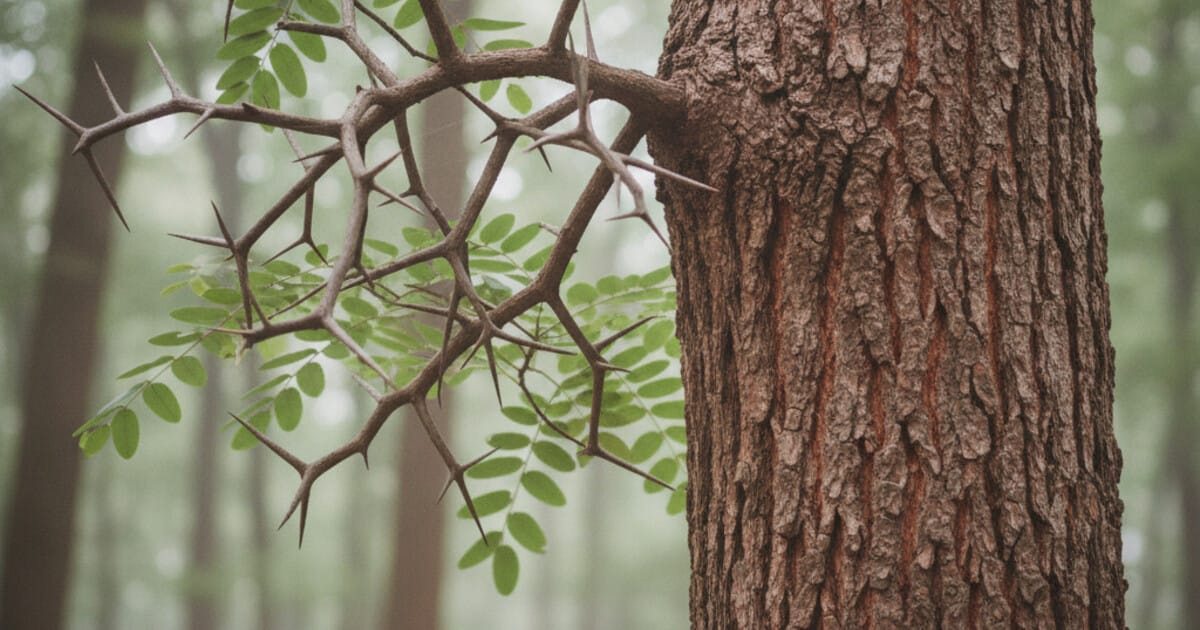
The thorns on wild trees are the most dramatic identifier. They grow directly out of the trunk itself, not from the branch tips, and they branch like small antlers, with one main spine and 2-4 shorter ones radiating from it. Clusters on large trunks can reach 6 inches long and pack densely near the base, sometimes covering the lower trunk so thoroughly that the bark underneath is barely visible.
Young branches also carry thorns, but these are smaller (1-2 inches) and usually unbranched. A branch with compound leaves and straight spines off the twig is a reliable honey locust signature. Thorny trees, as a group, are less common than you’d think; the trees with thorns guide lists the main North American species that carry spines and how to tell them apart.
If the tree you’re looking at has no thorns at all, check whether it’s a thornless cultivar before ruling out the species entirely. Fall back on the leaves and pods.
Identifying Honey Locust by Seed Pods
The seed pods are the easiest identifier at a distance, especially in fall and winter. They’re flat, ribbon-like, and long, typically 12-18 inches when fully ripe, with a leathery dark brown surface and a slight twist along the length. Inside, hard oval seeds sit in pockets of greenish-brown pulp that turns sweet and sticky as it matures, which is where the “honey” in the name comes from.
The pods hang through winter on many trees, and you’ll often find them piled under the canopy or along sidewalks after windstorms from October through February. This winter persistence makes honey locust one of the easier deciduous trees to identify when leaves are gone.
For comparison with other pod-bearing trees, the trees with long seed pods guide covers catalpa, redbud, and other species that produce similar structures and sometimes get confused with honey locust.
Honey Locust vs. Black Locust: Key Differences
Black locust (Robinia pseudoacacia) is the species most commonly confused with honey locust. Both grow across much of the eastern US, both have compound leaves, and both produce pods. Separated on the right features, though, they’re straightforward to tell apart.
Leaves: Both trees have compound leaves, but black locust leaflets are rounder and larger (1-2 inches), and all black locust leaves are once-compound only. Honey locust has smaller leaflets and that distinctive mix of once and twice-compound leaves on the same tree.
Thorns: Black locust has small, paired thorns (about 1/2 inch) at each leaf base where the leaf joins the twig. Honey locust has branching thorn clusters growing directly from the trunk. Thorn placement alone separates them reliably in most cases.
Pods: Black locust pods are 2-4 inches long, thin, flat, and stay on the tree through winter as dry, split husks. Honey locust pods are 12-18 inches, thick, and twisted. If the pods exceed 6 inches, it’s honey locust.
Flowers: Black locust has showy, pendulous clusters of white fragrant flowers in spring, very visible from a distance and recognizable by smell. Honey locust flowers are small, greenish, and easy to miss even when you’re looking for them.
The locust tree identification guide covers the full locust family in detail, including regional species and natural hybrid forms.
How Tree Identifier Can Help
Standing in front of a tree with compound leaves and wondering whether it’s honey locust, black locust, or something else entirely is a common situation on trails and in parks. A photo usually settles it fast.
Tree Identifier works from photos of leaves, bark, seed pods, or the full tree shape. Take a shot of the compound leaves or the trunk showing thorn clusters, and the app runs it through its database of thousands of North American tree species in seconds. It covers both honey and black locust, with results that list the specific features that confirmed the match.
The app works offline too, which matters on remote trails where cell service disappears. You get 2 free identifications per day, which covers most walks. Available on iOS and Android.
Frequently Asked Questions
What’s the difference between honey locust and black locust? Honey locust has large, twisted seed pods (12-18 inches) and branching thorn clusters growing from the trunk. Black locust has short pods (2-4 inches) and small paired thorns at each leaf base. Black locust also produces showy clusters of white, fragrant flowers in spring; honey locust flowers are small, greenish, and easy to overlook.
Are thornless honey locusts the same species? Yes. Thornless honey locust (Gleditsia triacanthos f. inermis) is the same species as the wild thorny form, just a naturally occurring variety selected for urban planting. It has the same compound leaves, the same long seed pods, and the same spreading canopy form. The absence of thorns is the only reliable difference.
When do honey locust pods appear and how long do they last? Pods develop through summer and reach full size (12-18 inches) by late summer to early fall. They ripen to dark brown by October and often stay on the tree or pile beneath it through January or February, making them one of the most reliable winter identification features for the species.
Does honey locust grow in the western United States? Honey locust is native to the central and eastern US, but it’s been planted widely as a street tree across much of North America. Naturalized or planted trees show up in parts of California, the Pacific Northwest, and other western states, though it’s far less common there than in its native range.
Can honey locust spread invasively? Outside its native range, honey locust spreads aggressively in some areas. It’s considered invasive or naturalized in parts of Europe, South America, Australia, and certain US regions where it was introduced beyond its natural territory. Within the central and eastern US, it’s a native forest species and not considered a problem plant.
The Bottom Line
Honey locust is a tree that rewards attention to detail. The long twisted seed pods in fall and winter, the compound leaves with their mix of once and twice-compound forms, the branching thorn clusters on wild trees, and the ridged reddish-brown bark all add up to a consistent ID picture across seasons. City trees often skip the thorns, so leaning on leaves and pods is the practical approach for urban identification.
If you come across a tree with fern-like compound leaves or long twisted pods and want a quick confirm, Tree Identifier can ID it from a photo of the leaves, bark, or pods in seconds. Two free identifications per day, works offline, available on iOS and Android.
Identify a tree from your photo — free
Upload a leaf, bark, or whole-tree photo and get the species in seconds. No signup.
Confidence:
Unlock the full species profile
Free in the app — with unlimited identifications.


AI result for guidance — the app gives full species details and works offline.
Want unlimited identifications?
Get the full species profile, photos and details — free in the app, with unlimited scans.
- Unlimited identifications
- Full species profiles & details
- Works offline, anywhere
- Save and revisit your finds
Elena Torres
Tree Identifier Team