Trees With Thorns: 8 Species Identified
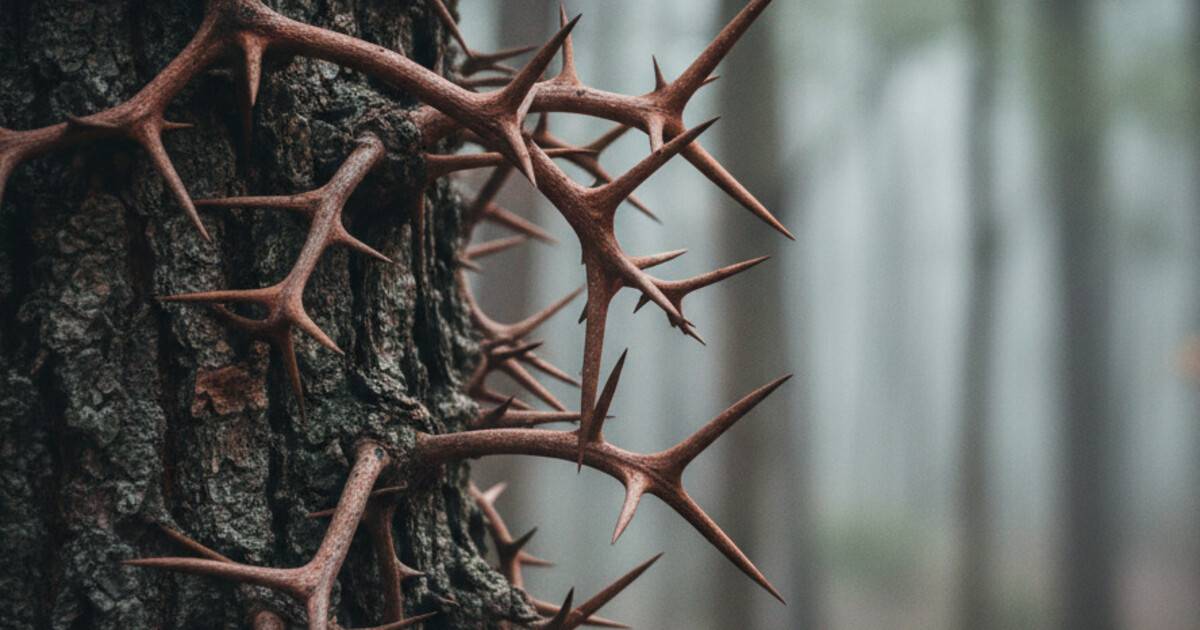
You reach into a thicket and pull back a scratched forearm. Or you walk past a trunk studded with what look like wooden nails or spikes and stop to wonder what kind of tree grows armor like that. People call these trees by different names — trees with thorns, trees with spikes, trees with spines — but they’re all describing the same defensive growths. They’re common across North America, and easy to mix up until you know what to look for.
Thorns aren’t random. Each species grows them in a specific location, size, and pattern that stays consistent enough to use as a field mark. A honey locust sprouts massive branching thorns from the bark itself. A hawthorn grows single needle-sharp thorns from its branches. A black locust puts out small paired spines at every leaf node. That difference in placement is often enough to get you to a species before you even look at the leaves.
This guide covers 8 trees with thorns you’re most likely to encounter, with the key features for each.
Trees with thorns common in North America include honey locust, black locust, hawthorn, osage orange, crabapple, common buckthorn, Russian olive, and pyracantha. The most reliable ID feature is where the thorns grow: honey locust grows multi-pronged thorns directly from bark; hawthorn grows single thorns from branches; black locust grows small paired spines at leaf bases.
Standing in front of one? Identify it from a photo in seconds — free, no sign-up needed.
How to Use Thorns to Identify a Tree
Before naming a species, look at three things: where the thorn or spine originates, whether it branches, and how long it is.
True thorns are modified woody branches that connect directly to the vascular system. You can’t snap them off cleanly. They’re part of the branch or trunk. Hawthorn thorns are true thorns. Honey locust thorns are also true thorns, just dramatically larger. When you find a thorn you can’t break off without tearing bark, you’re dealing with a true thorn species.
Spines grow from the bark surface and can be broken off with a hard snap. Black locust spines grow from the bark at leaf nodes, in pairs. They feel slightly different underhand from true thorns: a bit more surface-attached.
Stipular spines are modified leaf structures at the base of a leaf stalk. Black locust is the most common example in North America. They sit right where the leaf meets the branch.
When identifying trees with thorns, placement and structure matter more than size alone. True thorns are modified woody branches: they connect directly to the vascular system and can’t be broken off without tearing bark. Hawthorn and honey locust both have true thorns. Spines, by contrast, grow from the bark surface and snap off more cleanly. Black locust stipular spines fall into this category. In practice, the most reliable ID approach is to note three things: where the growth originates (from bark, from a branch, from a leaf node), whether it branches, and how long it runs. Honey locust grows multi-pronged clusters from the bark itself, 3 to 12 inches long. Hawthorn grows single thorns from branches, 1 to 3 inches. Osage orange grows single thorns at every leaf node, about 1 inch. Black locust has short paired spines at each leaf base. These placement patterns are consistent within each species and visible year-round, even after leaves fall, making thorns one of the few reliable winter field marks.
Trees With Spikes or Spines: Thorns, Spines, and Prickles
Plenty of people search for “trees with spikes” or “trees with spines” — same trees, different words. There’s no wrong term for the sharp point that just caught your sleeve, but botanists sort these growths into three types, and the difference maps neatly onto the species covered here.
Thorns are modified branches. They grow from the wood and can’t be snapped off without tearing bark. Honey locust and hawthorn carry true thorns, the biggest and most obvious spikes on this list.
Spines are modified leaves or leaf parts. Black locust’s paired growths at each leaf base are spines, and so are the thin spikes tucked among Russian olive branches. They tend to be smaller and sit right at leaf attachment points.
Prickles are the third type: small outgrowths of the bark surface, like the ones on a rose stem or a blackberry cane. They pop off with a sideways push. None of the trees below are pure prickle plants, so if the sharp thing you found grows straight from a trunk or branch, you’re almost certainly looking at a thorn or a spine.
For field ID the label matters less than the placement. A spike growing directly from bark points to honey locust. A pair of short spines at every leaf base points to black locust. And spikes aren’t always on the wood, either. Some trees are known for their spiky seed balls rather than any armor on the trunk. The species sections below break down each pattern.
Honey Locust
Honey locust (Gleditsia triacanthos) has the most striking thorns of any North American tree. They grow directly from the bark, in clusters that branch 2 or 3 times, reaching 3 to 12 inches long. On older trees, these clusters spread along the entire trunk and lower branches. They’re dark reddish-brown, hard enough to puncture a tractor tire, and sharp enough to go straight through a leather work glove.
The multi-pronged cluster growing from the bark (not from branch nodes) is the single most reliable field mark. No other common North American tree does this.
Beyond the thorns, honey locust has twice-compound leaves with small oval leaflets: feathery and fine-textured, almost delicate for such a tough tree. Long flat seed pods, 12 to 18 inches, hang from the branches in fall and stay on into winter. The bark runs in interlocking gray-brown ridges.
One common complication: landscapers often plant the thornless cultivar ‘Inermis.’ If you find what looks like a honey locust with no thorns, that’s the likely explanation.
To confirm: multi-branched trunk thorns + long brown seed pods + twice-compound leaves.
Black Locust
Black locust (Robinia pseudoacacia) has thorns, but you’d miss them if you weren’t specifically looking. They grow in pairs at the base of each leaf, small and slightly curved, half an inch to an inch long. On young growth, they’re soft. On older branches, they stiffen into proper spines.
They’re stipular spines, meaning modified leaf structures rather than modified branches. Look close at any leaf attachment point and you’ll see one short spine on each side.
For the full picture, black locust has once-compound leaves with rounded oval leaflets, bark with deep furrows and a rope-like texture, fragrant white flower clusters in late spring, and short flat seed pods 2 to 4 inches long. It’s a fast grower, widely naturalized, and common in disturbed areas across eastern North America.
See the locust tree identification guide for a detailed look at black locust vs. honey locust side by side.
Hawthorn
Hawthorn (Crataegus spp.) grows single, straight thorns from its branches, usually 1 to 3 inches long. On Washington hawthorn, thorns cluster densely enough to make the tree nearly impenetrable as a hedge. On downy hawthorn, they’re sparser.
Hawthorn thorns are true thorns. They branch from the wood and tear bark if you try to pull them off. They’re positioned along branches, often near leaf nodes, but growing from the same woody material as the branch itself.
Hawthorns are also recognizable by their lobed leaves (similar in shape to a small maple leaf), clusters of small white spring flowers, and small red berry-like fruits called haws that hang on well into winter. Small tree or large shrub, rarely taller than 25 feet. North America has dozens of hawthorn species, and they hybridize freely, but the combination of branch thorns, lobed leaves, and red haws in fall gets you to genus with confidence.
See the hawthorn tree identification guide for species-level breakdowns including Washington hawthorn and English hawthorn.
Osage Orange
Osage orange (Maclura pomifera) grows stout, single thorns at leaf nodes, straight and sharp, about an inch long. They’re positioned along every branch: reach out to grab a young stem and you’ll contact a thorn every few inches.
It’s best known for its fruit: large, wrinkled, tennis ball-sized green spheres called hedge apples. They drop in fall and litter the ground beneath the tree. The wood is extremely hard and orange-tinged, visible when a branch breaks.
Osage orange was planted widely as a windbreak and hedgerow across the Great Plains before barbed wire arrived. You’ll find old rows of it at field edges, often grown thick and tangled. Trees can be shrubby in these hedgerow conditions or grow to 50 feet when given space.
Key combination: thorns at every leaf node + knotty, bumpy green fruit + bright orange inner wood.
Crabapple
Crabapple (Malus spp.) produces short spur shoots that end in a sharp point, especially on older branches and wild individuals. These aren’t true thorns botanically: they’re modified short shoots. But they’ll catch skin and clothing just as effectively.
Wild and naturalized crabapples tend to be thorny. Most ornamental cultivars have been selected for fewer or no spurs, so the thorny character varies by tree. If you find a small apple-like tree with sharp projections, it’s almost certainly a wild or semi-wild crabapple.
Look for pea-to-grape-sized fruits in yellow, red, or orange in fall, white or pink spring flowers, and serrated oval leaves. Crabapples often get confused with hawthorns. The main separator is fruit size (hawthorn haws are small and berry-like; crabapple fruits look like tiny apples) and thorn type (hawthorn thorns are long and branch from wood; crabapple spurs are short and at branch tips).
See the crabapple tree identification guide for more on separating these two.
Common Buckthorn, Russian Olive, and Pyracantha
Three thorny trees that don’t get named as often, but are worth knowing.
Common buckthorn (Rhamnus cathartica) ends many of its branches in a sharp spine, visible at branch tips. It’s a large shrub or small tree, invasive across much of the Northeast and Midwest. Look for small oval leaves with slightly wavy margins, clusters of small black berries in fall, and that distinctive spine-tipped branch structure.
Russian olive (Elaeagnus angustifolia) has long, thin spines tucked among the branches. The thorns are less obvious than the leaves, which are narrow and covered in silvery-gray scales that give the whole tree a pale, shimmery appearance. Small fragrant yellow flowers appear in early summer. Planted as a windbreak and now invasive across western states.
Pyracantha (firethorn) grows as a large shrub or small tree with dense, rigid thorns along every branch. It’s most recognizable in fall and winter when the branches are loaded with clusters of orange or red berries. Evergreen or semi-evergreen in most climates, it’s a common landscape plant that sometimes escapes cultivation.
How Tree Identifier Can Help
If you’ve got a thorny tree in front of you and the species isn’t clicking, the Tree Identifier app can narrow it down from a photo. Take a picture of the thorns, bark, leaves, or fruit, and the AI returns a species match with a confidence score.
The app handles multiple photo types, so you can submit a bark shot separately from a leaf shot and compare results. It covers thousands of tree species, works offline on remote hikes without cell service, and is free to start with 2 identifications per day.
Download Tree Identifier at treeidentifier.app, available on iOS and Android.
FAQ: Trees With Thorns
What is the most common tree with thorns in North America? Honey locust and hawthorn are the two you’re most likely to encounter across eastern and central North America. Honey locust grows widely in forests, roadsides, and disturbed areas. Hawthorn grows at field edges and in thickets from coast to coast.
Are thorns on trees dangerous? Some are. Honey locust thorns are hard enough to puncture tires and can cause deep wounds. Hawthorn thorns are thin but sharp and can carry bacteria into punctures. Wear gloves when handling any thorny tree material, especially near the trunk. For hazards beyond the thorns themselves, see our guide to poisonous trees to avoid.
Can I identify a thorny tree in winter without leaves? Yes. Thorn placement and size are consistent year-round, which makes them especially useful in winter. Honey locust’s clustered trunk thorns are unmistakable in any season. Hawthorn’s branch thorns and common buckthorn’s spine-tipped branches are visible when bare.
Why do trees grow thorns? Thorns, spines, and prickles are anti-herbivore adaptations that deter deer, cattle, and browsers from stripping bark and leaves. Honey locust thorns are thought to have evolved to deter large mammals like ground sloths, which went extinct thousands of years ago.
How do I tell a thorn from a spine? True thorns are modified branches and can’t be broken off cleanly without tearing bark. Spines grow from the bark surface and snap off more easily. In the field, thorn placement and size will get you to a species identification more reliably than botanical category alone.
Conclusion
Trees with thorns are easier to identify than they look once you know where to focus. Honey locust stands apart with its massive, branching trunk thorns. Hawthorn’s single branch thorns, lobed leaves, and red fall haws are a reliable combination. Black locust thorns are easy to miss if you’re not checking the leaf bases.
If you’re trying to put a name to a thorny tree in the field, the Tree Identifier app can match species from bark, leaf, or fruit photos, and works even without a signal.
Identify a tree from your photo — free
Upload a leaf, bark, or whole-tree photo and get the species in seconds. No signup.
Confidence:
Unlock the full species profile
Free in the app — with unlimited identifications.


AI result for guidance — the app gives full species details and works offline.
Want unlimited identifications?
Get the full species profile, photos and details — free in the app, with unlimited scans.
- Unlimited identifications
- Full species profiles & details
- Works offline, anywhere
- Save and revisit your finds
Elena Torres
Tree Identifier Team