Pawpaw Tree Identification: Leaves, Bark, and Fruit
Walking through an eastern woodland in April and finding strange dark-purple flowers hanging from bare branches is disorienting the first time. Those flowers belong to the pawpaw (Asimina triloba), North America’s largest native fruit tree. Hikers stumble across pawpaws constantly without knowing what they’ve found. Gardeners plant them for the fruit without being able to spot them in the wild. If you want to nail pawpaw tree identification, this guide covers every season: leaves, bark, flowers, fruit, and habitat.
To identify a pawpaw tree, look for large, drooping leaves (6-12 inches long) that are widest above the midpoint and taper toward the stem. The bark is smooth and gray-brown for a hardwood. In early spring, deep maroon flowers appear on bare branches before leaves emerge. In late summer, clusters of yellowish-green, banana-shaped fruit confirm the ID. Pawpaws grow in moist, shaded bottomlands across the eastern US.
What Does a Pawpaw Tree Look Like?
Pawpaws are mid-sized deciduous trees, typically 15-30 feet tall, occasionally reaching 40 feet in ideal conditions. The canopy is dense and drooping, casting deep shade underneath. The overall silhouette looks a bit tropical for a North American woodland tree.
In the wild, pawpaws rarely grow alone. They spread by root suckers, forming dense colonies called pawpaw patches. Find one, and you’re usually standing in a grove.
The pawpaw (Asimina triloba) is native to 26 eastern US states, from Nebraska to the Atlantic coast and from northern Florida into southern Ontario. It’s the only temperate member of the Annonaceae family, a plant group typically found in tropical climates. That explains the unusually large leaves and custard-like fruit. Pawpaw leaves are obovate (widest above the middle), 6-12 inches long, and hang with a distinctive drooping angle from the branch. When young leaves are crushed, they release a faintly sharp smell unlike most other eastern hardwoods. The bark is thin and smooth, gray-brown with lighter blotches, lacking the deep furrows common on oaks or hickories of similar size. Pawpaws prefer moist, fertile soil and partial to full shade. Look for them on north-facing slopes, along creek banks, and in river floodplains. They’re rarely found on dry ridges or south-facing hillsides. This combination of habitat preference and physical features makes pawpaw identification more reliable once you know what to look for.
The tree looks quite different by season:
- Spring: bare branches with dark maroon flowers, no leaves
- Late spring/early summer: large, tropical-looking leaves fill out the canopy
- Late summer: heavy fruit clusters hang from branches
- Fall: leaves turn bright yellow before dropping
Pawpaw Leaves: Your Fastest ID Tool
The leaves are the most reliable year-round identification feature once they’ve come in.
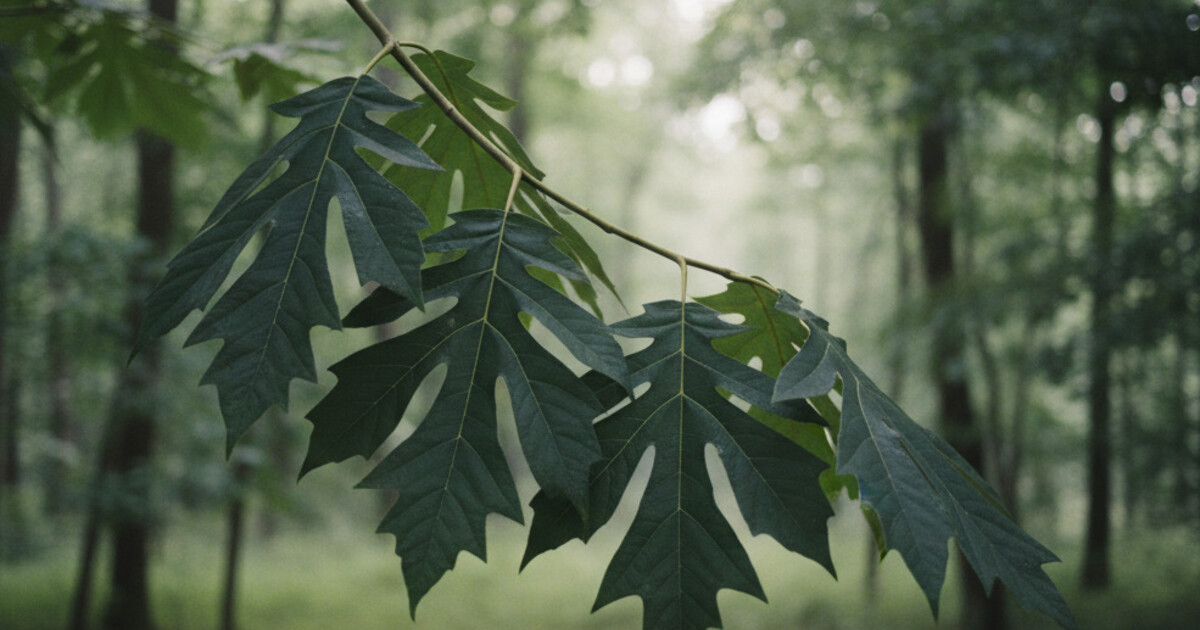
Size and shape. Pawpaw leaves run 6-12 inches long, with some reaching 14 inches on vigorous shoots. They’re obovate (widest above the midpoint) and taper gradually toward the stem. The tip comes to a rounded point.
Arrangement. Leaves attach alternately along the branch and hang at a downward angle, giving branches a slightly drooping appearance even in still air.
Color. Deep green on top, slightly paler underneath. In fall, they turn clean yellow before dropping. There’s no red or orange phase.
Smell. Crush a young leaf or twig and you’ll notice a mild but distinct smell. People describe it differently (slightly sweet, pungent, or green), but it’s noticeably different from anything else in the eastern forest. This smell is one reason deer tend to leave pawpaw trees alone.
One quick comparison: if you’re looking at a large, tropical-looking leaf in an Ohio or Virginia woodland with no other tropical-looking trees nearby, pawpaw is the most likely answer. The leaf size alone narrows it down fast.
For a deeper look at how leaf shape factors into tree identification, our guide to tree identification by leaf shape covers dozens of eastern species side by side.
Pawpaw Bark: Smooth for Its Size
Pawpaw bark is thin and smooth compared to most hardwoods of similar size. The color is gray-brown with lighter, irregularly shaped blotchy patches scattered across the surface.
On young trees, the surface is nearly smooth with minimal texture. Older specimens develop shallow, warty bumps, but even mature trees stay finer-textured than the bark on a comparable oak or hickory. There are no deep ridges or interlocking plates.
One thing to watch for: light-colored lenticels (small raised pores) scattered across the bark. These are present on many trees, but on pawpaw they tend to be pale and visible against the darker background.
If you’re doing pawpaw tree identification in winter without leaves or fruit, bark alone can be tricky. At that point, combine the bark character with the tree’s growth form (often multi-stemmed at the base, growing in clusters) and look for any dried, shriveled fruit on the ground underneath.
Our tree bark identification guide has close-up photos comparing bark textures across 20+ common eastern species, which helps put pawpaw’s smooth texture in context.
Pawpaw Flowers: April’s Best ID Marker
If you’re in eastern woodland in March or April, pawpaw flowers are the most definitive ID you can get. Nothing else in the common eastern flora looks quite like them.
The flowers appear before the leaves, hanging downward from the branch on short stalks. They’re about 1.5 inches across, with 6 petals arranged in two layers: 3 outer petals and 3 smaller inner ones. The color is deep maroon to purple-brown, sometimes described as liver-colored. Up close, the petals have a slightly wrinkled texture.
The smell is worth mentioning: faintly unpleasant, designed to attract fly and carrion beetle pollinators rather than bees. This is also why pawpaw fruit set can be inconsistent. Flies and beetles are less reliable pollinators than bees. Many growers hand-pollinate or plant two different pawpaw genotypes near each other to improve yields.
Seeing these flowers on bare branches in early spring is striking. The dark color makes them easy to mistake for dead buds at a distance. Get closer and the petal structure becomes obvious.
For comparison, most other flowering trees in the eastern US produce white or pink blooms specifically designed to attract bees, which look very different from pawpaw’s muted, hanging flowers.
Pawpaw Fruit: What Most People Are After
The fruit ripens from August into October depending on location. It’s what draws most people to pawpaw identification in the first place.
The fruit is short and oblong, 3-6 inches long, with thin skin that starts yellowish-green and turns yellow-spotted black when fully ripe. The flesh inside is creamy yellow-orange with a custard-like texture. The taste is sweet and tropical, most commonly compared to banana crossed with mango, though each tree produces fruit with its own flavor profile.
Fruit grows in clusters of 2-9, hanging heavily from the branch. When fully ripe, the skin becomes soft and the fruit pulls away easily, or falls on its own. You’ll often smell ripe pawpaws before you see them.
A few things to know before eating wild pawpaws:
- Eat only the ripe flesh (yellow-orange, soft to the touch)
- The skin can cause contact dermatitis in some people; handle with gloves
- The large flat seeds are mildly toxic and should not be eaten
- Ripe fruit spoils quickly and doesn’t store well at room temperature
Pawpaw’s status as North America’s largest native fruit has driven a real resurgence in cultivation. Ohio holds an annual Pawpaw Festival in Albany each September that draws thousands of visitors, a good signal of how much interest in the species has grown over the past decade.
Where Pawpaw Trees Grow
Habitat narrows down the search considerably. If you’re in the right environment, your odds of finding a pawpaw go up fast.
Pawpaws prefer:
- Moist, fertile, well-drained bottomlands
- North-facing slopes with partial to full shade
- Edges of creeks, streams, and rivers
- Areas with high organic matter in the soil
They’re shade-tolerant when young but need some canopy openings to fruit well as adults. Dense full shade produces vigorous vegetative growth but little to no fruit.
In terms of range, the highest concentrations are in Ohio, West Virginia, Virginia, Kentucky, Pennsylvania, and Maryland. The Appalachian region has particularly strong populations. You’re unlikely to find wild pawpaws in the driest parts of the Midwest or in the pine-dominated South.
For seasonal identification strategies in spring (when trees are flowering but leaves are just emerging), the guide on how to identify trees in spring covers the April window when pawpaw flowers make ID straightforward.
How Tree Identifier Helps Confirm a Pawpaw in the Field
If you’re on a trail and think you’ve found a pawpaw, Tree Identifier can confirm it in a few seconds.
Snap a photo of any part of the tree: a leaf, the bark, the flowers, or the fruit. The app runs it through AI identification and returns a species match with a confidence score and detailed species information, including habitat notes and characteristics.
The offline mode is particularly useful for pawpaw foraging. Remote bottomlands and creek valleys don’t always have cell service. Download species data in advance and you can ID trees without a signal, which is exactly the kind of situation where having the app ready matters.
Tree Identifier works on both iOS and Android. You get 2 free identifications per day, which covers confirming a few uncertain trees on any given hike.
Snap a photo of those big drooping leaves or that unusual dark flower and you’ll have a confirmed species match in seconds.
Frequently Asked Questions
What’s the best way to identify a pawpaw tree?
The fastest identification is the leaves: large (6-12 inches), drooping, widest above the midpoint. In spring, the dark maroon flowers on bare branches are unmistakable and unlike any other common eastern tree. In late summer, clusters of yellowish-green, banana-shaped fruit hanging from branches confirm the species. All three features together leave no doubt.
Are pawpaw trees easy to grow?
Pawpaws grow well across most of the eastern US given moist, fertile soil and some shade when young. They’re slow to establish from seed (often 2-3 years before visible above-ground growth). Grafted nursery trees are faster and more reliable for fruit production. They don’t transplant well as older trees due to a fleshy root system that’s easy to damage.
Do all pawpaw trees produce fruit?
Many wild pawpaws produce little or no fruit because they’ve sprouted from root suckers and are genetically identical clones. Clones can’t cross-pollinate each other. Two distinct seedling trees (or two different grafted varieties) planted near each other significantly improve fruit set.
When do pawpaw trees flower?
Pawpaws flower in March and April across most of their range, before the leaves emerge. The flowers are dark maroon, nodding, and about 1.5 inches across. Because they rely on fly and beetle pollination rather than bees, fruit set varies year to year depending on weather and insect activity.
Can you eat wild pawpaw fruit?
Yes, the ripe flesh of wild pawpaw fruit is edible and considered a delicacy by foragers. Only eat the soft, yellow-orange flesh. The skin can irritate some people’s skin and is best avoided. The large flat seeds are mildly toxic and should not be eaten. Ripe fruit doesn’t store long and is best eaten within a day or two of picking.
Pawpaw tree identification gets easier once you’ve seen all the features together. The tropical-looking foliage, dark maroon spring flowers, and large custard fruit are unlike anything else in the eastern forest. Once you’ve found one, you’ll start noticing how many you’ve been walking past.
Try Tree Identifier to confirm any uncertain trees on your next hike. Take a photo of a leaf or flower and get a species match in seconds, with the app working offline when you’re deep in the kind of bottomland creek habitat where pawpaws thrive.
Identify a tree from your photo — free
Upload a leaf, bark, or whole-tree photo and get the species in seconds. No signup.
Confidence:
Unlock the full species profile
Free in the app — with unlimited identifications.


AI result for guidance — the app gives full species details and works offline.
Want unlimited identifications?
Get the full species profile, photos and details — free in the app, with unlimited scans.
- Unlimited identifications
- Full species profiles & details
- Works offline, anywhere
- Save and revisit your finds
Elena Torres
Tree Identifier Team