Pin Oak Tree Identification: 7 Reliable Signs
Pin oak (Quercus palustris) is one of the most widely planted street trees in eastern and central North America, and one of the most distinctively shaped oaks you’ll encounter on a suburban walk or nature trail. Yet unless you know the right signs, it’s easy to confuse with scarlet oak, northern red oak, or black oak. All four share the same pointed, bristle-tipped leaf lobes typical of the red oak group. The differences are real, though, and once you’ve picked them up, pin oak identification becomes almost automatic. This guide covers 7 reliable signs that separate pin oak from the look-alikes, from its signature branch angles to the small round acorns it drops by the thousands each autumn.
Pin oak (Quercus palustris) is identified by its deeply lobed leaves with C-shaped sinuses cutting nearly to the midrib, a pyramidal crown with sharply drooping lower branches, and small round acorns with a shallow cap covering only the top quarter. Persistent pinlike dead branch stubs on the lower trunk confirm the ID.
How to Identify Pin Oak by Its Leaves
Pin oak leaves are the first place most people start, and for good reason. Each leaf is 3 to 6 inches long with 5 to 9 lobes ending in sharp, bristle-tipped points. So far that matches other red oak group members. What sets pin oak apart is the depth of the sinuses: the spaces between the lobes cut 60 to 80 percent of the way to the midrib, creating a distinctive cross-like outline when you hold a leaf up to light.
Pin oak leaves typically measure 3 to 6 inches long and 2 to 4 inches wide. The sinuses (spaces between lobes) cut 60 to 80 percent of the way to the midrib, deeper than most red oak relatives. The lobes taper to sharp bristle tips (a red oak group trait), and the upper surface is glossy dark green. The underside is pale green with small tufts of hair where the veins meet the midrib (called vein axil tufts). In autumn, pin oak turns a rich red to bronze-red and holds its dead brown leaves through winter, a behavior called marcescence. Leaf retention is especially pronounced on lower branches, making winter identification easier than many people expect. A single pin oak can hold brown marcescent leaves into February or even March while neighboring oaks stand bare.
The upper surface is glossy, noticeably shinier than the matte surface of northern red oak leaves. If you’re looking at leaves on the ground, that gloss fades quickly, so it’s more useful when checking leaves still on the branch.
Check the vein axil tufts with a hand lens if you have one. They’re a small but consistent detail that helps confirm the ID when other features are ambiguous.
The Pin Oak’s Signature Branch Angles
If leaf shape is the first clue, the branching pattern locks in the ID. Pin oak has a three-zone structure that no other common oak duplicates cleanly:
- Upper branches angle upward at roughly 45 degrees
- Middle branches run roughly horizontal
- Lower branches droop sharply downward, sometimes nearly vertical
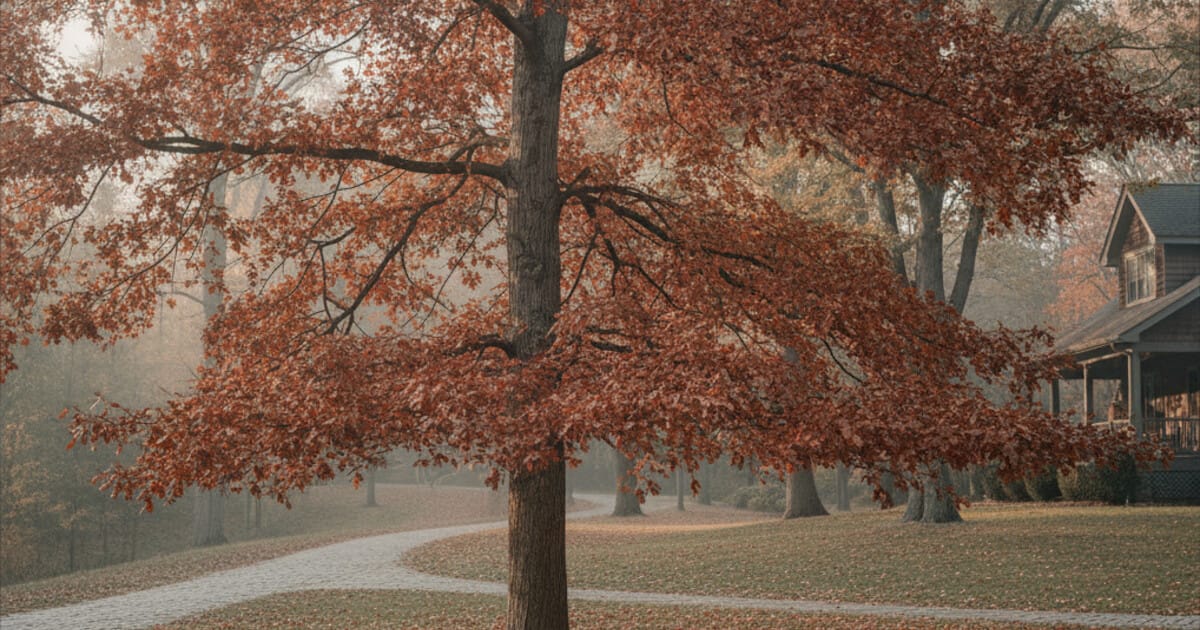
This gives young pin oaks a pyramidal silhouette: compact and Christmas-tree-shaped when viewed from across a street. Older trees spread wider and lose the tight pyramid, but the drooping lower branches remain throughout the tree’s life.
That downward angle on the lower branches is the single most useful distance ID feature. Scarlet oak’s lower branches angle upward or stay horizontal. Northern red oak’s lower branches spread outward. Pin oak’s droop. You can confirm a pin oak hypothesis from 50 feet away, before you can even see the leaf shape clearly.
The “pins” themselves are worth looking for. Pin oak retains dead branch stubs on the lower trunk and inner canopy for years. You’ll see short, stiff dead stubs projecting from the trunk and larger branches. Those are the same stubs that give the tree its common name. On a mature street tree with smooth gray bark, those dark dead stubs are hard to miss.
Pin Oak Acorns: Small, Round, Shallow Cap
Acorns are a reliable confirmation in late summer and fall, and pin oak’s are distinctive. They’re small and nearly round, about 3/8 to 1/2 inch in diameter (roughly the size of a marble). The cap is shallow, covering only the top quarter of the acorn.
Compare that to northern red oak, which produces acorns up to 1 inch wide with a flat, saucer-like cap that sits under the acorn. Scarlet oak has a deeper cup covering about half the acorn. Pin oak’s shallow cap on a small, round acorn is different enough that you can sort them out by touch in a handful of mixed acorns.
Pin oaks produce acorns prolifically. A mature tree can drop thousands in a good year, and the acorns persist on the tree through winter, sometimes hanging on through the following spring. If you’re under a pin oak in November and the ground is carpeted with small round acorns with thin caps, that’s a strong confirmation.
Acorns take 2 years to mature on pin oak, like other red oak group members. You’ll often see two generations at once: the current year’s acorns still green and small, and last year’s maturing acorns turning brown.
Pin Oak Bark and Size
Bark: Young pin oaks have smooth gray-brown bark with a slightly polished look. As the tree ages, the bark develops shallow interlacing ridges but stays relatively smooth and light gray. That’s a noticeably cleaner look than the dark, deeply furrowed bark of black oak or the rough, gray-brown texture of mature red oak. On urban street trees, pin oak bark often stays smooth and gray well into middle age.
Size: Pin oak reaches 60 to 70 feet tall at maturity, occasionally taller, with a trunk diameter of 1 to 2 feet. It’s a fast grower, typically 1 to 2 feet of height per year in good conditions. A young pin oak can hit 30 feet in 15 to 20 years. That fast early growth is a big reason it became a popular street and park planting through the latter half of the 20th century.
For bark identification across multiple oak species, the tree bark identification guide covers the key features to distinguish red oak, white oak, black oak, and pin oak at a glance.
Pin Oak Habitat and Range
Pin oak’s scientific name, palustris, means “of swamps” in Latin, and the name fits. In the wild it’s a bottomland species that tolerates wet, poorly drained, and seasonally flooded soils better than most oaks. You’ll find native pin oak groves along stream banks, in river bottomlands, and in wet mixed forests from Missouri and Illinois east through Indiana, Ohio, Pennsylvania, and into Virginia and the Carolinas.
That flooding tolerance, combined with fast growth and manageable size, made pin oak an appealing choice for urban planting. Landscapers planted it heavily across eastern and midwestern cities from the 1950s through the 1990s. Drive through almost any older suburb between Kansas City and Boston and you’ll find pin oaks lining streets, shading parking lots, and anchoring front yards, often far outside the tree’s native range.
One downside of pin oak in cultivation: it’s prone to chlorosis (yellowing leaves) in high-pH soils, which are common in urban environments with concrete and limestone. Chlorotic pin oaks show pale yellow-green leaves with dark green veins, a sign the tree can’t absorb enough iron. That’s an identification clue in reverse. If you see a big oak with that symptom on a suburban street, pin oak is the first species to check.
The oak tree identification guide covers the broader oak family, including the key features that separate the red oak and white oak groups, useful context when you’re working out which oak is which.
How Pin Oak Compares to Similar Species
Pin oak shares the red oak group with several similar oaks. Here’s where to focus:
Pin oak vs. scarlet oak (Quercus coccinea): Both have deeply lobed leaves and red fall color. The differences: scarlet oak acorns are larger with a deeper cup; scarlet oak lower branches don’t droop as sharply; and scarlet oak prefers dry, sandy, well-drained slopes, the opposite of pin oak’s wet-soil preference. If you’re on a dry ridgetop, the tree is more likely scarlet oak.
Pin oak vs. northern red oak (Quercus rubra): Northern red oak has broader leaves with shallower sinuses and much larger acorns, up to 1 inch wide with a flat saucer cap. Northern red oak lower branches angle up or horizontally. Red oak also grows larger and has darker, more furrowed bark.
Pin oak vs. black oak (Quercus velutina): Black oak bark is very dark and deeply furrowed, quite different from pin oak’s lighter, smoother gray. Black oak leaves are similar but often have fewer lobes and slightly shallower sinuses. Black oak prefers dry upland sites.
For detailed help with leaf shape differences across these species, the trees with lobed leaves guide covers the diagnostic leaf features side by side.
How Tree Identifier Helps with Pin Oak ID
Pin oak’s key features are distinctive on a mature street tree, but in the field the situation is often messier. You might be working with fallen leaves mixed with other oak litter, a sapling without the full branching pattern, or a view from below the canopy that doesn’t show the leaf shape clearly.
The Tree Identifier app handles multiple input types. Take a photo of a single leaf, a cluster of acorns, the bark pattern, or the full tree silhouette. The AI compares your photo against thousands of North American tree species, including all the major red oak group members that overlap with pin oak’s range.
For anyone exploring oak-heavy forests or neighborhoods where multiple oak species grow close together, offline mode means you can run identifications without cell service. You start with 2 free daily identifications. If you’re working through a whole neighborhood of unfamiliar oaks, a subscription unlocks unlimited scans. Download the app at treeidentifier.app and bring it on your next walk.
Frequently Asked Questions
How do I tell a pin oak from a scarlet oak? Check the acorns and the lower branches. Pin oak acorns are small (about 1/2 inch) with a shallow cap covering only the top quarter. Scarlet oak acorns are larger with a deep cup covering about half the acorn. Pin oak’s lower branches droop sharply; scarlet oak’s stay more horizontal. Habitat is also a clue: pin oak grows in wet bottomlands, while scarlet oak prefers dry, sandy, well-drained slopes.
Why does pin oak hold its dead leaves in winter? The leaf retention is called marcescence. The process that normally seals off leaves before autumn drop (formation of a layer at the base of the leaf stem) is delayed or incomplete in pin oak, especially on lower branches. The dead brown leaves stay attached through winter and often into early spring. It’s most pronounced in younger trees and on the lower canopy of older ones.
Why is it called a pin oak? The name comes from the short, stiff dead branch stubs that persist on the trunk and inner branches for years. These pinlike stubs, a result of the lower branches dying as they’re shaded out, are distinctive enough that early botanists used them as a naming feature. They’re useful for ID too: look for clusters of dark dead stubs on an otherwise smooth gray trunk.
What soil does pin oak prefer? Pin oak tolerates wet, poorly drained, and seasonally flooded soils that would stress most other oaks. In the wild it grows in lowlands, bottomlands, and along streams. In cultivation it’s planted widely in urban settings partly because of this tolerance, though it struggles in high-pH soils where it can develop iron chlorosis.
How long does a pin oak live? Pin oaks typically live 150 to 200 years in natural settings. Urban street trees often have shorter lifespans, 50 to 100 years, because of soil compaction, road salt, restricted root zones, and the chlorosis issues that come with alkaline urban soils. Wild pin oaks in bottomland forests generally outlive their city-planted counterparts by a wide margin.
Identify a tree from your photo — free
Upload a leaf, bark, or whole-tree photo and get the species in seconds. No signup.
Confidence:
Unlock the full species profile
Free in the app — with unlimited identifications.


AI result for guidance — the app gives full species details and works offline.
Want unlimited identifications?
Get the full species profile, photos and details — free in the app, with unlimited scans.
- Unlimited identifications
- Full species profiles & details
- Works offline, anywhere
- Save and revisit your finds
Elena Torres
Tree Identifier Team